What is the Powder Filling Machines Market Size and Growth Rate?
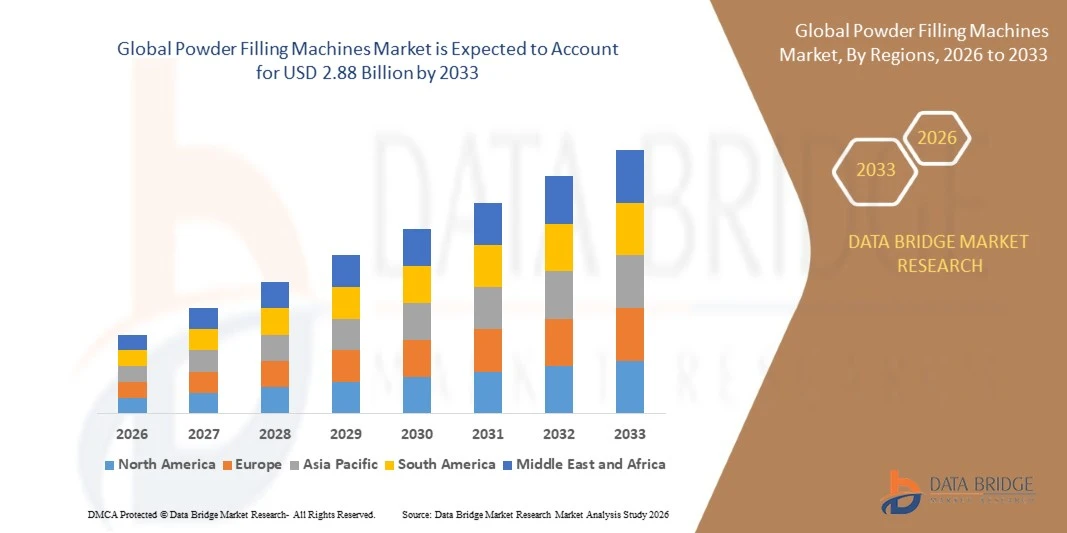
- As per Data Bridge Market Research analysis, the powder filling machines market was valued at USD 2.05 billion in 2025 and is projected to reach USD 2.88 billion by 2033, growing at a CAGR of 4.34% from 2026 to 2033.
- The market is experiencing steady growth driven by rising demand for accurate and hygienic powder dosing, increasing automation of packaging lines, and expanding applications across food and beverage, pharmaceutical, chemical, nutraceutical, and cosmetics manufacturing.
- The increasing consumption of powdered nutrition products, dietary supplements, and dry pharmaceutical formulations, combined with stricter hygiene and contamination-control requirements, is supporting market adoption. Powder filling machines are being applied across pharmaceutical packaging, food and beverage production, and nutraceutical manufacturing, offering manufacturers greater dosing accuracy, lower product loss, and higher throughput within automated packaging lines.
Market Size & Forecast
- Global Market Value (2025): USD 2.05 Billion
- Expected Market Value (2033): USD 2.88 Billion
- Forecast CAGR (2026–2033): 4.34%
- Leading Region in 2025: Asia-Pacific
- Fastest Growing Region: Middle East and Africa
What are the Major Takeaways of the Powder Filling Machines Market?
- Asia-Pacific dominated the powder filling machines market with the largest revenue share of 36.80% in 2025, supported by large-scale food processing, pharmaceutical manufacturing, chemical production, and rapid adoption of automated packaging lines across China, India, and Japan.
- Middle East and Africa is expected to be the fastest-growing region at a CAGR of 5.65% from 2026 to 2033, fueled by expanding food processing capacity, growing pharmaceutical localization, and rising investments in packaging infrastructure.
- The auger filling machines segment led the market with a 46.30% share in 2025, driven by suitability for free-flowing and non-free-flowing powders, precise volumetric dosing, and broad adoption across industries.
- Gravimetric filling machines are the fastest-growing type, projected to register a CAGR of 5.85%, reflecting demand for weight-verified dosing, reduced product giveaway, and compliance-ready fill accuracy.
- The 100 g to 1 kg segment dominated the filling range category with a 44.60% revenue share in 2025, led by extensive use in retail food, supplement, and specialty chemical packs.
- Bottles & jars accounted for 34.70% of the market share in 2025, preferred owing to widespread use for supplements, infant formula, spices, and pharmaceutical powders.
- The pouches & sachets segment is the fastest-growing packaging type category, with a CAGR of 5.95%, driven by single-serve nutrition, beverage premixes, and convenience packaging.
Report Scope and Powder Filling Machines Market Segmentation
|
Attributes |
Powder Filling Machines Key Market Insights |
|
Segments Covered |
|
|
Countries Covered |
North America
Europe
Asia-Pacific
Middle East and Africa
South America
|
|
Key Market Players |
|
|
Market Opportunities |
|
|
Value Added Data Infosets |
In addition to the insights on market scenarios such as market value, growth rate, segmentation, geographical coverage, and major players, the market reports curated by the Data Bridge Market Research also include import export analysis, production capacity overview, production consumption analysis, price trend analysis, climate change scenario, supply chain analysis, value chain analysis, raw material/consumables overview, vendor selection criteria, PESTLE Analysis, Porter Analysis, and regulatory framework. |
What is the Key Trend in the Powder Filling Machines Market?
- Powder filling machines are increasingly evolving from simple volumetric dosing equipment into flexible, sensor-integrated filling platforms, combining servo-driven dosing, in-line weight verification, and recipe-based format changeovers to handle diverse powders at varying batch sizes.
- For instance, in May 2025, according to Neue Verpackung, Marchesini Group displayed a powder filling machine with vacuum-pressure disk filling technology and 100% in-process control (IPC) at Pharmintech powered by Ipack-Ima, highlighting its focus on powder filling solutions following the integration of the MAR brand and the growing use of integrated, inspection-ready dosing systems in pharmaceutical and cosmetic production.
- Flexibility for small and mid-sized batches is emerging as an important design priority, as manufacturers of supplements, specialty foods, and pharmaceutical powders require quick changeovers, low product loss, and consistent accuracy across sticky, fine, and free-flowing materials.
- Digital controls, recipe memory, and data logging are becoming standard features, enabling manufacturers to document fill performance, reduce operator dependence, and meet traceability expectations in regulated and food-contact environments.
- For instance, in September 2025, according to Syntegon, the company presented its low-speed GKF 705 Capsylon capsule filling machine at Pack Expo Las Vegas, designed to dose sticky or fine-grained powders precisely at outputs of between 3,000 and 42,000 capsules per hour, making it particularly suitable for nutraceutical products and highlighting demand for flexible, small-batch powder dosing.
- As servo-driven dosing, in-process weight control, quick-change tooling, and connected data capabilities continue to advance, powder filling machines are expected to expand beyond conventional bulk packing into high-precision, compliance-ready, and multi-product filling across food, pharmaceutical, and specialty chemical applications.
What are the Key Drivers of the Powder Filling Machines Market?
- The growing consumption of powdered nutrition, dietary supplements, infant formula, and dry pharmaceutical formulations has significantly increased demand for filling equipment that delivers accurate, hygienic, and repeatable powder dosing at commercial speeds.
- For instance, in August 2022, according to the European Commission, the revised EU GMP Annex 1 on the manufacture of sterile medicinal products was published, with its requirements coming into operation on 25 August 2023, strengthening expectations for contamination-control strategies and encouraging pharmaceutical manufacturers to adopt enclosed, automated filling equipment.
- Food manufacturers, pharmaceutical producers, chemical companies, and contract packagers are investing in automated filling and packaging lines to reduce labor dependence, minimize product giveaway, and improve line efficiency while maintaining consistent fill weights.
- For instance, in July 2023, according to Packaging Insights, Syntegon launched its GKF Capsylon 6005 capsule filling machine in Europe and North America, citing growing interest in vitamins, proteins, and other dietary supplements; the machine, which features two dosing stations and 48 segment bores, can fill up to 360,000 capsules per hour.
- With manufacturers seeking higher throughput, lower contamination risk, and quicker changeovers, powder filling machines that combine accurate dosing, hygienic design, and integration with upstream and downstream packaging equipment are gaining preference across industries.
What Factors Are Challenging the Growth of the Powder Filling Machines Market?
- Powder filling machines must handle materials with widely varying flowability, bulk density, particle size, and cohesiveness, which complicates dosing accuracy and often requires machine-specific tooling and extensive process validation.
- For instance, in January 2017, according to Manufacturing Chemist, specialists from Biopharma Group noted that traditional auger fillers, while useful for large-dose filling of dry powdered or granular products, may lack the precision required for small incremental doses with close-tolerance repeat accuracy, prompting the use of vacuum-based volumetric dosing in which even filter pore size (40 µm versus 20 µm) can influence dosing performance.
- These technical requirements can increase machine cost, lengthen commissioning and validation time, and require skilled operators for calibration, cleaning, and format changes, particularly in pharmaceutical and food-contact applications.
- Dust generation, product bridging, aeration, and cross-contamination risks also create challenges, as powders can compact, leak, or segregate during dosing, affecting fill weight consistency and increasing cleaning and maintenance requirements.
- For instance, in May 2020, according to the KONA Powder and Particle Journal, researchers reported that calibrating discrete element method (DEM) models of auger dosing for pharmaceutical powders required extracting three bulk responses (angle of repose, bulk density, and mass flow rate) while varying four input factors, as several parameter combinations can produce similar bulk behavior, highlighting the complexity of predicting powder dosing performance.
- The combination of material variability, validation burden, hygiene requirements, and capital cost can constrain adoption among small manufacturers, particularly where manual or semi-automatic fillers already meet basic output and accuracy requirements.
How is the Powder Filling Machines Market Segmented?
The powder filling machines market is segmented on the basis of type, filling range, packaging type, and end user.
- By Type
On the basis of type, the powder filling machines market is segmented into auger filling machines, gravimetric filling machines, vacuum filling machines, and others. The auger filling machines segment dominated the market with 46.30% share in 2025, supported by their ability to dose free-flowing and non-free-flowing powders with consistent accuracy. Servo-driven augers allow precise control of fill volume across a wide range of container sizes and product densities. They are widely used in food, pharmaceutical, chemical, and nutraceutical production lines. Interchangeable auger and funnel sets support quick changeovers across products. Relatively low cost and simple operation also strengthen demand among small and large manufacturers alike.
The gravimetric filling machines segment is projected to register the fastest growth at a CAGR of 5.85% from 2026 to 2033, driven by increasing demand for weight-verified dosing and reduced product giveaway. Load-cell-based systems measure and correct fill weight in real time, improving accuracy for high-value and regulated products. Their applications include premium nutrition powders, pharmaceutical bulk powders, and specialty chemicals. Increasing regulatory scrutiny of net-content accuracy is creating additional demand across food and pharmaceutical operations. Improvements in sensor response, control software, and data logging are enhancing performance. Integration with checkweighers and line-management systems is also improving efficiency and traceability.
- By Filling Range
On the basis of filling range, the powder filling machines market is segmented into below 100 g, 100 g to 1 kg, and above 1 kg. The 100 g to 1 kg segment dominated the market with 44.60% share in 2025, supported by widespread use in retail food packs, dietary supplements, spices, infant nutrition, and specialty chemical products. Machines in this range balance speed, accuracy, and container flexibility for consumer-facing formats. They are commonly integrated with capping, sealing, labeling, and inspection equipment. Manufacturers also favor this range because a single machine can serve multiple product lines through format changes. Growing consumption of packaged powdered products continues to support demand.
The below 100 g segment is projected to register the fastest growth at a CAGR of 6.30% from 2026 to 2033, driven by increasing demand for micro-dosing, sample packs, and single-serve formats. Pharmaceutical powders, diagnostic reagents, cosmetics, and premium supplements often require accurate small fills with minimal waste. Precision dosing technologies such as vacuum-pressure and dosing-disk systems are improving accuracy at low fill weights. The expansion of personalized nutrition and trial-size packaging is creating additional opportunities. Strong emphasis on containment, cleanliness, and fill-weight verification further supports adoption of advanced small-dose filling equipment.
- By Packaging Type
On the basis of packaging type, the powder filling machines market is segmented into bottles & jars, pouches & sachets, cans & tins, capsules & vials, and others. The bottles & jars segment dominated the packaging type category with 34.70% share in 2025, supported by extensive use for dietary supplements, protein powders, spices, pharmaceutical powders, and personal care products. Rigid containers offer good protection, reusability, and shelf appeal for consumers. Filling machines for bottles and jars are readily integrated with desiccant insertion, induction sealing, capping, and labeling equipment. Their compatibility with a wide range of fill weights and container sizes further strengthens demand across industries.
The pouches & sachets segment is projected to register the fastest growth at a CAGR of 5.95% from 2026 to 2033, driven by increasing demand for single-serve nutrition, beverage premixes, supplements, and convenience-oriented packaging. Flexible formats reduce packaging weight, transportation cost, and material use compared with rigid containers. Form-fill-seal machines with servo-driven augers enable high-speed, accurate powder dosing into pouches and stick packs. Growth of e-commerce and on-the-go consumption is creating additional demand. Improvements in barrier films, sealing technologies, and recyclable mono-material structures are also supporting adoption.
- By End User
On the basis of end user, the powder filling machines market is segmented into food & beverage, pharmaceutical, chemical, cosmetics & personal care, and others. The food & beverage segment dominated the end-user category with 41.25% share in 2025, supported by large volumes of milk powder, infant formula, coffee, flour, spices, seasonings, and instant beverage mixes. Food producers require hygienic, washdown-capable machines that deliver consistent fill weights at high speeds. Increasing demand for packaged and fortified foods is creating further opportunities. Compliance with food-safety standards and traceability requirements is encouraging investment in modern automatic filling lines across both established and emerging markets.
The pharmaceutical segment is projected to register the fastest growth at a CAGR of 5.70% from 2026 to 2033, driven by increasing production of oral solid dose forms, powder-for-suspension products, inhalation powders, and nutraceutical formulations. Pharmaceutical manufacturers require accurate dosing, containment, cleanability, and complete batch documentation. Integration of in-process control, data integrity features, and enclosed filling systems supports regulatory compliance. Expansion of contract manufacturing and regional drug production capacity is creating additional demand. Stricter contamination-control expectations remain an important consideration for equipment selection and validation.
Which Region Holds the Largest Share of the Powder Filling Machines Market?
- Asia-Pacific dominated the powder filling machines market with the largest revenue share of 36.80% in 2025, supported by large-scale food processing, pharmaceutical manufacturing, chemical production, and rapid adoption of automated packaging lines across China, India, and Japan.
- The region also benefits from a strong base of machinery manufacturers, rising demand for packaged nutrition and supplements, and growing investment in pharmaceutical and food-safety infrastructure. Increasing use of automatic filling lines for infant formula, dairy powders, spices, and pharmaceutical products continues to strengthen Asia-Pacific’s position in the global market.
U.S. Powder Filling Machines Market Insight
The U.S. powder filling machines market is witnessing steady growth due to rising demand for dietary supplements, sports nutrition, pharmaceutical powders, and packaged foods across the country. The mature manufacturing base, strong regulatory emphasis on food safety and current good manufacturing practices, and presence of established equipment suppliers are driving demand for accurate and hygienic filling systems. In addition, growing contract packaging activity, labor-saving automation, and the need for flexible lines supporting frequent product changes are accelerating adoption of advanced powder filling machines across commercial and industrial applications.
Asia-Pacific Powder Filling Machines Market Insight
The Asia-Pacific powder filling machines market is expected to witness strong growth, driven by expanding food processing, rising pharmaceutical output, and increasing investments in automated packaging across countries such as China, India, and Japan. Growing demand for infant formula, nutritional powders, spices, and generic medicines is supporting regional market expansion. In addition, the region’s strong machinery manufacturing ecosystem, supportive government initiatives for manufacturing, and rising adoption of hygienic and traceable filling solutions are accelerating demand for powder filling machines.
Japan Powder Filling Machines Market Insight
The Japan powder filling machines market is witnessing consistent growth due to rising emphasis on precision packaging, food safety, and pharmaceutical quality assurance. Food processors, pharmaceutical manufacturers, and chemical companies are increasingly adopting compact, high-accuracy filling machines with advanced controls and strong cleanability. Moreover, strong demand for reliability, minimal product loss, and labor-saving automation in an aging workforce environment is further contributing to market growth in Japan.
China Powder Filling Machines Market Insight
The China powder filling machines market is growing rapidly, driven by large-scale food and dairy processing, expanding pharmaceutical and health-supplement production, and strong domestic machinery manufacturing capacity. Increasing adoption of automated packaging lines across infant formula, protein powders, seasonings, and chemical products is significantly boosting market demand. In addition, competitive local equipment suppliers, upgrading of food-safety standards, and growing export-oriented packaging activity are positioning China as a key growth market for powder filling machines across Asia-Pacific.
U.K. Powder Filling Machines Market Insight
The U.K. powder filling machines market is experiencing steady growth, supported by demand from food manufacturers, pharmaceutical producers, and nutraceutical brands seeking accurate, hygienic, and flexible filling solutions. Contract manufacturers and packaging service providers are increasingly investing in automated lines to improve efficiency and reduce manual handling. Furthermore, strict food-safety and pharmaceutical quality requirements, combined with growing interest in sustainable packaging formats, are supporting wider adoption of advanced powder filling machines in the U.K.
Germany Powder Filling Machines Market Insight
The Germany powder filling machines market is expanding steadily due to the country’s strong mechanical engineering base, advanced packaging technology ecosystem, and large pharmaceutical and food processing sectors. German manufacturers and end users emphasize precision, containment, energy efficiency, and integrated line automation. Continuous advancements in dosing technology, inspection systems, and digital controls, along with the country’s role as a leading exporter of packaging machinery, are further driving market growth in Germany.
Which are the Top Companies in Powder Filling Machines Market?
The powder filling machines industry is primarily led by well-established companies, including:
- Syntegon Technology GmbH (Germany)
- IMA S.p.A. (Italy)
- Coesia S.p.A. (Italy)
- Marchesini Group S.p.A. (Italy)
- Optima Packaging Group GmbH (Germany)
- Haver & Boecker OHG (Germany)
- GEA Group AG (Germany)
- ProMach, Inc. (U.S.)
- Viking Masek Global Packaging Technologies (U.S.)
- All-Fill Inc. (U.S.)
- Barry-Wehmiller Companies, Inc. (U.S.)
- Spee-Dee Packaging Machinery, Inc. (U.S.)
- Matrix Packaging Machinery (U.S.)
- Fuji Machinery Co., Ltd. (Japan)
- Ishida Co., Ltd. (Japan)
- Nichrome India Limited (India)
- Concetti S.p.A. (Italy)
- Rovema GmbH (Germany)
- Premier Tech Ltd. (Canada)
- Bossar Packaging, S.A. (Spain)
What are Latest Developments in Powder Filling Machines Market?
- In January 2026, ProSys Fill LLC, a Webb City, Missouri-based filling equipment manufacturer, acquired Pendergraph Machines of Durham, North Carolina. The acquisition brings hot-melt and cosmetic and nutraceutical filling capabilities into ProSys Fill’s portfolio, complementing its existing filling lines and expanding the applications and customers the company can address.
- In May 2026, Optima Group exhibited at interpack 2026 in Düsseldorf, Germany, presenting filling and packaging solutions for the food industry, including machines that handle powdered foods in cans, containers, or capsules, reflecting continued focus on precise portion filling of powder products.
- In March 2025, Syntegon announced that it would showcase highlights from its liquid and solid pharmaceutical portfolio at INTERPHEX 2025, including the virtual launch of its MLD Advanced syringe filling solution, the introduction of its new family member Telstar, and lab-scale capsule filling technology for pharmaceutical development and production.
- In February 2024, ProMach completed its acquisition of Zacmi, a Parma, Italy-based manufacturer of filling, seaming, and pasteurization technology. The addition expands ProMach’s filling and process portfolio and gives Zacmi opportunities to serve sectors such as beverage and powdered products, supporting the delivery of complete packaging line solutions.
- In October 2023, Syntegon showcased its GKF Capsylon 6005 capsule filling machine at SupplySide West in the U.S., positioning the machine for the growing nutraceutical industry. The machine processes powders, pellets, and granules with minimal modifications and uses a click system for faster format part changeovers, supporting flexible production of dietary supplements.
- Interactive Data Analysis Dashboard
- Company Analysis Dashboard for high growth potential opportunities
- Research Analyst Access for customization & queries
- Competitor Analysis with Interactive dashboard
- Latest News, Updates & Trend analysis
- Harness the Power of Benchmark Analysis for Comprehensive Competitor Tracking
Global Powder Filling Machines Market, Supply Chain Analysis and Ecosystem Framework
To support market growth and help clients navigate the impact of geopolitical shifts, DBMR has integrated in-depth supply chain analysis into its Global Powder Filling Machines Market research reports. This addition empowers clients to respond effectively to global changes affecting their industries. The supply chain analysis section includes detailed insights such as Global Powder Filling Machines Market consumption and production by country, price trend analysis, the impact of tariffs and geopolitical developments, and import and export trends by country and HSN code. It also highlights major suppliers with data on production capacity and company profiles, as well as key importers and exporters. In addition to research, DBMR offers specialized supply chain consulting services backed by over a decade of experience, providing solutions like supplier discovery, supplier risk assessment, price trend analysis, impact evaluation of inflation and trade route changes, and comprehensive market trend analysis.
Data collection and base year analysis are done using data collection modules with large sample sizes. The stage includes obtaining market information or related data through various sources and strategies. It includes examining and planning all the data acquired from the past in advance. It likewise envelops the examination of information inconsistencies seen across different information sources. The market data is analysed and estimated using market statistical and coherent models. Also, market share analysis and key trend analysis are the major success factors in the market report. To know more, please request an analyst call or drop down your inquiry.
The key research methodology used by DBMR research team is data triangulation which involves data mining, analysis of the impact of data variables on the market and primary (industry expert) validation. Data models include Vendor Positioning Grid, Market Time Line Analysis, Market Overview and Guide, Company Positioning Grid, Patent Analysis, Pricing Analysis, Company Market Share Analysis, Standards of Measurement, Global versus Regional and Vendor Share Analysis. To know more about the research methodology, drop in an inquiry to speak to our industry experts.
Data Bridge Market Research is a leader in advanced formative research. We take pride in servicing our existing and new customers with data and analysis that match and suits their goal. The report can be customized to include price trend analysis of target brands understanding the market for additional countries (ask for the list of countries), clinical trial results data, literature review, refurbished market and product base analysis. Market analysis of target competitors can be analyzed from technology-based analysis to market portfolio strategies. We can add as many competitors that you require data about in the format and data style you are looking for. Our team of analysts can also provide you data in crude raw excel files pivot tables (Fact book) or can assist you in creating presentations from the data sets available in the report.