


What is the Power Generation Market Size and Growth Rate?
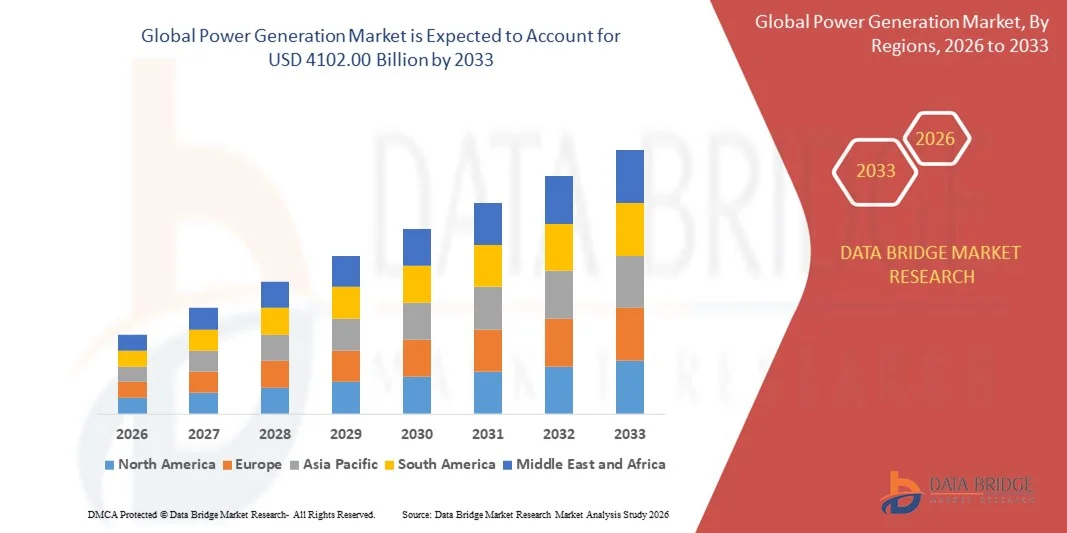
- As per Data Bridge Market Research Analysis the global power generation market size was valued at USD 2300.00 billion in 2025 and is expected to reach USD 4102.00 billion by 2033, at a CAGR of 7.50% during the forecast period
- The market growth is largely fuelled by the increasing global demand for electricity, rapid industrialization, and the transition toward renewable energy sources such as solar, wind, and hydroelectric power
- Growing investments in smart grids, energy storage solutions, and government initiatives to reduce carbon emissions are further driving market expansion
Market Size & Forecast
- Global Market Value (2025): USD 2300.00 billion in 2025
- Expected Market Value (2033): USD 4102.00 billion by 2033
- Forecast CAGR (2026–2033): 7.50%
Power Generation Market Analysis
- The market is witnessing a significant shift toward clean and sustainable energy generation technologies, with renewable energy sources gaining prominence over conventional fossil fuels
- Technological advancements in power generation, including high-efficiency turbines, advanced nuclear systems, and energy storage innovations, are enhancing operational efficiency and reliability
- North America dominated the global power generation market with the largest revenue share of 32.50% in 2025, driven by rapid industrialization, high electricity demand, and increasing investments in both conventional and renewable energy infrastructure
- Asia-Pacific region is expected to witness the highest growth rate in the global power generation market, driven by rising electricity consumption, strong industrial growth, government support for renewable energy and smart grid deployment, and increasing investments in clean energy infrastructure across countries such as China, India, Japan, and South Korea
- The Non-Conventional/Renewable segment held the largest market revenue share in 2025, driven by growing global emphasis on sustainability, government incentives for clean energy projects, and increasing adoption of solar, wind, and hydroelectric power across residential, commercial, and industrial sectors. Renewable energy sources offer lower carbon emissions, long-term cost savings, and alignment with international climate goals, making them the preferred choice for new power generation capacity
Report Scope and Power Generation Market Segmentation
|
Attributes |
Power Generation Key Market Insights |
|
Segments Covered |
|
|
Countries Covered |
North America
Europe
Asia-Pacific
Middle East and Africa
South America
|
|
Key Market Players |
|
|
Market Opportunities |
|
|
Value Added Data Infosets |
In addition to the insights on market scenarios such as market value, growth rate, segmentation, geographical coverage, and major players, the market reports curated by the Data Bridge Market Research also include import export analysis, production capacity overview, production consumption analysis, price trend analysis, climate change scenario, supply chain analysis, value chain analysis, raw material/consumables overview, vendor selection criteria, PESTLE Analysis, Porter Analysis, and regulatory framework. |
What is the Key Trend in the Power Generation Market?
Rising Demand for Clean and Renewable Energy Sources
- The growing emphasis on reducing carbon emissions and transitioning to sustainable energy is significantly shaping the global power generation market, as governments and consumers increasingly prioritize clean, renewable sources such as solar, wind, and hydroelectric power. These energy sources are gaining traction due to their ability to reduce environmental impact while providing reliable electricity, strengthening their adoption across residential, commercial, and industrial sectors
- Increasing awareness around climate change, energy efficiency, and government policies promoting decarbonization has accelerated the deployment of renewable energy projects. Companies and utilities are actively investing in solar farms, wind parks, and hydroelectric plants, encouraging innovations in power generation technology and grid integration to meet evolving demand
- Sustainability and regulatory trends are influencing investment decisions, with stakeholders emphasizing energy efficiency, carbon reduction, and compliance with emission standards. These factors are helping governments and companies differentiate their energy portfolios in a competitive market, while also driving the adoption of renewable energy certificates and carbon credits
- For instance, in 2024, NextEra Energy in the U.S. and Ørsted in Denmark expanded their renewable energy portfolios by commissioning new solar and offshore wind projects. These developments were introduced in response to rising demand for clean energy and stricter environmental regulations, with distribution across national grids and regional energy markets
- While demand for renewable power generation is growing, sustained market expansion depends on technological advancements, cost-effective deployment, and maintaining grid stability. Utilities and developers are also focusing on improving energy storage, smart grid integration, and developing innovative solutions that balance cost, efficiency, and sustainability for broader adoption
Power Generation Market Dynamics
Driver
Growing Preference for Clean and Renewable Energy Sources
- Rising global demand for sustainable and low-carbon energy is a major driver for the power generation market. Utilities and independent power producers are increasingly replacing fossil fuel-based generation with renewable alternatives to meet emission targets, enhance public image, and comply with regulatory standards. This trend is also pushing research into advanced renewable technologies and hybrid energy systems, supporting energy diversification
- Expanding applications in residential, commercial, and industrial sectors are influencing market growth. Renewable energy generation helps reduce operating costs, environmental impact, and dependency on non-renewable fuels while maintaining reliable power supply, enabling stakeholders to meet rising consumer and industrial demand for sustainable energy
- Governments and private energy developers are actively promoting renewable energy adoption through subsidies, tax incentives, and policy frameworks. These efforts are supported by increasing awareness of climate change and energy security, and they also encourage public-private partnerships to enhance project feasibility and reduce environmental footprint
- For instance, in 2023, Enel in Italy and Siemens Gamesa in Germany reported increased commissioning of wind and solar projects. This expansion followed higher policy support and rising consumer demand for renewable energy, driving project financing, grid integration, and long-term energy planning. Both companies also highlighted sustainability and reliability in communications to strengthen stakeholder trust and market positioning
- Although rising renewable energy adoption supports growth, wider market penetration depends on cost optimization, technological reliability, and grid integration capacity. Investment in energy storage, smart grid infrastructure, and advanced generation technology will be critical for meeting global demand and maintaining competitive advantage
Restraint/Challenge
High Capital Costs and Grid Integration Limitations
- The relatively high upfront investment required for renewable power generation projects compared to conventional energy systems remains a key challenge, limiting adoption among cost-sensitive developers. High equipment and installation costs, along with complex permitting and infrastructure requirements, contribute to elevated project expenses
- Awareness and technical expertise for integrating renewable sources into existing grids remain uneven, particularly in emerging economies where power infrastructure is still developing. Limited understanding of storage solutions and intermittency management restricts adoption across certain regions and sectors
- Regulatory and supply chain challenges also impact market growth, as renewable energy projects require adherence to stringent environmental and safety standards. Logistical complexities, long project timelines, and resource availability can increase operational costs and delay deployment
- For instance, in 2024, developers in India and Brazil reported slower adoption of large-scale solar and wind projects due to high capital costs and limited grid capacity. Regulatory approvals and financing constraints were additional barriers. These factors also prompted some utilities to delay project commissioning, affecting market visibility and revenue generation
- Overcoming these challenges will require cost-efficient technologies, enhanced grid infrastructure, and focused policy support. Collaboration with governments, financial institutions, and technology providers can help unlock the long-term growth potential of the global power generation market. Furthermore, developing scalable, cost-competitive solutions and strengthening public awareness around clean energy benefits will be essential for widespread adoption
Power Generation Market Scope
The market is segmented on the basis of type and end-user.
- By Type
On the basis of type, the global power generation market is segmented into Conventional/Non-Renewable (Nuclear and Fossil Fuels) and Non-Conventional/Renewable (Solar, Wind, Hydro, and Others). The Non-Conventional/Renewable segment held the largest market revenue share in 2025, driven by growing global emphasis on sustainability, government incentives for clean energy projects, and increasing adoption of solar, wind, and hydroelectric power across residential, commercial, and industrial sectors. Renewable energy sources offer lower carbon emissions, long-term cost savings, and alignment with international climate goals, making them the preferred choice for new power generation capacity.
The Conventional/Non-Renewable segment is expected to witness the fastest growth rate from 2026 to 2033 in certain developing regions, driven by stable energy supply requirements, existing infrastructure, and the continued reliance on fossil fuels and nuclear power for base-load electricity generation. This segment remains crucial for meeting immediate energy demands while supporting grid stability and complementing intermittent renewable energy sources.
- By End-User
On the basis of end-user, the global power generation market is segmented into Residential, Commercial, Industrial, and Others. The Industrial segment held the largest market revenue share in 2025, fueled by high electricity consumption in manufacturing, processing, and large-scale production facilities. Industries are increasingly investing in reliable and efficient power generation systems to ensure uninterrupted operations and reduce dependency on grid supply.
The Residential segment is expected to witness the fastest growth rate from 2026 to 2033, driven by the rising adoption of rooftop solar panels, small-scale wind systems, and home energy storage solutions. Residential consumers are increasingly prioritizing energy independence, sustainability, and cost savings, promoting the integration of renewable energy systems with smart home technologies and distributed power generation solutions.
Power Generation Market Regional Analysis
- North America dominated the global power generation market with the largest revenue share of 32.50% in 2025, driven by rapid industrialization, high electricity demand, and increasing investments in both conventional and renewable energy infrastructure
- Consumers and industries in the region highly value reliable, cost-effective, and sustainable power solutions, along with the integration of smart grid and energy storage technologies that enhance efficiency and energy management
- This widespread adoption is further supported by strong industrial activity, high disposable incomes, technological advancements, and supportive government policies, establishing North America as a key region for both conventional and renewable power generation
U.S. Power Generation Market Insight
The U.S. power generation market captured the largest revenue share in 2025 within North America, fueled by the growing demand for electricity across residential, commercial, and industrial sectors. Utilities and independent power producers are increasingly investing in renewable energy projects, including solar, wind, and hydroelectric systems, alongside modernization of existing fossil fuel and nuclear plants. In addition, the integration of smart grid technologies and energy storage solutions is enhancing operational efficiency, grid stability, and energy reliability, driving further market growth.
Europe Power Generation Market Insight
The Europe power generation market is expected to witness the fastest growth rate from 2026 to 2033, primarily driven by stringent carbon emission regulations, renewable energy targets, and the transition from fossil fuels to cleaner energy sources. Increasing urbanization and government incentives for renewable energy adoption are encouraging utilities and industries to invest in solar, wind, and hydroelectric projects. The region is also experiencing significant growth in offshore wind capacity and energy storage deployment, supporting grid stability and sustainable power supply.
U.K. Power Generation Market Insight
The U.K. power generation market is expected to witness strong growth from 2026 to 2033, driven by the country’s commitment to net-zero emissions, expansion of offshore wind projects, and investments in smart grid and energy storage systems. The U.K.’s adoption of distributed generation and renewable energy solutions, coupled with robust regulatory frameworks and financial incentives, is expected to continue stimulating market expansion.
Germany Power Generation Market Insight
The Germany power generation market is expected to witness steady growth from 2026 to 2033, fueled by the country’s energy transition policies, focus on renewable energy, and advancements in energy storage and grid management technologies. Germany’s strong industrial base and emphasis on energy efficiency promote the adoption of solar, wind, and biomass power projects, while modernization of conventional power plants ensures reliable base-load electricity supply.
Asia-Pacific Power Generation Market Insight
The Asia-Pacific power generation market is expected to witness the fastest growth rate from 2026 to 2033, driven by rapid industrialization, rising electricity demand, and significant investments in renewable and conventional energy infrastructure across countries such as China, India, Japan, and South Korea. Government initiatives promoting renewable energy deployment, smart grid adoption, and energy efficiency programs are boosting market expansion, while the region’s growing manufacturing and industrial sectors continue to drive electricity consumption.
Japan Power Generation Market Insight
The Japan power generation market is expected to witness steady growth from 2026 to 2033, due to the country’s focus on energy security, advanced technology adoption, and renewable energy integration. The demand for low-carbon, reliable, and efficient power solutions is rising, with an emphasis on solar, wind, and biomass projects, as well as energy storage systems to manage grid stability and support distributed generation.
China Power Generation Market Insight
The China power generation market accounted for the largest market revenue share in Asia-Pacific in 2025, attributed to the country’s rapidly growing electricity demand, large-scale industrial base, and aggressive renewable energy expansion. China is one of the largest markets for solar, wind, and hydroelectric power, alongside continued investments in coal and nuclear capacity to ensure grid stability. Government support for smart grid deployment, energy efficiency, and renewable energy targets are key factors driving market growth in the country.
Which are the Top Companies in Power Generation Market?
The Power Generation industry is primarily led by well-established companies, including:
- State Grid Corporation of China (China)
- Enel (Italy)
- EDF Energy (France)
- TEPCO (Japan)
- KEPCO (South Korea)
- Reliance Power (India)
- Iberdrola (Spain)
- NextEra Energy Inc (U.S.)
- American Electric Power (U.S.)
- China Huaneng Group Co Ltd (China)
- China Datang Corp (China)
- Kansai Electric Power Company (Japan)
- NTPC Limited (India)
- China Energy Investment Corporation (China)
- Engie (France)
Latest Developments in Global Power Generation Market
- In March 2024, Korea Western Power Co. (KOWEPO) and EDF Renewables, Joint Development, announced a 1.5 GW solar farm in Khazna, UAE, and are in advanced discussions for a similar project in Al-Ajban. The development aims to significantly increase renewable energy capacity in the UAE and support national clean energy targets. These projects are expected to create jobs, stimulate local investment, and strengthen the region’s solar infrastructure. By integrating advanced solar technologies, the farms will enhance efficiency and reliability, encouraging further adoption of large-scale solar projects in the Middle East
- In February 2024, Energies PH, Inc., Contract Agreement, partnered with Inyanga Marine Energy Group to build Southeast Asia’s first 1 MW tidal power plant on Capul Island, Philippines. The plant will integrate tidal power, solar PV, and energy storage to supplement the existing 750 kW diesel microgrid. This hybrid system provides a sustainable electricity alternative, reduces carbon emissions, and ensures reliable power for local communities. The project demonstrates the potential of combining marine and solar energy for island microgrids and may serve as a model for other regions in Southeast Asia
- In December 2023, Telstra, Power Purchase Agreement (PPA), signed an agreement with Global Power Generation for a 100 MW solar farm near Bundaberg, Queensland, Australia. The farm is expected to generate up to 153 GWh annually, enough to power around 30,000 homes. Construction began in 2024, with operations planned for late 2025. This agreement supports corporate sustainability goals, promotes large-scale solar deployment, and contributes to reducing Australia’s reliance on fossil fuels. It also highlights growing corporate investment in renewable energy procurement
- In December 2023, Vestas, Equipment Order, received a 1.1 GW turbine order from Pattern Energy for the SunZia Wind project in New Mexico, U.S. The order includes 242 V163-4.5 MW high-capacity turbines, making it the largest single onshore project and Vestas’ largest turbine order globally. Once operational, the project will supply clean energy to millions of households and significantly reduce greenhouse gas emissions. It reinforces the U.S. wind market’s growth, encourages technological innovation, and strengthens Vestas’ position as a leading turbine supplier worldwide
- In January 2022, SSE, Acquisition/Project Development, launched a 30 MW solar farm at Littleton Pastures near Evesham, Worcestershire, U.K., to power approximately 9,400 homes. The project is part of SSE’s USD 13.1 billion net-zero investment program, which includes solar and battery storage developments exceeding 1 GW. Daily investments of around USD 7.34 million are aimed at low-carbon infrastructure and sustainability. The solar farm supports the U.K.’s renewable energy transition, demonstrates scalable solar solutions, and contributes to energy security and reduced carbon emissions

- Interactive Data Analysis Dashboard
- Company Analysis Dashboard for high growth potential opportunities
- Research Analyst Access for customization & queries
- Competitor Analysis with Interactive dashboard
- Latest News, Updates & Trend analysis
- Harness the Power of Benchmark Analysis for Comprehensive Competitor Tracking
Global Power Generation Market, Supply Chain Analysis and Ecosystem Framework
To support market growth and help clients navigate the impact of geopolitical shifts, DBMR has integrated in-depth supply chain analysis into its Global Power Generation Market research reports. This addition empowers clients to respond effectively to global changes affecting their industries. The supply chain analysis section includes detailed insights such as Global Power Generation Market consumption and production by country, price trend analysis, the impact of tariffs and geopolitical developments, and import and export trends by country and HSN code. It also highlights major suppliers with data on production capacity and company profiles, as well as key importers and exporters. In addition to research, DBMR offers specialized supply chain consulting services backed by over a decade of experience, providing solutions like supplier discovery, supplier risk assessment, price trend analysis, impact evaluation of inflation and trade route changes, and comprehensive market trend analysis.
Data collection and base year analysis are done using data collection modules with large sample sizes. The stage includes obtaining market information or related data through various sources and strategies. It includes examining and planning all the data acquired from the past in advance. It likewise envelops the examination of information inconsistencies seen across different information sources. The market data is analysed and estimated using market statistical and coherent models. Also, market share analysis and key trend analysis are the major success factors in the market report. To know more, please request an analyst call or drop down your inquiry.
The key research methodology used by DBMR research team is data triangulation which involves data mining, analysis of the impact of data variables on the market and primary (industry expert) validation. Data models include Vendor Positioning Grid, Market Time Line Analysis, Market Overview and Guide, Company Positioning Grid, Patent Analysis, Pricing Analysis, Company Market Share Analysis, Standards of Measurement, Global versus Regional and Vendor Share Analysis. To know more about the research methodology, drop in an inquiry to speak to our industry experts.
Data Bridge Market Research is a leader in advanced formative research. We take pride in servicing our existing and new customers with data and analysis that match and suits their goal. The report can be customized to include price trend analysis of target brands understanding the market for additional countries (ask for the list of countries), clinical trial results data, literature review, refurbished market and product base analysis. Market analysis of target competitors can be analyzed from technology-based analysis to market portfolio strategies. We can add as many competitors that you require data about in the format and data style you are looking for. Our team of analysts can also provide you data in crude raw excel files pivot tables (Fact book) or can assist you in creating presentations from the data sets available in the report.













