


Power Quality Equipment Market Size
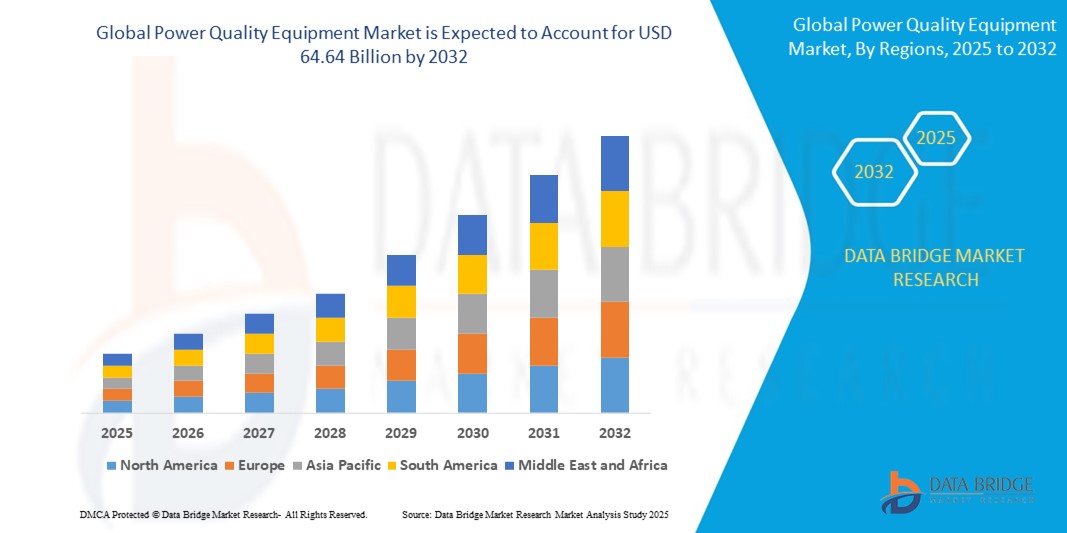
- The global power quality equipment market was valued at USD 41.80 billion in 2024 and is expected to reach USD 64.64 billion by 2032
- During the forecast period of 2025 to 2032 the market is likely to grow at a CAGR of 5.60%, primarily driven by increasing demand for reliable and uninterrupted power supply
- This growth is driven by Rapid industrialization, especially in emerging economies, has intensified the need for stable power infrastructure to avoid equipment damage and production losses
Power Quality Equipment Market Analysis
- The power quality equipment market continues to expand steadily, fueled by the increasing need for uninterrupted power in mission-critical applications, surging demand for energy-efficient solutions, and rising awareness regarding power quality issues in industrial automation, transportation, and commercial infrastructure
- The shift toward electrification of processes, along with the adoption of Industry 4.0 practices and automation in manufacturing, is accelerating the deployment of power quality equipment to ensure system reliability, reduce downtime, and protect sensitive electronic devices from power disturbances
- For instance, in the U.S., the Department of Energy allocated over USD 200 million in 2024 for enhancing grid modernization efforts, focusing on advanced power quality equipment deployment as part of its Grid Resilience and Innovation Partnership (GRIP) program
- The market is also being reshaped by innovations such as modular power quality systems, integration with renewable energy assets such as solar and wind, and the adoption of real-time monitoring through cloud-connected platforms, enabling predictive maintenance and energy optimization across diverse use cases
Report Scope and Power Quality Equipment Market Segmentation
|
Attributes |
Power Quality Equipment Key Market Insights |
|
Segments Covered |
|
|
Countries Covered |
North America
Europe
Asia-Pacific
Middle East and Africa
South America
|
|
Key Market Players |
|
|
Market Opportunities |
|
|
Value Added Data Infosets |
In addition to the insights on market scenarios such as market value, growth rate, segmentation, geographical coverage, and major players, the market reports curated by the Data Bridge Market Research also include in-depth expert analysis, geographically represented company-wise production and capacity, network layouts of distributors and partners, detailed and updated price trend analysis and deficit analysis of supply chain and demand |
Power Quality Equipment Market Trends
“Adoption of Digital Monitoring and Predictive Maintenance Technologies”
- A prominent trend in the power quality equipment market is the increasing use of digital monitoring tools and predictive maintenance technologies to enhance system performance, prevent equipment failure, and reduce downtime
- Companies are integrating advanced sensors, cloud platforms, and AI-based analytics into their power quality solutions to enable real-time diagnostics and automated alerts for proactive maintenance
- For instance, in February 2024, Eaton launched a next-generation digital power quality monitoring system equipped with machine learning to predict component failures before they occur, significantly reducing maintenance costs
- This digital shift is transforming how power quality systems are managed, allowing operators to gain insights into power disturbances, voltage fluctuations, and energy inefficiencies
- As digitalization advances, the trend is expected to support the evolution of smart power systems that are efficient and self-optimizing and adaptive to dynamic energy environments
Power Quality Equipment Market Dynamics
Driver
“Expansion of Industrial Automation and Smart Manufacturing”
- The rising adoption of industrial automation and smart manufacturing across sectors such as automotive, electronics, and pharmaceuticals is driving the demand for high-performance power quality equipment
- These facilities require highly stable and reliable power to operate sophisticated machinery, robotics, and control systems that are sensitive to power disturbances
- For instance, in January 2024, Bosch announced the installation of advanced Power Quality Equipment at its smart factory in Germany to ensure uninterrupted production and safeguard sensitive manufacturing equipment
- As smart factories continue to proliferate globally, the demand for power quality solutions that can support automation, precision control, and 24/7 operations will increase significantly
- This driver positions power quality equipment as a key enabler of Industry 4.0 and the digital transformation of the industrial sector
Opportunity
“Surge in Data Center and IT Infrastructure Development”
- The global boom in data centers and IT infrastructure, driven by cloud computing, AI, and IoT applications, presents a major opportunity for the power quality equipment market
- Power quality is critical for data centers, where even minor voltage dips or interruptions can lead to significant data loss, downtime, and operational disruptions
- For instance, in August 2024, Amazon Web Services (AWS) expanded its hyperscale data center in Ireland, incorporating advanced power quality equipment to ensure uninterrupted service for cloud users worldwide
- With the rising energy demands of digital platforms and the need for continuous uptime, data centers are expected to invest heavily in reliable power quality systems
- This growth area offers long-term opportunities for equipment manufacturers and solution providers, especially in regions expanding their digital infrastructure
Restraint/Challenge
“Lack of Standardization and Compatibility Issues”
- A key challenge in the power quality equipment market is the lack of global standardization and interoperability among products from different manufacturers, which can complicate system integration and limit scalability
- Variations in regional regulations, voltage levels, and technical specifications often require customized solutions, leading to longer installation times and higher costs
- For instance, in June 2024, a report by the International Energy Agency highlighted that inconsistent grid codes and lack of interoperability standards across the Asia-Pacific region delayed the deployment of advanced Power Quality Equipment solutions
- These compatibility issues hinder smooth deployment and may deter businesses from investing in multi-vendor solutions
- Overcoming this barrier will require collaborative efforts among industry stakeholders to develop universal standards and certification programs to ensure seamless integration and reliability
Power Quality Equipment Market Scope
The market is segmented on the basis of equipment type, phase, application, and end user.
|
Segmentation |
Sub-Segmentation |
|
By Equipment Type |
|
|
By Phase |
|
|
By Application |
|
|
By End User
|
|
Power Quality Equipment Market Regional Analysis
“North America is the Dominant Region in the Power Quality Equipment Market”
- North America is dominating the power quality equipment market due to its mature industrial base and demand for reliable energy infrastructure
- The region enforces stringent power quality regulations, prompting widespread adoption of compliant and efficient equipment across industries
- Continued investments in smart grid technologies and rapid adoption of digital solutions enhance power system resilience and efficiency
- North America’s dominance in the power quality equipment market is driven by its industrial maturity, regulatory framework, and advanced energy infrastructure
“Asia-Pacific is Projected to Register the Highest Growth Rate”
- Asia-Pacific is projected to register the highest growth rate in the power quality equipment market due to rapid industrialization in emerging economies such as China and India
- The region is witnessing increasing investments in renewable energy projects, boosting the need for reliable power quality management solutions
- Government-led initiatives to modernize and expand power grid infrastructure are further accelerating the adoption of advanced power quality technologies
- Asia-Pacific’s fast-paced growth in the power quality equipment market is fueled by industrial expansion, clean energy investments, and proactive infrastructure development
Power Quality Equipment Market Share
The market competitive landscape provides details by competitor. Details included are company overview, company financials, revenue generated, market potential, investment in research and development, new market initiatives, global presence, production sites and facilities, production capacities, company strengths and weaknesses, product launch, product width and breadth, application dominance. The above data points provided are only related to the companies' focus related to market.
The Major Market Leaders Operating in the Market Are:
- ABB (Switzerland)
- Schneider Electric (France)
- Mitsubishi Electric Corporation (Japan)
- Emerson Electric Co. (U.S.)
- Toshiba Corporation (Japan)
- General Electric Company (GE) (U.S.)
- Siemens (Germany)
- Honeywell International Inc. (U.S.)
- Hitachi Energy Ltd (Switzerland)
- Eaton (Ireland)
- Nidec ASI S.p.A. (Japan)
- AMETEK Inc. (U.S.)
- Hubbell (U.S.)
- Rockwell Automation (U.S.)
- Delta Electronics, Inc. (Taiwan)
- Cordyne Inc. (U.S.)
- Fuji Electric Co., Ltd. (Japan)
- Unipower AB (Sweden)
- Bloom Energy (U.S.)
Latest Developments in Global Power Quality Equipment Market
- In December 2024, ABB India announced it had signed an agreement to acquire the power electronics business of Gamesa Electric in Spain, a subsidiary of Siemens Gamesa, aiming to strengthen its position in the growing market for high-powered renewable power conversion technology. This acquisition enhances ABB's capabilities in sustainable energy solutions and positions it more competitively in the renewable sector
- In October 2024, Siemens signed an agreement to acquire Altair Engineering Inc., a prominent provider of industrial simulation and analysis software, at an enterprise value of approximately USD 10 billion, offering a 19% premium over Altair’s unaffected closing price. This strategic move strengthens Siemens' leadership in industrial software and reinforces its role as a top-tier technology company
- In September 2024, Siemens announced its agreement to acquire California-based Trayer Engineering Corporation, a specialist in medium-voltage secondary distribution switchgear for outdoor and below-ground applications. The acquisition boosts Siemens’ product portfolio in grid infrastructure and enhances its service capabilities in the U.S. market
- In November 2023, Schneider Electric finalized the acquisition of EcoAct SAS, a Paris-based global leader in climate consulting and net-zero solutions, after exclusive negotiations with Atos Group and regulatory approvals. This acquisition supports Schneider Electric’s sustainability goals and expands its expertise in climate strategy and decarbonization services
- In March 2023, GE commissioned the 300-megawatt Biblis Grid Stability Power Plant to maintain grid stability during supply-demand imbalances. This project showcases GE’s commitment to enhancing energy reliability and addressing grid challenges in real-time

- Interactive Data Analysis Dashboard
- Company Analysis Dashboard for high growth potential opportunities
- Research Analyst Access for customization & queries
- Competitor Analysis with Interactive dashboard
- Latest News, Updates & Trend analysis
- Harness the Power of Benchmark Analysis for Comprehensive Competitor Tracking
Global Power Quality Equipment Market, Supply Chain Analysis and Ecosystem Framework
To support market growth and help clients navigate the impact of geopolitical shifts, DBMR has integrated in-depth supply chain analysis into its Global Power Quality Equipment Market research reports. This addition empowers clients to respond effectively to global changes affecting their industries. The supply chain analysis section includes detailed insights such as Global Power Quality Equipment Market consumption and production by country, price trend analysis, the impact of tariffs and geopolitical developments, and import and export trends by country and HSN code. It also highlights major suppliers with data on production capacity and company profiles, as well as key importers and exporters. In addition to research, DBMR offers specialized supply chain consulting services backed by over a decade of experience, providing solutions like supplier discovery, supplier risk assessment, price trend analysis, impact evaluation of inflation and trade route changes, and comprehensive market trend analysis.
Data collection and base year analysis are done using data collection modules with large sample sizes. The stage includes obtaining market information or related data through various sources and strategies. It includes examining and planning all the data acquired from the past in advance. It likewise envelops the examination of information inconsistencies seen across different information sources. The market data is analysed and estimated using market statistical and coherent models. Also, market share analysis and key trend analysis are the major success factors in the market report. To know more, please request an analyst call or drop down your inquiry.
The key research methodology used by DBMR research team is data triangulation which involves data mining, analysis of the impact of data variables on the market and primary (industry expert) validation. Data models include Vendor Positioning Grid, Market Time Line Analysis, Market Overview and Guide, Company Positioning Grid, Patent Analysis, Pricing Analysis, Company Market Share Analysis, Standards of Measurement, Global versus Regional and Vendor Share Analysis. To know more about the research methodology, drop in an inquiry to speak to our industry experts.
Data Bridge Market Research is a leader in advanced formative research. We take pride in servicing our existing and new customers with data and analysis that match and suits their goal. The report can be customized to include price trend analysis of target brands understanding the market for additional countries (ask for the list of countries), clinical trial results data, literature review, refurbished market and product base analysis. Market analysis of target competitors can be analyzed from technology-based analysis to market portfolio strategies. We can add as many competitors that you require data about in the format and data style you are looking for. Our team of analysts can also provide you data in crude raw excel files pivot tables (Fact book) or can assist you in creating presentations from the data sets available in the report.













