


What is the Pre Harvest Equipment Market Size and Growth Rate?
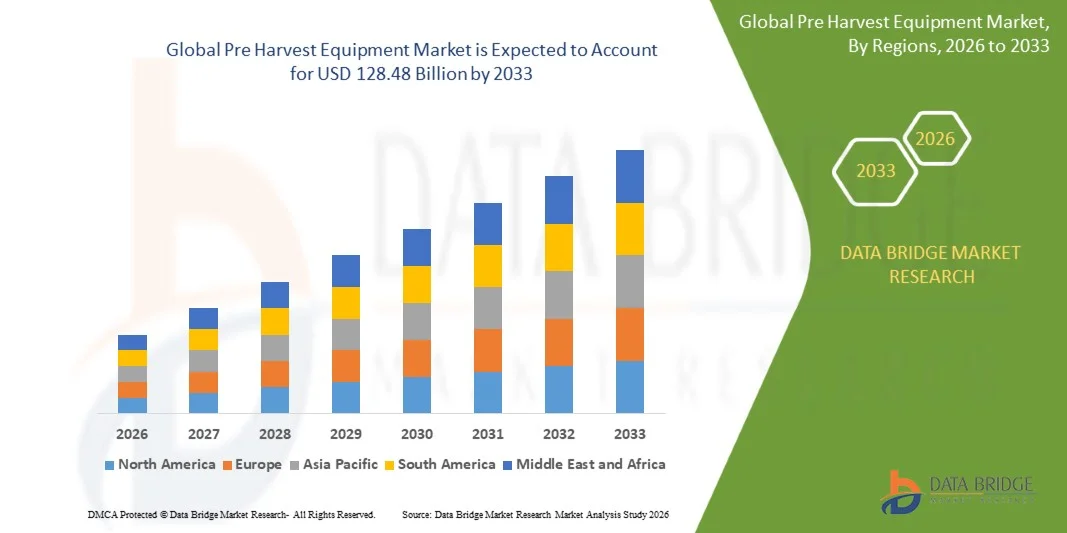
- As per Data Bridge Market Research analysis the pre harvest equipment market was valued at USD 82.46 billion in 2025 and is projected to reach USD 128.48 billion by 2033, growing at a CAGR of 5.70% from 2026 to 2033.
- The market is experiencing consistent growth driven by increasing agricultural mechanization, rising demand for efficient farming operations, technological advancements in agricultural machinery, and the growing need to improve productivity while reducing labor dependency.
- The increasing adoption of precision farming technologies, combined with rising labor costs and the need for timely land preparation, planting, and crop management, is encouraging farmers and agricultural enterprises to invest in advanced pre-harvest equipment.
Market Size & Forecast
- Market Value (2025): USD 82.46 Billion
- Expected Market Value (2033): USD 128.48 Billion
- Forecast CAGR (2026–2033): 5.70%
- Leading Region in 2025: North America
- Fastest Growing Region: Asia-Pacific
What are the Major Takeaways of the Pre Harvest Equipment Market?
- North America dominated the pre harvest equipment market with the largest revenue share in 2025, supported by high levels of agricultural mechanization, large-scale commercial farming, and rapid adoption of precision agriculture technologies.
- Asia-Pacific pre harvest equipment market is expected to witness the fastest growth rate from 2026 to 2033, supported by increasing agricultural mechanization, rising food demand, expanding farming operations, and technological advancements in countries such as China, India, and Japan.
- The primary tillage equipment segment held the largest market revenue share in 2025, driven by its widespread use in soil preparation, land cultivation, and seedbed formation across commercial farming operations. Primary tillage equipment is preferred due to its ability to break and loosen soil efficiently, improve soil aeration, and prepare fields for subsequent planting activities.
- The plant protection equipment segment is projected to register the fastest growth at a CAGR from 2026 to 2033, driven by increasing demand for precision spraying, efficient crop protection, and reduced chemical usage. Rising adoption of automated sprayers, precision application technologies, and integrated pest management practices is accelerating segment expansion.
- The agricultural segment held the largest market revenue share in 2025, driven by extensive equipment utilization across commercial crop production, soil preparation, planting, irrigation, and crop protection activities. Increasing farm mechanization and the need to improve productivity and operational efficiency are supporting widespread adoption across agricultural operations.
- The experimental segment is projected to register the fastest growth at a CAGR from 2026 to 2033, driven by increasing use of specialized equipment in agricultural research, crop trials, and controlled field experiments. Growing investment in agricultural innovation and precision farming research is accelerating demand for advanced equipment in experimental applications.
Report Scope and Pre Harvest Equipment Market Segmentation
|
Attributes |
Pre Harvest Equipment Key Market Insights |
|
Segments Covered |
|
|
Countries Covered |
North America
Europe
Asia-Pacific
Middle East and Africa
South America
|
|
Key Market Players |
|
|
Market Opportunities |
|
|
Value Added Data Infosets |
In addition to the insights on market scenarios such as market value, growth rate, segmentation, geographical coverage, and major players, the market reports curated by the Data Bridge Market Research also include in-depth expert analysis, pricing analysis, brand share analysis, consumer survey, demography analysis, supply chain analysis, value chain analysis, raw material/consumables overview, vendor selection criteria, PESTLE Analysis, Porter Analysis, and regulatory framework. |
What is the Key Trend in the Pre Harvest Equipment Market?
- Farmers are increasingly adopting precision-enabled pre-harvest equipment to improve input efficiency, optimize field operations, and increase crop productivity through automation, machine vision, and real-time data analytics.
- For instance, in February 2025, John Deere introduced its Precision Essentials hardware kit, enabling farmers to retrofit existing equipment with advanced displays, receivers, and connectivity technologies while reducing the upfront cost of precision agriculture adoption.
- Machine vision and AI-based technologies are enabling equipment to identify crops and weeds more accurately, supporting targeted application and reducing unnecessary input usage.
- For instance, in November 2025, John Deere reported that its See & Spray technology had been used across more than five million acres during the 2025 growing season, while customers reduced non-residual herbicide use by nearly 50% on average.
- As farmers increasingly prioritize precision, automation, and resource efficiency, the adoption of connected pre-harvest equipment is expected to accelerate, strengthening the role of digital technologies in modern agricultural operations.
What are the Key Drivers of the Pre Harvest Equipment Market?
- Rising agricultural mechanization and labor shortages are significantly increasing demand for efficient pre-harvest equipment capable of reducing manual work, improving operational timeliness, and increasing farm productivity.
- For instance, the Food and Agriculture Organization (FAO) states that sustainable mechanization can reduce hard labor, address labor shortages, improve productivity and timeliness of agricultural operations, and enhance the efficient use of resources.
- The growing adoption of automation, precision agriculture, and digital farming technologies is encouraging farmers to integrate intelligent tractors, planters, sprayers, and other equipment into crop production activities.
- For instance, FAO reports that the global share of the population employed in agriculture declined from 45% to 35% over two decades, increasing the importance of mechanization, digitalization, and automation to address agricultural labor constraints.
- With agriculture increasingly relying on mechanization and precision technologies to overcome labor constraints and improve resource efficiency, demand for advanced pre-harvest equipment is expected to remain strong across developed and emerging agricultural markets.
Which Factors are Challenging the Growth of the Pre Harvest Equipment Market?
- Advanced pre-harvest equipment requires significant upfront investment due to the integration of automation, sensors, GPS, machine vision, connectivity, and precision-control technologies.
- These high acquisition and technology costs can limit adoption among smallholder farmers and smaller agricultural enterprises, particularly in developing economies where access to financing and mechanization services remains constrained.
- For instance, the FAO highlights that small-scale farmer in developing countries often struggle to meet the initial investment required to purchase machinery or hire mechanization services, limiting their ability to benefit fully from agricultural mechanization.
- The organization also identifies barriers to inclusive adoption of digital agricultural automation, particularly among small-scale producers, despite the potential of automation to improve productivity and resilience.
- The high capital requirements and limited financing access continue to restrict the adoption of technologically advanced pre-harvest equipment, particularly among small and medium-sized farms, slowing market penetration in price-sensitive and emerging agricultural regions.
How is the Pre Harvest Equipment Market Segmented?
The market is segmented on the basis of type, application, and distribution.
- By Type
On the basis of type, the pre harvest equipment market is segmented into primary tillage equipment, secondary tillage equipment, planting equipment, irrigation equipment, and plant protection equipment. The primary tillage equipment segment held the largest market revenue share in 2025, driven by its widespread use in soil preparation, land cultivation, and seedbed formation across commercial farming operations. Primary tillage equipment is preferred due to its ability to break and loosen soil efficiently, improve soil aeration, and prepare fields for subsequent planting activities.
The plant protection equipment segment is projected to register the fastest growth at a CAGR from 2026 to 2033, driven by increasing demand for precision spraying, efficient crop protection, and reduced chemical usage. Rising adoption of automated sprayers, precision application technologies, and integrated pest management practices is accelerating segment expansion.
- By Application
On the basis of application, the pre harvest equipment market is segmented into agricultural and experimental. The agricultural segment held the largest market revenue share in 2025, driven by extensive equipment utilization across commercial crop production, soil preparation, planting, irrigation, and crop protection activities. Increasing farm mechanization and the need to improve productivity and operational efficiency are supporting widespread adoption across agricultural operations.
The experimental segment is projected to register the fastest growth at a CAGR from 2026 to 2033, driven by increasing use of specialized equipment in agricultural research, crop trials, and controlled field experiments. Growing investment in agricultural innovation and precision farming research is accelerating demand for advanced equipment in experimental applications.
- By Distribution
On the basis of distribution, the pre harvest equipment market is segmented into O.E.M. and after markets. The O.E.M. segment held the largest market revenue share in 2025, driven by strong farmer preference for original equipment, manufacturer-supported technology, warranty services, and integrated machinery solutions. Direct availability of advanced equipment and compatibility with farm machinery are further supporting the dominance of O.E.M. distribution.
The after markets segment is projected to register the fastest growth at a CAGR from 2026 to 2033, driven by increasing demand for replacement components, maintenance services, equipment upgrades, and aftermarket precision technologies. The growing installed base of agricultural machinery and rising focus on extending equipment operating life are accelerating segment expansion.
Which Region Holds the Largest Share of the Pre Harvest Equipment Market?
- North America dominated the pre harvest equipment market with the largest revenue share in 2025, supported by high levels of agricultural mechanization, large-scale commercial farming, and rapid adoption of precision agriculture technologies.
- Farmers across the region increasingly use advanced tractors, planting equipment, irrigation systems, and crop protection machinery to improve productivity and reduce labor dependency. Strong investment in autonomous equipment, GPS-enabled machinery, and connected farming technologies further supports the region's leading position.
U.S. Pre Harvest Equipment Market Insight
U.S. pre harvest equipment market captured the largest revenue share in 2025 within North America, fueled by extensive mechanization across large commercial farms and increasing adoption of precision farming solutions. Farmers are increasingly investing in automated tractors, intelligent planting systems, precision sprayers, and advanced irrigation equipment to improve operational efficiency. Moreover, rising labor costs, large-scale agricultural production, and growing adoption of data-driven farming technologies are significantly contributing to market expansion.
Europe Pre Harvest Equipment Market Insight
Europe pre harvest equipment market is expected to witness the fastest growth rate from 2026 to 2033, primarily driven by increasing agricultural automation, sustainability initiatives, and growing adoption of precision farming technologies. Farmers are increasingly adopting efficient machinery to optimize fertilizer, water, seed, and pesticide use while improving crop productivity. The region's emphasis on sustainable agriculture, technological innovation, and reduction of agricultural labor dependency is further supporting the adoption of advanced pre harvest equipment.
U.K. Pre Harvest Equipment Market Insight
U.K. pre harvest equipment market is expected to witness the fastest growth rate from 2026 to 2033, driven by increasing farm mechanization, labor shortages, and growing demand for efficient agricultural production. Farmers are increasingly adopting precision planting, crop protection, and automated equipment to improve productivity and reduce operational costs. In addition, the expansion of sustainable farming practices and government support for agricultural technology adoption is expected to continue stimulating market growth.
Germany Pre Harvest Equipment Market Insight
Germany pre harvest equipment market is expected to witness the fastest growth rate from 2026 to 2033, fueled by the country's advanced agricultural machinery industry, strong focus on precision farming, and increasing demand for automated equipment. German farmers are adopting GPS-guided machinery, smart planting systems, advanced sprayers, and connected equipment to enhance productivity and resource efficiency. The country's emphasis on sustainable agriculture and technological innovation further promotes the adoption of advanced pre harvest equipment.
Asia-Pacific Pre Harvest Equipment Market Insight
The Asia-Pacific pre harvest equipment market is expected to witness the fastest growth rate from 2026 to 2033, supported by increasing agricultural mechanization, rising food demand, expanding farming operations, and technological advancements in countries such as China, India, and Japan. The region's large agricultural workforce and growing labor shortages are encouraging farmers to adopt mechanized planting, tillage, irrigation, and crop protection equipment. Furthermore, government initiatives promoting farm mechanization and precision agriculture are improving access to advanced equipment across the region.
Japan Pre Harvest Equipment Market Insight
Japan pre harvest equipment market is expected to witness the fastest growth rate from 2026 to 2033 due to the country's aging agricultural workforce, limited availability of farm labor, and strong emphasis on agricultural automation. Farmers are increasingly adopting compact, automated, and precision-enabled machinery to improve productivity and overcome labor constraints. Moreover, the integration of robotics, sensors, GPS, and autonomous technologies into agricultural equipment is fueling market growth across Japanese farming operations.
China Pre Harvest Equipment Market Insight
China pre harvest equipment market accounted for the largest market revenue share in Asia Pacific in 2025, attributed to the country's extensive agricultural sector, increasing farm mechanization, and government initiatives supporting agricultural modernization. China is rapidly adopting tractors, planting equipment, irrigation systems, and intelligent crop protection machinery to improve agricultural productivity and reduce reliance on manual labor. The expansion of precision agriculture, smart farming, and domestic agricultural machinery manufacturing is further propelling the pre harvest equipment market in China.
Which are the Top Companies in Pre Harvest Equipment Market?
The pre harvest equipment industry is primarily led by well-established companies, including:
- Deere & Company (U.S.)
- CNH Industrial N.V. (U.K.)
- AGCO Corporation (U.S.)
- Kubota Corporation (Japan)
- Mahindra & Mahindra Ltd. (India)
- CLAAS KGaA mbH (Germany)
- Yanmar Holdings Co., Ltd. (Japan)
- Bucher Industries AG (Switzerland)
- Iseki & Co., Ltd. (Japan)
- J.C. Bamford Excavators Ltd. (U.K.)
- SDF Group (Italy)
- Kverneland Group (Norway)
- Exel Industries S.A. (France)
- Valmont Industries, Inc. (U.S.)
- Vermeer Corporation (U.S.)
What are Latest Developments in Pre Harvest Equipment Market?
- In July 2025, FieldWorks secured Japanese government funding to support the commercialization of its robotic weeding system. The technology targets an 80% reduction in weeding time by 2027 through automated crop management. The initiative is expected to reduce labor requirements and improve operational efficiency. It also highlights the growing adoption of robotics in pre-harvest agricultural activities.
- In April 2025, AGCO expanded its distribution network through Carter Agri-Systems in Utah and Delta Ag Equipment in Mississippi. The expansion increased farmer access to Fendt and Massey Ferguson agricultural equipment and technologies. It strengthens AGCO’s regional distribution capabilities and supports wider adoption of advanced pre-harvest machinery. The development is expected to improve equipment availability for farmers.
- In October 2024, CLAAS launched its Connect digital ecosystem to integrate machine management, service planning, and precision farming capabilities. The platform was made available across more than 30 countries to support connected agricultural operations. The technology enables farmers to manage machinery and farming data through a cloud-based system. The development is expected to improve equipment utilization and operational efficiency in pre-harvest activities.

- Interactive Data Analysis Dashboard
- Company Analysis Dashboard for high growth potential opportunities
- Research Analyst Access for customization & queries
- Competitor Analysis with Interactive dashboard
- Latest News, Updates & Trend analysis
- Harness the Power of Benchmark Analysis for Comprehensive Competitor Tracking
Global Pre Harvest Equipment Market, Supply Chain Analysis and Ecosystem Framework
To support market growth and help clients navigate the impact of geopolitical shifts, DBMR has integrated in-depth supply chain analysis into its Global Pre Harvest Equipment Market research reports. This addition empowers clients to respond effectively to global changes affecting their industries. The supply chain analysis section includes detailed insights such as Global Pre Harvest Equipment Market consumption and production by country, price trend analysis, the impact of tariffs and geopolitical developments, and import and export trends by country and HSN code. It also highlights major suppliers with data on production capacity and company profiles, as well as key importers and exporters. In addition to research, DBMR offers specialized supply chain consulting services backed by over a decade of experience, providing solutions like supplier discovery, supplier risk assessment, price trend analysis, impact evaluation of inflation and trade route changes, and comprehensive market trend analysis.
Data collection and base year analysis are done using data collection modules with large sample sizes. The stage includes obtaining market information or related data through various sources and strategies. It includes examining and planning all the data acquired from the past in advance. It likewise envelops the examination of information inconsistencies seen across different information sources. The market data is analysed and estimated using market statistical and coherent models. Also, market share analysis and key trend analysis are the major success factors in the market report. To know more, please request an analyst call or drop down your inquiry.
The key research methodology used by DBMR research team is data triangulation which involves data mining, analysis of the impact of data variables on the market and primary (industry expert) validation. Data models include Vendor Positioning Grid, Market Time Line Analysis, Market Overview and Guide, Company Positioning Grid, Patent Analysis, Pricing Analysis, Company Market Share Analysis, Standards of Measurement, Global versus Regional and Vendor Share Analysis. To know more about the research methodology, drop in an inquiry to speak to our industry experts.
Data Bridge Market Research is a leader in advanced formative research. We take pride in servicing our existing and new customers with data and analysis that match and suits their goal. The report can be customized to include price trend analysis of target brands understanding the market for additional countries (ask for the list of countries), clinical trial results data, literature review, refurbished market and product base analysis. Market analysis of target competitors can be analyzed from technology-based analysis to market portfolio strategies. We can add as many competitors that you require data about in the format and data style you are looking for. Our team of analysts can also provide you data in crude raw excel files pivot tables (Fact book) or can assist you in creating presentations from the data sets available in the report.













