


Pre-Hospital Blood Warmer Market Size
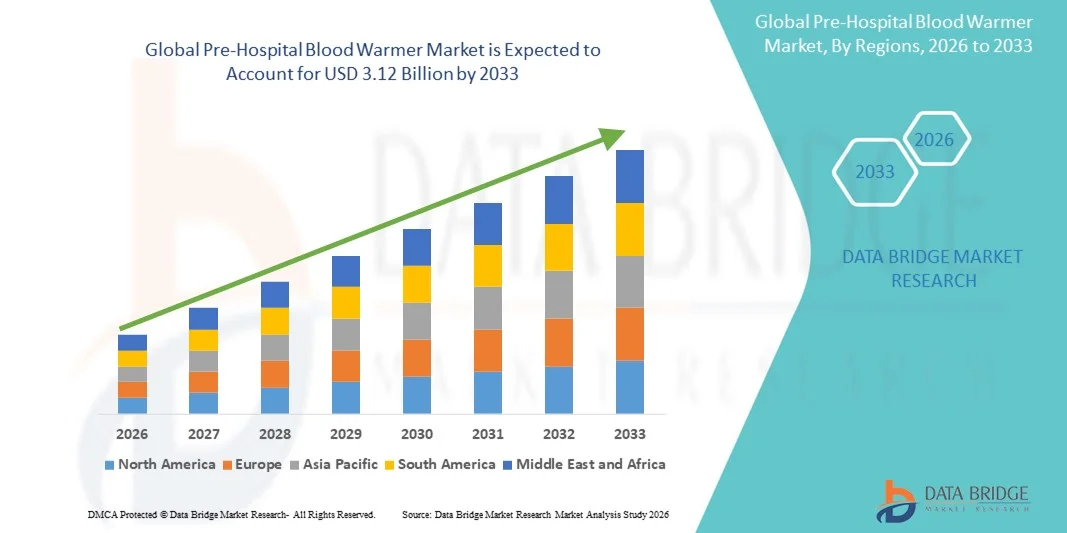
- The global pre-hospital blood warmer market size was valued at USD 1.83 billion in 2025 and is expected to reach USD 3.12 billion by 2033, at a CAGR of 6.90% during the forecast period
- The market growth is largely fueled by the growing adoption and technological advancements in pre-hospital emergency care devices, especially blood warmers, leading to improved patient outcomes and operational efficiency in emergency medical services (EMS), military, and HEMS (Helicopter Emergency Medical Services)
- Furthermore, rising demand for portable, reliable, and easy-to-use blood warming solutions in ambulances, field hospitals, and remote care settings is driving the adoption of pre-hospital blood warmers. These converging factors are accelerating the uptake of these solutions, thereby significantly boosting the industry's growth
Pre-Hospital Blood Warmer Market Analysis
- Pre-Hospital Blood Warmers, providing rapid and safe warming of blood and blood products in pre-hospital and emergency settings, are increasingly vital components of emergency medical care due to their ability to prevent hypothermia, improve patient outcomes, and ensure timely transfusions
- The escalating demand for pre-hospital blood warmers is primarily fueled by the growing adoption of advanced emergency medical services, increasing trauma and accident cases, and a rising focus on patient safety and rapid intervention in pre-hospital environments
- North America dominated the pre-hospital blood warmer market with the largest revenue share of 42.5% in 2025, driven by advanced emergency medical services infrastructure, high adoption of pre-hospital care technologies, and the presence of key market players. The U.S. market, in particular, is witnessing substantial growth due to increasing demand for rapid transfusion management in ambulances and emergency response units
- Asia-Pacific is expected to be the fastest-growing region in the pre-hospital blood warmer market during the forecast period, registering a robust CAGR, supported by expanding healthcare access, rising government investments in emergency medical services, and growing awareness of patient safety protocols
- The portable blood warmer segment dominated the largest market revenue share of 46.8% in 2025, driven by its rapid warming capability for blood and intravenous fluids, ensuring critical patient safety during transport
Report Scope and Pre-Hospital Blood Warmer Market Segmentation
|
Attributes |
Pre-Hospital Blood Warmer Key Market Insights |
|
Segments Covered |
|
|
Countries Covered |
North America
Europe
Asia-Pacific
Middle East and Africa
South America
|
|
Key Market Players |
|
|
Market Opportunities |
|
|
Value Added Data Infosets |
In addition to the insights on market scenarios such as market value, growth rate, segmentation, geographical coverage, and major players, the market reports curated by the Data Bridge Market Research also include in-depth expert analysis, patient epidemiology, pipeline analysis, pricing analysis, and regulatory framework. |
Pre-Hospital Blood Warmer Market Trends
Technological Advancements and Increasing Field Applications
- A major and accelerating trend in the global pre-hospital blood warmer market is the increasing adoption of portable, lightweight, and energy-efficient warming systems for emergency and pre-hospital care. These devices are being designed to ensure rapid warming of blood and intravenous fluids during transport, thereby reducing the risk of hypothermia in trauma patients
- For instance, modern compact blood warmers integrate advanced temperature regulation mechanisms that maintain consistent fluid temperatures, even under varying environmental conditions, making them suitable for ambulances, air transport, and battlefield applications
- Furthermore, manufacturers are increasingly focusing on user-friendly interfaces and modular designs that facilitate quick setup and operation in high-pressure emergency scenarios, improving the overall efficiency of pre-hospital care
- The trend towards multi-functional devices capable of warming blood, saline, and other intravenous solutions simultaneously is enhancing the appeal of these systems among paramedics and emergency medical service providers
- Portable pre-hospital warming devices are witnessing increased deployment in disaster response and military medical units due to their robust construction and reliability under extreme conditions
- This trend is driving innovation in both design and operational capabilities, encouraging companies to develop next-generation pre-hospital blood warmers that meet evolving clinical and logistical requirements
Pre-Hospital Blood Warmer Market Dynamics
Driver
Rising Incidence of Trauma and Emergency Cases
- The growing frequency of road accidents, trauma cases, and emergency surgeries worldwide is a major driver for the Pre-Hospital Blood Warmer market. Immediate access to properly warmed blood and fluids is critical to stabilize patients and prevent hypothermia-related complications
- For instance, in 2023, global emergency response organizations emphasized the integration of rapid blood warming systems in ambulances and mobile ICUs to improve patient survival rates during transit.
- Awareness among paramedics, trauma centers, and emergency care providers regarding the clinical benefits of maintaining normothermia during transfusion is fueling demand for these devices
- Furthermore, the expanding pre-hospital care infrastructure in developing regions and growing investments in ambulance and emergency services are accelerating adoption of advanced blood warming systems
- The convenience of portable, easy-to-use devices that can be deployed in unpredictable environments is particularly appealing to field medics, emergency medical services, and military medical teams
- The increasing focus on minimizing transfusion-related complications in emergency care is creating a strong demand for pre-hospital blood warmers, positioning them as an essential tool for trauma management
Restraint/Challenge
High Costs and Regulatory Compliance Challenges
- The relatively high cost of advanced pre-hospital blood warming devices compared to traditional warming methods remains a significant challenge for market expansion, especially in low-resource and developing regions
- For instance, small emergency medical services with limited budgets may opt for conventional methods due to the premium pricing of portable, battery-operated systems
- Compliance with stringent international medical device regulations, including ISO certifications and FDA/CE approvals, adds complexity and cost to product development and market entry
- Furthermore, maintenance requirements and the need for specialized training for proper device operation can limit adoption among smaller ambulance services and field units
- While prices are gradually stabilizing with technological advancements and production scale-up, the initial investment remains a barrier for many potential end users
- Addressing these challenges through cost-optimization strategies, robust after-sales support, and simplified operational protocols will be vital for sustained growth of the Pre-Hospital Blood Warmer market
Pre-Hospital Blood Warmer Market Scope
The market is segmented on the basis of modality, product, and end user.
- By Modality
On the basis of modality, the Pre-Hospital Blood Warmer market is segmented into portable blood warmers and non-portable blood warmers. The portable blood warmer segment dominated the largest market revenue share of 46.8% in 2025, driven by its rapid warming capability for blood and intravenous fluids, ensuring critical patient safety during transport. Its lightweight, compact design allows for easy deployment in ambulances, helicopters, and remote emergency settings. Increasing adoption in EMS, HEMS, and military operations has reinforced its market dominance. Advanced temperature regulation, battery operation, and compatibility with multiple fluid types make portable devices highly preferred. The segment also benefits from continuous technological enhancements that improve reliability and efficiency. Emergency responders favor portable systems due to their versatility and ease of integration into existing pre-hospital infrastructure. Disaster response units and remote location medical services further contribute to high demand. The convenience of immediate use and reduced setup time enhances operational efficiency. Healthcare authorities are increasingly standardizing portable warmers in trauma protocols. Rising investments in emergency medical services globally continue to support the segment’s growth trajectory.
The non-portable blood warmer segment is expected to witness the fastest CAGR of 22.4% from 2026 to 2033, owing to the growing need for continuous warming capacity in mobile field hospitals and large-scale EMS operations. These systems allow warming multiple fluid lines simultaneously with advanced safety mechanisms. Integration with mobile intensive care units and enhanced energy efficiency further drives adoption. Military and disaster response sectors are increasingly incorporating non-portable solutions. High throughput and precise temperature maintenance make them ideal for mass casualty or high-demand scenarios. Improvements in portability features for semi-fixed installations also contribute to their rising usage. The segment’s growth is fueled by technological innovations enhancing reliability and safety. Increased demand in high-volume trauma care facilities highlights the importance of these devices. Regulatory approvals and standardization efforts in pre-hospital care support market expansion. Rising awareness about hypothermia prevention is an additional driver. Growing adoption in emerging economies presents further opportunities for expansion.
- By Product
On the basis of product, the market is segmented into invasive pre-hospital blood warmers and non-invasive pre-hospital blood warmers. The invasive segment held the largest market revenue share of 44.5% in 2025, primarily due to its ability to directly warm blood and intravenous fluids, ensuring rapid patient stabilization. Widely used in trauma and surgical emergencies, invasive systems offer precise temperature control, reducing transfusion-related complications. Compatibility with standard IV sets and rapid deployment in EMS and HEMS vehicles enhances operational efficiency. The robust design ensures reliable performance under variable pre-hospital conditions. Emergency medical personnel favor invasive devices for their high accuracy and efficiency. The segment benefits from technological advances improving safety, monitoring, and reliability. Increasing investments in trauma care and pre-hospital protocols strengthen adoption. Portable invasive devices further enhance field usability. Growing awareness about hypothermia prevention in pre-hospital care drives consistent demand. Healthcare facilities increasingly integrate these systems into emergency preparedness kits. Rising demand from both civilian and military EMS contributes to revenue dominance.
The non-invasive product segment is expected to witness the fastest CAGR of 21.8% from 2026 to 2033, due to rising demand for safe, easy-to-use systems minimizing blood handling risks. Non-invasive devices are preferred in pediatric care, mass casualty situations, and scenarios where intravenous access is limited. Continuous innovations in heat-exchange technologies and fluid warming accuracy fuel adoption. EMS, HEMS, and military services are progressively utilizing non-invasive warmers to complement invasive systems. Enhanced safety features, user-friendly design, and lower complication risks drive popularity. Expansion in emerging markets and adoption in mobile medical units further boost growth. Regulatory approvals and increased pre-hospital care standards contribute to segment expansion. Technological improvements, such as precise temperature monitoring, strengthen market traction. Growing emphasis on patient safety during transport supports adoption. Non-invasive systems also reduce training complexity for emergency staff. Rising investments in emergency response infrastructure are additional growth factors.
- By End User
On the basis of end user, the market is segmented into EMS, military, HEMS, and others. The EMS segment accounted for the largest market revenue share of 48.1% in 2025, driven by increasing emergency medical interventions and ambulance-based trauma services. EMS providers prioritize portable and invasive warmers to stabilize patients during pre-hospital transport. Growing investments in EMS infrastructure, standardization of trauma protocols, and rising awareness about hypothermia prevention are key drivers. Portable, easy-to-deploy systems allow rapid response in time-critical emergencies. Adoption is strengthened by technological advances in fluid warming, monitoring, and battery efficiency. EMS personnel benefit from user-friendly, reliable devices ensuring patient safety. Integration with existing ambulance setups enhances operational efficiency. Expansion of EMS services in emerging markets supports market dominance. Regulatory mandates for trauma and emergency care standardization reinforce the segment’s growth. Increasing number of high-acuity interventions in urban and rural areas further boosts revenue share. Continuous innovation and training programs strengthen adoption in EMS.
The military segment is expected to witness the fastest CAGR of 23.2% from 2026 to 2033, driven by rising defense medical investments and the requirement for reliable pre-hospital blood warming in battlefield conditions. Portable, ruggedized systems capable of functioning in extreme environments are highly preferred. Military adoption emphasizes durability, high performance, and multi-functional deployment. Increasing use in field hospitals and combat casualty care is a major growth driver. Technological advances enhancing portability, energy efficiency, and safety further support adoption. Integration into mobile field units improves operational readiness. Rising focus on trauma care and emergency preparedness in defense forces fuels demand. Standardization of pre-hospital protocols and regulatory approvals accelerate market growth. Military adoption in emerging economies presents additional opportunities. Focus on mass casualty and rapid deployment scenarios strengthens segment growth. Continuous innovation in system robustness and reliability ensures sustained demand.
Pre-Hospital Blood Warmer Market Regional Analysis
- North America dominated the pre-hospital blood warmer market with the largest revenue share of 42.5% in 2025
- Driven by the region’s well-established emergency medical services infrastructure, high adoption of pre-hospital care technologies, and the presence of leading market players
- The region benefits from extensive EMS networks, advanced ambulance equipment, and a strong focus on rapid transfusion management in emergency situations
U.S. Pre-Hospital Blood Warmer Market Insight
The U.S. pre-hospital blood warmer market captured the largest revenue share in 2025 within North America, propelled by the increasing use of portable blood warmers in ambulances, HEMS, and trauma units. Growing awareness of the importance of patient safety during emergency care, combined with supportive healthcare policies and a strong R&D focus on innovative devices, is significantly expanding the market.
Europe Pre-Hospital Blood Warmer Market Insight
The Europe pre-hospital blood warmer market is projected to grow steadily at a notable CAGR during the forecast period, driven by rising investments in EMS infrastructure, stringent patient safety regulations, and increasing adoption of pre-hospital care technologies across countries such as Germany, France, and the U.K. The region is witnessing a gradual modernization of ambulances and emergency response units, facilitating improved patient outcomes.
U.K. Pre-Hospital Blood Warmer Market Insight
The U.K. pre-hospital blood warmer market is expected to expand at a considerable CAGR, fueled by the adoption of advanced EMS equipment, ongoing improvements in pre-hospital patient care, and increasing awareness among healthcare providers about rapid transfusion needs in emergency scenarios.
Germany Pre-Hospital Blood Warmer Market Insight
The Germany pre-hospital blood warmer market is anticipated to grow significantly during the forecast period, supported by government initiatives aimed at modernizing emergency medical services, increasing deployment of portable blood warming systems, and rising focus on pre-hospital trauma care in both urban and rural areas.
Asia-Pacific Pre-Hospital Blood Warmer Market Insight
The Asia-Pacific pre-hospital blood warmer market is poised to grow at the fastest CAGR during the forecast period, fueled by expanding healthcare access, rising government investments in emergency medical services, and increasing awareness of patient safety protocols. Countries such as China, Japan, and India are witnessing rapid modernization of EMS systems, with portable and non-invasive blood warming solutions becoming standard in ambulances and emergency units.
Japan Pre-Hospital Blood Warmer Market Insight
The Japan pre-hospital blood warmer market is gaining momentum due to rapid urbanization, high healthcare standards, and the increasing number of emergency medical units equipped with advanced pre-hospital care technologies. The country’s emphasis on patient safety and trauma care efficiency is driving the adoption of portable blood warmers.
China Pre-Hospital Blood Warmer Market Insight
The China pre-hospital blood warmer market accounted for the largest revenue share in the Asia-Pacific region in 2025, supported by growing government investment in healthcare modernization, expanding EMS networks, and a rising patient base requiring rapid transfusion management during pre-hospital care. The increasing presence of domestic manufacturers is also helping to make devices more accessible and cost-effective.
Pre-Hospital Blood Warmer Market Share
The Pre-Hospital Blood Warmer industry is primarily led by well-established companies, including:
• Smiths Medical (U.K.)
• Teleflex (U.S.)
• Haemonetics Corporation (U.S.)
• Cardinal Health (U.S.)
• Eppendorf (Germany)
• Vyaire Medical (U.S.)
• BestMedical International (U.S.)
• Medtronic (Ireland)
• ZOLL Medical Corporation (U.S.)
• Becton Dickinson (U.S.)
• Fresenius Kabi (Germany)
• ICU Medical (U.S.)
• Deltex Medical (U.K.)
• Hamilton Medical (Switzerland)
• Welch Allyn (U.S.)
Latest Developments in Global Pre-Hospital Blood Warmer Market
- In October 2021, QinFlow Inc. announced a partnership with 410 Medical to expand the deployment of its “Warrior” line of blood and fluid warmers into pre‑hospital and transport settings, enabling EMS agencies to warm both blood and IV fluids in the field
- In June 2023, Bound Tree Medical signed a distribution agreement with QinFlow Inc. for the Warrior line of blood and fluid warmers, facilitating expanded access of these devices to EMS agencies across the United States for pre‑hospital trauma care
- In June 2024, MEQU received U.S. FDA 510(k) clearance for its portable °M Warmer System — a compact blood and IV fluid warming device designed for pre‑hospital and military emergency environments
- In August 2024, Delta Development Team launched its “Single Unit Blood Warmer (SUBW)”, a multi‑power, lightweight pre‑hospital device capable of warming blood and thawing plasma without consumables, aimed at rural, EMS, field hospital, and military use

- Interactive Data Analysis Dashboard
- Company Analysis Dashboard for high growth potential opportunities
- Research Analyst Access for customization & queries
- Competitor Analysis with Interactive dashboard
- Latest News, Updates & Trend analysis
- Harness the Power of Benchmark Analysis for Comprehensive Competitor Tracking
Data collection and base year analysis are done using data collection modules with large sample sizes. The stage includes obtaining market information or related data through various sources and strategies. It includes examining and planning all the data acquired from the past in advance. It likewise envelops the examination of information inconsistencies seen across different information sources. The market data is analysed and estimated using market statistical and coherent models. Also, market share analysis and key trend analysis are the major success factors in the market report. To know more, please request an analyst call or drop down your inquiry.
The key research methodology used by DBMR research team is data triangulation which involves data mining, analysis of the impact of data variables on the market and primary (industry expert) validation. Data models include Vendor Positioning Grid, Market Time Line Analysis, Market Overview and Guide, Company Positioning Grid, Patent Analysis, Pricing Analysis, Company Market Share Analysis, Standards of Measurement, Global versus Regional and Vendor Share Analysis. To know more about the research methodology, drop in an inquiry to speak to our industry experts.
Data Bridge Market Research is a leader in advanced formative research. We take pride in servicing our existing and new customers with data and analysis that match and suits their goal. The report can be customized to include price trend analysis of target brands understanding the market for additional countries (ask for the list of countries), clinical trial results data, literature review, refurbished market and product base analysis. Market analysis of target competitors can be analyzed from technology-based analysis to market portfolio strategies. We can add as many competitors that you require data about in the format and data style you are looking for. Our team of analysts can also provide you data in crude raw excel files pivot tables (Fact book) or can assist you in creating presentations from the data sets available in the report.













