Prebiotic Soda Market Overview
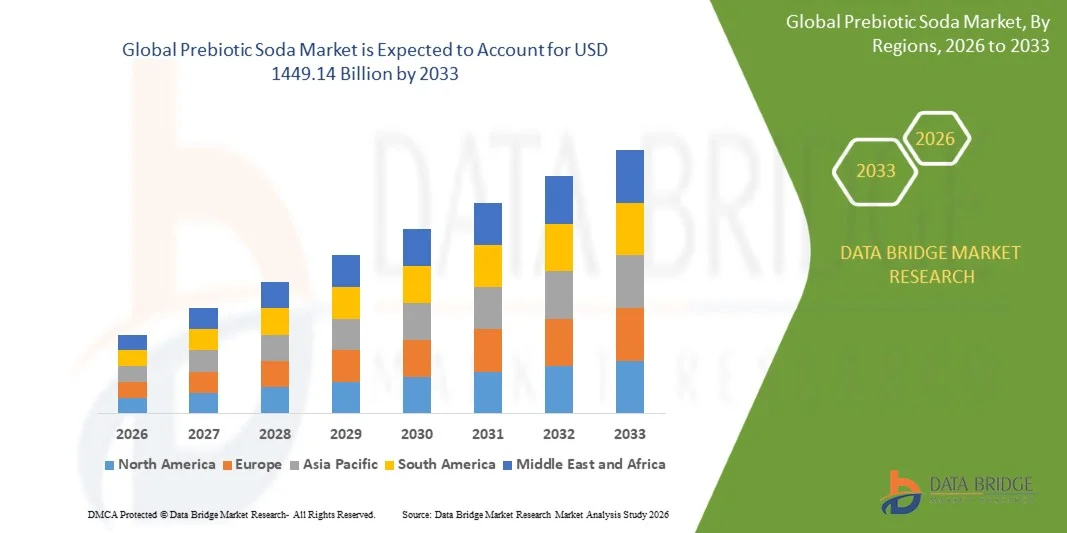
The Prebiotic Soda Market was valued at USD 380.34 Million in 2025 and is projected to reach USD 1449.14 Million by 2033, growing at a CAGR of 18.20% from 2026 to 2033. The market is experiencing consistent growth driven by rising consumer demand for healthier functional beverages, increasing awareness of gut health, and the growing popularity of low-sugar and clean-label drinks.
The shift toward preventive healthcare, coupled with changing lifestyle preferences and rising consumption of functional ingredients such as prebiotics, dietary fibers, and plant-based sweeteners, is encouraging beverage manufacturers to develop innovative soda alternatives. Prebiotic soda products are increasingly positioned as a healthier substitute to traditional carbonated soft drinks, offering digestive health benefits, reduced sugar content, and natural ingredient formulations, thereby gaining strong traction across health-conscious consumers, especially in urban markets.
Key Market Trends & Insights
- North America dominated the Prebiotic Soda Market with the largest revenue share of 35.12% in 2025, driven by high consumer awareness of gut health, strong functional beverage penetration, and rapid product launches by leading brands.
- The Flavored Prebiotic Soda segment dominated the market with a share of 62.48% in 2025, driven by strong consumer preference for taste-enhanced functional beverages that combine digestive health benefits with soda-like sensory appeal.
- Asia-Pacific is expected to be the fastest-growing region at a CAGR of 8.3% from 2026 to 2033, fueled by rising health consciousness, urbanization, and increasing adoption of functional beverages in China, India, and Japan.
- The online retail segment is the fastest-growing distribution channel, projected to register a CAGR of 9.1%, driven by rising e-commerce penetration, D2C brand expansion, and subscription-based beverage delivery models.
- The supermarkets & hypermarkets segment dominates the distribution channel category with a 46.28% revenue share in 2025, supported by strong retail shelf visibility and high impulse purchase behavior among consumers.
Market Size & Forecast
- Global Market Value (2025): USD 380.34 Million
- Expected Market Value (2033): USD 1449.14 Million
- Forecast CAGR (2026–2033): 18.20%
- Leading Region in 2025: North America
- Fastest Growing Region: Asia-Pacific
Report Scope and Prebiotic Soda Market Segmentation
|
Attributes |
Prebiotic Soda Key Market Insights |
|
Segments Covered |
|
|
Countries Covered |
North America · U.S. · Canada · Mexico Europe · Germany · France · U.K. · Netherlands · Switzerland · Belgium · Russia · Italy · Spain · Turkey · Rest of Europe Asia-Pacific · China · Japan · India · South Korea · Singapore · Malaysia · Australia · Thailand · Indonesia · Philippines · Rest of Asia-Pacific Middle East and Africa · Saudi Arabia · U.A.E. · South Africa · Egypt · Israel · Rest of Middle East and Africa South America · Brazil · Argentina · Rest of South America |
|
Key Market Players |
· Olipop Inc. (U.S.) · Poppi LLC (U.S.) · Culture Pop Soda (U.S.) · Recess Inc. (U.S.) · Bubly (PepsiCo) (U.S.) · Zevia PBC (U.S.) · Spindrift Beverage Co. (U.S.) · KeVita (PepsiCo) (U.S.) · Wildwonder Inc. (U.S.) · Humm Kombucha LLC (U.S.) · Health-Ade LLC (U.S.) · Kosmic Soda (U.S.) · Ghia Inc. (U.S.) · Hoplark LLC (U.S.) · All G Foods (Australia) · Fever-Tree PLC (U.K.) · Coca-Cola Company (U.S.) · PepsiCo Inc. (U.S.) · Keurig Dr Pepper Inc. (U.S.) · Live Soda LLC (U.S.) · SodaStream International Ltd. (Israel) · BelliWelli (U.S.) · SunSip (U.S.) · Vive Organic (U.S.) · Health-Ade Kombucha (U.S.) · Good Culture Soda (U.S.) · Better Booch (U.S.) · Wonder Juice Co. (U.S.) · Minna (U.S.) · Mighty Pop (U.S.) · Sap Sucker (Canada) · Mamma Chia (U.S.) · GT’s Living Foods (U.S.) · OLIPOP (expanded listing) (U.S.) · Poppi (expanded listing) (U.S.) · Juneshine (U.S.) |
|
Market Opportunities |
· Rising demand for functional and gut-health beverages · Shift toward low-sugar, clean-label, and healthier carbonated drinks · Expansion through modern retail and online distribution channels |
|
Value Added Data Infosets |
In addition to the insights on market scenarios such as market value, growth rate, segmentation, geographical coverage, and major players, the market reports curated by the Data Bridge Market Research also include in-depth expert analysis, geographically represented company-wise production and capacity, network layouts of distributors and partners, detailed and updated price trend analysis and deficit analysis of supply chain and demand. |
Prebiotic Soda Market Trends
Trend: Growth in Functional Beverage Adoption and Wellness Consumption
Consumers are increasingly shifting toward gut-health-focused beverages, leading to rapid adoption of prebiotic soda as an alternative to traditional carbonated drinks. Brands such as Poppi and Olipop have expanded retail penetration across North America, supported by rising awareness of digestive health and low-sugar diets. The integration of natural fiber ingredients such as inulin and agave has strengthened product positioning in the functional beverage segment. Social media-driven wellness trends and influencer marketing have significantly boosted product visibility among Gen Z and millennial consumers. Continuous flavor innovation and clean-label formulations are improving repeat purchase rates. Expansion into supermarkets and e-commerce platforms has widened accessibility. Beverage companies are investing in R&D to improve taste profiles while maintaining prebiotic benefits. This trend is accelerating growth in the Prebiotic Soda Market.
Prebiotic Soda Market Dynamics
Key Market Driver: Rising Demand for Gut Health and Low-Sugar Beverages
The growing prevalence of digestive health concerns and obesity has increased demand for functional beverages with health benefits beyond hydration. Consumers are actively reducing sugar intake, driving substitution away from traditional carbonated soft drinks. Clinical studies linking gut microbiome health to overall wellness have strengthened market credibility. Major beverage manufacturers are launching prebiotic-infused soda variants to capture health-conscious consumers. Regulatory support for clean-label and natural ingredients is further supporting product adoption. Increasing disposable income in emerging economies is expanding premium beverage consumption. Product differentiation through fiber content, natural sweeteners, and probiotic blends is enhancing competitiveness. Strong retail expansion strategies are improving product visibility. This driver is significantly accelerating the Prebiotic Soda Market growth.
Key Restraint/Challenge: High Product Cost and Limited Consumer Awareness in Emerging Markets
Despite strong growth in developed regions, prebiotic soda remains relatively expensive compared to conventional soft drinks, limiting mass adoption. Limited awareness of prebiotic benefits in developing economies restricts penetration. Supply chain costs associated with natural functional ingredients increase retail pricing. Small and regional brands face challenges in scaling production efficiently. Taste acceptance remains a barrier for certain consumer groups accustomed to traditional sodas. Regulatory differences in labeling functional beverages also create compliance challenges across countries. Limited cold-chain and retail infrastructure in rural areas further restricts distribution. These factors collectively slow down adoption in price-sensitive markets, restraining global expansion.
Key Market Opportunity: Expansion through E-commerce and Functional Beverage Innovation
The rapid growth of online grocery platforms and direct-to-consumer beverage brands is creating new sales channels for prebiotic soda. Subscription-based beverage delivery models are increasing customer retention and brand loyalty. Companies are investing in AI-driven consumer analytics to personalize flavor offerings and marketing strategies. Expansion into hybrid functional beverages combining prebiotics with probiotics, vitamins, and adaptogens is creating new product categories. Partnerships with fitness centers, wellness brands, and health retailers are expanding visibility. Emerging markets in Asia-Pacific and Latin America present untapped growth potential due to rising urbanization and dietary shifts. Innovation in low-calorie and plant-based formulations is further enhancing market appeal. These developments are opening strong long-term opportunities in the Prebiotic Soda Market.
Prebiotic Soda Market Scope
The Prebiotic Soda Market is segmented on the basis of product type, distribution channel, packaging type, flavor profile, end user, and sales channel.
By Product Type
On the basis of product type, the Prebiotic Soda Market is segmented into flavored prebiotic soda and unflavored/original prebiotic soda. The Flavored Prebiotic Soda segment dominated the market with a share of 62.48% in 2025, driven by strong consumer preference for taste-enhanced functional beverages that combine digestive health benefits with soda-like sensory appeal. Increasing demand for low-sugar, gut-friendly carbonated drinks is further supporting category expansion. Rising innovation in fruit-based, citrus, herbal, and botanical flavor combinations is strengthening consumer adoption across global markets. Growing availability in supermarkets, convenience stores, and online channels is boosting visibility. Leading brands are heavily investing in flavor innovation to attract younger consumers. Product positioning as a healthier alternative to traditional carbonated soft drinks is enhancing demand. Expansion of clean-label and plant-based ingredient formulations is further strengthening market penetration. Marketing campaigns emphasizing gut health benefits are improving awareness. Premiumization of functional beverages is also driving higher per-unit value. The segment continues to benefit from rising health-conscious consumption trends. Overall, flavored variants remain the dominant revenue-generating category.
The Unflavored/Original Prebiotic Soda segment is expected to witness the fastest growth at a CAGR of 8.1% from 2026 to 2033, driven by increasing demand from consumers seeking minimal-ingredient, clean-label functional beverages. Rising awareness of gut microbiome health and digestive wellness is supporting adoption of simplified formulations. Health-focused consumers are shifting toward low-additive beverages with transparent ingredient profiles. Growth in fitness and wellness communities is further supporting demand. Medical nutrition and dietary recommendation trends are indirectly boosting acceptance. Manufacturers are introducing naturally fermented and zero-sugar variants to expand appeal. Expanding availability in online retail channels is improving accessibility. Premium positioning of original formulations is attracting niche health-conscious buyers. Rising intolerance toward artificial sweeteners is also contributing to growth. Increasing R&D in natural fermentation processes is enhancing product innovation. Overall, the segment is expanding rapidly from a smaller base due to strong wellness-driven demand.
By Distribution Channel
On the basis of distribution channel, the Prebiotic Soda Market is segmented into supermarkets & hypermarkets, convenience stores, online retail, and specialty stores. The Supermarkets & Hypermarkets segment dominated the market with a share of 38.92% in 2025, driven by high consumer footfall and strong product visibility across organized retail environments. Wide shelf space allocation for functional beverages supports strong sales conversion. Retailers are increasingly promoting healthier beverage alternatives in premium beverage aisles. Bulk purchasing behavior in supermarkets supports higher volume sales. Strong distribution partnerships between beverage manufacturers and retail chains are reinforcing dominance. In-store promotions and discounts further stimulate impulse buying. Availability of multiple brands under one roof increases consumer choice. Rising urban retail expansion in emerging economies is strengthening penetration. Established cold-chain infrastructure supports beverage storage and display. Consumer trust in physical retail channels continues to remain strong. Overall, supermarkets remain the primary distribution backbone of the market.
The Online Retail segment is projected to register the fastest growth at a CAGR of 9.4% from 2026 to 2033, driven by rapid e-commerce expansion and increasing consumer preference for home delivery of functional beverages. Subscription-based beverage delivery models are gaining traction among urban consumers. Direct-to-consumer (D2C) brands are leveraging digital platforms for faster market entry. Social media marketing and influencer campaigns are significantly boosting product visibility. Digital payment penetration is improving purchasing convenience. Availability of niche and premium functional beverages is higher online compared to offline retail. Personalized recommendations and algorithm-driven product discovery are increasing conversions. Rising adoption of health-focused e-grocery platforms is supporting category expansion. Lower distribution barriers are enabling new brand entry. Discounts and bundled offers are attracting price-sensitive consumers. Overall, online retail is becoming the fastest-growing and most scalable channel globally.
Prebiotic Soda Market Regional Analysis
North America dominated the Prebiotic Soda Market and accounted for the largest revenue share of 35.12% in 2025, driven by high consumer awareness of gut health, strong functional beverage penetration, and rapid product launches by leading brands. The region also benefits from a well-established health-conscious consumer base, increasing demand for low-sugar carbonated alternatives, and strong retail and e-commerce distribution networks. Continuous innovation in functional beverages is further strengthening North America’s leadership in the Prebiotic Soda Market.
U.S. Prebiotic Soda Market Insight
The U.S. prebiotic soda market is witnessing strong growth due to rising demand for gut-health-focused beverages, increasing preference for low-calorie and clean-label drinks, and expanding product availability across supermarkets, specialty stores, and online platforms. Beverage manufacturers are introducing innovative prebiotic formulations with improved taste profiles and functional ingredients, supported by growing consumer awareness of digestive wellness and preventive health trends.
Europe Prebiotic Soda Market Insight
The Europe prebiotic soda market remains a major contributor to global revenue, supported by strong demand for functional beverages, increasing health-conscious consumer behavior, and rising adoption of low-sugar soft drink alternatives. The region’s well-developed retail infrastructure and growing focus on clean-label and natural ingredients are further driving market expansion across major economies.
U.K. Prebiotic Soda Market Insight
The U.K. prebiotic soda market is experiencing steady growth, supported by increasing consumer shift toward healthier beverage alternatives and rising awareness of gut health benefits. Growing availability of premium functional drinks in retail and online channels, along with continuous product innovation by beverage brands, is contributing to market expansion.
Germany Prebiotic Soda Market Insight
The Germany prebiotic soda market is expanding steadily due to rising demand for natural and functional beverages, strong consumer preference for low-sugar drinks, and increasing adoption of gut-health-focused products. Growing health awareness and expanding distribution of specialty beverages are further supporting market growth in the country.
Asia-Pacific Prebiotic Soda Market Insight
The Asia-Pacific prebiotic soda market is expected to witness the fastest growth, registering a CAGR of 8.3% from 2026 to 2033, driven by rising health consciousness, urbanization, and increasing adoption of functional beverages in China, India, and Japan. Expanding middle-class populations, growing disposable incomes, and rapid expansion of modern retail channels are further accelerating market growth in the region
Japan Prebiotic Soda Market Insight
The Japan prebiotic soda market is witnessing consistent growth due to increasing consumer focus on digestive health, rising demand for functional beverages, and strong preference for innovative, low-sugar drink options. Continuous product development in flavored functional beverages and growing availability across retail channels are supporting market expansion.
China Prebiotic Soda Market Insight
The China prebiotic soda market is growing rapidly, driven by increasing urbanization, rising health awareness, and expanding demand for functional and low-sugar beverages. Growing penetration of modern retail formats, strong e-commerce expansion, and increasing interest in gut-health products are significantly boosting market demand, positioning China as one of the fastest-growing markets globally.
Prebiotic Soda Market Share
The Prebiotic Soda industry is primarily led by well-established companies, including:
- Moog Inc. (U.S.)
- Dallara (Italy)
- Exail (France)
- IPG Automotive GmbH (Germany)
- aiMotive (Hungary)
- VI‑grade GmbH (Germany)
- Cruden B.V. (Netherlands)
- Dynisma Ltd. (UK)
- Applied Intuition Inc. (U.S.)
- rFpro (rFpro Limited) (England)
- Siemens AG (Germany)
- Dassault Systèmes SE (France)
- MTS Systems Corporation (U.S.)
- CAE Inc. (Canada)
- NVIDIA Corporation (U.S.)
- AB Dynamics PLC (U.K.)
- Forum8 (Japan)
- Mitsubishi Precision Co., Ltd. (Japan)
- FAAC Incorporated (U.S.)
- DriveSafety (U.S.)
- Simtec Simulation Technology GmbH (Germany)
- MB Dynamics Inc. (U.S.)
- Sanlab Simulation (India)
- SimCraft (U.S.)
- CXC Simulations (U.S.)
- XPI Simulation (United Kingdom)
- Tecknotrove Simulator Systems Pvt. Ltd. (India)
- Zhejiang Kechi Intelligent Technology Co., Ltd. (China)
- Shenzhen Zhongzhi Simulation (China)
- Hindustan Simulators (India)
- DriveSimSolutions (U.S.)
- Teksim Technologies (India)
- iMVR Inc. (U.S.)
- SimXperience (U.S.)
Latest Developments in Prebiotic Soda Market
- In March 2021, OLIPOP, a leading functional beverage company, expanded its nationwide distribution in the United States by significantly increasing its retail footprint across major grocery chains such as Whole Foods and Target. The expansion marked one of the earliest large-scale retail penetrations of prebiotic soda, helping establish the category within mainstream functional beverages. The company’s rapid growth was driven by rising consumer interest in gut-health-focused drinks and low-sugar soda alternatives
- In July 2022, Poppi, a fast-growing prebiotic soda brand, strengthened its U.S. market presence by expanding into thousands of retail locations and enhancing its direct-to-consumer digital sales strategy. The brand’s formulation, combining prebiotics with fruit juice and apple cider vinegar, gained strong traction among Gen Z consumers seeking healthier carbonated beverages. This expansion supported the accelerating shift toward functional sodas in the mainstream beverage industry
- In October 2023, OLIPOP surpassed major retail distribution milestones by reaching availability in more than 30,000 retail outlets across North America, including Walmart and Kroger chains. The company also expanded its product portfolio with new flavor launches targeting mainstream soda consumers transitioning to healthier alternatives. This development highlighted the rapid commercialization and scaling of the prebiotic soda category
- In February 2025, The Coca-Cola Company announced its entry into the prebiotic soda market with the launch of “Simply Pop,” a new functional beverage line under its Simply brand. The product contains prebiotic fiber and no added sugar, and was designed to compete directly with OLIPOP and Poppi in the rapidly growing gut-health beverage segment. This marked a major validation of the category by a global beverage leader and significantly intensified competition
- In March 2025, PepsiCo announced the acquisition of Poppi for approximately USD 1.95 billion, marking one of the largest deals in the functional beverage space. The acquisition strengthened PepsiCo’s position in the prebiotic soda category and provided access to Poppi’s strong Gen Z consumer base and rapidly growing retail distribution network

- Interactive Data Analysis Dashboard
- Company Analysis Dashboard for high growth potential opportunities
- Research Analyst Access for customization & queries
- Competitor Analysis with Interactive dashboard
- Latest News, Updates & Trend analysis
- Harness the Power of Benchmark Analysis for Comprehensive Competitor Tracking
Global Prebiotic Soda Market, Supply Chain Analysis and Ecosystem Framework
To support market growth and help clients navigate the impact of geopolitical shifts, DBMR has integrated in-depth supply chain analysis into its Global Prebiotic Soda Market research reports. This addition empowers clients to respond effectively to global changes affecting their industries. The supply chain analysis section includes detailed insights such as Global Prebiotic Soda Market consumption and production by country, price trend analysis, the impact of tariffs and geopolitical developments, and import and export trends by country and HSN code. It also highlights major suppliers with data on production capacity and company profiles, as well as key importers and exporters. In addition to research, DBMR offers specialized supply chain consulting services backed by over a decade of experience, providing solutions like supplier discovery, supplier risk assessment, price trend analysis, impact evaluation of inflation and trade route changes, and comprehensive market trend analysis.
Data collection and base year analysis are done using data collection modules with large sample sizes. The stage includes obtaining market information or related data through various sources and strategies. It includes examining and planning all the data acquired from the past in advance. It likewise envelops the examination of information inconsistencies seen across different information sources. The market data is analysed and estimated using market statistical and coherent models. Also, market share analysis and key trend analysis are the major success factors in the market report. To know more, please request an analyst call or drop down your inquiry.
The key research methodology used by DBMR research team is data triangulation which involves data mining, analysis of the impact of data variables on the market and primary (industry expert) validation. Data models include Vendor Positioning Grid, Market Time Line Analysis, Market Overview and Guide, Company Positioning Grid, Patent Analysis, Pricing Analysis, Company Market Share Analysis, Standards of Measurement, Global versus Regional and Vendor Share Analysis. To know more about the research methodology, drop in an inquiry to speak to our industry experts.
Data Bridge Market Research is a leader in advanced formative research. We take pride in servicing our existing and new customers with data and analysis that match and suits their goal. The report can be customized to include price trend analysis of target brands understanding the market for additional countries (ask for the list of countries), clinical trial results data, literature review, refurbished market and product base analysis. Market analysis of target competitors can be analyzed from technology-based analysis to market portfolio strategies. We can add as many competitors that you require data about in the format and data style you are looking for. Our team of analysts can also provide you data in crude raw excel files pivot tables (Fact book) or can assist you in creating presentations from the data sets available in the report.