


What is the Precision Engineering Machines Market Size and Growth Rate?
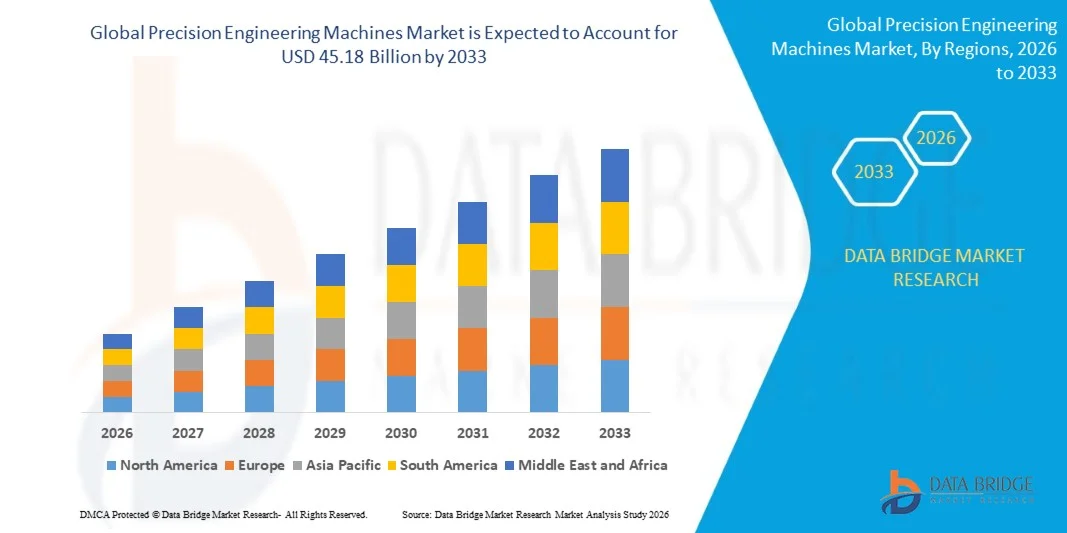
- As per Data Bridge Market Research analysis, the precision engineering machines market was valued at USD 27.30 billion in 2025 and is projected to reach USD 45.18 billion by 2033, growing at a CAGR of 6.50% from 2026 to 2033.
- The market is experiencing consistent growth driven by rising demand for high-accuracy machining solutions, rapid advancements in computer numerical control (CNC) technologies, and expanding applications across automotive, aerospace, electronics, medical devices, and industrial manufacturing.
- The increasing adoption of automated and digitally controlled manufacturing processes, combined with growing requirements for tight tolerances and complex component production, is compelling manufacturers to invest in advanced precision engineering machines. CNC machining, electrical discharge machining, and other high-precision technologies are increasingly replacing conventional machining processes, offering improved accuracy, repeatability, productivity, and reduced material waste.
Market Size & Forecast
- Global Market Value (2025): USD 27.30 Billion
- Expected Market Value (2033): USD 45.18 Billion
- Forecast CAGR (2026–2033): 6.50%
- Leading Region in 2025: Asia Pacific
- Fastest Growing Region: North America
What are the Major Takeaways of the Precision Engineering Machines Market?
- Asia-Pacific dominated the precision engineering machines market with the largest revenue share of 41.0% in 2025, supported by rapid industrialization, expanding manufacturing capabilities, and strong demand for advanced machining technologies across China, Japan, South Korea, and India.
- North America is expected to be the fastest-growing region at a CAGR of 5.9% from 2026 to 2033, fueled by increasing automation, reshoring of manufacturing activities, and growing investments in aerospace, defense, automotive, and precision component production.
- The CNC machine tools segment led the market with a 42.3% share in 2025, driven by their extensive use in high-precision manufacturing across automotive, aerospace, electronics, medical devices, and general engineering industries.
- EDM machine tools are the fastest-growing type, projected to register a CAGR of 5.8%, reflecting the surge in demand for machining complex components made from hard and difficult-to-machine materials
- The steel segment dominated the material category with a 38% revenue share in 2025, led by the extensive use of steel in automotive, aerospace, industrial machinery, construction equipment, and defense components
- Automotive mold tools accounted for 39.6% of the market share in 2025, preferred by high-volume vehicle manufacturing and continuous demand for precision molds, dies, tooling, and production components.
- The electronics segment is the fastest-growing application category, with a CAGR of 8.0%, driven by increasing production of semiconductors, electronic devices, connectors, sensors, and miniaturized components.
Report Scope and Precision Engineering Machines Market Segmentation
|
Attributes |
Precision Engineering Machines Key Market Insights |
|
Segments Covered |
|
|
Countries Covered |
North America
Europe
Asia-Pacific
Middle East and Africa
South America
|
|
Key Market Players |
|
|
Market Opportunities |
|
|
Value Added Data Infosets |
|
What is the Key Trend in the Precision Engineering Machines Market?
- Manufacturers are increasingly adopting smart and connected precision engineering machines that integrate CNC controls, industrial Internet of Things (IIoT), digital twins, artificial intelligence, and real-time monitoring to improve machining accuracy and production efficiency.
- For instance, in January 2025, Siemens launched MACHINUM at IMTEX 2025, a CNC digitalization portfolio integrating machine-tool analysis, optimization, IoT-enabled hardware, and digital-twin capabilities. Siemens stated that its solutions can reduce machine setup time by up to 20% and cycle times and energy consumption by up to 18%, demonstrating the growing shift toward digitally connected and optimized precision machining.
- The integration of digital technologies is enabling manufacturers to simulate machining operations, optimize toolpaths, monitor machine performance, and identify potential production issues before they affect physical operations.
- Multi-axis machining and automated production systems are gaining traction as manufacturers seek to produce increasingly complex geometries with fewer setups, shorter production cycles, and tighter dimensional tolerances.
- Precision machine manufacturers are also emphasizing energy efficiency and sustainable production through optimized machining processes, reduced setup times, lower energy consumption, and improved resource utilization.
- For instance, in March 2025, DMG MORI highlighted the integration of digital twins with connected CNC manufacturing, explaining how digital representations of machines, tools, and manufacturing processes can use sensor, maintenance, and production data to optimize complex machining operations before production.
- As manufacturers increasingly transition toward connected and automated production environments, the adoption of digitally integrated precision engineering machines is expected to accelerate, making digital twins, intelligent CNC controls, automation, and real-time optimization increasingly central to high-precision manufacturing.
What are the Key Drivers of the Precision Engineering Machines Market?
- The rapid expansion of automotive, aerospace, electronics, semiconductor, and medical-device manufacturing is significantly increasing demand for precision machines capable of producing complex components with tight dimensional tolerances and consistent repeatability.
- For instance, in July 2025, Doncasters completed a USD 13 million upgrade of its Groton, Connecticut precision-casting facility, adding automation, three six-axis industrial robots, and real-time process-monitoring technology
- The increasing complexity and miniaturization of manufactured components are encouraging manufacturers to replace conventional machining processes with advanced CNC, multi-axis, grinding, laser, and electrical discharge machining technologies.
- Growing adoption of electric vehicles, advanced electronics, aerospace systems, and lightweight components is further increasing the requirement for precision machining of difficult-to-process materials and intricate geometries.
- Manufacturers are also investing in automated machining and digital manufacturing to improve productivity, reduce material waste, shorten production cycles, and address rising labor costs and shortages of skilled machining personnel.
- For instance, in September 2025, Siemens demonstrated its SINUMERIK Machine Tool Robot at EMO 2025, combining intelligent CNC control with industrial robotics to deliver high precision and increased productivity, including machining of hard materials such as steel.
- With manufacturers increasingly prioritizing automation, high-accuracy production, and digitally optimized machining, continued investment in advanced precision engineering machines will remain essential for meeting the increasingly demanding requirements of modern manufacturing.
Which Factors are Challenging the Growth of the Precision Engineering Machines Market?
- Advanced precision engineering machines require substantial capital investment because sophisticated CNC controls, multi-axis configurations, automation systems, digital technologies, and high-precision inspection equipment increase acquisition and implementation costs.
- For instance, in January 2025, Deloitte reported that nearly 60% of U.S. manufacturers surveyed by the National Association of Manufacturers identified the inability to attract and retain employees as their top challenge. Deloitte also noted that 1.9 million manufacturing jobs could remain unfilled over the next 10 years if talent shortages are not addressed, creating a significant constraint for precision machining operations that require skilled CNC machinists, programmers, and technicians.
- The market also faces a shortage of skilled CNC programmers, machine operators, maintenance technicians, and digitally trained manufacturing personnel capable of operating increasingly sophisticated precision machinery effectively.
- Workforce shortages can delay machine deployment, increase training expenses, and reduce equipment utilization, while manufacturers must simultaneously invest in upskilling programs to operate increasingly automated and digitally connected production systems.
- For instance, in May 2025, Deloitte India reported that manufacturing and engineering blue-collar wages were rising by approximately 6% annually, while the sector faced a persistent skills gap and rising demand for skilled workers. The report noted that hiring intent for blue-collar roles increased 10% in 2025, demonstrating how rising labor costs and shortages of skilled technicians can increase operating expenses for manufacturers using advanced precision machinery.
- The combination of high equipment costs, workforce shortages, specialized training requirements, and the complexity of integrating advanced machines into existing production environments continues to challenge smaller manufacturers and organizations in emerging markets, slowing broader adoption.
How is the Precision Engineering Machines Market Segmented?
The precision engineering machines market is segmented on the basis of type, material, application, and end user.
- By Type
On the basis of type, the precision engineering machines market is segmented into CNC machine tools, EDM machine tools, and others. The CNC machine tools segment dominated the market with 42.3% share in 2025, owing to their extensive use in high-precision manufacturing across automotive, aerospace, electronics, medical devices, and general engineering industries. CNC machines provide high dimensional accuracy, repeatability, and automated control, making them suitable for complex component manufacturing. Increasing demand for multi-axis machining is further supporting segment growth by enabling manufacturers to produce intricate geometries with fewer setups. Integration of computer-aided manufacturing, robotics, sensors, and real-time monitoring is also improving CNC machine productivity. In addition, manufacturers are increasingly replacing conventional machining equipment with automated CNC systems to improve throughput and reduce human error.
The EDM machine tools segment is projected to register the fastest growth at 5.8% CAGR from 2026 to 2033, driven by increasing demand for machining complex components made from hard and difficult-to-machine materials. EDM technology enables manufacturers to produce intricate shapes, narrow cavities, sharp corners, and fine features that are difficult to achieve using conventional cutting methods. Its increasing adoption in aerospace, automotive, medical-device, mold-and-die, and electronics manufacturing is strengthening demand. The technology is particularly valuable where high dimensional accuracy and superior surface finishes are required. Growing production of miniaturized components and complex tooling is further expanding EDM applications. Technological improvements in wire EDM, sinker EDM, and automated process controls are enhancing productivity and precision.
- By Material
On the basis of material, the precision engineering machines market is segmented into plastic, steel, bronze, glass, brass, and others. The steel segment dominated the market with 38% share in 2025, owing to the extensive use of steel in automotive, aerospace, industrial machinery, construction equipment, and defense components. Steel offers high strength, durability, and dimensional stability, making it suitable for precision-engineered components requiring mechanical reliability. Precision machining is widely used for manufacturing steel gears, shafts, molds, engine components, tooling, and structural parts. The growing production of vehicles and industrial equipment is supporting demand for accurately machined steel components. Advanced CNC and EDM technologies enable manufacturers to process hardened and specialized steel grades with increasingly tight tolerances.
The plastic segment is projected to register the fastest growth at 7.0% CAGR from 2026 to 2033, supported by increasing demand for lightweight, corrosion-resistant, and cost-effective precision components. Engineering plastics are increasingly replacing metals in selected automotive, electronics, medical, and industrial applications because of their low weight and design flexibility. Precision machining allows manufacturers to produce plastic components with complex geometries and tight dimensional specifications. The growing adoption of lightweight components in electric vehicles is creating additional opportunities for engineered plastic parts. Electronics and medical-device manufacturers are also increasingly using specialized plastics for housings, connectors, components, and laboratory equipment. Improvements in high-speed machining and specialized tooling are enhancing the quality of precision-machined plastic components.
- By Application
On the basis of application, the precision engineering machines market is segmented into aerospace parts, medical implants, automotive mold tools, electronics, and defense components. The automotive mold tools segment dominated the market with 39.6% share in 2025, supported by high-volume vehicle manufacturing and continuous demand for precision molds, dies, tooling, and production components. Automotive manufacturers require highly accurate molds and tooling to maintain dimensional consistency and surface quality across large production volumes. The increasing complexity of vehicle designs is creating demand for advanced machining technologies capable of producing intricate mold geometries. Electric vehicle production is further increasing requirements for specialized tooling used for battery, motor, power electronics, and lightweight component manufacturing. CNC and EDM technologies are extensively utilized for mold and die production because of their accuracy and ability to machine complex features.
The electronics segment is projected to register the fastest growth at 8.0% CAGR from 2026 to 2033, driven by increasing production of semiconductors, electronic devices, connectors, sensors, and miniaturized components. Electronics manufacturing requires extremely precise machining capabilities because components increasingly incorporate smaller dimensions and more complex geometries. The rapid expansion of consumer electronics, electric vehicles, telecommunications equipment, and industrial electronics is increasing demand for precision-manufactured components and tooling. Semiconductor manufacturing is also creating opportunities for high-accuracy machines capable of meeting stringent dimensional and surface-finish requirements. Growing miniaturization is encouraging manufacturers to adopt advanced CNC, EDM, grinding, and micro-machining technologies. Increasing investment in domestic semiconductor and electronics manufacturing facilities is further supporting demand.
- By End User
On the basis of end user, the precision engineering machines market is segmented into automotive and non-automotive. The automotive segment dominated the market with 38% share in 2025, owing to extensive requirements for precision-machined components, molds, dies, transmission parts, engine components, and electric vehicle systems. Automotive manufacturers and suppliers increasingly use CNC, EDM, grinding, and other precision technologies to achieve consistent quality across high-volume production. The transition toward electric and connected vehicles is creating additional demand for accurately manufactured battery, motor, power electronics, and sensor components. Increasing vehicle model diversification is also requiring flexible machining systems capable of producing complex components in shorter production cycles. Automation and digital manufacturing are further encouraging automotive manufacturers to upgrade conventional machining operations.
The non-automotive segment is projected to register the fastest growth at 6.5% CAGR from 2026 to 2033, supported by expanding applications across aerospace, defense, medical devices, electronics, semiconductor manufacturing, energy, and industrial equipment. These industries increasingly require components with extremely tight tolerances, complex geometries, and high-quality surface finishes. Aerospace and defense manufacturers are investing in advanced machining capabilities for lightweight structural components, turbine parts, and specialized equipment. Medical-device manufacturers are increasing the use of precision machining for implants, surgical instruments, and miniature components. Meanwhile, electronics and semiconductor manufacturing is generating demand for highly accurate tooling and equipment components. Growing industrial automation and expansion of advanced manufacturing facilities are further increasing precision-machine requirements outside the automotive industry.
Which Region Holds the Largest Share of the Precision Engineering Machines Market?
- Asia-Pacific dominated the precision engineering machines market with the largest revenue share of 41.0% in 2025, supported by rapid industrialization, expanding manufacturing capabilities, and strong demand for advanced machining technologies across China, Japan, South Korea, and India.
- The region also benefits from the presence of major manufacturing hubs such as China, Japan, South Korea, and India, alongside rising demand for high-precision components and smart manufacturing solutions. Increasing industrial automation, semiconductor production, and adoption of advanced CNC technologies continue to strengthen Asia-Pacific’s leadership position in the global market.
The Japan Precision Engineering Machines Market Insight
The Japan precision engineering machines market is witnessing consistent growth due to rising investments in advanced manufacturing technologies, robotics, and high-precision production systems. Automotive manufacturers, electronics companies, aerospace suppliers, and industrial machinery producers are increasingly adopting high-accuracy machines for component manufacturing, tooling, and complex machining applications. Moreover, increasing integration of automation, artificial intelligence, and digitally connected manufacturing systems, along with Japan’s strong focus on manufacturing quality and productivity, is further contributing to market growth.
China Precision Engineering Machines Market Insight
The China precision engineering machines market is growing rapidly, driven by expanding industrial production, increasing automotive and electronics manufacturing, and rising government focus on advanced manufacturing capabilities. Growing adoption of CNC, multi-axis, automated, and digitally integrated machining platforms across automotive, aerospace, electronics, and industrial sectors is significantly boosting market demand. In addition, rising investments in semiconductor manufacturing, electric vehicles, and high-end equipment production are strengthening domestic demand and positioning China as one of the largest and fastest-expanding markets for precision engineering machines globally.
North America Precision Engineering Machines Market Insight
The North America precision engineering machines market is witnessing fastest growth due to rising investments in advanced manufacturing, aerospace and defense production, and industrial automation technologies. The region’s strong automotive, aerospace, medical-device, electronics, and semiconductor manufacturing ecosystem, along with increasing adoption of CNC, multi-axis, and digitally connected machining systems, is driving demand across industrial applications. In addition, growing reshoring initiatives, increasing demand for high-precision components, and efforts to improve manufacturing productivity are accelerating the adoption of advanced precision engineering machines across the region.
U.S. Precision Engineering Machines Market Insight
The U.S. precision engineering machines market is witnessing strong growth due to rising investments in advanced manufacturing, aerospace and defense production, and industrial automation technologies. The country’s mature automotive, aerospace, medical-device, and electronics manufacturing ecosystem, along with increasing adoption of CNC, multi-axis, and digitally connected machining systems, is driving demand across industrial applications. In addition, growing emphasis on reshoring manufacturing activities, improving production efficiency, and addressing skilled-labor shortages is accelerating investment in precision engineering machinery across manufacturers and component suppliers.
U.K. Precision Engineering Machines Market Insight
The U.K. precision engineering machines market is experiencing steady growth, supported by rising adoption of advanced machining technologies in aerospace, defense, automotive, medical devices, and industrial manufacturing applications. Increasing investments in automation, high-precision production equipment, and digitally connected manufacturing solutions are contributing to market growth. Furthermore, integration of CNC automation, robotics, digital monitoring, and advanced manufacturing technologies is improving production efficiency and machining accuracy, positioning the U.K. as an important market for precision engineering technologies.
Germany Precision Engineering Machines Market Insight
The Germany precision engineering machines market is expanding steadily due to the country’s strong automotive manufacturing base, advanced industrial capabilities, and increasing adoption of Industry 4.0 technologies. Automotive companies, aerospace manufacturers, machinery producers, and industrial suppliers are increasingly utilizing precision machines for complex component production, tooling, and high-volume manufacturing. Continuous advancements in CNC automation, robotics, digital twins, and intelligent machining, along with Germany’s strong focus on engineering quality and manufacturing efficiency, are further driving market growth.
Which are the Top Companies in Precision Engineering Machines Market?
The precision engineering machines industry is primarily led by well-established companies, including:
- Yamazaki Mazak Corporation (Japan)
- DMG MORI (Japan)
- Okuma Corporation (U.S.)
- Haas Automation, Inc. (U.S.)
- FANUC CORPORATION (U.S.)
- Makino J (Japan)
- Hurco Companies, Inc. (U.S.)
- INDEX-Werke GmbH & Co. KG Hahn & Tessky (Germany)
- Okamoto Machine Tool Works, Ltd. (Japan)
- CHIRON Group SE (Germany)
- Maschinenfabrik Berthold HERMLE AG (Germany)
- DN Solutions Co., Ltd. (South Korea)
- TRUMPF SE + Co. KG (Germany)
- Sodick Co., Ltd. (Japan)
- Kitamura Machinery Co., Ltd. (Japan)
- Gleason Corporation (U.S.)
- Brother Industries, Ltd. (Japan)
- Mitsubishi Electric Corporation (Japan)
- Nidec Machine Tool Corporation (Japan)
- Citizen Machinery Co., Ltd. (Japan)
What are Latest Developments in Precision Engineering Machines Market?
- In March 2025, Siemens introduced the SINUMERIK Machine Tool Robot (MTR), a new machining-robot technology designed to combine industrial robotics with advanced CNC motion control for high-precision manufacturing. Siemens stated that the solution can improve path accuracy by up to 300% and productivity by up to 40%, while enabling demanding applications such as machining steel. The technology was developed with partners Danobat and autonox, expanding the use of robotic systems into precision machining applications
- In September 2023, Siemens and DMG MORI introduced an end-to-end digital twin for machine-tool machining on the Siemens Xcelerator Marketplace, combining digital twins of the CNC controller, machine tool, and workpiece. The solution enables manufacturers to simulate and validate machining processes virtually before running them on physical equipment, helping reduce programming errors, scrap, and machine damage. Siemens reported that the technology can enable production ramp-up up to 40% faster and reduce unproductive machine time by up to 75%
- In August 2023, Okuma America announced the launch of its OSP-P500 next-generation CNC machine control, designed to provide enhanced CNC control capabilities for machine-tool applications. The new control was scheduled to become available in the Americas in September 2023, representing an advancement in CNC technology for precision machining.
- In September 2022, Siemens introduced new technology functions for SINUMERIK ONE to simplify machine-tool operation and increase productivity, further strengthening the role of digital-native CNC technology in precision manufacturing. The new functions support the creation and use of digital twins for machine tools and provide an integrated user interface for efficient operation across different machining technologies. The development reflects the industry's shift toward digitally simulated and optimized machining processes.
- In July 2021, Siemens expanded its machine-tool portfolio with Industrial Edge extensions and new SINUMERIK ONE capabilities, enabling machine builders and manufacturers to use edge and cloud computing for real-time production-data analysis. Siemens highlighted the use of Industrial Edge for processing machine-tool data directly within production environments and its intelligent use for improving manufacturing operations. The company also positioned SINUMERIK ONE as a key technology for the digital transformation of the machine-tool industry.

- Interactive Data Analysis Dashboard
- Company Analysis Dashboard for high growth potential opportunities
- Research Analyst Access for customization & queries
- Competitor Analysis with Interactive dashboard
- Latest News, Updates & Trend analysis
- Harness the Power of Benchmark Analysis for Comprehensive Competitor Tracking
Global Precision Engineering Machines Market, Supply Chain Analysis and Ecosystem Framework
To support market growth and help clients navigate the impact of geopolitical shifts, DBMR has integrated in-depth supply chain analysis into its Global Precision Engineering Machines Market research reports. This addition empowers clients to respond effectively to global changes affecting their industries. The supply chain analysis section includes detailed insights such as Global Precision Engineering Machines Market consumption and production by country, price trend analysis, the impact of tariffs and geopolitical developments, and import and export trends by country and HSN code. It also highlights major suppliers with data on production capacity and company profiles, as well as key importers and exporters. In addition to research, DBMR offers specialized supply chain consulting services backed by over a decade of experience, providing solutions like supplier discovery, supplier risk assessment, price trend analysis, impact evaluation of inflation and trade route changes, and comprehensive market trend analysis.
Data collection and base year analysis are done using data collection modules with large sample sizes. The stage includes obtaining market information or related data through various sources and strategies. It includes examining and planning all the data acquired from the past in advance. It likewise envelops the examination of information inconsistencies seen across different information sources. The market data is analysed and estimated using market statistical and coherent models. Also, market share analysis and key trend analysis are the major success factors in the market report. To know more, please request an analyst call or drop down your inquiry.
The key research methodology used by DBMR research team is data triangulation which involves data mining, analysis of the impact of data variables on the market and primary (industry expert) validation. Data models include Vendor Positioning Grid, Market Time Line Analysis, Market Overview and Guide, Company Positioning Grid, Patent Analysis, Pricing Analysis, Company Market Share Analysis, Standards of Measurement, Global versus Regional and Vendor Share Analysis. To know more about the research methodology, drop in an inquiry to speak to our industry experts.
Data Bridge Market Research is a leader in advanced formative research. We take pride in servicing our existing and new customers with data and analysis that match and suits their goal. The report can be customized to include price trend analysis of target brands understanding the market for additional countries (ask for the list of countries), clinical trial results data, literature review, refurbished market and product base analysis. Market analysis of target competitors can be analyzed from technology-based analysis to market portfolio strategies. We can add as many competitors that you require data about in the format and data style you are looking for. Our team of analysts can also provide you data in crude raw excel files pivot tables (Fact book) or can assist you in creating presentations from the data sets available in the report.













