


Precision Viticulture Market Overview
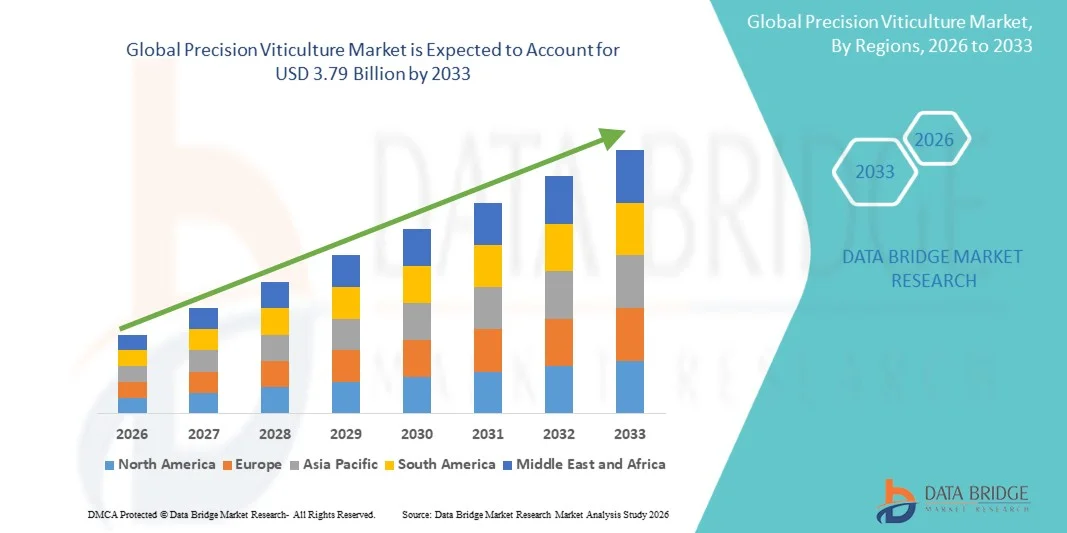
The Precision Viticulture Market was valued at USD 1.96 billion in 2025 and is projected to reach USD 3.79 billion by 2033, growing at a CAGR of 8.60% from 2026 to 2033. The market is witnessing steady expansion driven by the growing adoption of smart farming practices, increasing demand for high-quality wine grapes, and rising integration of advanced digital agriculture technologies such as IoT sensors, remote sensing, and AI-based vineyard monitoring systems.
The increasing pressure on vineyard owners to optimize yield, improve grape quality, and reduce resource consumption is significantly accelerating the adoption of precision viticulture solutions. Climate variability, water scarcity, and soil health management challenges are further encouraging growers to implement data-driven vineyard management systems. Technologies such as GPS-guided machinery, drone-based crop monitoring, and variable rate application systems are enhancing operational efficiency while supporting sustainable wine production practices across major viticulture regions.
Key Market Trends & Insights
- North America dominated the Precision Viticulture Market with the largest revenue share of 36.48% in 2025, supported by advanced agricultural infrastructure, high adoption of smart farming technologies, and strong presence of commercial vineyards in the U.S. and Canada.
- The Hardware segment led the market with a 42.08% share in 2025, driven by the extensive deployment of IoT sensors, weather monitoring stations, soil moisture probes, and drone-based imaging systems across commercial vineyards.
- Asia-Pacific is expected to be the fastest-growing region at a CAGR of 8.1% from 2026 to 2033, fueled by rapid expansion of vineyard cultivation, increasing agritech investments, and growing adoption of precision farming practices in countries such as China, India, and Australia.
- Software is the fastest-growing product type, projected to register a CAGR of 8.2%, reflecting the surge in adoption of AI-based analytics, predictive modeling, and vineyard management platforms.
- The Yield Monitoring segment dominated the application with a 31.45% revenue share in 2025, led by strong demand for accurate production forecasting and quality control in high-value wine grape cultivation.
- Remote Sensing accounted for 38.76% of the market, preferred by widespread use of satellite imagery, drones, and aerial sensors for vineyard monitoring.
- The Variable-Rate Technology segment is the fastest-growing technology category, with a CAGR of 8.3%, driven by the rising demand for precision application of water, fertilizers, and pesticides in vineyards.
Market Size & Forecast
- Global Market Value (2025): USD 1.96 Billion
- Expected Market Value (2033): USD 3.79 Billion
- Forecast CAGR (2026–2033): 8.60%
- Leading Region in 2025: North America
- Fastest Growing Region: Asia Pacific
Report Scope and Precision Viticulture Market Segmentation
|
Attributes |
Precision Viticulture Key Market Insights |
|
Segments Covered |
|
|
Countries Covered |
North America · U.S. · Canada · Mexico Europe · Germany · France · U.K. · Netherlands · Switzerland · Belgium · Russia · Italy · Spain · Turkey · Rest of Europe Asia-Pacific · China · Japan · India · South Korea · Singapore · Malaysia · Australia · Thailand · Indonesia · Philippines · Rest of Asia-Pacific Middle East and Africa · Saudi Arabia · U.A.E. · South Africa · Egypt · Israel · Rest of Middle East and Africa South America · Brazil · Argentina · Rest of South America |
|
Key Market Players |
· John Deere (U.S.) · Trimble Inc. (U.S.) · Ag Leader Technology (U.S.) · Topcon Positioning Systems (Japan) · Raven Industries (U.S.) · AgJunction Inc. (Canada) · XAG Co., Ltd. (China) · DJI (China) · AGCO Corporation (U.S.) · Hexagon AB (Sweden) · Boumatic (U.S.) · Climate LLC (U.S.) · BASF Digital Farming GmbH (Germany) · Yara International ASA (Norway) · Taranis (Israel) · Prospera Technologies (Israel) · Gamaya (Switzerland) · Ceres Imaging (U.S.) · Sentera Inc. (U.S.) |
|
Market Opportunities |
· Expansion of AI-driven disease and pest prediction platforms integrated with vineyard IoT data · Growing opportunity for precision irrigation systems using real-time soil moisture analytics · Increasing adoption of satellite and drone-based hyperspectral imaging solutions |
|
Value Added Data Infosets |
In addition to the insights on market scenarios such as market value, growth rate, segmentation, geographical coverage, and major players, the market reports curated by the Data Bridge Market Research also include in-depth expert analysis, patient epidemiology, pipeline analysis, pricing analysis, and regulatory framework. |
Precision Viticulture Market Trends
Trend: Growth in Digital Vineyard Monitoring and Smart Farming Adoption
Vineyard operators are increasingly adopting precision viticulture solutions to enhance grape quality, optimize yields, and reduce input costs through data-driven decision-making systems. The integration of IoT sensors, satellite imaging, and AI-powered analytics enables continuous monitoring of soil conditions, vine health, and microclimatic variations across vineyard blocks. Advanced platforms combining drone imagery and variable rate technology are helping growers implement targeted irrigation, fertilization, and pest control strategies while improving sustainability outcomes. For instance, large wine estates in California and France are deploying sensor networks and aerial analytics to improve harvest forecasting and vineyard efficiency.
Precision Viticulture Market Dynamics
Key Market Driver: Rising Demand for High-Quality Wine and Climate-Resilient Farming
The growing global demand for premium wine products and increasing climate variability are driving vineyard owners to adopt precision viticulture solutions for better yield management and quality control. Advanced technologies such as AI-based crop modeling, soil moisture monitoring, and predictive climate analytics are enabling growers to mitigate risks associated with drought, disease, and temperature fluctuations. This is further supported by increasing investments from agritech companies and government initiatives promoting sustainable agriculture practices across major wine-producing regions. For instance, vineyards in Australia and Italy are using predictive analytics platforms to optimize harvest timing and improve grape composition.
Key Restraint/Challenge: High Implementation Cost and Limited Accessibility for Small Vineyards
A major restraint in the precision viticulture market is the high cost associated with deploying advanced hardware, software, and data analytics systems, which limits adoption among small and medium-sized vineyard owners. The requirement for specialized equipment such as drones, IoT sensor networks, and satellite data subscriptions adds significant financial burden, along with ongoing costs for maintenance, calibration, and skilled personnel. Limited digital infrastructure in emerging wine-producing regions further restricts widespread adoption of these technologies. For instance, small family-owned vineyards in parts of South America face challenges in adopting full-scale precision farming solutions due to high upfront investment requirements and technical complexity.
Key Market Opportunity: Expansion of AI, Remote Sensing, and Smart Irrigation Systems in Vineyards
The integration of AI-driven analytics, satellite remote sensing, and automated irrigation systems presents a significant opportunity for improving vineyard productivity, resource efficiency, and grape quality across global wine-producing regions. These technologies enable real-time decision-making, early disease detection, and precise water and nutrient management, which are critical under increasing climate stress conditions. Growing digitization of agriculture and rising demand for sustainable wine production are further accelerating the adoption of scalable precision viticulture platforms. For instance, vineyards in Spain and Chile are deploying AI-powered irrigation scheduling and drone-based imaging systems to enhance yield consistency and reduce water consumption.
Precision Viticulture Market Scope
The precision viticulture market is segmented on the basis of product, application, and technology.
- By Product
On the basis of product, the Precision Viticulture Market is segmented into hardware, software, and services. The Hardware segment dominated the market with a 42.08% share in 2025, owing to extensive deployment of IoT sensors, weather monitoring stations, soil moisture probes, and drone-based imaging systems across commercial vineyards. These components form the core infrastructure for real-time vineyard monitoring and enable continuous data collection from field environments. Hardware systems are widely preferred due to their direct impact on yield optimization, irrigation control, and disease detection. Increasing integration of connected devices with cloud platforms is further strengthening their operational value. Large vineyard estates in Europe and North America are heavily investing in advanced sensor networks. However, high installation and maintenance requirements slightly limit adoption among small-scale growers.
The Software segment is expected to register the fastest growth at a CAGR of 8.2% from 2026 to 2033, driven by rising adoption of AI-based analytics, predictive modeling, and vineyard management platforms. Software solutions enable growers to interpret large datasets generated from sensors, drones, and satellites for actionable insights. Increasing demand for precision irrigation scheduling, yield forecasting, and disease prediction is accelerating usage. Cloud-based platforms are improving accessibility and real-time decision-making capabilities. Continuous advancements in machine learning algorithms are enhancing system accuracy and automation. Growing focus on digital transformation in agriculture is further boosting software adoption globally.
- By Application
On the basis of application, the Precision Viticulture Market is segmented into weather tracking & forecasting, inventory management, farm labor management, yield monitoring, crop scouting, field mapping, and others. The Yield Monitoring segment dominated the market with a 31.45% share in 2025, driven by strong demand for accurate production forecasting and quality control in high-value wine grape cultivation. Vineyard operators rely on yield monitoring systems to optimize harvest timing and improve resource allocation efficiency. Integration of remote sensing and in-field sensors enables precise estimation of grape quantity and quality. This application is critical for premium wine producers focusing on consistency and branding. Increasing use of AI-based predictive analytics is further enhancing yield accuracy. The segment benefits from rising emphasis on reducing production uncertainty in climate-sensitive regions.
The Crop Scouting segment is expected to register the fastest growth at a CAGR of 8.5% from 2026 to 2033, driven by increasing need for early detection of pests, diseases, and nutrient deficiencies in vineyards. Drone and satellite-based imaging technologies are transforming traditional scouting methods by enabling large-scale and high-frequency monitoring. Real-time visualization tools help growers respond quickly to vineyard stress conditions. Rising concerns about crop losses due to climate variability are further boosting adoption. Integration of AI-based image recognition is improving detection accuracy and response time. Expanding use of automated scouting solutions is particularly strong in large commercial vineyards.
- By Technology
On the basis of technology, the Precision Viticulture Market is segmented into remote sensing, variable-rate technology, and guidance systems. The Remote Sensing segment dominated the market with a 38.76% share in 2025, driven by widespread use of satellite imagery, drones, and aerial sensors for vineyard monitoring. This technology enables continuous assessment of vine health, soil variability, and water stress across large vineyard areas. It significantly reduces manual inspection efforts while improving precision in decision-making. Remote sensing is widely used in yield prediction, disease detection, and irrigation planning. Increasing availability of high-resolution imaging data is further strengthening adoption. Major wine-producing regions are heavily investing in geospatial analytics platforms.
The Variable-Rate Technology segment is expected to register the fastest growth at a CAGR of 8.3% from 2026 to 2033, driven by rising demand for precision application of water, fertilizers, and pesticides in vineyards. This technology enables site-specific input management based on real-time field variability data. It helps reduce resource wastage while improving grape quality and sustainability outcomes. Integration with GPS-enabled machinery and IoT sensors is enhancing operational efficiency. Increasing pressure to optimize input costs under climate stress conditions is further accelerating adoption. Expanding use in large-scale commercial vineyards is driving strong growth momentum globally.
Precision Viticulture Market Regional Analysis
North America dominated the Precision Viticulture Market with the largest revenue share of 36.48% in 2025, supported by advanced agricultural infrastructure, high adoption of smart farming technologies, and strong presence of commercial vineyards in the U.S. and Canada. The region also benefits from widespread use of IoT-based vineyard monitoring systems, AI-driven analytics platforms, and drone-assisted crop management solutions across wine production zones. Increasing focus on sustainable farming practices, water optimization, and climate-resilient agriculture continues to strengthen North America’s leadership position in the global market.
U.S. Precision Viticulture Market Insight
The U.S. precision viticulture market is witnessing strong growth due to rising investments in smart agriculture technologies, advanced vineyard automation, and data-driven crop management systems. The country’s mature agritech ecosystem, along with increasing adoption of IoT-enabled sensors, AI-based analytics, and drone imaging solutions, is driving demand across commercial vineyards. In addition, growing emphasis on sustainable farming, water efficiency, and climate risk mitigation is accelerating the deployment of precision viticulture solutions across major wine-producing states such as California and Oregon.
Europe Precision Viticulture Market Insight
The Europe precision viticulture market remains a major contributor to global revenue, driven by its established wine industry, strong government support for sustainable agriculture, and high adoption of advanced vineyard technologies. The widespread use of remote sensing systems, IoT-based monitoring platforms, and AI-powered vineyard management tools is supporting market expansion across the region. Increasing focus on climate-resilient farming practices, premium wine production, and resource optimization continues to strengthen adoption across key countries such as France, Italy, and Spain.
U.K. Precision Viticulture Market Insight
The U.K. precision viticulture market is experiencing steady growth, supported by rising adoption of digital farming technologies and increasing focus on efficient vineyard management practices. Vineyard operators are gradually implementing sensor-based monitoring systems, AI-driven analytics, and precision irrigation solutions to enhance productivity and sustainability. Furthermore, growing domestic wine production and rising awareness of climate adaptation strategies are contributing to the gradual expansion of the market in the region.
Germany Precision Viticulture Market Insight
The Germany precision viticulture market is expanding steadily due to strong agricultural innovation capabilities, advanced research infrastructure, and increasing adoption of smart farming solutions. Wine producers are increasingly utilizing drone-based monitoring, remote sensing technologies, and AI-powered vineyard analytics to improve yield quality and operational efficiency. Continuous investment in agri-tech development and strong emphasis on sustainability and precision agriculture practices are further driving market growth in Germany.
Asia-Pacific Precision Viticulture Market Insight
The Asia-Pacific precision viticulture market is expected to witness rapid growth, driven by expanding vineyard cultivation, rising agricultural digitalization, and increasing investments in smart farming technologies across countries such as China, India, and Australia. Growing awareness of climate-resilient agriculture, increasing adoption of IoT-based vineyard monitoring systems, and demand for efficient resource utilization are supporting regional market expansion. In addition, rising development of modern vineyard infrastructure is accelerating technology adoption across emerging wine-producing areas.
Japan Precision Viticulture Market Insight
The Japan precision viticulture market is witnessing steady growth due to rising adoption of advanced agricultural technologies, strong focus on high-quality wine production, and increasing interest in smart vineyard management systems. Vineyard operators are integrating AI-based analytics, sensor networks, and drone monitoring technologies to improve yield precision and resource efficiency. Moreover, Japan’s strong emphasis on technological innovation and sustainable agriculture practices is further supporting market growth.
China Precision Viticulture Market Insight
The China precision viticulture market is growing rapidly, driven by expanding vineyard acreage, strong government support for agricultural modernization, and increasing adoption of digital farming technologies. The use of AI-enabled analytics, satellite monitoring systems, and drone-based crop surveillance is significantly enhancing vineyard productivity and efficiency. In addition, rising awareness of sustainable farming practices and increasing investment in smart agriculture infrastructure are positioning China as one of the fastest-growing markets globally.
Precision Viticulture Market Share
The precision viticulture industry is primarily led by well-established companies, including:
- John Deere (U.S.)
- Trimble Inc. (U.S.)
- Ag Leader Technology (U.S.)
- Topcon Positioning Systems (Japan)
- Raven Industries (U.S.)
- AgJunction Inc. (Canada)
- XAG Co., Ltd. (China)
- DJI (China)
- AGCO Corporation (U.S.)
- Hexagon AB (Sweden)
- Boumatic (U.S.)
- Climate LLC (U.S.)
- BASF Digital Farming GmbH (Germany)
- Yara International ASA (Norway)
- Taranis (Israel)
- Prospera Technologies (Israel)
- Gamaya (Switzerland)
- Ceres Imaging (U.S.)
- Sentera Inc. (U.S.)
Latest Developments in Precision Viticulture Market
- In April 2026, researchers at Queen Mary University of London developed RipenAI, a handheld AI-powered sensor for real-time grape ripeness detection. The device uses spectral analysis and machine learning to assess grape maturity without destructive sampling. It enhances precision viticulture by enabling accurate harvest timing and reducing reliance on manual testing. The technology improves vineyard efficiency and supports higher wine quality outcomes
- In December 2025, European research initiatives advanced the use of autonomous robotic systems for vineyard biostimulant distribution and soil management. These robotic platforms integrate IoT sensors and agronomic data to deliver targeted applications based on vineyard variability. The innovation improves precision viticulture by reducing chemical inputs and enhancing soil health monitoring. It also supports sustainable grape production and climate-resilient farming practices
- In November 2025, XAG unveiled advanced agricultural drone and rover systems at Agritechnica 2025, strengthening automation in precision viticulture. The company introduced its P150 Max drone and R Series rover, designed for autonomous spraying, vineyard monitoring, and precision crop protection. These systems integrate AI navigation, IoT connectivity, and high-capacity spraying features to improve operational efficiency and reduce chemical usage in vineyards. The development highlights the growing shift toward robotics and intelligent farming solutions in global wine-producing regions
- In April 2025, Scout launched its Gen 5 AI-powered precision vineyard platform focused on predictive yield management and advanced vineyard analytics. The platform enables growers to analyze vine-level data, weather patterns, and historical yield performance for better decision-making. It enhances precision viticulture by supporting predictive forecasting, optimized harvest planning, and improved resource allocation. The integration of AI and real-time monitoring tools is helping vineyards reduce uncertainty in production cycles
- In March 2025, adoption of AI-powered autonomous tractors increased across vineyards in the United States, particularly in regions such as Napa Valley. These tractors are equipped with sensors, machine learning algorithms, and mapping technologies to perform tasks such as spraying, crop monitoring, and vineyard navigation. The technology enhances precision viticulture by improving irrigation efficiency, pest control accuracy, and yield prediction capabilities. It also reduces labor dependency while increasing sustainability and operational consistency

- Interactive Data Analysis Dashboard
- Company Analysis Dashboard for high growth potential opportunities
- Research Analyst Access for customization & queries
- Competitor Analysis with Interactive dashboard
- Latest News, Updates & Trend analysis
- Harness the Power of Benchmark Analysis for Comprehensive Competitor Tracking
Data collection and base year analysis are done using data collection modules with large sample sizes. The stage includes obtaining market information or related data through various sources and strategies. It includes examining and planning all the data acquired from the past in advance. It likewise envelops the examination of information inconsistencies seen across different information sources. The market data is analysed and estimated using market statistical and coherent models. Also, market share analysis and key trend analysis are the major success factors in the market report. To know more, please request an analyst call or drop down your inquiry.
The key research methodology used by DBMR research team is data triangulation which involves data mining, analysis of the impact of data variables on the market and primary (industry expert) validation. Data models include Vendor Positioning Grid, Market Time Line Analysis, Market Overview and Guide, Company Positioning Grid, Patent Analysis, Pricing Analysis, Company Market Share Analysis, Standards of Measurement, Global versus Regional and Vendor Share Analysis. To know more about the research methodology, drop in an inquiry to speak to our industry experts.
Data Bridge Market Research is a leader in advanced formative research. We take pride in servicing our existing and new customers with data and analysis that match and suits their goal. The report can be customized to include price trend analysis of target brands understanding the market for additional countries (ask for the list of countries), clinical trial results data, literature review, refurbished market and product base analysis. Market analysis of target competitors can be analyzed from technology-based analysis to market portfolio strategies. We can add as many competitors that you require data about in the format and data style you are looking for. Our team of analysts can also provide you data in crude raw excel files pivot tables (Fact book) or can assist you in creating presentations from the data sets available in the report.












