Premium Motorcycle Helmets Market Overview
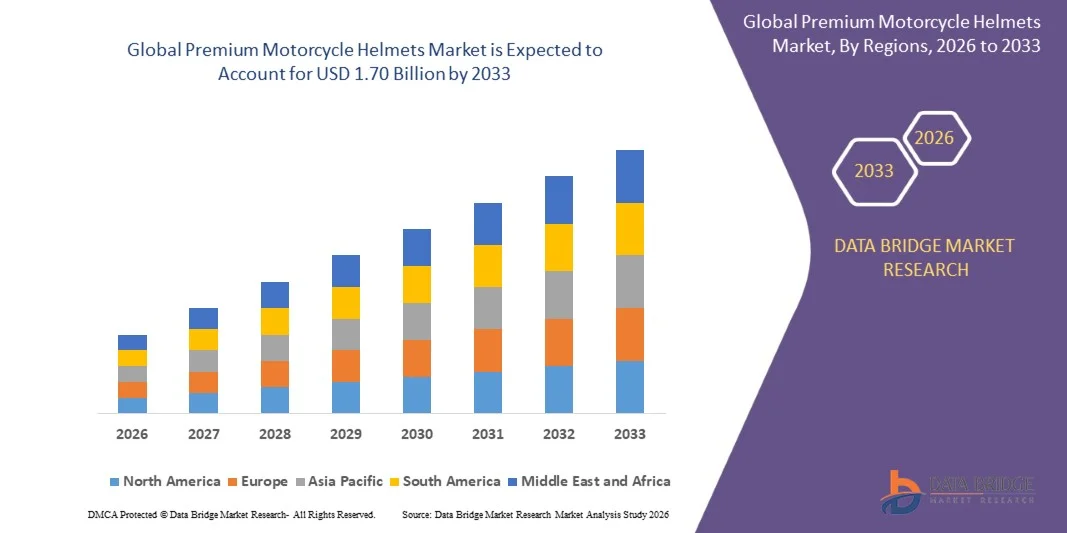
The Premium Motorcycle Helmets Market was valued at USD 1.19 billion in 2025 and is projected to reach USD 1.70 billion by 2033, growing at a CAGR of 4.62% from 2026 to 2033. The Premium Motorcycle Helmets Market is experiencing consistent growth driven by rising demand for advanced rider safety solutions, increasing awareness regarding head protection, rapid advancements in helmet materials and smart technologies, and expanding adoption among professional riders, commuters, and motorcycle enthusiasts. Premium motorcycle helmets are gaining popularity due to enhanced safety features, improved comfort, lightweight construction, aerodynamic designs, and integration of advanced technologies such as communication systems, impact protection materials, and smart connectivity solutions.
The increasing incidence of motorcycle accidents globally, combined with stricter government safety regulations and growing enforcement of helmet standards, is encouraging riders to adopt high-quality protective gear. Manufacturers are focusing on developing helmets with advanced composite materials, improved ventilation systems, and enhanced impact resistance to provide superior protection and riding experience. The growing popularity of premium motorcycles, motorsports activities, and increasing demand for technologically advanced and customized helmets are further accelerating market growth across global regions.
Key Market Trends & Insights
- North America dominated the Premium Motorcycle Helmets Market with the largest revenue share of 34.6% in 2025, supported by high motorcycle adoption, strong safety regulations, advanced rider training infrastructure, and increasing penetration of premium protective gear. The region benefits from a mature motorsports culture, rising demand for high-performance helmets among recreational riders and professional racers, and growing awareness regarding road safety standards certified by organizations such as DOT and Snell. Increasing sales of heavyweight motorcycles and adventure touring bikes is further strengthening demand for premium helmets across the region.
- The Conventional Premium Helmets segment dominated the market with a 67.12% revenue share in 2025, supported by strong affordability, regulatory compliance, and widespread availability across global distribution networks.
- Asia-Pacific is expected to be the fastest-growing region at a CAGR of 7.8% from 2026 to 2033, fueled by rapid urbanization, rising disposable income, increasing two-wheeler ownership, and expanding motorcycle commuting culture across countries such as India, China, Indonesia, and Vietnam. Growing road safety awareness, government initiatives promoting helmet usage, and increasing availability of affordable premium helmets are accelerating market expansion. In addition, rising penetration of e-commerce platforms and growing demand for branded protective gear are contributing to strong regional growth.
- Carbon fiber helmets are expected to be the fastest-growing material segment with a CAGR of 8.4% from 2026 to 2033, driven by increasing demand for ultra-lightweight, high-strength, and impact-resistant helmet materials. Carbon fiber offers superior durability, enhanced shock absorption, and reduced rider fatigue, making it highly preferred among professional racers and premium motorcycle users. Advancements in composite manufacturing technologies and increasing adoption in motorsports and adventure biking segments are further accelerating growth.
Market Size & Forecast
- Global Market Value (2025): USD 1.19 Billion
- Expected Market Value (2033): USD 1.70 Billion
- Forecast CAGR (2026–2033): 4.62%
- Leading Region in 2025: North America
- Fastest Growing Region: Asia-Pacific
Report Scope and Premium Motorcycle Helmets Market Segmentation
|
Attributes |
Premium Motorcycle Helmets Key Market Insights |
|
Segments Covered |
|
|
Countries Covered |
North America · U.S. · Canada · Mexico Europe · Germany · France · U.K. · Netherlands · Switzerland · Belgium · Russia · Italy · Spain · Turkey · Rest of Europe Asia-Pacific · China · Japan · India · South Korea · Singapore · Malaysia · Australia · Thailand · Indonesia · Philippines · Rest of Asia-Pacific Middle East and Africa · Saudi Arabia · U.A.E. · South Africa · Egypt · Israel · Rest of Middle East and Africa South America · Brazil · Argentina · Rest of South America |
|
Key Market Players |
• Dainese S.p.A. (Italy) |
|
Market Opportunities |
· Rising Demand for Smart Helmets with Connected Technologies · Expansion of Premium Motorcycle and Adventure Riding Segment · Increasing Focus on Road Safety Regulations and Helmet Standardization |
|
Value Added Data Infosets |
In addition to the insights on market scenarios such as market value, growth rate, segmentation, geographical coverage, and major players, the market reports curated by the Data Bridge Market Research also include in-depth expert analysis, geographically represented company-wise production and capacity, network layouts of distributors and partners, detailed and updated price trend analysis and deficit analysis of supply chain and demand. |
Premium Motorcycle Helmets Market Trends
Trend: Rising Demand for Smart Connectivity & Motorsports-Grade Premium Motorcycle Helmets
The Premium Motorcycle Helmets Market is witnessing strong growth driven by increasing adoption of smart helmets and motorsports-grade protective gear designed for enhanced rider safety, communication, and performance monitoring. Professional racing teams and track-day riders are increasingly adopting high-performance premium helmets integrated with communication systems, crash sensors, and real-time telemetry features to improve race strategy and rider feedback. Racing academies and motorsport training centers are also incorporating advanced helmet technologies to simulate real-world racing environments and enhance rider response training. For instance, in 2024, companies such as Shoei Co., Ltd. and AGV (Dainese Group) expanded their premium helmet portfolios with advanced aerodynamic designs, improved carbon fiber structures, and enhanced ventilation systems targeting professional and high-performance riders. The integration of Bluetooth communication systems, heads-up displays (HUD), and crash detection sensors is further transforming premium helmets into intelligent safety devices, particularly in Europe, North America, and Asia-Pacific motorsports hubs.
Premium Motorcycle Helmets Market Dynamics
Key Market Driver: Rising Motorcycle Usage & Safety Regulations Driving Premium Helmet Adoption
The rapid increase in global motorcycle ownership, particularly in Asia-Pacific and emerging economies, is significantly driving demand for premium motorcycle helmets. Governments across regions are implementing stricter road safety regulations, including mandatory helmet usage standards such as DOT (United States), ECE (Europe), and BIS (India), which is boosting adoption of certified high-quality helmets. The growing popularity of adventure biking, touring motorcycles, and high-performance sports bikes is also increasing demand for lightweight, aerodynamic, and impact-resistant helmets. In addition, rising consumer awareness regarding road safety and head injury prevention is encouraging riders to shift from standard helmets to premium variants equipped with advanced safety materials such as carbon fiber and Kevlar composites. According to industry estimates, motorcycle usage in countries like India alone exceeds 200 million registered two-wheelers, creating a massive addressable market for helmet manufacturers.
Key Restraint/Challenge: High Cost of Advanced Premium & Smart Helmets
A major challenge in the Premium Motorcycle Helmets Market is the high cost associated with advanced materials and smart helmet technologies. Premium helmets made from carbon fiber, Kevlar, and advanced composite materials significantly increase manufacturing costs, limiting affordability for price-sensitive consumers, especially in developing regions. In addition, smart helmets integrated with Bluetooth systems, HUD displays, and crash detection sensors require complex electronics integration, increasing overall product pricing. The presence of low-cost, non-certified helmets in emerging markets also restricts premium helmet penetration. Furthermore, compliance with multiple international safety standards (such as ECE 22.06 and DOT certification) increases R&D and testing costs for manufacturers, impacting profit margins and slowing adoption in cost-sensitive segments.
Key Market Opportunity: Expansion of Smart Helmets & Connected Rider Ecosystems
The integration of IoT, AI, and connected mobility technologies presents a significant growth opportunity in the premium motorcycle helmets market. Smart helmets equipped with GPS navigation, voice control, rear-view cameras, and crash alert systems are gaining rapid adoption among urban commuters and professional riders. Companies are increasingly investing in connected helmet ecosystems that link riders with smartphones, vehicle systems, and emergency response networks to enhance safety and convenience. For instance, in 2025, Sena Technologies expanded its smart helmet communication systems portfolio with advanced mesh intercom technology enabling real-time rider-to-rider communication across large groups. The growing penetration of electric motorcycles, increasing demand for connected mobility solutions, and rising adoption of AR/VR-based rider training systems are expected to further accelerate innovation in smart helmet technologies. In addition, expansion of e-commerce platforms and rising demand in Asia-Pacific markets are opening new growth avenues for premium helmet manufacturers globally.
Premium Motorcycle Helmets Market Scope
The Premium Motorcycle Helmets market is segmented on the basis of Type, Material Type, Technology, Application, End-User, and Distribution Channel.
- By Type
On the basis of type, the Premium Motorcycle Helmets Market is segmented into Full Face, open face, flip-up, and others. The Full Face Helmets segment dominated the market with a 46.28% revenue share in 2025, owing to superior protection coverage, aerodynamic efficiency, and strong compliance with global safety regulations such as ECE and DOT standards. Full face helmets are widely preferred among commuters, touring riders, and professional racers due to their ability to provide maximum head, chin, and facial protection during high-impact collisions. Increasing awareness of road safety, rising motorcycle accident rates globally, and strict enforcement of helmet laws across Asia-Pacific and Europe are significantly driving adoption. In addition, manufacturers are enhancing product offerings with lightweight composite shells, advanced ventilation systems, anti-fog visors, and improved shock absorption technologies, further strengthening demand. Growing urban commuting and long-distance riding trends are also contributing to sustained dominance. Strong presence of established brands and continuous product innovation cycles reinforce segment leadership globally.
The flip-up helmets segment is projected to register the fastest growth with a CAGR of 6.9% from 2026 to 2033, driven by increasing demand for hybrid helmet designs that combine safety with convenience and comfort. Flip-up helmets are gaining traction among urban commuters and touring riders due to their modular design, which allows riders to lift the chin bar without removing the helmet entirely. Rising traffic congestion in emerging economies and frequent short-distance riding patterns are accelerating adoption. Technological enhancements such as improved locking mechanisms, dual certification (P/J homologation), and lightweight polycarbonate structures are further improving safety performance. Integration of communication systems, Bluetooth connectivity, and smart visor technology is increasing consumer appeal. Growing preference for versatile helmets that support both city commuting and long-distance travel is fueling strong CAGR expansion across global markets.
- By Material Type
On the basis of material type, the market is segmented into kevlar, fiber glass, carbon fiber, plastics, and others. The fiber glass segment dominated the market with a 38.74% share in 2025, due to its optimal balance of strength, durability, weight reduction, and affordability compared to premium carbon fiber alternatives. Fiber glass helmets are widely adopted across commuter and mid-premium categories, especially in price-sensitive markets such as Asia-Pacific and Latin America. Their superior impact resistance and ability to absorb energy during collisions make them a preferred choice among safety-conscious riders. Established manufacturing infrastructure and lower production costs compared to advanced composites further strengthen adoption. Increasing availability through OEM partnerships and retail distribution networks supports market penetration. Continuous improvements in resin technology and layering techniques are enhancing durability and safety performance.
The carbon fiber segment is expected to witness the fastest growth at a CAGR of 7.3% from 2026 to 2033, driven by increasing demand for ultra-lightweight, high-strength helmets in motorsports and premium motorcycle segments. Carbon fiber helmets significantly reduce neck fatigue and improve aerodynamic stability, making them highly preferred among professional racers and performance riders. Rising participation in global motorsports events, track racing activities, and adventure biking is accelerating demand. Manufacturers are investing heavily in advanced composite molding techniques and hybrid carbon-Kevlar structures to improve safety and comfort. Increasing disposable income and premiumization trends in motorcycle accessories are further boosting adoption in developed markets such as North America and Europe.
- By Technology
On the basis of technology, the market is segmented into conventional premium helmets and smart helmets. The Conventional Premium Helmets segment dominated the market with a 67.12% revenue share in 2025, supported by strong affordability, regulatory compliance, and widespread availability across global distribution networks. These helmets remain the primary choice for mass consumers due to their reliability, proven safety performance, and cost-effectiveness. Continuous improvements in shell materials, interior padding, ventilation systems, and impact resistance technologies are enhancing product appeal. Strong penetration in developing countries, where price sensitivity remains high, further reinforces dominance. Regulatory mandates requiring certified helmets in countries such as India, China, and Brazil significantly drive adoption. Established retail and offline distribution channels also contribute to sustained market leadership.
The Smart Helmets segment is projected to register the fastest growth with a CAGR of 8.1% from 2026 to 2033, driven by increasing integration of connected technologies such as Bluetooth communication systems, GPS navigation, heads-up displays (HUD), crash detection sensors, and voice-controlled assistants. Rising demand for connected mobility and smart riding ecosystems is transforming rider experience. Motorcycle OEMs and tech startups are investing heavily in IoT-enabled safety innovations and AI-assisted riding features. Increasing adoption among premium and adventure riders is accelerating market penetration. Growing smartphone integration and digital navigation dependency are further supporting demand for smart helmets globally.
- By Application
On the basis of application, the market is segmented into scooters, motorcycles, step-through, and others. The motorcycles segment dominated the market with a 52.46% share in 2025, driven by high global motorcycle ownership, strong commuter base, and increasing usage for both personal and commercial mobility. Motorcycles remain the most widely used two-wheeler globally, especially in densely populated countries such as India, China, Indonesia, and Vietnam. Rising demand for safety gear among daily riders and regulatory enforcement of helmet usage are major growth drivers. Increasing popularity of premium motorcycles and touring bikes is further boosting demand for advanced helmets. Strong aftermarket ecosystem and availability of branded protective gear reinforce segment dominance.
The Scooters segment is expected to witness the fastest growth at a CAGR of 6.5% from 2026 to 2033, driven by rapid urbanization, rising last-mile mobility needs, and expansion of electric scooter adoption. Scooters are increasingly preferred in congested urban areas due to ease of use, fuel efficiency, and affordability. Growth of shared mobility platforms and ride-hailing services is further boosting demand. Electric scooter penetration in Asia-Pacific and Europe is significantly contributing to helmet sales growth. Lightweight helmet designs and affordability-focused premium offerings are accelerating adoption in this segment.
- By End-User
On the basis of end-user, the market is segmented into commuters and racers. the commuters segment dominated the market with a 74.33% revenue share in 2025, due to the large global population of daily riders using motorcycles and scooters for transportation. Rising urban congestion, increasing fuel prices, and cost-effective mobility options continue to drive commuter reliance on two-wheelers. Government mandates for helmet usage and increasing road safety awareness campaigns are strengthening adoption. Manufacturers are focusing on affordable yet durable helmets tailored for everyday usage. Expanding distribution networks in emerging economies further support dominance. Continuous improvement in comfort, ventilation, and lightweight materials is enhancing commuter adoption globally.
The racers segment is expected to witness the fastest growth with a CAGR of 7.8% from 2026 to 2033, driven by increasing participation in motorsports, track racing events, and professional riding competitions. Growing popularity of motorcycle racing leagues and adventure sports is boosting demand for high-performance helmets. These helmets offer advanced aerodynamics, enhanced ventilation, and superior impact resistance using carbon fiber and composite materials. Rising investments in motorsport infrastructure and training academies are accelerating segment expansion. Increasing sponsorships and professional racing teams are also contributing to higher adoption of premium racing helmets globally.
- By Distribution Channel
On the basis of distribution channel, the market is segmented into offline and online. The Offline segment dominated the market with a 61.58% revenue share in 2025, due to strong consumer preference for physical inspection, proper fitting, and trust in authorized dealers and specialty stores. Helmets require precise sizing and comfort testing, which drives customers toward offline retail channels. Established dealership networks and motorcycle accessory stores continue to dominate sales, especially in developing regions. Retailers also provide after-sales services and customization options, strengthening consumer reliance on offline channels. Brand presence in physical stores enhances product visibility and trust.
The Online segment is expected to witness the fastest growth at a CAGR of 8.4% from 2026 to 2033, driven by rapid growth in e-commerce platforms and direct-to-consumer brand strategies. Increasing smartphone penetration and digital shopping adoption are transforming purchasing behavior. Online platforms offer wider product variety, competitive pricing, and easy comparison features. Advanced technologies such as AR-based virtual fitting tools and AI-driven size recommendation systems are improving customer confidence. Expansion of logistics networks and fast delivery services is further accelerating online helmet sales globally.
Premium Motorcycle Helmets Market Regional Analysis
North America dominated the Premium Motorcycle Helmets Market and accounted for the largest revenue share of 34.6% in 2025, supported by high motorcycle adoption, strong safety regulations, advanced rider training infrastructure, and increasing penetration of premium protective gear. The region benefits from a mature motorsports culture, rising demand for high-performance helmets among recreational riders and professional racers, and growing awareness regarding road safety standards certified by organizations such as DOT and Snell. Increasing sales of heavyweight motorcycles and adventure touring bikes is further strengthening demand for premium helmets across the region.
U.S. Premium Motorcycle Helmets Market Insight
The U.S. premium motorcycle helmets market is witnessing strong growth due to high motorcycle ownership, increasing participation in recreational riding, and strong demand for advanced protective gear. The country’s well-established motorsports ecosystem, combined with stringent safety regulations and rising consumer awareness, is driving adoption of certified premium helmets. Growing popularity of touring motorcycles, sport bikes, and adventure riding, along with increasing preference for lightweight carbon fiber and smart helmets, is further supporting market expansion.
Europe Premium Motorcycle Helmets Market Insight
The Europe premium motorcycle helmets market remains a major contributor to global revenue, driven by strong safety regulations, high-quality manufacturing standards, and growing demand for advanced rider protection solutions. The region’s established motorsport industry and increasing adoption of premium helmets among commuters and professional riders are supporting market growth. Rising focus on sustainability, lightweight materials, and enhanced comfort features is also influencing product innovation across Europe.
U.K. Premium Motorcycle Helmets Market Insight
The U.K. premium motorcycle helmets market is experiencing steady growth, supported by increasing motorcycle usage, strong road safety enforcement, and rising demand for certified protective gear. Growing interest in premium biking culture, along with higher adoption of advanced helmets featuring improved aerodynamics, ventilation, and smart connectivity, is contributing to market expansion.
Germany Premium Motorcycle Helmets Market Insight
The Germany premium motorcycle helmets market is expanding steadily due to strong automotive and motorsport culture, high safety awareness, and increasing demand for premium riding gear. German consumers show strong preference for high-quality, durable, and technologically advanced helmets, particularly in touring and sport riding segments. Continuous innovation in lightweight composite materials and safety-certified helmet designs is further driving market growth.
Asia-Pacific Premium Motorcycle Helmets Market Insight
The Asia-Pacific premium motorcycle helmets market is expected to be the fastest-growing region at a CAGR of 7.8% from 2026 to 2033, fueled by rapid urbanization, rising disposable income, increasing two-wheeler ownership, and expanding motorcycle commuting culture across countries such as India, China, Indonesia, and Vietnam. Growing road safety awareness, government initiatives promoting helmet usage, and increasing availability of affordable premium helmets are accelerating market expansion. In addition, rising penetration of e-commerce platforms and growing demand for branded protective gear are contributing to strong regional growth.
Japan Premium Motorcycle Helmets Market Insight
The Japan Premium Motorcycle Helmets market is witnessing consistent growth due to high safety consciousness, strong motorcycle culture, and demand for technologically advanced protective gear. Japanese consumers prefer high-quality helmets with superior safety certification, comfort, and lightweight design. Increasing adoption of premium and smart helmets among touring riders and commuters is further supporting market growth
China Premium Motorcycle Helmets Market Insight
The China premium motorcycle helmets market is growing rapidly, driven by increasing motorcycle ownership, rising urban commuting needs, and growing awareness of road safety. Expansion of e-commerce platforms and availability of affordable premium helmets are making high-quality protective gear more accessible. In addition, rising interest in recreational biking and improving safety regulations are further accelerating market demand across the country.
Premium Motorcycle Helmets Market Share
The Premium Motorcycle Helmets industry is primarily led by well-established companies, including:
- Dainese S.p.A. (Italy)
- Alpinestars S.p.A. (Italy)
- Shoei Co., Ltd. (Japan)
- Arai Helmet, Ltd. (Japan)
- Schuberth GmbH (Germany)
- HJC Helmets (South Korea)
- AGV (Italy)
- Bell Helmets (U.S.)
- LS2 Helmets (Spain)
- Nolan Group (Italy)
- Studds Accessories Ltd. (India)
- Steelbird Hi-Tech India Ltd. (India)
- Shark Helmets (France)
- Caberg S.p.A. (Italy)
- MT Helmets (Spain)
- Icon Motorsports (U.S.)
- Nexx Helmets (Portugal)
- Ruroc (U.K.)
- Yohe Helmets (China)
- Vega Helmets (India)
- Royal Enfield (Riding Gear Division) (India)
- Scorpion EXO (U.S.)
- Klim (U.S.)
- Spidi Sport S.r.l. (Italy)
Latest Developments in Premium Motorcycle Helmets Market
- In March 2021, Arai Helmet Ltd., a leading Japanese premium helmet manufacturer, expanded its global distribution network in Europe and North America, strengthening availability of its high-end RX-7V and Corsair-X models. The expansion was aimed at meeting rising demand for ECE 22.05-certified racing and touring helmets, particularly among professional riders and motorsport users. The initiative reinforced Arai’s position in the premium safety helmet segment through enhanced global accessibility and aftersales support
- In June 2022, SHOEI Co., Ltd., a major premium motorcycle helmet manufacturer, introduced updates to its GT-Air II lineup with enhanced ventilation systems and improved aerodynamic shell design. The upgrade focused on rider comfort, noise reduction, and long-distance touring performance, aligning with increasing consumer demand for sport-touring helmets in Europe and Asia-Pacific markets. The development reflected SHOEI’s continued investment in ergonomic innovation and safety compliance under evolving ECE standards
- In July 2022, Steelbird Hi-Tech India Ltd., one of India’s largest helmet manufacturers, announced expansion of its premium helmet production capacity in Himachal Pradesh to address growing domestic and export demand. The expansion targeted higher production of ISI and ECE-certified helmets, particularly in the premium full-face and modular categories. This move supported the rising adoption of safety helmets in India’s rapidly expanding two-wheeler market
- In April 2023, Schuberth GmbH launched its upgraded C5 modular premium motorcycle helmet, designed for touring riders with enhanced aerodynamics, reduced wind noise, and improved communication system integration. The helmet complied with ECE 22.06 safety standards and incorporated advanced multi-density EPS liner technology to improve impact absorption. The launch strengthened Schuberth’s premium positioning in the European touring helmet market
- In October 2024, Sena Technologies, a global leader in motorcycle communication systems, launched the Momentum Pro Smart Helmet featuring integrated head-up display (HUD) and mesh communication capabilities. The helmet combined Bluetooth connectivity, navigation display, and real-time riding data visualization, targeting premium riders seeking smart and connected safety solutions. The product represented growing convergence between wearable tech and helmet safety systems
- In November 2025, SHOEI Co., Ltd. in collaboration with EyeLights introduced the GT-Air 3 Smart Helmet, the world’s first fully integrated augmented reality (AR) motorcycle helmet. The helmet features a nano-OLED visor-mounted HUD projecting speed, navigation, and calls directly into the rider’s field of vision, improving reaction time by over 30%. It also integrates Bluetooth communication, voice assistant support, and built-in safety certification under ECE 22.06 and DOT standards, marking a major milestone in smart helmet innovation

- Interactive Data Analysis Dashboard
- Company Analysis Dashboard for high growth potential opportunities
- Research Analyst Access for customization & queries
- Competitor Analysis with Interactive dashboard
- Latest News, Updates & Trend analysis
- Harness the Power of Benchmark Analysis for Comprehensive Competitor Tracking
Data collection and base year analysis are done using data collection modules with large sample sizes. The stage includes obtaining market information or related data through various sources and strategies. It includes examining and planning all the data acquired from the past in advance. It likewise envelops the examination of information inconsistencies seen across different information sources. The market data is analysed and estimated using market statistical and coherent models. Also, market share analysis and key trend analysis are the major success factors in the market report. To know more, please request an analyst call or drop down your inquiry.
The key research methodology used by DBMR research team is data triangulation which involves data mining, analysis of the impact of data variables on the market and primary (industry expert) validation. Data models include Vendor Positioning Grid, Market Time Line Analysis, Market Overview and Guide, Company Positioning Grid, Patent Analysis, Pricing Analysis, Company Market Share Analysis, Standards of Measurement, Global versus Regional and Vendor Share Analysis. To know more about the research methodology, drop in an inquiry to speak to our industry experts.
Data Bridge Market Research is a leader in advanced formative research. We take pride in servicing our existing and new customers with data and analysis that match and suits their goal. The report can be customized to include price trend analysis of target brands understanding the market for additional countries (ask for the list of countries), clinical trial results data, literature review, refurbished market and product base analysis. Market analysis of target competitors can be analyzed from technology-based analysis to market portfolio strategies. We can add as many competitors that you require data about in the format and data style you are looking for. Our team of analysts can also provide you data in crude raw excel files pivot tables (Fact book) or can assist you in creating presentations from the data sets available in the report.