


Printed Sensor Market Overview
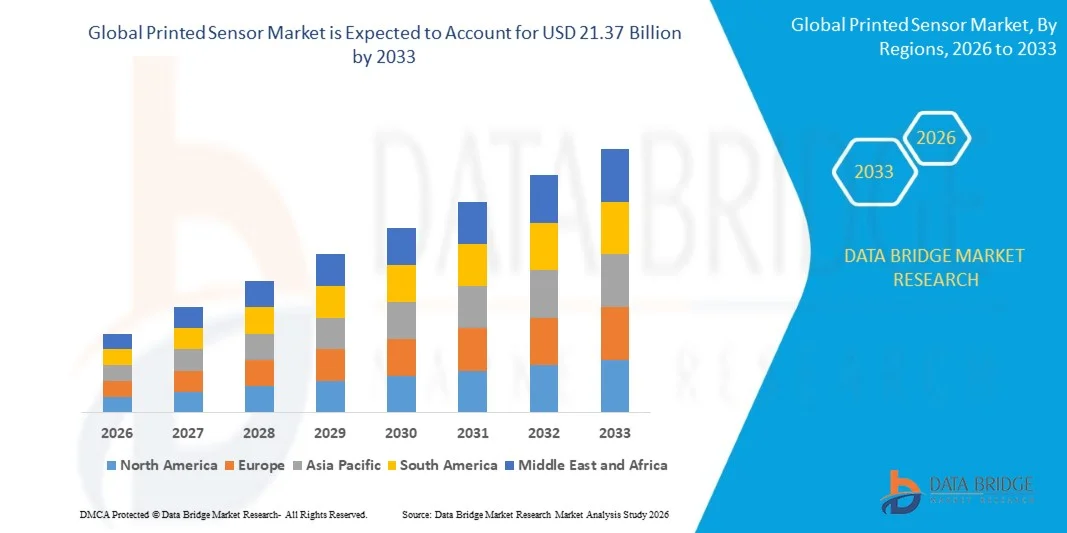
The Printed Sensor Market was valued at USD 12.55 Billion in 2025 and is projected to reach USD 21.37 Billion by 2033, growing at a CAGR of 6.88% from 2026 to 2033. The market is experiencing consistent growth driven by increasing demand for flexible and low-cost sensing technologies, rising adoption of wearable and smart electronic devices, and growing integration of printed sensors across healthcare, automotive, consumer electronics, and industrial applications. Advancements in printed electronics, conductive inks, and flexible substrate technologies are further supporting market expansion across developed and emerging economies.
The increasing focus on lightweight, energy-efficient, and miniaturized electronic components, combined with rising demand for real-time monitoring solutions, is accelerating the adoption of printed sensors across multiple industries. Printed sensors are increasingly being utilized in medical diagnostics, smart packaging, environmental monitoring, and automotive safety systems due to their flexibility, scalability, and cost-effective manufacturing capabilities. Growing investments in IoT-enabled devices and next-generation flexible electronics are further contributing to market growth worldwide.
Key Market Trends & Insights
- Asia-Pacific dominated the Printed Sensor Market with the largest revenue share of 39.55% in 2025, supported by strong electronics manufacturing infrastructure, rapid adoption of flexible electronics, and increasing production of consumer electronic devices across major economies
- The screen printing segment led the market with a 42.05% share in 2025, driven by its extensive adoption in large-scale printed electronics manufacturing due to cost efficiency and high-volume production capability
- North America is expected to be the fastest-growing region at a CAGR of 15.1% from 2026 to 2033, fueled by increasing adoption of IoT-enabled devices, wearable healthcare technologies, and smart industrial automation systems
- Ink- Jet printing is the fastest-growing technique type, projected to register a CAGR of 13.75% from 2026 to 2033, supported by rising demand for customized and high-resolution printed sensor production across healthcare and smart wearable applications
- The printed touch sensor segment dominated the product type category with a 31.62% revenue share in 2025, led by rising integration of touch-enabled interfaces in smartphones, tablets, wearable electronics, and smart appliances
- Consumer electronics accounted for 30.7% of the market in 2025, preferred by increasing incorporation of printed sensors in smartphones, wearable devices, gaming systems, and smart appliances
- The printed biosensor segment is the fastest-growing product type category, with a CAGR of 11.95% from 2026 to 2033, driven by increasing demand for rapid diagnostics, point-of-care testing, and wearable healthcare monitoring systems
Market Size & Forecast
- Global Market Value (2025): USD 12.55 Billion
- Expected Market Value (2033): USD 21.37 Billion
- Forecast CAGR (2026–2033): 6.88%
- Leading Region in 2025: Asia-Pacific
- Fastest Growing Region: North America
Report Scope and Printed Sensor Market Segmentation
|
Attributes |
Printed Sensor Key Market Insights |
|
Segments Covered |
|
|
Countries Covered |
North America · U.S. · Canada · Mexico Europe · Germany · France · U.K. · Netherlands · Switzerland · Belgium · Russia · Italy · Spain · Turkey · Rest of Europe Asia-Pacific · China · Japan · India · South Korea · Singapore · Malaysia · Australia · Thailand · Indonesia · Philippines · Rest of Asia-Pacific Middle East and Africa · Saudi Arabia · U.A.E. · South Africa · Egypt · Israel · Rest of Middle East and Africa South America · Brazil · Argentina · Rest of South America |
|
Key Market Players |
· Ensurge Micropower ASA (Norway) · PolyIC GmbH & Co. KG (Germany) · Nissha Co., Ltd. (Japan) · KWJ Engineering Inc. (South Korea) · ISORG (France) · Peratech Holdco Limited (U.K.) · MC10, Inc. (U.S.) · Sensitronics, LLC (U.S.) · Canatu Oy (Finland) · IDTechEx Ltd. (U.K.) · Yokogawa Electric Corporation (Japan) · Tekscan, Inc. (U.S.) · PST Sensors (South Korea) · Sharp Electronics Corporation (Japan) · Intel Corporations (U.S.) · WinMate Inc. (Taiwan) · Hitachi, Ltd. (Japan) · Henkel AG & Co. KGaA (Germany) · Parker Hannifin Corporation (U.S.) · NovaCentrix (U.S.) · Brewer Science, Inc. (U.S.) · GSI Technologies, LLC (U.S.) |
|
Market Opportunities |
· Expansion of Printed Sensors in Smart Packaging Applications · Growing Integration of Printed Sensors in Healthcare Monitoring Devices · Increasing Adoption of IoT-Enabled Industrial Monitoring Solutions |
|
Value Added Data Infosets |
In addition to the insights on market scenarios such as market value, growth rate, segmentation, geographical coverage, and major players, the market reports curated by the Data Bridge Market Research also include in-depth expert analysis, geographically represented company-wise production and capacity, network layouts of distributors and partners, detailed and updated price trend analysis and deficit analysis of supply chain and demand. |
Printed Sensor Market Trends
Trend: Rising Adoption of Flexible and Wearable Electronics
The increasing adoption of flexible electronics and wearable devices is significantly driving demand for printed sensors across healthcare, consumer electronics, fitness monitoring, and smart textile applications. Printed sensors are gaining strong traction due to their lightweight structure, flexibility, low manufacturing cost, and compatibility with bendable substrates, making them suitable for next-generation wearable technologies. Advancements in conductive inks, printed circuits, and flexible substrates are further supporting large-scale commercialization of printed sensing solutions across global markets.
Companies such as Nissha Co., Ltd. are actively expanding flexible printed sensor technologies for healthcare monitoring and human-machine interface applications, while Canatu Oy is advancing transparent conductive film and flexible sensor solutions for automotive and consumer electronics applications.
Printed Sensor Market Dynamics
Key Market Driver: Increasing Demand for Low-Cost and Scalable Sensor Technologies
The growing demand for cost-effective and scalable sensing technologies across industrial, automotive, healthcare, and consumer electronics sectors is significantly driving the printed sensor market. Printed sensors offer advantages such as low material consumption, high-volume manufacturing capability, reduced production cost, and compatibility with roll-to-roll printing processes, making them increasingly suitable for mass-market applications. The rapid expansion of IoT devices, smart packaging solutions, and connected monitoring systems is further accelerating demand for compact and energy-efficient printed sensing technologies worldwide.
Major companies such as Tekscan, Inc. and PolyIC GmbH & Co. KG are investing in printed pressure sensors and flexible electronic platforms to support scalable sensing solutions across industrial automation, automotive interiors, and healthcare diagnostics applications.
Key Restraint/Challenge: Limited Durability and Performance Stability in Harsh Environments
A major challenge in the printed sensor market is the limited durability and long-term performance stability of printed sensing materials under harsh environmental conditions. Printed sensors often face operational limitations related to moisture exposure, temperature fluctuations, mechanical stress, and chemical degradation, which can impact sensing accuracy and product lifespan in industrial and automotive applications. In addition, maintaining consistent conductivity and sensitivity across large-scale production processes remains a technical challenge for manufacturers developing advanced printed electronic systems.
Organizations such as IDTechEx Ltd. have highlighted material reliability and environmental stability as key barriers affecting wider commercialization of printed electronics and printed sensor technologies across demanding end-use industries.
Key Market Opportunity: Expansion of Printed Sensors in Smart Packaging Applications
The rapid expansion of smart packaging technologies is creating significant growth opportunities for the printed sensor market across food & beverage, pharmaceuticals, logistics, and retail industries. Printed sensors are increasingly being integrated into smart labels and intelligent packaging systems for temperature monitoring, freshness detection, anti-counterfeiting, and supply chain tracking applications. Growing demand for real-time product monitoring and connected packaging solutions is further supporting innovation in disposable and low-cost printed sensor technologies.
Companies such as Nissha Co., Ltd. and ISORG are actively developing printed electronic and organic sensor technologies for smart packaging and connected sensing applications, supporting wider adoption of intelligent packaging systems across global consumer goods and healthcare markets.
Printed Sensor Market Scope
The printed sensor market is segmented on the basis of techniques, product type, and application.
- By Techniques
On the basis of techniques, the Printed Sensor Market is segmented into Ink-Jet Printing, Screen Printing, Contact Printing, and Non-Contact Printing. The Screen Printing segment dominated the market with the largest share of 42.05% in 2025, driven by its extensive adoption in large-scale printed electronics manufacturing due to cost efficiency and high-volume production capability. The technique supports precise deposition of conductive inks on multiple substrates, making it highly suitable for printed sensors used in consumer electronics and automotive applications. Manufacturers increasingly prefer screen printing because of its compatibility with flexible materials and ability to maintain stable sensor performance. The segment also benefits from widespread industrial adoption and established production infrastructure across Asia-Pacific and Europe. Continuous advancements in conductive ink formulations and multilayer printing processes are further strengthening segment dominance.
The Ink-Jet Printing segment is projected to register the fastest growth at a CAGR of 13.75% from 2026 to 2033, driven by rising demand for customized and high-resolution printed sensor production across healthcare and smart wearable applications. Ink-jet printing enables precise material deposition with minimal material wastage, which significantly improves production efficiency and sustainability. Growing demand for flexible and lightweight electronic devices is accelerating the use of digitally controlled non-contact printing technologies. Advancements in nanoparticle inks, rapid prototyping capabilities, and roll-to-roll manufacturing systems are further enhancing scalability. Increasing investment in next-generation flexible electronics and IoT-enabled devices is supporting rapid market expansion across developed and emerging economies.
- By Product Type
On the basis of product type, the Printed Sensor Market is segmented into Printed Biosensor, Printed Pressure Sensor, Printed Touch Sensor, Printed Temperature Sensor, Printed Humidity Sensor, Printed Photodetectors, Printed Image Sensors, Printed Gas Sensor, and Others. The Printed Touch Sensor segment dominated the market with a share of 31.62% in 2025, supported by rising integration of touch-enabled interfaces in smartphones, tablets, wearable electronics, and smart appliances. Increasing consumer preference for lightweight and flexible electronic devices is accelerating the adoption of printed touch sensor technologies across consumer electronics manufacturers. These sensors provide improved sensitivity, lower power consumption, and enhanced design flexibility compared to conventional sensing technologies. Strong expansion of the consumer electronics sector in Asia-Pacific is further supporting large-scale production and commercialization. Continuous innovation in transparent conductive materials and flexible substrates is reinforcing long-term segment growth.
The Printed Biosensor segment is projected to register the fastest growth at a CAGR of 11.95% from 2026 to 2033, driven by increasing demand for rapid diagnostics, point-of-care testing, and wearable healthcare monitoring systems. Printed biosensors enable low-cost and disposable medical testing solutions, which significantly improve accessibility in healthcare applications. Rising prevalence of chronic diseases and growing focus on personalized healthcare are accelerating adoption across hospitals and home-care environments. Technological advancements in bio-compatible inks, flexible electronics, and miniaturized sensor systems are improving detection accuracy and reliability. Expanding investments in digital healthcare infrastructure and remote patient monitoring technologies are further supporting strong market expansion globally.
- By Application
On the basis of application, the Printed Sensor Market is segmented into Consumer Electronics, Automotive, Retail, Medical Devices, Industrial, Smart Packaging, Smart Card, Smart Homes, Military and Security, Water and Environment Testing, Robotics, and Others. The Consumer Electronics segment dominated the market with the largest share of 30.7% in 2025, driven by increasing incorporation of printed sensors in smartphones, wearable devices, gaming systems, and smart appliances. Growing consumer demand for compact, lightweight, and flexible electronic products is accelerating sensor integration across advanced electronic devices. Printed sensors provide enhanced functionality, lower manufacturing costs, and improved energy efficiency, making them highly suitable for mass-market electronics production. The segment also benefits from continuous innovation in flexible displays, touch interfaces, and IoT-enabled smart devices. Rapid expansion of electronics manufacturing facilities across Asia-Pacific is further strengthening segment dominance.
The Medical Devices segment is projected to register the fastest growth at a CAGR of 10.8% from 2026 to 2033, driven by increasing adoption of printed sensors in wearable health monitors, diagnostic devices, and remote patient monitoring systems. Rising focus on preventive healthcare and continuous patient monitoring is accelerating demand for flexible and disposable sensing technologies. Printed sensors enable real-time health tracking with improved patient comfort and reduced production costs, which enhances adoption across healthcare providers. Advancements in biocompatible materials, wireless connectivity, and miniaturized sensor technologies are improving performance and reliability. Growing investments in digital healthcare transformation and smart medical infrastructure are significantly supporting long-term market growth.
Printed Sensor Market Regional Analysis
Asia-Pacific dominated the printed sensor market and accounted for the largest revenue share of 39.55% in 2025, supported by strong electronics manufacturing infrastructure, rapid adoption of flexible electronics, and increasing production of consumer electronic devices across major economies. The region benefits from large-scale semiconductor and printed electronics production capabilities, cost-effective manufacturing environments, and rising investments in IoT-enabled technologies. Growing demand for wearable electronics, smart packaging, automotive electronics, and healthcare monitoring systems is accelerating regional market expansion. Continuous advancements in conductive inks, flexible substrates, and printed electronic technologies are further strengthening Asia-Pacific’s leadership in the global market.
China Printed Sensor Market Insight
China held the largest share in the Asia-Pacific Printed Sensor market in 2025, supported by its dominant position in consumer electronics manufacturing and extensive production capacity for printed electronic components. The country has a highly developed electronics supply chain that enables large-scale integration of printed sensors across smartphones, wearable devices, and industrial automation systems. Rising investments in smart manufacturing, flexible display technologies, and IoT infrastructure are significantly supporting market growth. In addition, strong government support for advanced electronics production and increasing exports of electronic products are reinforcing China’s leading market position.
India Printed Sensor Market Insight
India is witnessing the fastest growth in the Asia-Pacific region, driven by rising adoption of smart electronics, expanding healthcare technology infrastructure, and increasing domestic electronics manufacturing activities. Growing demand for wearable health monitoring devices, smart packaging solutions, and low-cost sensor technologies is significantly supporting market expansion. The country is also benefiting from government initiatives promoting domestic electronics production and digital transformation across industrial sectors. In addition, increasing investments in IoT applications, automotive electronics, and flexible electronic technologies are accelerating long-term market growth.
Europe Printed Sensor Market Insight
The Europe Printed Sensor market is expanding steadily, supported by increasing adoption of advanced sensing technologies across automotive, healthcare, industrial automation, and smart packaging applications. Strong focus on sustainable and energy-efficient electronic solutions is driving demand for lightweight and flexible printed sensors across the region. Growing utilization of printed sensors in electric vehicles, medical diagnostics, and environmental monitoring systems is further contributing to market expansion. In addition, rising investments in research and development activities related to flexible electronics and smart manufacturing technologies are supporting regional market development.
Germany Printed Sensor Market Insight
Germany accounted for the largest share in the Europe Printed Sensor market in 2025, driven by strong automotive manufacturing capabilities and rising integration of advanced sensor technologies across industrial automation systems. The country has a well-established electronics and engineering industry that extensively utilizes printed sensors in automotive electronics, smart factories, and healthcare equipment. Increasing adoption of Industry 4.0 technologies and connected manufacturing systems is further strengthening market growth. In addition, strong investment in electric vehicle development and smart sensing technologies is reinforcing Germany’s leadership in the regional market.
U.K. Printed Sensor Market Insight
The U.K. market is supported by growing demand for printed sensors across healthcare monitoring, smart packaging, and wearable electronic applications. Increasing focus on digital healthcare technologies and remote patient monitoring systems is driving adoption of flexible sensing solutions across medical industries. The country is also witnessing rising utilization of printed sensors in environmental monitoring and smart retail applications due to expanding IoT integration. In addition, increasing research activities in printed electronics and advanced material technologies are further supporting market growth.
North America Printed Sensor Market Insight
North America is projected to grow at the fastest CAGR of 15.1% from 2026 to 2033, driven by increasing adoption of IoT-enabled devices, wearable healthcare technologies, and smart industrial automation systems. Rising demand for flexible and lightweight electronic components across consumer electronics and automotive industries is significantly supporting regional market expansion. Strong investments in advanced healthcare diagnostics, smart packaging technologies, and connected devices are further accelerating printed sensor adoption. In addition, increasing focus on next-generation flexible electronics and digital transformation initiatives is boosting long-term regional market development.
U.S. Printed Sensor Market Insight
The U.S. accounted for the largest share in the North America Printed Sensor market in 2025, supported by strong demand from healthcare, consumer electronics, automotive, and aerospace industries. The country benefits from extensive adoption of wearable devices, smart sensors, and advanced medical monitoring technologies across commercial and industrial applications. Growing investments in flexible electronics research, IoT infrastructure, and industrial automation are further strengthening market growth. In addition, rising demand for real-time sensing solutions and connected electronic systems is reinforcing the U.S. leadership position in the regional market.
Printed Sensor Market Share
The printed sensor industry is primarily led by well-established companies, including:
- Ensurge Micropower ASA (Norway)
- PolyIC GmbH & Co. KG (Germany)
- Nissha Co., Ltd. (Japan)
- KWJ Engineering Inc. (South Korea)
- ISORG (France)
- Peratech Holdco Limited (U.K.)
- MC10, Inc. (U.S.)
- Sensitronics, LLC (U.S.)
- Canatu Oy (Finland)
- IDTechEx Ltd. (U.K.)
- Yokogawa Electric Corporation (Japan)
- Tekscan, Inc. (U.S.)
- PST Sensors (South Korea)
- Sharp Electronics Corporation (Japan)
- Intel Corporation (U.S.)
- WinMate Inc. (Taiwan)
- Hitachi, Ltd. (Japan)
- Henkel AG & Co. KGaA (Germany)
- Parker Hannifin Corporation (U.S.)
- NovaCentrix (U.S.)
- Brewer Science, Inc. (U.S.)
- GSI Technologies, LLC (U.S.)
Latest Developments in Printed Sensor Market
- In May 2025, DwyerOmega acquired Process Sensing Technologies to strengthen its printed and industrial sensor portfolio through the addition of proprietary moisture, gas, and flow sensing technologies. The acquisition is expanding DwyerOmega’s capabilities across pharmaceuticals, energy, and industrial automation sectors where demand for compact and high-precision printed sensing systems is increasing rapidly. The development is also supporting broader commercialization of integrated sensing platforms for next-generation smart monitoring applications
- In April 2025, ISORG joined the CARDIF Consortium to co-develop printed RF gas sensors targeting NO₂, SO₂, and O₃ detection for advanced air-quality monitoring applications. The initiative is accelerating innovation in low-cost and scalable printed environmental sensors capable of supporting billions of connected smart devices globally. The collaboration is further strengthening adoption of printed sensor technologies across smart cities, industrial emission monitoring, and environmental sustainability programs
- In March 2025, Qosina and Polestar Technologies introduced iDOT single-use sensor bag ports integrated with optical transducers for pH and dissolved oxygen monitoring in bioprocessing applications. The development is enhancing adoption of disposable printed sensing solutions within pharmaceutical manufacturing and biotechnology industries due to improved sterility, process efficiency, and regulatory compliance. The innovation is also supporting increasing demand for real-time monitoring technologies across advanced biologics production facilities
- In February 2025, Oklahoma State University developed a dual-material 3D-printed auxetic pressure sensor with high sensitivity for wearable electronics and robotics applications. The prototype is improving affordability and design flexibility for next-generation printed pressure sensors while enabling enhanced motion detection and tactile sensing capabilities. The advancement is expected to support wider commercialization of lightweight and flexible sensing technologies across healthcare, industrial automation, and smart robotics industries
- In January 2025, Henkel expanded its conductive ink portfolio for printed electronics to support high-performance flexible sensors used in automotive interiors, wearable devices, and smart packaging applications. The expansion is improving durability, conductivity, and large-scale manufacturability of printed sensor components, which is accelerating integration across next-generation flexible electronic systems. The development is also strengthening market growth by enabling faster production scalability and enhanced performance reliability for printed sensing technologies

- Interactive Data Analysis Dashboard
- Company Analysis Dashboard for high growth potential opportunities
- Research Analyst Access for customization & queries
- Competitor Analysis with Interactive dashboard
- Latest News, Updates & Trend analysis
- Harness the Power of Benchmark Analysis for Comprehensive Competitor Tracking
Global Printed Sensor Market, Supply Chain Analysis and Ecosystem Framework
To support market growth and help clients navigate the impact of geopolitical shifts, DBMR has integrated in-depth supply chain analysis into its Global Printed Sensor Market research reports. This addition empowers clients to respond effectively to global changes affecting their industries. The supply chain analysis section includes detailed insights such as Global Printed Sensor Market consumption and production by country, price trend analysis, the impact of tariffs and geopolitical developments, and import and export trends by country and HSN code. It also highlights major suppliers with data on production capacity and company profiles, as well as key importers and exporters. In addition to research, DBMR offers specialized supply chain consulting services backed by over a decade of experience, providing solutions like supplier discovery, supplier risk assessment, price trend analysis, impact evaluation of inflation and trade route changes, and comprehensive market trend analysis.
Data collection and base year analysis are done using data collection modules with large sample sizes. The stage includes obtaining market information or related data through various sources and strategies. It includes examining and planning all the data acquired from the past in advance. It likewise envelops the examination of information inconsistencies seen across different information sources. The market data is analysed and estimated using market statistical and coherent models. Also, market share analysis and key trend analysis are the major success factors in the market report. To know more, please request an analyst call or drop down your inquiry.
The key research methodology used by DBMR research team is data triangulation which involves data mining, analysis of the impact of data variables on the market and primary (industry expert) validation. Data models include Vendor Positioning Grid, Market Time Line Analysis, Market Overview and Guide, Company Positioning Grid, Patent Analysis, Pricing Analysis, Company Market Share Analysis, Standards of Measurement, Global versus Regional and Vendor Share Analysis. To know more about the research methodology, drop in an inquiry to speak to our industry experts.
Data Bridge Market Research is a leader in advanced formative research. We take pride in servicing our existing and new customers with data and analysis that match and suits their goal. The report can be customized to include price trend analysis of target brands understanding the market for additional countries (ask for the list of countries), clinical trial results data, literature review, refurbished market and product base analysis. Market analysis of target competitors can be analyzed from technology-based analysis to market portfolio strategies. We can add as many competitors that you require data about in the format and data style you are looking for. Our team of analysts can also provide you data in crude raw excel files pivot tables (Fact book) or can assist you in creating presentations from the data sets available in the report.













