


What is the Pro/Self Hosted Digital Payment Gateways Market Size and Growth Rate?
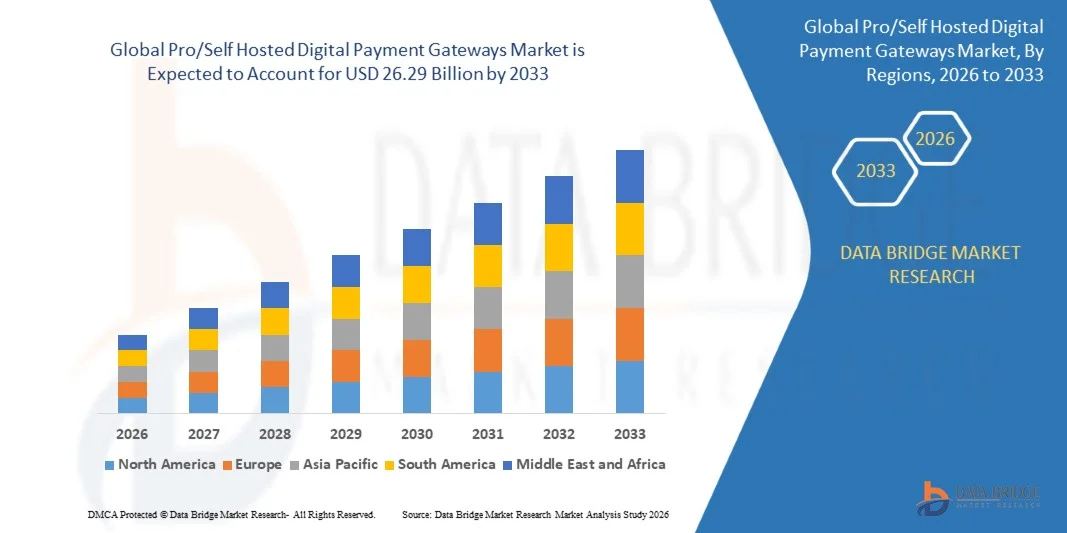
- As per Data Bridge Market Research Analysis the global pro/self hosted digital payment gateways market size was valued at USD 10.46 billion in 2025 and is expected to reach USD 26.29 billion by 2033, at a CAGR of 12.20% during the forecast period
- The market growth is largely fuelled by increasing e-commerce adoption, rising demand for secure and flexible payment processing solutions, and growing preference for direct control over payment infrastructure by merchants
- The proliferation of digital transactions, coupled with advancements in API-based integrations and enhanced fraud prevention features, is further supporting market expansion
Market Size & Forecast
Global Market Value (2025): USD 10.46 billion
Expected Market Value (2033): USD 26.29 billion
Forecast CAGR (2026–2033): 12.20%
What are the Major Takeaways of Pro/Self Hosted Digital Payment Gateways Market?
- Businesses and online merchants are increasingly adopting pro/self hosted gateways to reduce dependency on third-party processors, achieve lower transaction costs, and gain full control over payment data and security protocols
- The rise of omnichannel commerce, regulatory compliance requirements, and the need for customizable checkout experiences are driving demand for scalable and secure self-hosted payment solutions across various industries
- North America dominated the pro/self hosted digital payment gateways market with the largest revenue share of 38.5% in 2025, driven by the rapid adoption of e-commerce, growing digital payment volumes, and increasing demand for secure and customizable payment solutions
- Asia-Pacific region is expected to witness the highest growth rate in the global pro/self hosted digital payment gateways market, driven by rising smartphone usage, growing e-commerce penetration, and increasing investments in secure and integrated payment infrastructures in countries such as China, Japan, and India
- The Large Enterprises segment held the largest market revenue share in 2025, driven by high transaction volumes, multi-region operations, and the need for robust, secure, and customizable payment processing solutions. Large enterprises often benefit from centralized payment management, reduced dependency on third-party providers, and enhanced data security, making self-hosted gateways a preferred choice
Report Scope and Pro/Self Hosted Digital Payment Gateways Market Segmentation
|
Attributes |
Pro/Self Hosted Digital Payment Gateways Key Market Insights |
|
Segments Covered |
|
|
Countries Covered |
North America
Europe
Asia-Pacific
Middle East and Africa
South America
|
|
Key Market Players |
|
|
Market Opportunities |
• Growing Adoption Of E-Commerce And Online Transactions |
|
Value Added Data Infosets |
In addition to the market insights such as market value, growth rate, market segments, geographical coverage, market players, and market scenario, the market report curated by the Data Bridge Market Research team includes in-depth expert analysis, import/export analysis, pricing analysis, production consumption analysis, and pestle analysis. |
What is the Key Trend in the Pro/Self Hosted Digital Payment Gateways Market?
Rise of Customizable and Secure Payment Gateways
• The growing adoption of pro/self hosted digital payment gateways is transforming online and offline transaction processing by offering secure, real-time payment solutions. These platforms enable merchants to manage payments directly on their infrastructure, reducing dependency on third-party services and ensuring faster settlement cycles. They also allow businesses to maintain full control over payment data, optimize reconciliation processes, and implement customized fraud detection mechanisms. Enhanced transparency and reporting capabilities help organizations monitor transaction patterns and reduce operational risks, further improving confidence among merchants and customers alike
• Increasing demand for tailored payment solutions in e-commerce, retail, and subscription-based businesses is accelerating the implementation of self-hosted gateways. These platforms allow integration with multiple payment methods, enhancing customer convenience and operational efficiency. Merchants can also leverage advanced analytics and reporting to better understand customer behavior and improve decision-making. In addition, these solutions support omnichannel operations, allowing seamless payments across websites, mobile apps, and physical stores. The flexibility to implement custom workflows ensures businesses can comply with regional regulations while maintaining consistent customer experience
• The scalability and reliability of modern payment gateways are making them attractive for businesses of all sizes. Merchants benefit from enhanced data security, reduced transaction fees, and improved user experience, ultimately boosting customer retention and transaction volumes. Cloud-based backup and failover options further reduce downtime, ensuring continuous operations during peak traffic periods or unexpected outages. Businesses can also easily expand into new regions or accept additional payment methods without investing heavily in new infrastructure. The combination of reliability, efficiency, and cost-effectiveness makes these solutions essential for modern digital commerce
• For instance, in 2023, several mid-sized e-commerce platforms in North America adopted self-hosted payment gateways to centralize payment processing, resulting in faster checkouts, reduced fraud risk, and improved financial control. Companies reported improved reconciliation times, fewer transaction disputes, and enhanced customer trust due to secure and reliable payment processing. This adoption also enabled them to integrate loyalty programs and subscription billing, driving customer engagement and repeat purchases. The success of these implementations demonstrated the business value of self-hosted gateways in optimizing both operational efficiency and revenue growth
• While adoption of pro/self hosted gateways is increasing, their effectiveness depends on secure implementation, integration capabilities, and ongoing system maintenance. Providers must focus on compliance, scalability, and robust infrastructure to fully capture market potential. Continuous monitoring, regular software updates, and advanced encryption protocols are critical to maintaining operational security. Companies also need to invest in employee training to manage gateway platforms efficiently and handle potential technical issues promptly. Adoption success hinges on the ability to balance flexibility, security, and user experience in a rapidly evolving digital payment ecosystem
Pro/Self Hosted Digital Payment Gateways Market Dynamics
Driver
Increasing Digital Transactions and Demand for Secure Payment Solutions
• The exponential growth of online commerce and digital payment adoption is driving businesses to implement pro/self hosted payment gateways to manage high transaction volumes efficiently. Secure and reliable payment processing is critical for maintaining customer trust and business continuity. Organizations are also leveraging these platforms to reduce dependency on third-party processors and enhance data governance. Payment gateways provide real-time transaction visibility, enabling better fraud detection and risk mitigation across business operations
• Merchants are seeking integrated solutions that support multiple payment methods, recurring billing, and cross-border transactions, which increases demand for customizable and scalable gateway platforms. Self-hosted gateways allow businesses to tailor payment workflows to suit diverse customer segments, business models, and international regulations. The ability to support multi-currency and multi-lingual transactions strengthens the global reach of organizations. These features not only improve customer satisfaction but also help businesses capture new markets efficiently
• Regulatory requirements related to data privacy, PCI-DSS compliance, and fraud prevention are further propelling adoption, as businesses prioritize secure, compliant payment environments. Organizations implementing self-hosted gateways can directly enforce compliance measures, reducing the risk of fines and reputational damage. Auditing and reporting features provide transparency to regulators, ensuring adherence to stringent financial standards. Businesses gain a competitive advantage by demonstrating robust security and compliance, which enhances credibility with partners, customers, and investors alike
• For instance, in 2022, several European retail chains upgraded to self-hosted payment gateways to ensure compliance with GDPR while streamlining transaction processing, resulting in enhanced operational efficiency and reduced risk exposure. The deployment also enabled integration with enterprise resource planning (ERP) systems, improving financial reconciliation and inventory management. Retailers reported higher transaction success rates and faster settlement times, which strengthened customer confidence and loyalty. The case highlighted the strategic value of self-hosted gateways in supporting both compliance and operational excellence
• While growth is fueled by digital commerce expansion, businesses must continually update security protocols, ensure system reliability, and maintain compliance with evolving regulations to maximize benefits. Proactive monitoring, regular vulnerability testing, and timely system upgrades are essential for minimizing cyber risks. Companies are also increasingly adopting AI-driven fraud detection and analytics to further protect transactions. The ability to balance scalability, security, and compliance is critical for long-term success in the digital payment gateway market
Restraint/Challenge
High Setup Costs and Technical Complexity for Self-Hosted Solutions
• Implementing self-hosted payment gateways often involves significant initial investment in infrastructure, security measures, and IT expertise, making it challenging for small and medium enterprises to adopt. High setup costs remain a key barrier to entry. Businesses may also require ongoing technical support to ensure smooth operation, which increases operational expenditure. This can deter adoption, particularly among startups and cost-sensitive organizations
• Technical complexity in integrating gateways with existing e-commerce platforms, ERP systems, and multiple payment providers can slow deployment and increase maintenance requirements. Continuous monitoring and troubleshooting are needed to prevent downtime or transactional errors. Improper integration may lead to payment failures, lost revenue, or customer dissatisfaction. Organizations must invest in skilled IT staff or external consultants to manage system deployment and maintenance effectively
• Cybersecurity risks and the need for ongoing compliance with financial regulations make self-hosted solutions more resource-intensive compared to fully managed payment services. Businesses must invest in skilled personnel and robust systems to mitigate vulnerabilities. Encryption, firewalls, and continuous security audits are mandatory to prevent data breaches. Regulatory changes may require system modifications, adding further complexity and costs for enterprises
• For instance, in 2023, several SMEs in Asia-Pacific delayed implementation of self-hosted payment gateways due to setup costs and technical challenges, limiting immediate adoption despite growing e-commerce demand. Companies struggled with initial infrastructure investments and lacked trained personnel for effective deployment. This delayed adoption slowed their ability to compete with larger enterprises leveraging secure, high-performance payment gateways
• While technology continues to advance, addressing cost, complexity, and security concerns is essential. Providers and businesses must focus on user-friendly, secure, and scalable solutions to unlock long-term market growth for pro/self hosted digital payment gateways. Emphasis on pre-configured, modular gateway solutions and managed deployment services can help mitigate adoption challenges. Businesses that successfully overcome these barriers stand to gain enhanced operational efficiency, customer satisfaction, and revenue growth
How is the Pro/Self Hosted Digital Payment Gateways Market Segmented?
The market is segmented on the basis of application and end user.
• By Application
On the basis of application, the pro/self hosted digital payment gateways market is segmented into Micro and Small Enterprises, Large Enterprises, and Mid-Size Enterprises. The Large Enterprises segment held the largest market revenue share in 2025, driven by high transaction volumes, multi-region operations, and the need for robust, secure, and customizable payment processing solutions. Large enterprises often benefit from centralized payment management, reduced dependency on third-party providers, and enhanced data security, making self-hosted gateways a preferred choice.
The Micro and Small Enterprises segment is expected to witness the fastest growth rate from 2026 to 2033, fueled by the increasing adoption of digital commerce, mobile payments, and subscription-based business models. Self-hosted solutions enable smaller businesses to maintain control over transactions, optimize operational costs, and integrate multiple payment methods efficiently. The scalability, flexibility, and ease of implementation make these gateways highly attractive for small businesses seeking reliable and secure payment processing.
• By End User
On the basis of end user, the pro/self hosted digital payment gateways market is segmented into BFSI, Media & Entertainment, Retail & E-commerce, Travel & Hospitality, and Others. The Retail & E-commerce segment held the largest market revenue share in 2025, driven by the exponential growth of online shopping, digital payments, and subscription services. Merchants leverage self-hosted gateways to ensure secure transactions, streamline checkout processes, and support multiple payment methods, enhancing customer satisfaction and retention.
The BFSI segment is expected to witness the fastest growth rate from 2026 to 2033, fueled by the increasing adoption of digital banking, fintech solutions, and cross-border payment services. Financial institutions are deploying self-hosted gateways to improve transaction control, reduce operational risks, and comply with regulatory standards. The ability to integrate with existing core banking systems and provide real-time monitoring further strengthens adoption among BFSI organizations.
Which Region Holds the Largest Share of the Pro/Self Hosted Digital Payment Gateways Market?
• North America dominated the pro/self hosted digital payment gateways market with the largest revenue share of 38.5% in 2025, driven by the rapid adoption of e-commerce, growing digital payment volumes, and increasing demand for secure and customizable payment solutions
• Businesses in the region highly value the ability to directly manage transactions, integrate multiple payment methods, and ensure faster settlement cycles, enhancing operational efficiency and customer trust
• This widespread adoption is further supported by advanced IT infrastructure, high internet penetration, and strong regulatory frameworks, establishing self-hosted payment gateways as a preferred solution across micro, small, and large enterprises
U.S. Pro/Self Hosted Digital Payment Gateways Market Insight
The U.S. market captured the largest revenue share in North America in 2025, fueled by the surge in online retail, subscription-based services, and mobile payments. Companies are increasingly investing in secure and scalable self-hosted payment platforms to handle high transaction volumes efficiently. The demand for seamless integration with ERP systems, fraud prevention tools, and multi-currency support is further driving market growth. In addition, fintech innovations and government initiatives to promote digital payments are significantly contributing to the market’s expansion.
Europe Pro/Self Hosted Digital Payment Gateways Market Insight
The Europe market is expected to witness the fastest growth rate from 2026 to 2033, primarily driven by growing e-commerce penetration, stricter data security regulations, and the need for compliant payment processing. Enterprises are adopting self-hosted gateways to ensure GDPR compliance and secure online transactions. The region is witnessing strong growth across retail, BFSI, and travel sectors, with businesses favoring platforms that offer real-time payment tracking, fraud management, and operational efficiency.
U.K. Pro/Self Hosted Digital Payment Gateways Market Insight
The U.K. market is expected to witness the fastest growth rate from 2026 to 2033, supported by increasing online shopping, digital service subscriptions, and cross-border transactions. Concerns over payment security and fraud prevention are motivating businesses to adopt self-hosted payment solutions. The country’s robust e-commerce ecosystem and technologically advanced financial infrastructure are expected to continue stimulating market growth.
Germany Pro/Self Hosted Digital Payment Gateways Market Insight
The Germany market is expected to witness the fastest growth rate from 2026 to 2033 due to high digital literacy, strong IT infrastructure, and regulatory focus on secure financial transactions. Businesses are increasingly leveraging self-hosted gateways to gain better control over transaction data, reduce dependency on third-party processors, and enhance customer experience. Integration with existing enterprise systems and compliance with EU financial regulations are key factors driving adoption.
Asia-Pacific Pro/Self Hosted Digital Payment Gateways Market Insight
The Asia-Pacific market is expected to witness the fastest growth rate from 2026 to 2033, driven by rapid digitalization, rising e-commerce activities, and increasing adoption of mobile payments in countries like China, India, and Japan. The expansion of internet infrastructure, growing middle-class population, and government initiatives promoting cashless economies are accelerating the use of self-hosted payment gateways. APAC is also emerging as a hub for gateway technology development, improving affordability and accessibility for businesses of all sizes.
Japan Pro/Self Hosted Digital Payment Gateways Market Insight
The Japan market is expected to witness the fastest growth rate from 2026 to 2033 due to widespread digital adoption, high smartphone penetration, and the increasing demand for secure and convenient payment processing. Businesses in retail, hospitality, and fintech sectors are investing in self-hosted gateways to enhance transaction security and operational efficiency. The integration with mobile wallets, point-of-sale systems, and e-commerce platforms is further driving market growth.
China Pro/Self Hosted Digital Payment Gateways Market Insight
The China market accounted for the largest revenue share in APAC in 2025, supported by rapid e-commerce growth, rising online retail transactions, and increasing adoption of digital payment infrastructure. The availability of affordable gateway solutions, combined with strong domestic technology providers, is boosting adoption across micro, small, and large enterprises. The government’s push toward digital payments and smart city initiatives is also playing a significant role in driving market expansion.
hich are the Top Companies in Pro/Self Hosted Digital Payment Gateways Market?
The Pro/Self Hosted Digital Payment Gateways industry is primarily led by well-established companies, including:
- Alipay (China)
- Amazon, Inc. (U.S.)
- Wirecard (Germany)
- PesoPay (Malaysia)
- PayU (Netherlands)
- PayPal (U.S.)
- Paymill (Germany)
- MOLPay (Malaysia)
- eWAY AU (Australia)
- Net (Sweden)
- Worldpay (U.K.)
- Beanstream (Canada)
- Stripe (U.S.)
- Klarna (Sweden)
- Realex (Ireland)
- CashU (U.A.E.)
- WebMoney (Russia)
- Pagosonline (Colombia)
- 99bill (China)
- MyGate (South Africa)
- ServiRed (Spain)
- Payson (Sweden)
- Cardstream (U.K.)
- Sage Pay (U.K.)
- e-Path (Australia)
- NAB Transact (Australia)
- MercadoPago (Argentina)
- CCBill (U.S.)

- Interactive Data Analysis Dashboard
- Company Analysis Dashboard for high growth potential opportunities
- Research Analyst Access for customization & queries
- Competitor Analysis with Interactive dashboard
- Latest News, Updates & Trend analysis
- Harness the Power of Benchmark Analysis for Comprehensive Competitor Tracking
Data collection and base year analysis are done using data collection modules with large sample sizes. The stage includes obtaining market information or related data through various sources and strategies. It includes examining and planning all the data acquired from the past in advance. It likewise envelops the examination of information inconsistencies seen across different information sources. The market data is analysed and estimated using market statistical and coherent models. Also, market share analysis and key trend analysis are the major success factors in the market report. To know more, please request an analyst call or drop down your inquiry.
The key research methodology used by DBMR research team is data triangulation which involves data mining, analysis of the impact of data variables on the market and primary (industry expert) validation. Data models include Vendor Positioning Grid, Market Time Line Analysis, Market Overview and Guide, Company Positioning Grid, Patent Analysis, Pricing Analysis, Company Market Share Analysis, Standards of Measurement, Global versus Regional and Vendor Share Analysis. To know more about the research methodology, drop in an inquiry to speak to our industry experts.
Data Bridge Market Research is a leader in advanced formative research. We take pride in servicing our existing and new customers with data and analysis that match and suits their goal. The report can be customized to include price trend analysis of target brands understanding the market for additional countries (ask for the list of countries), clinical trial results data, literature review, refurbished market and product base analysis. Market analysis of target competitors can be analyzed from technology-based analysis to market portfolio strategies. We can add as many competitors that you require data about in the format and data style you are looking for. Our team of analysts can also provide you data in crude raw excel files pivot tables (Fact book) or can assist you in creating presentations from the data sets available in the report.













