What is the Probiotics in Poultry Market Size and Growth Rate?
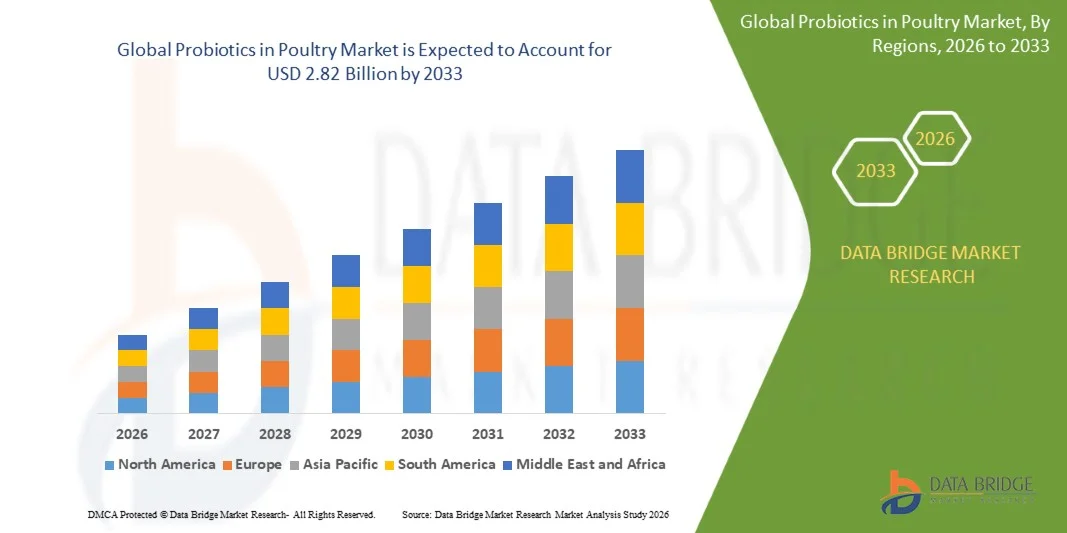
- As per Data Bridge Market Research analysis the probiotics in poultry market was valued at USD 1.57 billion in 2025 and is projected to reach USD 2.82 billion by 2033, growing at a CAGR of 7.60% from 2026 to 2033.
- The market is experiencing steady growth driven by increasing demand for natural feed additives, growing awareness of poultry gut health, and the rising adoption of probiotics to improve animal performance, immunity, and feed efficiency.
- The growing focus on reducing antibiotic use in poultry production, coupled with increasing consumer demand for antibiotic-free poultry products and stricter regulations on antibiotic growth promoters, is encouraging poultry producers to adopt probiotic-based feed solutions.
Market Size & Forecast
- Market Value (2025): USD 1.57 Billion
- Expected Market Value (2033): USD 2.82 Billion
- Forecast CAGR (2026–2033): 7.60%
- Leading Region in 2025: North America
- Fastest Growing Region: Asia-Pacific
What are the Major Takeaways of the Probiotics in Poultry Market?
- North America dominated the probiotics in poultry market with the largest revenue share in 2025, supported by the well-established poultry industry, increasing demand for antibiotic-free poultry products, and growing awareness of animal gut health.
- Asia-Pacific probiotics in poultry market is expected to witness the fastest growth rate from 2026 to 2033, supported by expanding poultry production, rising demand for animal protein, increasing disposable incomes, and growing awareness of poultry health management in countries such as China, India, and Japan.
- The Lactobacillus segment held the largest market revenue share in 2025 driven by its widespread use in poultry feed to maintain intestinal microbial balance, improve digestion, and support immune function. Lactobacillus probiotics are preferred due to their ability to promote beneficial gut bacteria and improve overall bird health and feed efficiency.
- The Bacillus segment is projected to register the fastest growth at a CAGR from 2026 to 2033, driven by increasing demand for heat-stable probiotic strains that can withstand feed processing and storage conditions. Rising adoption of Bacillus-based solutions in commercial poultry production is accelerating segment expansion.
- The dry segment held the largest market revenue share in 2025 driven by its extended shelf life, ease of handling, and compatibility with commercial poultry feed manufacturing. Dry probiotics are widely preferred due to their stability during storage, transportation, and feed processing applications.
- The liquid segment is projected to register the fastest growth at a CAGR from 2026 to 2033, driven by increasing adoption of probiotics through drinking-water systems and the growing need for convenient supplementation during periods of stress and disease challenges. Rising use of liquid probiotic formulations for rapid and uniform delivery is accelerating segment expansion.
Report Scope and Probiotics in Poultry Market Segmentation
|
Attributes |
Probiotics in Poultry Key Market Insights |
|
Segments Covered |
|
|
Countries Covered |
North America
Europe
Asia-Pacific
Middle East and Africa
South America
|
|
Key Market Players |
|
|
Market Opportunities |
|
|
Value Added Data Infosets |
In addition to the insights on market scenarios such as market value, growth rate, segmentation, geographical coverage, and major players, the market reports curated by the Data Bridge Market Research also include import export analysis, production capacity overview, production consumption analysis, price trend analysis, climate change scenario, supply chain analysis, value chain analysis, raw material/consumables overview, vendor selection criteria, PESTLE Analysis, Porter Analysis, and regulatory framework. |
What is the Key Trend in the Probiotics in Poultry Market?
- Poultry producers are increasingly adopting spore-forming probiotics to support intestinal microbial balance, improve feed efficiency, and strengthen bird resilience while reducing reliance on antibiotic growth promoters.
- For instance, in April 2025, Evonik introduced its poultry-focused Ecobiol probiotic in mainland China, marking the first registered feed-grade Bacillus subtilis product from the company in the country. Evonik stated that the product can improve feed conversion, reduce mortality, and enhance animal performance under challenging conditions.
- Advanced probiotic formulations are increasingly designed to provide greater stability during feed processing and faster activation in the poultry intestine, supporting consistent performance across commercial production systems. Evonik's Ecobiol PRO, for instance, is designed to germinate an average of 46% faster than other spore-forming probiotic products.
- Poultry producers are also adopting water-soluble probiotic delivery systems to provide rapid gut-health support during stressful periods, including periods of low feed intake and production challenges.
- For instance, Evonik's Ecobiol PRO Fizz is an effervescent probiotic tablet applied directly through poultry drinking-water systems, enabling homogeneous distribution of probiotic spores without biofilm formation or clogging in water lines.
- As poultry producers increasingly prioritize antibiotic-free production, gut health, and feed efficiency, the development of stable, fast-acting, and convenient probiotic solutions is expected to remain a key trend in the global probiotics in poultry market.
What are the Key Drivers of the Probiotics in Poultry Market?
- The growing need to reduce antibiotic use in poultry production is significantly increasing demand for probiotics as natural feed additives that support gut health, microbial balance, and animal performance.
- For instance, in June 2026, Evonik reported that 73% of antibiotics used globally are administered in livestock production and highlighted probiotics as an important approach for reducing antibiotic use in animal production. The company also stated that global sales of probiotics in animal feed reached around USD 4 billion in 2025, growing at approximately 7% annually.
- Increasing concerns regarding antimicrobial resistance, together with the expansion of antibiotic-free poultry production, are encouraging feed manufacturers and poultry producers to incorporate probiotics into nutrition programs.
- For instance, Evonik's GutCare probiotic is based on a spore-forming Bacillus subtilis strain and is designed to support beneficial microbial populations in poultry. Its published meta-analysis of necrotic-enteritis challenge trials reported an 8% improvement in weight gain, a 5% improvement in feed conversion ratio, and a 7% reduction in mortality.
- With increasing pressure to improve poultry productivity while reducing antibiotic dependence and maintaining intestinal health, probiotics are expected to remain an important component of modern poultry nutrition strategies.
Which Factors are Challenging the Growth of the Probiotics in Poultry Market?
- The effectiveness of probiotics can vary depending on bacterial strain, dosage, feed composition, storage conditions, production environment, and the health status of poultry, making consistent performance a major challenge for producers.
- Differences in probiotic stability during feed processing and storage can affect the survival and activity of beneficial microorganisms, particularly when products are exposed to high temperatures during pelleting.
- For instance, Evonik highlights that its GutPlus probiotic is specifically designed to withstand pelleted-feed processing and has demonstrated stability in pelleted feed at temperatures of up to 85°C for one minute, illustrating the importance of thermal stability in probiotic applications.
- The need for strain-specific validation, controlled dosing, suitable storage, and compatibility with other feed additives increases the technical requirements for successful probiotic implementation across different poultry production systems.
- These formulation, stability, and performance-consistency challenges can increase product development and quality-control requirements, potentially limiting adoption among smaller producers and in price-sensitive poultry markets despite the growing demand for antibiotic-free and gut-health-focused production.
How is the Probiotics in Poultry Market Segmented?
The market is segmented on the basis of product, form, function, and application.
- By Product
On the basis of product, the probiotics in poultry market is segmented into Lactobacillus, Streptococcus, Bacillus, and Bifidobacterium. The Lactobacillus segment held the largest market revenue share in 2025 driven by its widespread use in poultry feed to maintain intestinal microbial balance, improve digestion, and support immune function. Lactobacillus probiotics are preferred due to their ability to promote beneficial gut bacteria and improve overall bird health and feed efficiency.
The Bacillus segment is projected to register the fastest growth at a CAGR from 2026 to 2033, driven by increasing demand for heat-stable probiotic strains that can withstand feed processing and storage conditions. Rising adoption of Bacillus-based solutions in commercial poultry production is accelerating segment expansion.
- By Form
On the basis of form, the probiotics in poultry market is segmented into dry and liquid. The dry segment held the largest market revenue share in 2025 driven by its extended shelf life, ease of handling, and compatibility with commercial poultry feed manufacturing. Dry probiotics are widely preferred due to their stability during storage, transportation, and feed processing applications.
The liquid segment is projected to register the fastest growth at a CAGR from 2026 to 2033, driven by increasing adoption of probiotics through drinking-water systems and the growing need for convenient supplementation during periods of stress and disease challenges. Rising use of liquid probiotic formulations for rapid and uniform delivery is accelerating segment expansion.
- By Function
On the basis of function, the probiotics in poultry market is segmented into nutrition, gut health, yield, immunity, and productivity. The gut health segment held the largest market revenue share in 2025 driven by increasing awareness of intestinal microbiota management and the role of probiotics in improving digestion and nutrient absorption. Probiotics are increasingly used to maintain microbial balance and support healthy intestinal function in poultry.
The immunity segment is projected to register the fastest growth at a CAGR from 2026 to 2033, driven by increasing concerns regarding poultry diseases, antimicrobial resistance, and the need for natural health-supporting feed additives. Rising adoption of probiotics to strengthen immune response and improve bird resilience is accelerating segment expansion.
- By Application
On the basis of application, the probiotics in poultry market is segmented into broilers, layers, turkeys, breeders, chicks, and poults. The broilers segment held the largest market revenue share in 2025 driven by the large-scale production of broiler chickens and increasing demand for improved feed conversion, weight gain, and overall growth performance. Probiotics are widely incorporated into broiler nutrition programs to support gut health and optimize production efficiency.
The layers segment is projected to register the fastest growth at a CAGR from 2026 to 2033, driven by increasing demand for improved egg production, bird health, and productivity. Rising adoption of probiotics to support intestinal health, nutrient utilization, and immune function in laying birds is accelerating segment expansion.
Which Region Holds the Largest Share of the Probiotics in Poultry Market?
- North America dominated the probiotics in poultry market with the largest revenue share in 2025, supported by the well-established poultry industry, increasing demand for antibiotic-free poultry products, and growing awareness of animal gut health.
- Poultry producers in the region are increasingly adopting probiotics to improve feed efficiency, immunity, digestion, and overall bird performance. The presence of advanced feed manufacturing facilities, strong research and development activities, and growing concerns regarding antimicrobial resistance further supports the adoption of probiotic solutions across commercial poultry production.
U.S. Probiotics in Poultry Market Insight
U.S. probiotics in poultry market captured the largest revenue share in 2025 within North America, fueled by the country's large-scale poultry production and increasing shift toward antibiotic-free animal production. Poultry producers are increasingly incorporating probiotics into feed and drinking-water programs to support intestinal health, nutrient absorption, and productivity. Moreover, growing consumer preference for naturally produced and antibiotic-free poultry products, combined with increasing investments in animal nutrition research, is significantly contributing to market expansion.
Europe Probiotics in Poultry Market Insight
Europe probiotics in poultry market is expected to witness the fastest growth rate from 2026 to 2033, primarily driven by stringent regulations concerning antibiotic use in animal production and increasing demand for sustainable poultry farming practices. The growing emphasis on antimicrobial resistance prevention is encouraging producers to adopt probiotics as alternatives to antibiotic growth promoters. Furthermore, rising consumer awareness regarding animal welfare, food safety, and antibiotic-free meat and eggs is fostering the use of probiotic-based poultry nutrition solutions across the region.
U.K. Probiotics in Poultry Market Insight
U.K. probiotics in poultry market is expected to witness the fastest growth rate from 2026 to 2033, driven by increasing restrictions on antibiotic use, growing demand for sustainable poultry production, and rising awareness of gut health management. Poultry producers are increasingly using probiotics to improve bird performance and maintain intestinal microbial balance while reducing dependence on antibiotics. Additionally, the growing consumer preference for responsibly produced and antibiotic-free poultry products is expected to continue stimulating market growth.
Germany Probiotics in Poultry Market Insight
Germany probiotics in poultry market is expected to witness the fastest growth rate from 2026 to 2033, fueled by increasing emphasis on sustainable livestock production, antimicrobial resistance reduction, and advanced animal nutrition. Germany's well-developed poultry and feed industries, combined with strong regulatory focus on responsible antibiotic use, promote the adoption of probiotic feed additives. The increasing preference for scientifically validated and environmentally sustainable poultry nutrition solutions is also supporting market expansion.
Asia-Pacific Probiotics in Poultry Market Insight
The Asia-Pacific probiotics in poultry market is expected to witness the fastest growth rate from 2026 to 2033, supported by expanding poultry production, rising demand for animal protein, increasing disposable incomes, and growing awareness of poultry health management in countries such as China, India, and Japan. The region's rapidly developing livestock sector is encouraging producers to adopt probiotics to improve feed efficiency, growth performance, and disease resistance. Furthermore, increasing concerns regarding antibiotic resistance and the expansion of commercial poultry farming are creating significant opportunities for probiotic manufacturers across the region.
Japan Probiotics in Poultry Market Insight
Japan probiotics in poultry market is expected to witness the fastest growth rate from 2026 to 2033 due to the country's advanced poultry production systems, emphasis on food safety, and growing adoption of scientifically developed animal nutrition products. Japanese poultry producers are increasingly focusing on maintaining gut health and improving feed efficiency through functional feed additives such as probiotics. Moreover, the country's strong focus on quality, productivity, and sustainable livestock production is supporting demand for advanced probiotic solutions.
China Probiotics in Poultry Market Insight
The China probiotics in poultry market accounted for the largest market revenue share in Asia Pacific in 2025, attributed to the country's large poultry population, expanding commercial poultry industry, and increasing demand for efficient animal nutrition. China is one of the world's major poultry producers, creating substantial demand for feed additives that can improve bird health, productivity, and feed utilization. The growing emphasis on reducing antibiotic use, improving food safety, and developing modern livestock production systems, alongside the presence of domestic feed additive manufacturers, is further propelling market growth in China.
Which are the Top Companies in Probiotics in Poultry Market?
The probiotics in poultry industry is primarily led by well-established companies, including:
- Chr. Hansen A/S (Denmark)
- dsm-firmenich AG (Switzerland)
- Adisseo (France)
- Evonik Industries AG (Germany)
- Kerry Group plc (Ireland)
- Lallemand Inc. (Canada)
- Lesaffre (France)
- Alltech (U.S.)
- Novus International, Inc. (U.S.)
- Novonesis A/S (Denmark)
- Unique Biotech (India)
- Provita Eurotech Ltd. (U.K.)
- Land O'Lakes, Inc. (U.S.)
- Suguna Foods Private Limited (India)
- ASAHI GROUP HOLDINGS, LTD. (Japan)

- Interactive Data Analysis Dashboard
- Company Analysis Dashboard for high growth potential opportunities
- Research Analyst Access for customization & queries
- Competitor Analysis with Interactive dashboard
- Latest News, Updates & Trend analysis
- Harness the Power of Benchmark Analysis for Comprehensive Competitor Tracking
Data collection and base year analysis are done using data collection modules with large sample sizes. The stage includes obtaining market information or related data through various sources and strategies. It includes examining and planning all the data acquired from the past in advance. It likewise envelops the examination of information inconsistencies seen across different information sources. The market data is analysed and estimated using market statistical and coherent models. Also, market share analysis and key trend analysis are the major success factors in the market report. To know more, please request an analyst call or drop down your inquiry.
The key research methodology used by DBMR research team is data triangulation which involves data mining, analysis of the impact of data variables on the market and primary (industry expert) validation. Data models include Vendor Positioning Grid, Market Time Line Analysis, Market Overview and Guide, Company Positioning Grid, Patent Analysis, Pricing Analysis, Company Market Share Analysis, Standards of Measurement, Global versus Regional and Vendor Share Analysis. To know more about the research methodology, drop in an inquiry to speak to our industry experts.
Data Bridge Market Research is a leader in advanced formative research. We take pride in servicing our existing and new customers with data and analysis that match and suits their goal. The report can be customized to include price trend analysis of target brands understanding the market for additional countries (ask for the list of countries), clinical trial results data, literature review, refurbished market and product base analysis. Market analysis of target competitors can be analyzed from technology-based analysis to market portfolio strategies. We can add as many competitors that you require data about in the format and data style you are looking for. Our team of analysts can also provide you data in crude raw excel files pivot tables (Fact book) or can assist you in creating presentations from the data sets available in the report.