What is the Probiotics in Ruminants Market Size and Growth Rate?
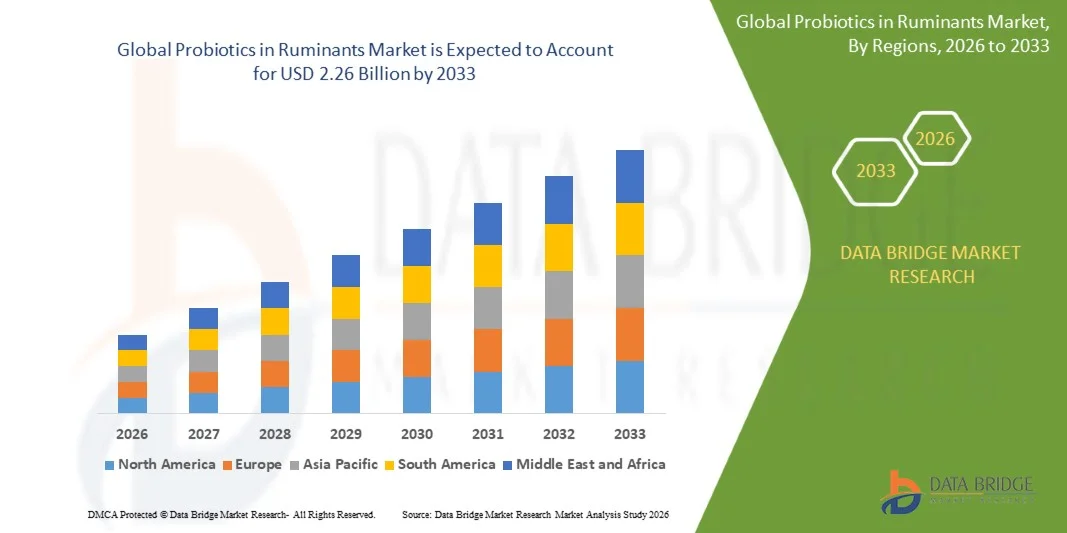
- As per Data Bridge Market Research analysis, the probiotics in ruminants market was valued at USD 1.13 billion in 2025 and is projected to reach USD 2.26 billion by 2033, growing at a CAGR of 9.85% from 2026 to 2033.
- The market is expanding rapidly on the back of tightening restrictions on antibiotic growth promoters in livestock production, rising global demand for dairy and beef products, and growing farmer awareness of the milk yield, feed efficiency, and animal health benefits delivered by science-validated probiotic strains.
- Probiotics in ruminants are live microbial feed additives, most commonly Bacillus species, lactic acid bacteria, and rumen-specific live yeasts such as Saccharomyces cerevisiae, supplemented into cattle, sheep, and goat diets to support rumen fermentation, fibre digestibility, gut barrier integrity, and immune function. Their commercial relevance is being reshaped by mounting regulatory and consumer pressure to reduce livestock methane emissions, positioning certain probiotic and direct-fed microbial strains as a dual-purpose solution for both productivity and environmental performance.
Market Size & Forecast
- Global Market Value (2025): USD 1.13 Billion
- Expected Market Value (2033): USD 2.26 Billion
- Forecast CAGR (2026–2033): 9.85%
- Leading Region in 2025: North America
- Fastest Growing Region: Asia-Pacific
What are the Major Takeaways of the Probiotics in Ruminants Market?
- North America dominated the global probiotics in ruminants market with the largest revenue share of 35.42% in 2025, supported by a large, technically advanced dairy and beef cattle industry, high farmer awareness of science-backed feed additives, and the concentration of leading probiotic developers headquartered in the region.
- Asia-Pacific is expected to be the fastest-growing region at a CAGR of 12.4% from 2026 to 2033, driven by rapidly expanding dairy herds in India and China, rising commercialisation of smallholder livestock operations, and growing regional regulatory pressure to curb antibiotic use in animal husbandry.
- The yeast-based probiotics segment led the product type category with a 38.67% share in 2025, owing to the well-established efficacy of rumen-specific live yeast strains in supporting fibre digestibility and buffering rumen pH, and their decades-long track record of peer-reviewed research in dairy and beef cattle.
- Bacillus-based probiotics are the fastest-growing product type, projected to register a CAGR of 11.6%, reflecting their heat and processing stability and growing adoption in feed-stable, ready-to-use dairy cow formulations.
- The dry/powder form segment dominated the form category with a 71.38% revenue share in 2025, favoured for its extended shelf stability, ease of incorporation into compound feed and premixes, and compatibility with pelleting processes.
- Dairy cattle accounted for 54.26% of the market in 2025, reflecting the direct and measurable link between rumen health and milk yield, but the calves & young stock life-stage segment is the fastest-growing category at a CAGR of 12.1%, as producers prioritise early-life gut health to reduce antibiotic reliance.
- The methane reduction functional segment is the fastest-growing function category, with a CAGR of 13.8%, driven by regulatory and dairy processor pressure on farms to demonstrate emission reduction alongside productivity gains.
Report Scope and Probiotics in Ruminants Market Segmentation
|
Attributes |
Probiotics in Ruminants Key Market Insights |
|
Segments Covered |
|
|
Countries Covered |
North America
Europe
Asia-Pacific
Middle East and Africa
South America
|
|
Key Market Players |
|
|
Market Opportunities |
|
|
Value Added Data Infosets |
In addition to the insights on market scenarios such as market value, growth rate, segmentation, geographical coverage, and major players, the market reports curated by the Data Bridge Market Research also include import export analysis, production capacity overview, production consumption analysis, price trend analysis, climate change scenario, supply chain analysis, value chain analysis, raw material/consumables overview, vendor selection criteria, PESTLE Analysis, Porter Analysis, and regulatory framework. |
What is the Key Trend in the Probiotics in Ruminants Market?
- Suppliers are increasingly consolidating multiple microbial modes of action into single combination products, allowing producers and feed mills to address rumen function, lower-gut health, and immune support with one formulation rather than managing several separate additives.
- This consolidation trend reduces formulation complexity for nutritionists and feed mills while improving consistency of results across variable on-farm conditions.
- For instance, in October 2025, Lallemand Animal Nutrition launched LEVUCELL Trivantage in the United States, an all-in-one feed supplement combining LEVUCELL SC live yeast for rumen efficiency and fibre digestion, PROTERNATIVE live yeast for lower-gut integrity and immune support, and the AGRIMOS yeast postbiotic to reinforce beneficial microbiota, positioned to give dairy and beef producers "nose-to-tail" digestive coverage in a single product.
- Regional market entry of well-established probiotic technologies is also accelerating, as suppliers extend proven strains into new geographies to meet local dairy productivity and margin pressures.
- For instance, in April 2026, Novonesis launched Bovacillus, described as Europe’s first Bacillus probiotic for lactating dairy cows, a heat-stable formulation able to withstand temperatures up to 95°C and be incorporated across pellets, premixes, total mixed rations, mineral blocks, and liquid feed systems, backed by nine peer-reviewed publications and five years of field data.
- As suppliers continue to combine multiple microbial technologies into single products and extend proven strains into new regional dairy markets, product consolidation and heat-stable formulation technology are expected to remain defining trends in ruminant probiotic development through the forecast period.
What are the Key Drivers of the Probiotics in Ruminants Market?
- Tightening global restrictions on antibiotic growth promoters in livestock production are compelling dairy and beef producers to adopt microbial alternatives capable of delivering comparable gut health and performance benefits without contributing to antimicrobial resistance.
- Rising feed costs, which typically account for 60 to 70% of total milk production expenses, are increasing farmer focus on feed efficiency technologies that allow more milk or growth to be extracted from the same quantity of feed.
- For instance, in April 2026, Novonesis reported that its newly launched Bovacillus probiotic delivers an additional one kilogram of milk per cow per day, along with increases of 37 grams of protein, 31 grams of fat, and 44 grams of lactose per cow per day, while improving feed efficiency by 3.7%, directly addressing the margin pressure faced by dairy farmers.
- Independent university and field research continues to strengthen the evidence base for specific probiotic strains, giving nutritionists and veterinarians confidence to recommend inclusion as a standard part of ration formulation, particularly under heat stress conditions.
- For instance, January 2025, a controlled study conducted at the University of Florida under heat stress conditions, using the rumen-specific live yeast Saccharomyces cerevisiae CNCM I-1077 supplied as LEVUCELL SC by Lallemand Animal Nutrition, demonstrated a 7.6% improvement in feed efficiency in heat-stressed dairy cows, findings subsequently used in a life cycle assessment that recorded a 6.1% reduction in the carbon footprint of milk production under the same conditions.
- With antibiotic restrictions tightening, feed costs remaining elevated, and a growing body of peer-reviewed research reinforcing strain-specific performance claims, probiotic adoption across dairy and beef cattle operations is expected to continue expanding steadily through the forecast period.
Which Factors are Challenging the Growth of the Probiotics in Ruminants Market?
- Probiotic strains, particularly live bacteria and yeast, are inherently sensitive to the heat, pressure, and mechanical stress generated during feed pelleting and high-temperature processing, which can significantly reduce viable organism counts by the time feed reaches the animal.
- Overcoming this challenge requires specialised microencapsulation and protective coating technologies, which add cost and manufacturing complexity relative to conventional feed additives, creating a barrier for smaller suppliers seeking to compete on processing-stable formulations.
- For instance, Lallemand Animal Nutrition has developed multiple protective formats for its LEVUCELL SC live yeast, including a vermicelli form for standard formulation processes, a MICROBEAD format engineered for mineral premixtures containing reactive ingredients such as copper and zinc, and a patented TITAN microencapsulation technology designed to shield the yeast from heat, pressure, and mechanical energy during pelleting, illustrating the depth of processing investment required to maintain probiotic viability at commercial scale.
- Demonstrating consistent, farm-level efficacy also remains challenging given the wide variability in diets, climates, and management practices across regions, requiring suppliers to generate extensive localized field data before farmers and nutritionists will adopt a product with confidence.
- The combined cost of protective processing technology, the scientific burden of proving strain-specific efficacy across diverse farming conditions, and the fragmented, farm-by-farm nature of adoption continue to slow the pace at which probiotic inclusion becomes standard practice across the full global ruminant population, particularly among smallholder producers in price-sensitive markets.
How is the Probiotics in Ruminants Market Segmented?
The probiotics in ruminants market is segmented on the basis of product type, form, livestock type, life stage, function, route of administration and distribution channel.
- By Product Type
On the basis of product type, the global probiotics in ruminants market is segmented into lactic acid bacteria, Bacillus-based probiotics, yeast-based probiotics, Bifidobacterium, and multi-strain blends. The yeast-based probiotics segment dominated the market with a 38.67% share in 2025, owing to the well-established efficacy of rumen-specific live yeast strains such as Saccharomyces cerevisiae in supporting fibre digestibility and rumen pH stability, and their long history of peer-reviewed research across dairy and beef cattle.
The Bacillus-based probiotics segment is projected to register the fastest growth at a CAGR of 11.6% from 2026 to 2033, driven by the superior heat and processing stability of Bacillus spores relative to many other microbial forms, supporting their growing use in feed-stable, ready-to-use dairy cow formulations that must withstand pelleting and variable storage conditions.
- By Form
On the basis of form, the global probiotics in ruminants market is segmented into dry/powder and liquid. The dry/powder segment dominated the market with a share of 71.38% in 2025, favoured for its extended shelf stability, ease of incorporation into compound feed, premixes, and mineral blocks, and compatibility with standard feed mill pelleting processes.
The liquid segment is expected to witness the fastest CAGR of 10.4% from 2026 to 2033, driven by rising use of liquid probiotic drenches and water-soluble formats for targeted intervention in calves and young stock, where rapid onset of action is particularly valued.
- By Livestock Type
On the basis of livestock type, the global probiotics in ruminants market is segmented into dairy cattle, beef cattle, sheep, goats, and other ruminants. The dairy cattle segment dominated the market with a share of 54.26% in 2025, reflecting the direct and highly measurable link between rumen health, feed efficiency, and milk yield, which gives dairy producers a clear and quantifiable return on probiotic investment.
The beef cattle segment is expected to witness the fastest CAGR of 10.3% from 2026 to 2033, driven by growing feedlot adoption of probiotics to support digestive and immune function during high-stress periods such as transport, weaning, and diet transition, where performance losses are costly.
- By Life Stage
On the basis of life stage, the global probiotics in ruminants market is segmented into calves & young stock, growing & finishing animals, and lactating & breeding animals. The lactating & breeding animals segment dominated the market with a share of 46.85% in 2025, reflecting the concentration of probiotic use in the life stage where feed efficiency and milk yield gains translate most directly into farm revenue.
The calves & young stock segment is expected to witness the fastest CAGR of 12.1% from 2026 to 2033, driven by rising producer focus on early-life gut health as a strategy to reduce antibiotic reliance and improve long-term herd productivity and disease resistance.
- By Function
On the basis of function, the global probiotics in ruminants market is segmented into gut health & digestive support, immunity & disease resistance, feed efficiency & milk yield enhancement, heat stress mitigation, and methane reduction. The feed efficiency & milk yield enhancement segment dominated the market with a share of 33.94% in 2025, reflecting the primary commercial justification producers cite for probiotic adoption.
The methane reduction segment is expected to witness the fastest CAGR of 13.8% from 2026 to 2033, driven by mounting regulatory and dairy processor pressure on farms to demonstrate progress on livestock emission reduction targets, positioning certain probiotic and direct-fed microbial technologies as a dual productivity and sustainability solution.
- By Route of Administration
On the basis of route of administration, the global probiotics in ruminants market is segmented into feed premix, water-soluble, and direct-fed boluses & drenches. The feed premix segment dominated the market with a share of 62.17% in 2025, owing to its seamless integration into existing compound feed manufacturing and ration formulation processes at both feed mill and farm level.
The direct-fed boluses & drenches segment is expected to witness the fastest CAGR of 9.7% from 2026 to 2033, driven by rising demand for targeted, rapid-intervention probiotic dosing in calves and animals under acute stress, where waiting for the next feed cycle is not practical.
- By Distribution Channel
On the basis of distribution channel, the global probiotics in ruminants market is segmented into veterinary clinics, feed mills & compound feed manufacturers, farm & cooperative stores, and online/direct-to-farm. The feed mills & compound feed manufacturers segment dominated the market with a share of 48.93% in 2025, reflecting the central role of industrial feed formulation in probiotic inclusion at commercial scale across dairy and beef operations.
The online/direct-to-farm segment is expected to witness the fastest CAGR of 11.2% from 2026 to 2033, driven by growing direct engagement between probiotic suppliers and farmers through digital ordering platforms, particularly for smaller and independent producers seeking to bypass traditional distribution layers.
Which Region Holds the Largest Share of the Probiotics in Ruminants Market?
- North America dominated the probiotics in ruminants market and accounted for the largest revenue share of 35.42% in 2025, supported by a large, technically advanced dairy and beef cattle industry, high farmer and nutritionist awareness of science-backed feed additives, and the concentration of leading global probiotic developers headquartered in the region.
- The region also benefits from an established regulatory and research infrastructure that supports rapid clinical validation and adoption of new probiotic strains, along with sustained commercial pressure on producers to improve feed efficiency amid persistently high input costs. Continued new product launches by regionally headquartered suppliers are expected to reinforce North America’s leadership through the forecast period.
U.S. Probiotics in Ruminants Market Insight
The U.S. probiotics in ruminants market holds the leading position within North America, underpinned by the scale of the domestic dairy and beef cattle industry and the concentration of major probiotic and direct-fed microbial developers in the country. U.S. producers show strong and growing adoption of combination probiotic products that consolidate multiple modes of action, supported by an extensive body of university and field research validating strain-specific performance claims. Continued new product launches, including all-in-one gut health formulations for both dairy and beef segments, are reinforcing the country’s position as the primary innovation and commercialisation hub for the category.
Canada Probiotics in Ruminants Market Insight
Canada’s probiotics in ruminants market is supported by a well-established dairy and beef industry, increasing emphasis on animal gut health, feed efficiency, and sustainable livestock production. Probiotic solutions are gaining attention as producers seek alternatives that can support animal performance while reducing dependence on antimicrobial inputs. Canada’s strong agricultural infrastructure, food-safety standards, and research capabilities also support market development. Regulatory recognition of probiotic microorganisms for dairy and beef cattle further provides opportunities for specialized ruminant-feed formulations.
Asia-Pacific Probiotics in Ruminants Market Insight
The Asia-Pacific probiotics in ruminants market is expected to witness the fastest growth globally, driven by rapidly expanding dairy herds in India and China, growing commercialisation of smallholder livestock operations, and increasing regional regulatory attention to antibiotic use in animal husbandry. Rising dairy consumption and government-backed livestock productivity programmes across the region are creating substantial headroom for probiotic adoption, while multinational suppliers are expanding local distribution and technical support capacity to serve this demand.
China Probiotics in Ruminants Market Insight
China’s probiotics in ruminants market is developing alongside modernization of dairy farming, growing demand for animal productivity, and increasing emphasis on gut health and feed efficiency. Probiotics are being incorporated into ruminant nutrition strategies to support digestion, nutrient utilization, and animal health. Ruminant applications are projected to expand as Chinese producers adopt more precision-nutrition practices and functional feed additives. However, price sensitivity among smaller farms and regulatory requirements for new probiotic strains can influence adoption.
India Probiotics in Ruminants Market Insight
The India probiotics in ruminants market is expanding rapidly, supported by the scale of the country’s dairy cattle and buffalo population and rising farmer awareness of feed efficiency and gut health products. Government dairy productivity initiatives and growing cooperative dairy sector investment are accelerating adoption of science-backed feed additives among small and medium-sized producers, while multinational and domestic suppliers continue to expand product availability and technical outreach across rural markets.
Which are the Top Companies in Probiotics in Ruminants Market?
The probiotics in ruminants industry is primarily led by well-established companies, including:
- Novonesis A/S (Denmark)
- DSM-Firmenich AG (Switzerland)
- Lallemand Inc. (Canada)
- Kemin Industries, Inc. (U.S.)
- Evonik Industries AG (Germany)
- Cargill, Incorporated (U.S.)
- Archer Daniels Midland Company (U.S.)
- International Flavors & Fragrances Inc. (U.S.)
- Adisseo France SAS (France)
- Alltech, Inc. (U.S.)
- BIOMIN Holding GmbH (Austria)
- Novus International, Inc. (U.S.)
- Lesaffre et Compagnie (France)
- Nutreco N.V. (Netherlands)
- Provita Eurotech Ltd (U.K.)
- Bio Vet, Inc. (U.S.)
- Chr. Hansen Holding A/S (Denmark)
- Danisco Animal Nutrition (Denmark)
- Suzhou VDO Biotech Co., Ltd. (China)
- Unique Biotech Ltd (India)
- Bentoli, Inc. (U.S.)
- Probiotics International Limited (U.K.)
- AB Vista (U.K.)
- Phibro Animal Health Corporation (U.S.)
- Elanco Animal Health Incorporated (U.S.)
What are Latest Developments in Probiotics in Ruminants Market?
- In April 2026, Novonesis launched Bovacillus, described as Europe’s first Bacillus probiotic for lactating dairy cows. The feed-stable formulation works through dual action in the rumen and intestines, supports gut barrier function and fibre digestibility, and can withstand temperatures up to 95°C, enabling use across pellets, premixes, total mixed rations, mineral blocks, and liquid feed systems. The launch is backed by nine peer-reviewed publications, twelve mode-of-action studies, and five years of field data, and the company reports the probiotic delivers an additional one kilogram of milk per cow per day alongside a 3.7% improvement in feed efficiency.
- In January 2026, Journal of Dairy Science published research evaluating Bacillus licheniformis and Bacillus subtilis supplementation in dairy cows, examining effects on milk production, nutrient digestibility, colostrum quality, and metabolic health.
- In October 2025, Lallemand Animal Nutrition launched LEVUCELL Trivantage in the United States, an all-in-one feed supplement for dairy and beef producers combining LEVUCELL SC live yeast for rumen efficiency and fibre digestion, PROTERNATIVE live yeast for lower-gut integrity and immune support, and the AGRIMOS yeast postbiotic to reinforce beneficial microbiota and immune response, consolidating three previously separate technologies into a single formulation to reduce formulation complexity for nutritionists and feed mills.
- In August 2026, Journal of Dairy Science researchers reported work on probiotic lactic acid bacteria for silage fermentation, investigating their potential to improve silage quality and support ruminant health.
- In September 2024, Lallemand Animal Nutrition has continued to expand its protective formulation technology for ruminant probiotics, offering its LEVUCELL SC live yeast in a vermicelli format for standard feed processes, a MICROBEAD format for mineral premixtures containing reactive ingredients such as copper and zinc, and a patented TITAN microencapsulation technology designed to protect live yeast viability through the heat, pressure, and mechanical stress of pelleting.

- Interactive Data Analysis Dashboard
- Company Analysis Dashboard for high growth potential opportunities
- Research Analyst Access for customization & queries
- Competitor Analysis with Interactive dashboard
- Latest News, Updates & Trend analysis
- Harness the Power of Benchmark Analysis for Comprehensive Competitor Tracking
Data collection and base year analysis are done using data collection modules with large sample sizes. The stage includes obtaining market information or related data through various sources and strategies. It includes examining and planning all the data acquired from the past in advance. It likewise envelops the examination of information inconsistencies seen across different information sources. The market data is analysed and estimated using market statistical and coherent models. Also, market share analysis and key trend analysis are the major success factors in the market report. To know more, please request an analyst call or drop down your inquiry.
The key research methodology used by DBMR research team is data triangulation which involves data mining, analysis of the impact of data variables on the market and primary (industry expert) validation. Data models include Vendor Positioning Grid, Market Time Line Analysis, Market Overview and Guide, Company Positioning Grid, Patent Analysis, Pricing Analysis, Company Market Share Analysis, Standards of Measurement, Global versus Regional and Vendor Share Analysis. To know more about the research methodology, drop in an inquiry to speak to our industry experts.
Data Bridge Market Research is a leader in advanced formative research. We take pride in servicing our existing and new customers with data and analysis that match and suits their goal. The report can be customized to include price trend analysis of target brands understanding the market for additional countries (ask for the list of countries), clinical trial results data, literature review, refurbished market and product base analysis. Market analysis of target competitors can be analyzed from technology-based analysis to market portfolio strategies. We can add as many competitors that you require data about in the format and data style you are looking for. Our team of analysts can also provide you data in crude raw excel files pivot tables (Fact book) or can assist you in creating presentations from the data sets available in the report.