




Global Processed Meat Market
Market Size in USD Billion
CAGR :
% 
 USD
375.74 Billion
USD
572.28 Billion
2025
2033
USD
375.74 Billion
USD
572.28 Billion
2025
2033
 Forecast Period Forecast Period |
2026 –2033 |
 Market Size (Base Year) Market Size (Base Year) |
USD 375.74 Billion |
 Market Size (Forecast Year) Market Size (Forecast Year) |
USD 572.28 Billion |
 CAGR CAGR |
% |
| Major Markets Players |
|
Processed Meat Market Size
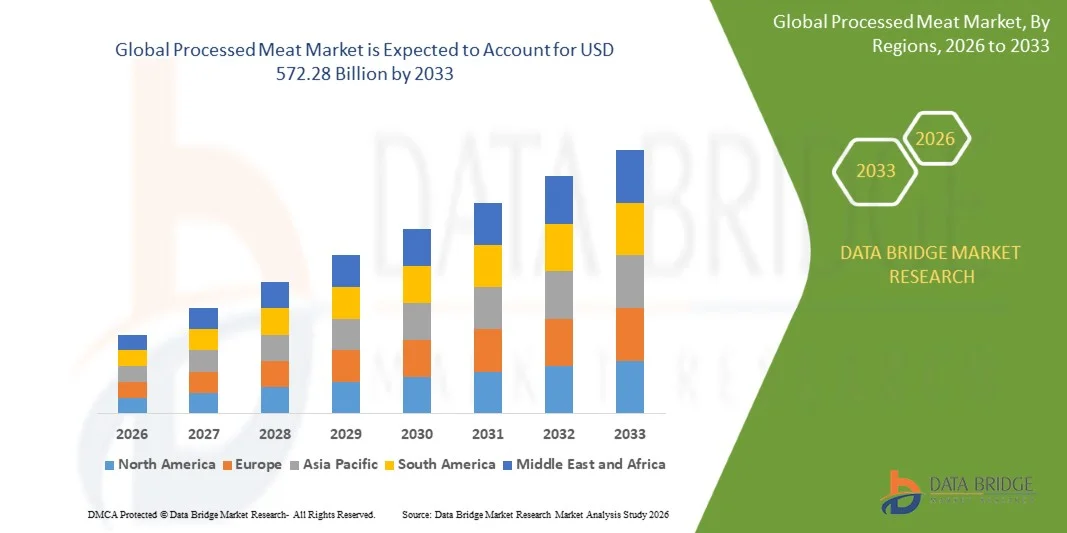
- The global processed meat market size was valued at USD 375.74 billion in 2025 and is expected to reach USD 572.28 billion by 2033, at a CAGR of 5.4% during the forecast period
- The market growth is largely fueled by rising urbanization, changing dietary preferences, and increasing demand for convenient and protein-rich ready-to-eat food products. Busy lifestyles and growing dual-income households are further accelerating the shift toward processed meat consumption across both developed and emerging economies
- Furthermore, expanding organized retail, quick-service restaurant penetration, and improved cold chain logistics are strengthening the availability and accessibility of processed meat products. Increasing consumer preference for packaged, flavored, and easy-to-cook meat items is establishing processed meat as a key component of modern diets, thereby significantly boosting the industry’s growth
Processed Meat Market Analysis
- Processed meat refers to meat products that have been transformed through curing, smoking, fermentation, or packaging processes to enhance flavor, shelf life, and convenience. These products include sausages, bacon, ham, deli meats, and ready-to-eat meat items widely consumed across retail and foodservice channels
- The escalating demand for processed meat is primarily fueled by rising consumption of convenience foods, growing fast-food culture, and increasing demand for protein-rich diets. In addition, product innovation in healthier, low-fat, and organic processed meat variants is further supporting market expansion globally
- Asia-Pacific dominated the processed meat market with a share of 42.18% in 2025, due to rising urban population, changing dietary patterns, and increasing demand for convenient protein-rich food products
- North America is expected to be the fastest growing region in the processed meat market during the forecast period due to rising demand for convenient protein-based food products and strong consumption of processed meat items
- Cured segment dominated the market with a market share of 60.5% in 2025, due to its extended shelf life and strong traditional consumption patterns across multiple regions. Smoking, salting, and curing techniques enhance flavor profiles and preservation, making them widely preferred in packaged meat products
Report Scope and Processed Meat Market Segmentation
|
Attributes |
Processed Meat Key Market Insights |
|
Segments Covered |
|
|
Countries Covered |
North America
Europe
Asia-Pacific
Middle East and Africa
South America
|
|
Key Market Players |
|
|
Market Opportunities |
|
|
Value Added Data Infosets |
In addition to the insights on market scenarios such as market value, growth rate, segmentation, geographical coverage, and major players, the market reports curated by the Data Bridge Market Research also include in-depth expert analysis, pricing analysis, brand share analysis, consumer survey, demography analysis, supply chain analysis, value chain analysis, raw material/consumables overview, vendor selection criteria, PESTLE Analysis, Porter Analysis, and regulatory framework. |
Processed Meat Market Trends
“Increasing Demand for Convenience and Ready-to-Eat Meat Products”
- A significant trend in the processed meat market is the rising preference for premium, flavored, and ready-to-eat meat products, driven by changing consumer lifestyles and growing demand for convenient protein-based food options across urban populations. This shift is strengthening the role of branded and value-added meat offerings in both retail and foodservice channels
- For instance, Tyson Foods and Hormel Foods Corporation are expanding their product portfolios with premium sausage, deli meat, and flavored processed meat variants that cater to evolving consumer taste preferences. Such product innovations are enhancing shelf appeal and increasing consumption of packaged meat items in supermarkets and quick-service restaurants
- The expansion of smoked, marinated, and specialty sausage categories is gaining momentum as consumers seek diverse taste profiles and restaurant-style meat experiences at home. This is positioning processed meat manufacturers to focus on product differentiation and regional flavor customization strategies
- Retail chains such as Kroger and Walmart are increasingly allocating shelf space to branded processed meat products, reflecting strong consumer demand for convenient meal solutions. This retail expansion is improving product visibility and accelerating category growth in urban markets
- Foodservice operators, including fast-food chains and quick-service restaurants, are incorporating processed meat-based menus to meet rising demand for quick protein meals. This trend is further reinforcing the penetration of processed meat products across institutional consumption channels
- The market is witnessing continuous innovation in packaging, preservation, and product formulation to enhance taste retention and shelf life. This ongoing evolution is supporting the broader shift toward convenient, ready-to-consume meat solutions across global markets
Processed Meat Market Dynamics
Driver
“Rising Urbanization and Shift Toward Protein-Rich Diets”
- The processed meat market is primarily driven by rising urbanization and increasing consumer shift toward protein-rich and convenience-based food consumption patterns. Busy lifestyles, growing working populations, and higher disposable incomes are significantly boosting demand for ready-to-eat and easy-to-cook meat products
- For instance, JBS Foods and Smithfield Foods, Inc. are expanding their processed meat production capacity to meet growing demand for sausages, bacon, and packaged meat products in both domestic and international markets. Their large-scale distribution networks are ensuring consistent supply across retail and foodservice sectors
- The increasing preference for high-protein diets among health-conscious consumers is further driving consumption of processed meat products. This is particularly evident in urban regions where consumers seek quick meal solutions without compromising nutritional intake
- Expansion of organized retail and modern supermarket formats is improving product accessibility and availability across developed and emerging economies. This is enabling wider adoption of packaged meat products among middle-income populations
- The combined effect of urban lifestyle changes, dietary transitions, and retail modernization is continuously reinforcing the demand for processed meat products globally
Restraint/Challenge
“Health Concerns and Rising Preference for Plant-Based Alternatives”
- The processed meat market faces significant challenges due to growing health concerns related to high sodium, preservatives, and saturated fat content in processed meat products. Increasing awareness of lifestyle-related diseases is influencing consumers to reduce or modify meat consumption habits
- For instance, global health organizations such as the World Health Organization have highlighted potential risks associated with excessive consumption of processed meat, influencing consumer behavior and regulatory scrutiny in several regions
- The rising popularity of plant-based meat alternatives offered by companies such as Beyond Meat and Impossible Foods is creating strong competition for traditional processed meat products. These alternatives are increasingly being adopted by health-conscious and environmentally aware consumers
- Regulatory pressure on food safety, labeling, and ingredient transparency is also increasing compliance costs for manufacturers. This is pushing companies to reformulate products and adopt cleaner label standards
- The combined impact of health awareness, alternative protein adoption, and regulatory constraints is creating a challenging environment for traditional processed meat manufacturers, requiring continuous product innovation and repositioning strategies
Processed Meat Market Scope
The market is segmented on the basis of product type, type, category, nature, packaging type, packaging material, end-user, and distribution channel.
• By Product Type
On the basis of product type, the processed meat market is segmented into beef, pork, goat, lamb, chicken, turkey, duck, and fish. The chicken segment dominated the largest market revenue share in 2025 due to its wide acceptance across regions and relatively lower price compared to other meat types. Rising urbanization and fast-paced lifestyles support higher consumption of chicken-based processed meat products in ready-to-eat and convenience formats. Strong supply chain availability and consistent taste preference across age groups further strengthen its market position. Demand from quick service restaurants and retail packaged food channels continues to reinforce dominance of this segment.
The fish segment is anticipated to witness the fastest growth rate from 2026 to 2033 due to increasing consumer shift toward high-protein and omega-rich food options. Growing awareness regarding heart health and nutritional benefits supports rising adoption of fish-based processed meat products. Expansion of frozen and ready-to-cook seafood offerings in retail stores is improving accessibility. Rising demand in coastal regions and expanding cold chain infrastructure further accelerate consumption. Product innovation in flavored and marinated fish items is also contributing to market expansion.
• By Type
On the basis of type, the processed meat market is segmented into fresh processed meat, frozen meat, chilled meat, canned meat, dried or semi-dried meat, fermented meat, and others. The frozen meat segment dominated the largest market revenue share in 2025 due to its longer shelf life and ease of storage and transportation. Increasing demand from supermarkets and organized retail channels supports large-scale adoption of frozen meat products. Consumers prefer frozen processed meat for its convenience in meal preparation and reduced spoilage risk. Strong cold chain logistics development further strengthens its distribution efficiency across regions.
The chilled meat segment is expected to witness the fastest growth rate from 2026 to 2033 driven by rising preference for minimally processed and fresher food products. Growing consumer awareness about quality retention and taste preservation supports higher demand for chilled variants. Expansion of modern retail infrastructure and refrigerated storage systems is improving product availability. Food service establishments increasingly rely on chilled meat for premium menu offerings requiring fresh texture. Improved packaging technologies ensuring freshness retention are further supporting segment growth.
• By Category
On the basis of category, the processed meat market is segmented into cured and uncured products. The cured segment dominated the largest market revenue share of 60.5% in 2025 due to its extended shelf life and strong traditional consumption patterns across multiple regions. Smoking, salting, and curing techniques enhance flavor profiles and preservation, making them widely preferred in packaged meat products. High demand from retail shelves and convenience food applications further strengthens its position. Established production processes and consumer familiarity contribute to sustained dominance.
The uncured segment is expected to witness the fastest growth rate from 2026 to 2033 due to increasing demand for clean label and minimally processed food products. Consumers are becoming more health conscious and are reducing intake of preservatives and synthetic additives. Manufacturers are focusing on natural preservation techniques to meet evolving dietary preferences. Rising popularity of organic and fresh meat-based diets is further supporting uncured product adoption. Expanding health-focused retail offerings is accelerating market penetration.
• By Nature
On the basis of nature, the processed meat market is segmented into conventional and organic. The conventional segment dominated the largest market revenue share in 2025 due to its cost efficiency, large-scale production, and wide availability across retail and food service channels. Established supply chains and mass production capabilities ensure consistent product supply at competitive pricing. High consumer acceptance across developing and developed regions further supports segment leadership. Strong presence in fast food and packaged food industries reinforces its market position.
The organic segment is anticipated to witness the fastest growth rate from 2026 to 2033 driven by rising demand for chemical-free and sustainably sourced food products. Increasing health awareness and preference for ethically produced meat are influencing purchasing decisions. Retail expansion of certified organic processed meat products is improving consumer accessibility. Premium positioning and higher nutritional perception are attracting health-conscious consumers. Supportive regulatory frameworks for organic certification are further boosting segment growth.
• By Packaging Type
On the basis of packaging type, the processed meat market is segmented into trays, pouches, boxes, canisters, and others. The trays segment dominated the largest market revenue share in 2025 due to their wide usage in retail display and easy handling characteristics. Tray packaging enhances product visibility, which supports impulse purchasing behavior in supermarkets. Strong adoption in chilled and fresh meat categories further strengthens demand. Efficient sealing and portion control features also contribute to its dominance.
The pouches segment is expected to witness the fastest growth rate from 2026 to 2033 driven by rising demand for lightweight, cost-effective, and convenient packaging solutions. Flexible pouch packaging reduces transportation costs and improves storage efficiency. Increasing preference for resealable and portion-controlled packs supports consumer convenience. Growth in ready-to-eat and on-the-go meat products is further accelerating adoption. Advances in barrier materials improving shelf life are strengthening market expansion.
• By Packaging Material
On the basis of packaging material, the processed meat market is segmented into plastic, glass, paper or cardboard, metal, and others. The plastic segment dominated the largest market revenue share in 2025 due to its versatility, durability, and strong barrier properties against contamination and moisture. It is widely used across frozen, chilled, and packaged meat products due to cost efficiency. Strong compatibility with vacuum and modified atmosphere packaging supports extended shelf life. Large-scale manufacturing availability further reinforces its dominance.
The paper or cardboard segment is expected to witness the fastest growth rate from 2026 to 2033 driven by increasing environmental concerns and demand for sustainable packaging solutions. Rising restrictions on single-use plastics are encouraging adoption of recyclable materials. Consumers are showing preference for eco-friendly packaging in food products. Innovation in coated and moisture-resistant paper-based packaging is improving usability in meat applications. Strong branding and sustainability positioning are further driving segment growth.
• By End-User
On the basis of end-user, the processed meat market is segmented into food service sector and household. The food service sector dominated the largest market revenue share in 2025 due to high consumption of processed meat in restaurants, hotels, and quick service outlets. Rising demand for ready-to-use meat ingredients supports operational efficiency in large-scale kitchens. Growing urban dining culture and expansion of global food chains further strengthen demand. Bulk purchasing patterns also contribute to segment dominance.
The household segment is expected to witness the fastest growth rate from 2026 to 2033 driven by increasing preference for convenient home-cooked meals. Rising dual-income households and busy lifestyles are boosting demand for ready-to-cook meat products. Expansion of online grocery platforms is improving product accessibility. Increasing availability of portion-sized packaged meat is further supporting household consumption. Growing awareness of protein-rich diets is accelerating adoption.
• By Distribution Channel
On the basis of distribution channel, the processed meat market is segmented into store-based retailers and non-store based retailers. The store-based retailers segment dominated the largest market revenue share in 2025 due to strong presence of supermarkets, hypermarkets, and convenience stores. Consumers prefer physical inspection of meat products before purchase, supporting high footfall in retail outlets. Wide product variety and promotional offers further strengthen store-based sales. Established cold storage infrastructure in retail chains enhances product availability.
The non-store based retailers segment is expected to witness the fastest growth rate from 2026 to 2033 driven by rapid expansion of e-commerce grocery platforms. Increasing consumer preference for doorstep delivery and contactless shopping supports online purchasing behavior. Improved cold chain logistics and packaging solutions ensure product safety during transit. Digital payment adoption and mobile shopping convenience further accelerate growth. Expanding penetration of online grocery services in urban and semi-urban areas is boosting segment expansion.
Processed Meat Market Regional Analysis
- Asia-Pacific dominated the processed meat market with the largest revenue share of 42.18% in 2025, driven by rising urban population, changing dietary patterns, and increasing demand for convenient protein-rich food products
- The region benefits from large-scale food processing capacity, expanding cold chain infrastructure, and strong presence of retail and quick-service restaurant channels
- Rapid urbanization, growing middle-class income levels, and increasing adoption of ready-to-eat and packaged meat products are accelerating market expansion
China Processed Meat Market Insight
China held the largest share in the Asia-Pacific processed meat market in 2025, supported by strong consumption demand from urban households and food service industries. The country has a well-developed food processing ecosystem enabling large-scale production of sausages, cured meat, and frozen meat products. Rising preference for convenient meal solutions among working populations is further strengthening demand. In addition, expanding retail penetration and modern supermarket chains are supporting consistent product availability and market growth.
India Processed Meat Market Insight
India is witnessing the fastest growth in the Asia-Pacific region, driven by increasing urbanization, rising disposable income, and shifting dietary preferences toward protein-rich foods. Growing demand for ready-to-cook and packaged meat products across metropolitan cities is supporting market expansion. The food service sector and quick-service restaurants are also contributing to higher consumption. In addition, improving cold storage logistics and expansion of organized retail are accelerating long-term market development.
Europe Processed Meat Market Insight
The Europe processed meat market is expanding steadily, supported by strong consumption of sausages, ham, bacon, and other cured meat products across key countries. The region has a well-established food processing industry with high demand for premium and specialty meat products. Strict food safety regulations are encouraging advanced processing and quality control practices. In addition, growing preference for convenience foods and ready-to-eat meals is sustaining market growth across urban populations.
Germany Processed Meat Market Insight
Germany accounted for the largest share in the Europe processed meat market in 2025, driven by high consumption of sausages and traditional meat-based food products. The country has a strong meat processing industry supported by advanced production facilities and established supply chains. Demand from retail supermarkets and food service outlets remains consistently high. In addition, strong export capability for processed meat products is reinforcing Germany’s leadership in the regional market.
U.K. Processed Meat Market Insight
The U.K. market is supported by strong demand from retail, hospitality, and quick-service restaurant sectors. Increasing consumption of packaged meat snacks and ready-to-eat products is driving market adoption. Consumer preference for convenient meal solutions is further influencing product innovation in processed meat categories. In addition, evolving food retail formats and strong supermarket penetration are supporting steady market expansion.
North America Processed Meat Market Insight
North America is projected to grow at the fastest CAGR from 2026 to 2033, driven by rising demand for convenient protein-based food products and strong consumption of processed meat items. High adoption of packaged and ready-to-eat meals across busy urban lifestyles is supporting market growth. Continuous product innovation in low-fat, organic, and premium meat products is further expanding demand. In addition, strong retail infrastructure and expanding food service industry are accelerating regional growth.
U.S. Processed Meat Market Insight
The U.S. accounted for the largest share in the North America processed meat market in 2025, supported by high consumption of bacon, sausages, deli meats, and packaged meat products. The country has a highly developed meat processing industry with advanced manufacturing and distribution systems. Strong presence of major food brands and retail chains is ensuring wide product availability. In addition, continuous product diversification and demand for convenience foods are reinforcing the U.S. leadership position in the regional market.
Processed Meat Market Share
The processed meat industry is primarily led by well-established companies, including:
- Cargill, Incorporated (U.S.)
- JBS Foods (Brazil)
- Tyson Foods, Inc. (U.S.)
- Smithfield Foods, Inc. (U.S.)
- Hormel Foods Corporation (U.S.)
- Groupe Bigard (France)
- NH Foods Ltd. (Japan)
- Tönnies Group (Germany)
- Koch Foods (U.S.)
- HKScan (Finland)
- Gruppo Veronesi (Italy)
- OSI Group (U.S.)
- Charoen Pokphand Foods PCL (Thailand)
- Perdue Farms Inc. (U.S.)
- Sanderson Farms, Inc. (U.S.)
- National Beef Packing Company L.L.C. (U.S.)
- Westfleisch SCE mbH (Germany)
- Marfrig (Brazil)
- Vion Food Group (Netherlands)
- Danish Crown A.M.B.A (Denmark)
- The Kraft Heinz Company (U.S.)
Latest Developments in Global Processed Meat Market
- In October 2025, Hormel Foods expanded its premium deli meat portfolio across major U.S. retail chains, introducing upgraded sliced ham and turkey variants with improved flavor profiles and cleaner-label formulations. This development strengthened the demand for convenient, ready-to-eat protein products and reinforced competition in the premium processed meat segment. It also supported growth in value-added packaged meats as consumers increasingly preferred on-the-go meal solutions
- In September 2025, Dickey’s Barbecue Pit announced its Rancher’s Premium Smokehouse Sausage line debut in select Kroger stores across Dallas-Fort Worth starting September 2025, for a limited four-week period. Rancher’s Premium, introduced in spring 2024, has gained popularity for its authentic Texas-style smoked sausages, offered in bold flavors such as Bacon Cheddar, Brisket Burnt Ends, and Philly Cheese Steak. This development strengthened retail visibility of specialty smoked meat products and supported rising consumer interest in regional and gourmet sausage offerings
- In July 2025, JBS Foods introduced an enhanced range of packaged sausage products across European retail markets, focusing on improved taste, extended shelf life, and diversified flavor offerings. This launch contributed to rising demand for affordable yet high-quality processed protein options in the region. It also helped the company strengthen its presence in the retail-driven processed meat category, where convenience and product variety are key growth drivers
- In June 2025, Tyson Foods, a leading food company specializing in protein products, announced the launch of Wright Brand Premium Sausage Links. The product line features three varieties: Wright Brand Bacon, Cheddar & Jalapeño Premium Sausage Links, Wright Brand White Cheddar & Bacon Premium Sausage Links, and Wright Brand Applewood Premium Sausage Links. This expansion enhanced brand positioning in the premium sausage segment and supported growing consumer demand for flavored and high-quality processed meat products
- In May 2025, Amylu Foods, a company specializing in natural, fully-cooked chicken products, has announced the launch of its Organic Chicken Sausages. Available in the refrigerated aisles of Fresh Thyme, Harris Teeter, and Gelson's, this product represents the latest addition to Amylu Foods' expanding organic product line. This launch reinforced the shift toward organic and clean-label processed meat alternatives, supporting increased adoption among health-conscious consumers and strengthening demand for natural protein-based offerings
SKU-
Get online access to the report on the World's First Market Intelligence Cloud

- Interactive Data Analysis Dashboard
- Company Analysis Dashboard for high growth potential opportunities
- Research Analyst Access for customization & queries
- Competitor Analysis with Interactive dashboard
- Latest News, Updates & Trend analysis
- Harness the Power of Benchmark Analysis for Comprehensive Competitor Tracking
Global Processed Meat Market, Supply Chain Analysis and Ecosystem Framework
To support market growth and help clients navigate the impact of geopolitical shifts, DBMR has integrated in-depth supply chain analysis into its Global Processed Meat Market research reports. This addition empowers clients to respond effectively to global changes affecting their industries. The supply chain analysis section includes detailed insights such as Global Processed Meat Market consumption and production by country, price trend analysis, the impact of tariffs and geopolitical developments, and import and export trends by country and HSN code. It also highlights major suppliers with data on production capacity and company profiles, as well as key importers and exporters. In addition to research, DBMR offers specialized supply chain consulting services backed by over a decade of experience, providing solutions like supplier discovery, supplier risk assessment, price trend analysis, impact evaluation of inflation and trade route changes, and comprehensive market trend analysis.
Research Methodology
Data collection and base year analysis are done using data collection modules with large sample sizes. The stage includes obtaining market information or related data through various sources and strategies. It includes examining and planning all the data acquired from the past in advance. It likewise envelops the examination of information inconsistencies seen across different information sources. The market data is analysed and estimated using market statistical and coherent models. Also, market share analysis and key trend analysis are the major success factors in the market report. To know more, please request an analyst call or drop down your inquiry.
The key research methodology used by DBMR research team is data triangulation which involves data mining, analysis of the impact of data variables on the market and primary (industry expert) validation. Data models include Vendor Positioning Grid, Market Time Line Analysis, Market Overview and Guide, Company Positioning Grid, Patent Analysis, Pricing Analysis, Company Market Share Analysis, Standards of Measurement, Global versus Regional and Vendor Share Analysis. To know more about the research methodology, drop in an inquiry to speak to our industry experts.
Customization Available
Data Bridge Market Research is a leader in advanced formative research. We take pride in servicing our existing and new customers with data and analysis that match and suits their goal. The report can be customized to include price trend analysis of target brands understanding the market for additional countries (ask for the list of countries), clinical trial results data, literature review, refurbished market and product base analysis. Market analysis of target competitors can be analyzed from technology-based analysis to market portfolio strategies. We can add as many competitors that you require data about in the format and data style you are looking for. Our team of analysts can also provide you data in crude raw excel files pivot tables (Fact book) or can assist you in creating presentations from the data sets available in the report.












