


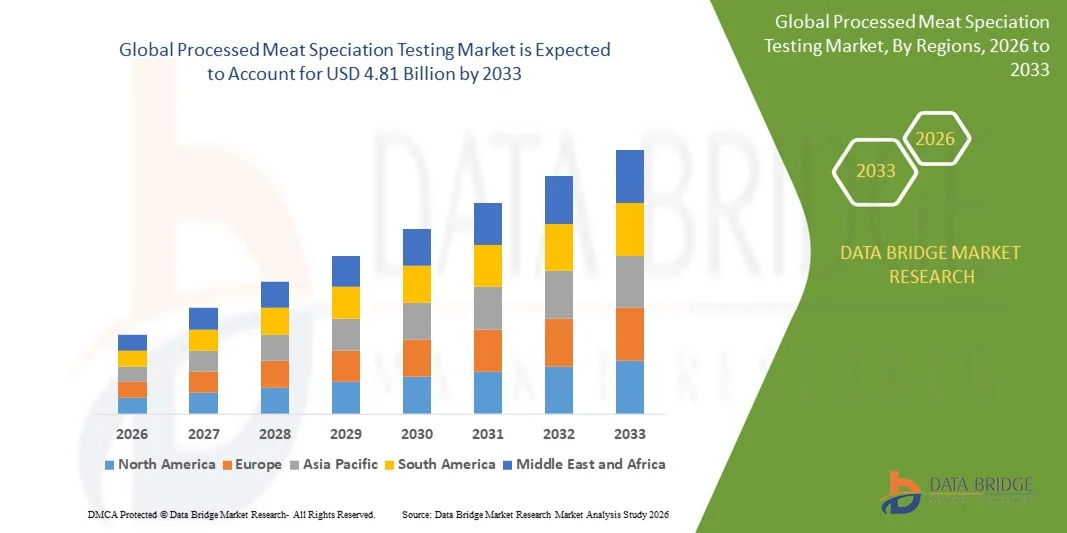
Processed Meat Speciation Testing Market Size
- The global processed meat speciation testing market size was valued at USD 2.62 billion in 2025 and is expected to reach USD 4.81 billion by 2033, at a CAGR of 7.90% during the forecast period
- The market growth is largely fueled by the increasing need for accurate species identification and authentication in processed meat products, driven by regulatory requirements, rising incidents of meat adulteration, and growing consumer awareness regarding food safety and labeling standards
- Furthermore, rising adoption of advanced molecular diagnostic technologies, such as PCR, ELISA, and LC-MS/MS, by meat processors and testing laboratories is enhancing testing accuracy and reliability. For instance, companies such as Eurofins and Intertek are expanding laboratory capacities to offer rapid and precise species verification, which is significantly boosting market growth
Processed Meat Speciation Testing Market Analysis
- Processed meat speciation testing, which provides DNA- or protein-based verification of meat species, is increasingly vital for ensuring product authenticity, compliance with labeling laws, and maintaining consumer trust in both domestic and export markets
- The escalating demand for processed meat speciation testing is primarily fueled by stricter regulatory frameworks, rising consumer preference for verified meat products, and the growing prevalence of food fraud incidents, which together are accelerating adoption of high-precision testing solutions across the industry
- Europe dominated the processed meat speciation testing market with a share of 34.92% in 2025, due to stringent food safety regulations, high enforcement of meat authenticity standards, and strong consumer awareness regarding ingredient transparency
- Asia-Pacific is expected to be the fastest growing region in the processed meat speciation testing market during the forecast period due to rapid industrialization of meat processing, rising awareness of food safety risks, and increasing regulatory attention on species authentication
- Polymerase Chain Reaction (PCR) segment dominated the market with a market share of 45.71% in 2025, due to its high accuracy, sensitivity, and ability to detect even trace amounts of species-specific DNA in complex processed meat matrices. PCR testing is widely adopted across certified laboratories owing to its rapid turnaround time and strong regulatory acceptance in global food authentication programs. Food manufacturers depend on PCR because it ensures precise verification of meat origin despite high-temperature or high-pressure processing conditions. The technique supports multiplex testing, enabling simultaneous identification of multiple species in a single analysis. Its reliability in detecting intentional adulteration and cross-contamination makes PCR the preferred method for routine inspections. As regulatory agencies strengthen DNA-based authentication requirements, PCR continues to dominate the market for processed meat speciation testing
Report Scope and Processed Meat Speciation Testing Market Segmentation
|
Attributes |
Processed Meat Speciation Testing Key Market Insights |
|
Segments Covered |
|
|
Countries Covered |
North America
Europe
Asia-Pacific
Middle East and Africa
South America
|
|
Key Market Players |
|
|
Market Opportunities |
|
|
Value Added Data Infosets |
In addition to the insights on market scenarios such as market value, growth rate, segmentation, geographical coverage, and major players, the market reports curated by the Data Bridge Market Research also include in-depth expert analysis, pricing analysis, brand share analysis, consumer survey, demography analysis, supply chain analysis, value chain analysis, raw material/consumables overview, vendor selection criteria, PESTLE Analysis, Porter Analysis, and regulatory framework. |
Processed Meat Speciation Testing Market Trends
Adoption of Advanced Molecular Diagnostics in Meat Testing
- The processed meat speciation testing market is witnessing growing adoption of advanced molecular diagnostics technologies to ensure reliable detection and identification of meat species in processed products. Techniques such as PCR-based testing, ELISA, and next-generation sequencing are increasingly being integrated into testing workflows, providing higher sensitivity, speed, and throughput compared to traditional methods. These advancements enable manufacturers and regulators to detect meat adulteration and mislabeling more accurately, reinforcing consumer confidence and regulatory compliance
- For instance, leading market players such as Eurofins Scientific and Neogen have developed multiplex PCR kits that can simultaneously test for multiple meat species in highly processed and mixed meat products. Their solutions help food processors, regulatory authorities, and retail chains improve testing efficiency and reduce turnaround times, critical in maintaining food safety and authenticity standards
- Emerging trends in miniaturization and automation of molecular assays are further improving the affordability and accessibility of advanced speciation testing. Portable and rapid test kits allow on-site testing, facilitating real-time monitoring and enforcement, especially in regions with complex or fragmented supply chains
- Growing emphasis on traceability in the food supply chain is driving broader adoption of species identification services that incorporate digital reporting and blockchain integration. These features ensure end-to-end transparency and help stakeholders address food fraud issues effectively
- In addition, rising consumer awareness regarding food authenticity, ethical sourcing, and product safety continues to fuel demand for rapid, reliable, and cost-effective meat speciation testing solutions across developed and emerging markets. This adoption fosters greater trust in processed meat products and aligns with stringent international labeling regulations
Processed Meat Speciation Testing Market Dynamics
Driver
Growing Regulatory and Consumer Demand for Meat Authenticity
- Increasing regulatory enforcement and heightened consumer expectations for meat product authenticity are key drivers accelerating demand for processed meat speciation testing. Food safety agencies globally are mandating rigorous species verification to counter fraudulent adulteration, protect public health, and uphold labeling accuracy in processed and minced meat products
- For instance, the European Food Safety Authority (EFSA) and the U.S. FDA have established strict guidelines requiring routine speciation testing, prompting food processors to implement advanced molecular diagnostics in their quality assurance protocols. Companies such as VWR International and LGC Science are working closely with regulatory bodies to develop compliant and validated testing platforms
- Consumer-driven transparency campaigns and social media advocacy about meat origin and quality contribute significantly to market expansion. Retailers and foodservice providers are responding by implementing traceability programs supported by comprehensive speciation testing to reassure consumers and safeguard brand integrity
- The rise in processed meat consumption, particularly in emerging economies, amplifies the need for systematic speciation testing to manage risks associated with adulteration and contamination. This growth aligns with improving regulatory infrastructures and increasing investment in food safety laboratories globally
- Enhanced testing capabilities allow for comprehensive detection of economically motivated adulteration, preventing economic loss and reputational damage. This results in wider adoption of species testing in food manufacturing and distribution networks as a critical compliance and quality control measure
Restraint/Challenge
High Cost and Complexity of Testing Methods
- The high cost and technical complexity of advanced molecular testing methods pose significant challenges for widespread adoption of processed meat speciation testing. Sophisticated equipment, skilled personnel, and rigorous quality assurance systems increase operational costs, especially for small and medium-sized laboratories and food producers
- For instance, multiple market reports cite that upfront investment and maintenance expenses associated with PCR thermocyclers, next-generation sequencers, and automated workstations constrain testing availability in resource-limited settings. In addition, the need for continual method validation and accreditation adds administrative burdens and expenses
- Variability in laboratory expertise and differences in testing protocols can lead to inconsistent results, necessitating standardization efforts that further increase costs and complexity. Cross-laboratory reproducibility and proficiency testing are essential but resource-intensive processes
- Limited on-site testing options also restrict rapid decision-making and increase dependence on centralized laboratories, impacting supply chain responsiveness and increasing logistical costs
- Addressing these limitations will require investment in streamlined, user-friendly testing platforms, automation, and capacity-building initiatives for decentralized testing. Lowering the costs without compromising sensitivity and specificity is critical for ensuring broader market penetration and supporting global food safety objectives
Processed Meat Speciation Testing Market Scope
The market is segmented on the basis of species and technology.
- By Species
On the basis of species, the market is segmented into Cow (Bos Taurus), Swine (Sus Scrofa), Chicken (Gallus Gallus), Horse (Equus Caballus), Sheep (Ovis Aries), and Others Species. The cow (Bos Taurus) segment dominated the processed meat speciation testing market in 2025 with the largest revenue share, driven by its widespread consumption across global food chains and extensive use in processed meat products. Food safety authorities enforce rigorous testing protocols for bovine-derived ingredients due to frequent adulteration cases involving substitution with cheaper meat sources. Manufacturers rely heavily on cow-speciation testing to maintain transparency and uphold labeling accuracy in packaged foods. Growing consumer concerns about product authenticity and ethical sourcing further strengthen the demand for cow meat verification. The segment also benefits from well-established testing standards and harmonized international regulations supporting consistent monitoring. As a result, cow-speciation testing continues to lead the market owing to its regulatory importance and high-volume application across food categories.
The chicken (Gallus Gallus) segment is anticipated to exhibit the fastest growth rate from 2026 to 2033, driven by the rapidly rising consumption of poultry-based processed foods worldwide. The increasing preference for chicken in ready-to-eat meals, frozen products, and mixed-meat formulations fuels the need for stringent species verification. Poultry adulteration incidents, such as mixing chicken with lower-quality meat sources, encourage manufacturers to adopt reliable speciation testing. The segment gains further momentum due to the expansion of quick-service restaurant supply chains, which require consistent validation of chicken-origin ingredients. Growing consumer health awareness also heightens demand for accurate labeling of poultry-based products. As product diversification expands across global markets, chicken-speciation testing becomes essential for maintaining trust and compliance.
- By Technology
On the basis of technology, the market is segmented into Polymerase Chain Reaction (PCR), Enzyme-Linked Immunosorbent Assay (ELISA), and Other Molecular-Diagnostic Tests (LC-MS/MS). The polymerase chain reaction (PCR) segment held the largest revenue share of 45.71% in 2025 due to its high accuracy, sensitivity, and ability to detect even trace amounts of species-specific DNA in complex processed meat matrices. PCR testing is widely adopted across certified laboratories owing to its rapid turnaround time and strong regulatory acceptance in global food authentication programs. Food manufacturers depend on PCR because it ensures precise verification of meat origin despite high-temperature or high-pressure processing conditions. The technique supports multiplex testing, enabling simultaneous identification of multiple species in a single analysis. Its reliability in detecting intentional adulteration and cross-contamination makes PCR the preferred method for routine inspections. As regulatory agencies strengthen DNA-based authentication requirements, PCR continues to dominate the market for processed meat speciation testing.
Other molecular-diagnostic tests, particularly LC-MS/MS, are expected to record the fastest growth from 2026 to 2033 due to their capability to deliver highly specific protein-based species identification. LC-MS/MS is increasingly adopted for complex processed food testing where DNA may degrade, making protein fingerprinting a more effective approach. The method is gaining traction among advanced analytical laboratories seeking ultra-high precision for verifying meat origin in premium and export-grade products. Its ability to differentiate closely related species enhances its value in detecting sophisticated adulteration techniques. Rising investments in high-resolution mass spectrometry platforms support wider adoption of LC-MS/MS in commercial food testing facilities. As global markets emphasize premium quality assurance, LC-MS/MS emerges as a rapidly expanding technology for next-level authentication needs.
Processed Meat Speciation Testing Market Regional Analysis
- Europe dominated the processed meat speciation testing market with the largest revenue share of 34.92% in 2025, driven by stringent food safety regulations, high enforcement of meat authenticity standards, and strong consumer awareness regarding ingredient transparency
- The region maintains a rigorous testing ecosystem supported by advanced laboratory infrastructure and strict compliance with regulatory frameworks such as EU food labeling laws
- The increasing focus on preventing species adulteration and ensuring traceability across processed meat supply chains reinforces Europe’s leadership position in the global market
U.K. Processed Meat Speciation Testing Market Insight
The U.K. processed meat speciation testing market captured the largest share within Europe in 2025, supported by its strong regulatory oversight and the growing need for transparent labeling in packaged meat products. The market is driven by increasing consumer concerns regarding adulteration incidents and the expanding role of independent testing laboratories. The rising adoption of PCR-based species detection methods and continuous surveillance by food safety authorities further strengthen the UK's position in the regional testing landscape.
Germany Processed Meat Speciation Testing Market Insight
The Germany processed meat speciation testing market is expected to grow steadily during the forecast period, fueled by advancements in molecular diagnostics and increased demand for accurate species identification across meat processors. Germany’s strong meat processing industry, coupled with emphasis on product quality, encourages the use of reliable and automated testing platforms. The presence of sophisticated laboratories and accelerated adoption of LC-MS/MS technologies ensure precise detection, supporting the country’s leadership in Europe.
North America Processed Meat Speciation Testing Market Insight
The North America processed meat speciation testing market is projected to show notable growth, driven by rising cases of mislabeling, expanding processed meat production, and increased regulatory inspections. The region benefits from heightened consumer awareness and growing adoption of molecular-level authenticity verification. The emphasis on maintaining brand trust and meeting federal compliance requirements supports the market’s expansion across commercial meat processors and testing facilities.
U.S. Processed Meat Speciation Testing Market Insight
The U.S. accounted for the largest revenue share within North America in 2025, driven by robust demand for accurate species verification and strengthening of food safety protocols. Growing adoption of PCR and ELISA testing methods among meat processors, federal laboratories, and third-party certification bodies supports the country’s dominance. The increasing incidence of food fraud investigations and the need for high-precision testing solutions further stimulate the U.S. market.
Asia-Pacific Processed Meat Speciation Testing Market Insight
The Asia-Pacific processed meat speciation testing market is poised to expand at the fastest CAGR during the forecast period owing to rapid industrialization of meat processing, rising awareness of food safety risks, and increasing regulatory attention on species authentication. Growing urban consumption of processed meat, combined with higher adoption of molecular diagnostic tools, accelerates the region’s testing requirements. Countries across APAC are investing in modern laboratory capabilities to support their expanding processed meat sectors.
China Processed Meat Speciation Testing Market Insight
China accounted for the largest revenue share within Asia-Pacific in 2025 due to its large processed meat industry, expanding consumer base, and increasing focus on food fraud detection. The push toward advanced testing technologies, combined with the government's strengthening of food safety regulations, accelerates demand for PCR and LC-MS/MS-based species verification. China’s large-scale meat production creates sustained need for accuracy, compliance, and traceability across processing facilities.
Processed Meat Speciation Testing Market Share
The processed meat speciation testing industry is primarily led by well-established companies, including:
- Eurofins China (China)
- ALS Laboratories (UK) Limited (U.K.)
- NEOGEN Corporation (U.S.)
- LGC Limited (U.K.)
- International Laboratory Services (U.K.)
- DH Tech. Dev. Pte. Ltd. (Singapore)
- SYNLAB (Germany)
- VWR International LLC (U.S.)
- Food and Drug Administration (FDA) (U.S.)
- United States Department of Agriculture (USDA) (U.S.)
- FoodChain ID Group Inc. (U.S.)
- Bio-Check (UK) Ltd. (U.K.)
- PerkinElmer Inc. (U.S.)
- Intertek Group plc (U.K.)
- Chemik Chemicals (India)
- Romer Labs Division Holding GmbH (Austria)
- Life Technologies India Private Limited (India)
- Thermo Fisher Scientific Inc. (U.S.)
- Merck KGaA (Germany)
- 3M (U.S.)
Latest Developments in Global Processed Meat Speciation Testing Market
- In November 2025, Intertek expanded its global food testing footprint through the acquisition of Suplilab, a Costa Rica–based laboratory specializing in analytical services for food safety. This strategic move strengthens Intertek’s capabilities in authenticity verification and enhances access to advanced testing solutions across Latin America. The development reinforces the company’s role in supporting processed meat speciation testing by improving regional laboratory coverage, ensuring faster service delivery, and elevating testing reliability for manufacturers and regulators
- In September 2025, Eurofins Scientific completed the purchase of multiple related-party testing sites, significantly broadening its operational infrastructure and analytical capacity. This expansion enhances Eurofins’ ability to deliver high-volume and high-precision DNA-based species detection testing across key markets. The development strengthens the processed meat speciation testing landscape by increasing resource availability, improving sample throughput, and reinforcing quality standards needed to address rising regulatory and consumer demands
- In 2025, Eurofins advanced its molecular diagnostics capabilities by expanding DNA testing operations at its Ebersberg, Germany laboratory, incorporating real-time PCR and sequencing technologies. This enhancement improves the precision and sensitivity required to detect even minimal species adulteration in processed meat products. The development accelerates market adoption of next-generation authenticity testing and strengthens Europe’s position as a leader in high-accuracy species verification
- In 2025, Eurofins Genomics launched its DNA SourceTracker and AuthenticityTracker platforms to elevate traceability and transparency across the processed meat supply chain. These tools utilize next-generation sequencing to verify species origin, helping producers and regulators maintain strict control over product integrity. This development enhances the market by promoting genetic-level traceability, reducing fraud risks, and improving confidence in processed meat authentication processes
- In July 2025, Eurofins introduced its food irradiation testing service, expanding the breadth of its food safety and authenticity offerings. This addition supports integrated quality assurance for meat producers by enabling combined safety and species verification workflows. The development enhances the processed meat speciation testing market by strengthening end-to-end testing capabilities, improving compliance readiness, and helping manufacturers

- Interactive Data Analysis Dashboard
- Company Analysis Dashboard for high growth potential opportunities
- Research Analyst Access for customization & queries
- Competitor Analysis with Interactive dashboard
- Latest News, Updates & Trend analysis
- Harness the Power of Benchmark Analysis for Comprehensive Competitor Tracking
Global Processed Meat Speciation Testing Market, Supply Chain Analysis and Ecosystem Framework
To support market growth and help clients navigate the impact of geopolitical shifts, DBMR has integrated in-depth supply chain analysis into its Global Processed Meat Speciation Testing Market research reports. This addition empowers clients to respond effectively to global changes affecting their industries. The supply chain analysis section includes detailed insights such as Global Processed Meat Speciation Testing Market consumption and production by country, price trend analysis, the impact of tariffs and geopolitical developments, and import and export trends by country and HSN code. It also highlights major suppliers with data on production capacity and company profiles, as well as key importers and exporters. In addition to research, DBMR offers specialized supply chain consulting services backed by over a decade of experience, providing solutions like supplier discovery, supplier risk assessment, price trend analysis, impact evaluation of inflation and trade route changes, and comprehensive market trend analysis.
Data collection and base year analysis are done using data collection modules with large sample sizes. The stage includes obtaining market information or related data through various sources and strategies. It includes examining and planning all the data acquired from the past in advance. It likewise envelops the examination of information inconsistencies seen across different information sources. The market data is analysed and estimated using market statistical and coherent models. Also, market share analysis and key trend analysis are the major success factors in the market report. To know more, please request an analyst call or drop down your inquiry.
The key research methodology used by DBMR research team is data triangulation which involves data mining, analysis of the impact of data variables on the market and primary (industry expert) validation. Data models include Vendor Positioning Grid, Market Time Line Analysis, Market Overview and Guide, Company Positioning Grid, Patent Analysis, Pricing Analysis, Company Market Share Analysis, Standards of Measurement, Global versus Regional and Vendor Share Analysis. To know more about the research methodology, drop in an inquiry to speak to our industry experts.
Data Bridge Market Research is a leader in advanced formative research. We take pride in servicing our existing and new customers with data and analysis that match and suits their goal. The report can be customized to include price trend analysis of target brands understanding the market for additional countries (ask for the list of countries), clinical trial results data, literature review, refurbished market and product base analysis. Market analysis of target competitors can be analyzed from technology-based analysis to market portfolio strategies. We can add as many competitors that you require data about in the format and data style you are looking for. Our team of analysts can also provide you data in crude raw excel files pivot tables (Fact book) or can assist you in creating presentations from the data sets available in the report.













