


Processed Milk Processing Equipment Market Size
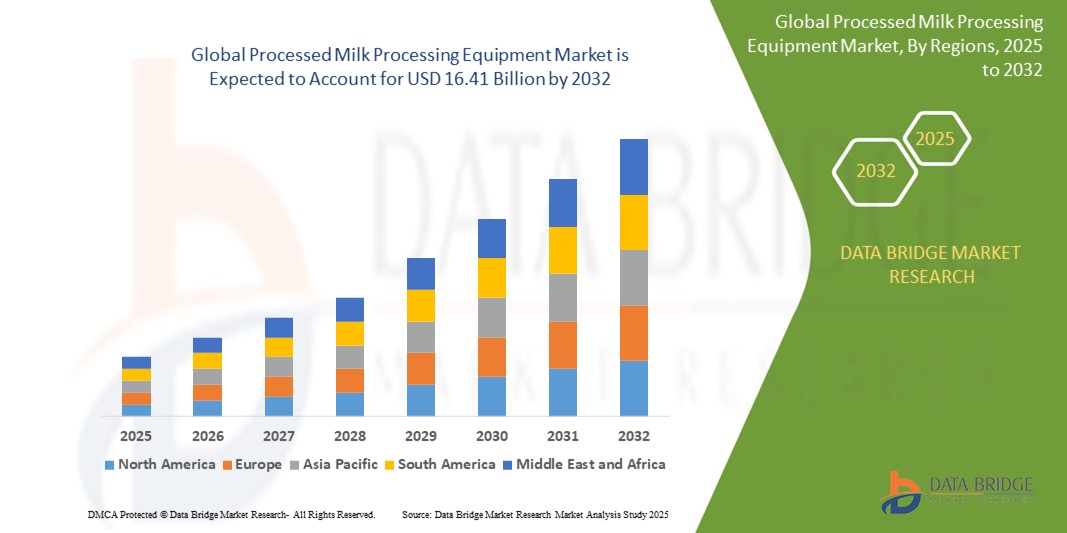
- The global processed milk processing equipment market size was valued at USD 11.10 billion in 2024 and is expected to reach USD 16.41 billion by 2032, at a CAGR of 5.00% during the forecast period
- The market growth is largely fuelled by the increasing global demand for processed dairy products, rising investments in dairy automation technologies, and the expanding dairy industry in emerging economies
- In addition, the rising adoption of energy-efficient and sustainable equipment by dairy manufacturers to minimize operational costs and meet environmental regulations is significantly contributing to the market expansion
Processed Milk Processing Equipment Market Analysis
- The processed milk processing equipment market is witnessing steady growth due to the rising consumption of milk-based products such as cheese, butter, yogurt, and flavored milk across both developed and developing regions
- Technological advancements, such as the integration of automation and smart sensors in milk processing lines, are enabling manufacturers to enhance production efficiency and ensure product safety, which is a key factor contributing to the market expansion
- Asia-Pacific dominated the processed milk processing equipment market with the largest revenue share in 2024, attributed to rapid urbanization, increasing dairy consumption, and government-led initiatives to modernize dairy processing in countries such as China, India, and Japan
- Europe region is expected to witness the highest growth rate in the global processed milk processing equipment market, driven by strict food safety regulations, growing preference for value-added dairy products, and the push for modernizing aging milk processing infrastructure across several European nations
- The pasteurizers segment dominated the market with the largest market revenue share in 2024, driven by the critical role of pasteurization in ensuring milk safety, extending shelf life, and meeting food safety regulations. Pasteurizers are a standard requirement across small and large dairy processing operations, and the rise in demand for safe, packaged dairy has reinforced their central role in plant operations. Their compatibility with different milk volumes and automation levels also contributes to their widespread adoption across global dairy markets
Report Scope and Processed Milk Processing Equipment Market Segmentation
|
Attributes |
Processed Milk Processing Equipment Key Market Insights |
|
Segments Covered |
|
|
Countries Covered |
North America
Europe
Asia-Pacific
Middle East and Africa
South America
|
|
Key Market Players |
|
|
Market Opportunities |
• Rising Adoption of Automation and Smart Processing Technologies |
|
Value Added Data Infosets |
In addition to the insights on market scenarios such as market value, growth rate, segmentation, geographical coverage, and major players, the market reports curated by the Data Bridge Market Research also include in-depth expert analysis, pricing analysis, brand share analysis, consumer survey, demography analysis, supply chain analysis, value chain analysis, raw material/consumables overview, vendor selection criteria, PESTLE Analysis, Porter Analysis, and regulatory framework. |
Processed Milk Processing Equipment Market Trends
“Growing Integration of IoT and Automation in Dairy Processing”
• Dairy manufacturers are increasingly investing in automation and IoT-integrated milk processing equipment to achieve greater consistency, reduce manual intervention, and improve throughput in high-demand environments, especially as consumer expectations for safety and quality rise in both developed and emerging markets
• Advanced systems now include real-time data tracking, remote monitoring, and self-diagnosing components, enabling processors to identify performance issues early and reduce equipment downtime across pasteurization, homogenization, and packaging stages
• For instance, companies such as Tetra Pak and GEA Group have introduced IoT-enabled separators and pasteurizers that provide automated feedback on flow rate, temperature, and energy usage, helping dairy firms comply with hygiene standards and meet sustainability goals
• Integration of automation also allows processors to scale operations more efficiently by adapting recipes and workflows through programmable logic controllers, thereby minimizing product loss and labor dependence
• These smart capabilities are positioning dairy producers to meet surging global demand for packaged milk products, but they also create a competitive gap where only capital-strong firms can afford initial upgrades, highlighting the need for cost-effective smart solutions for small and mid-sized processors
Processed Milk Processing Equipment Market Dynamics
Driver
“Rising Demand for Packaged Dairy Products in Urban Areas”
- Rapid urbanization, growing disposable incomes, and rising consumer preference for ready-to-consume dairy products are pushing dairy processors to expand operations and invest in advanced milk processing equipment that ensures hygiene, longer shelf life, and production scalability
- Packaged dairy formats such as tetra pack milk, flavored drinks, UHT milk, and cream require specialized equipment such as ultra-pasteurizers, aseptic fillers, and homogenizers that are efficient and capable of maintaining consistent quality standards across batches
- For instance, Amul in India and Lactalis in France have ramped up investments in automated milk handling lines and filling systems to meet growing urban demand while maintaining traceability and regulatory compliance
- Expansion of supermarkets, quick-service restaurants, and online grocery channels is also driving demand for pre-processed dairy items, prompting even small and regional dairies to modernize their equipment to remain competitive in quality and supply consistency
- As urban populations continue to expand in regions such as Asia-Pacific, Latin America, and the Middle East, the rising demand for safe, packaged milk is set to fuel sustained growth in the processed milk equipment industry, especially among producers that can rapidly scale and adapt to shifting consumer needs
Restraint/Challenge
“High Initial Investment and Maintenance Costs”
- The installation of modern processed milk equipment involves substantial upfront costs, including specialized machinery for pasteurization, chilling, storage, and aseptic packaging, which significantly limits the ability of small-scale producers to upgrade their infrastructure
- Ongoing operational costs such as routine equipment maintenance, energy consumption, skilled labor training, and spare parts procurement add to the financial burden, particularly in cost-sensitive regions where dairy processors operate on thin margins
- For instance, small dairy cooperatives in Southeast Asia and parts of Africa face significant hurdles in acquiring modern processing lines due to lack of access to financing, technical expertise, and government support, which delays modernization and affects product quality
- Equipment such as automated separators or UHT lines require regular calibration, cleaning-in-place (CIP) systems, and downtime management protocols, which can be both labor- and cost-intensive for operations with limited scale
- These investment and operational hurdles are slowing down technology penetration in emerging markets, underlining the need for affordable processing solutions, scalable automation options, and policy-level incentives to help smaller dairies modernize and participate in global value chains
Processed Milk Processing Equipment Market Scope
The market is segmented on the basis of type, operation, and distribution channel.
- By Type
On the basis of type, the processed milk processing equipment market is segmented into pasteurizers, homogenizers, mixers and blenders, separators, evaporators and dryers, churning equipment, and membrane filtration equipment. The pasteurizers segment dominated the market with the largest market revenue share in 2024, driven by the critical role of pasteurization in ensuring milk safety, extending shelf life, and meeting food safety regulations. Pasteurizers are a standard requirement across small and large dairy processing operations, and the rise in demand for safe, packaged dairy has reinforced their central role in plant operations. Their compatibility with different milk volumes and automation levels also contributes to their widespread adoption across global dairy markets.
The membrane filtration equipment segment is expected to witness the fastest growth rate from 2025 to 2032, fuelled by its growing application in high-value dairy processing such as protein concentration, bacteria removal, and lactose reduction. The demand for specialized milk derivatives and low-lactose dairy products in developed markets is pushing processors to integrate membrane filtration systems for product differentiation and quality improvement.
- By Operation
On the basis of operation, the processed milk processing equipment market is segmented into automatic and semi-automatic. Automatic equipment enhances process efficiency through programmable controls, real-time monitoring, and reduced human error, making it suitable for operations handling high production volumes.
The semi-automatic segment is expected to witness the fastest growth rate from 2025 to 2032, particularly in emerging markets where small and mid-scale dairies prefer cost-effective solutions. Semi-automatic equipment offers a balance between manual control and automation, appealing to processors upgrading from traditional setups while managing budget constraints.
- By Distribution Channel
On the basis of distribution channel, the processed milk processing equipment market is segmented into supermarkets/hypermarkets, convenience stores, and online stores. The supermarkets/hypermarkets segment accounted for the largest revenue share in 2024, attributed to their dominant role in dairy product retailing and the need for consistent processed milk supply to meet consumer demand. The rise in private-label dairy brands and large-scale procurement contracts also drives the demand for high-capacity processing equipment among suppliers targeting these retail chains.
The online stores segment is expected to witness the fastest growth rate from 2025 to 2032, propelled by increasing digital penetration and the rise of e-commerce platforms offering processing equipment to both domestic and industrial buyers. Easy product comparisons, access to technical specifications, and the growing trust in online equipment purchases are making online channels a preferred option, especially for small-scale processors and international buyers.
Processed Milk Processing Equipment Market Regional Analysis
- Asia-Pacific dominated the processed milk processing equipment market with the largest revenue share in 2024, attributed to rapid urbanization, increasing dairy consumption, and government-led initiatives to modernize dairy processing in countries such as China, India, and Japan
- The region benefits from strong demand for packaged milk, rising health awareness, and growing investments in advanced equipment technologies such as automated pasteurization, homogenization, and filtration systems
China Processed Milk Processing Equipment Market Insight
The China processed milk processing equipment market held the largest market share in Asia-Pacific in 2024, driven by rapid industrialization of the dairy sector and growing consumer demand for safe, processed dairy products. Rising urbanization and the expansion of supermarket chains are pushing dairy producers to invest in efficient, large-scale equipment, while government support for rural dairy development continues to fuel equipment demand.
Japan Processed Milk Processing Equipment Market Insight
The Japan processed milk processing equipment market is expected to witness the fastest growth rate from 2025 to 2032, supported by strong demand for high-quality, value-added dairy products and emphasis on automation and hygiene. Advanced technologies such as membrane filtration and energy-efficient homogenizers are being increasingly adopted, and the country's aging population is further fueling demand for functional milk offerings, prompting investment in precision processing equipment.
North America Processed Milk Processing Equipment Market Insight
The North America processed milk processing equipment market is expected to witness the fastest growth rate from 2025 to 2032, supported by strong dairy consumption patterns and widespread adoption of advanced processing technologies. Demand for energy-efficient and automated solutions is rising as producers aim to meet stringent safety standards and scale operations. In addition, the shift toward organic and fortified milk products is further driving investment in cutting-edge equipment.
U.S. Processed Milk Processing Equipment Market Insight
The U.S. processed milk processing equipment market a is expected to witness the fastest growth rate from 2025 to 2032, driven by the country’s highly developed dairy processing industry and demand for technologically advanced, sustainable equipment. Producers are focusing on product diversification, including lactose-free and high-protein variants, which require specialized processing systems. Ongoing innovation and digital integration are further fueling market growth.
Europe Processed Milk Processing Equipment Market Insight
The Europe processed milk processing equipment market is expected to witness the fastest growth rate from 2025 to 2032, driven by strict food safety regulations, increasing demand for sustainable dairy solutions, and rising consumption of plant-based and organic milk alternatives. Countries across the region are investing in high-efficiency and environmentally friendly equipment to align with evolving consumer preferences and sustainability goals.
Germany Processed Milk Processing Equipment Market Insight
The Germany processed milk processing equipment market is expected to witness the fastest growth rate from 2025 to 2032, by its well-established dairy industry, emphasis on food safety compliance, and strong focus on energy-efficient and automated solutions. The rise in demand for specialty dairy products and sustainable packaging is further driving innovation in milk processing technologies, making Germany a key player in the European market.
U.K. Processed Milk Processing Equipment Market Insight
The U.K. processed milk processing equipment market is expected to witness the fastest growth rate from 2025 to 2032, supported by increasing consumer demand for fortified and ready-to-drink milk products. The country’s evolving retail landscape and preference for private-label dairy offerings are prompting producers to upgrade their processing capabilities. Focus on clean-label products and reduced environmental impact is also contributing to the adoption of modern equipment.
Processed Milk Processing Equipment Market Share
The Processed Milk Processing Equipment industry is primarily led by well-established companies, including:
- ALFA LAVAL (Sweden)
- Rodem Inc. (U.S.)
- SSP Private Limited (India)
- GEA Group Aktiengesellschaft (Germany)
- IDMC Limited (India)
- SEALTECH ENGINEERS (India)
- Gemak (Turkey)
- Coperion GmbH (Germany)
- INOXPA INDIA PVT. LTD (India)
- Shanghai Triowin Intelligent Machinery Co. Ltd (China)
- Mahanagar Engineering Pvt. Ltd (India)
- Dairy Tech India. (India)
- Sanchelima International Inc. (U.S.)
Latest Developments in Global Processed Milk Processing Equipment Market
- In May 2024, Triowin introduced a small-scale, multi-purpose integrated solution for pasteurized milk and yogurt production, with processing capacities of 200L/H and 500L/H. This product development aims to support small dairy processors engaged in fresh milk processing from self-owned pastures and daily low-temperature milk production. The compact design enhances operational efficiency and flexibility for small-scale operations. It is expected to boost localized dairy production and contribute to the market by enabling decentralized, cost-effective processing capabilities.

- Interactive Data Analysis Dashboard
- Company Analysis Dashboard for high growth potential opportunities
- Research Analyst Access for customization & queries
- Competitor Analysis with Interactive dashboard
- Latest News, Updates & Trend analysis
- Harness the Power of Benchmark Analysis for Comprehensive Competitor Tracking
Global Processed Milk Processing Equipment Market, Supply Chain Analysis and Ecosystem Framework
To support market growth and help clients navigate the impact of geopolitical shifts, DBMR has integrated in-depth supply chain analysis into its Global Processed Milk Processing Equipment Market research reports. This addition empowers clients to respond effectively to global changes affecting their industries. The supply chain analysis section includes detailed insights such as Global Processed Milk Processing Equipment Market consumption and production by country, price trend analysis, the impact of tariffs and geopolitical developments, and import and export trends by country and HSN code. It also highlights major suppliers with data on production capacity and company profiles, as well as key importers and exporters. In addition to research, DBMR offers specialized supply chain consulting services backed by over a decade of experience, providing solutions like supplier discovery, supplier risk assessment, price trend analysis, impact evaluation of inflation and trade route changes, and comprehensive market trend analysis.
Data collection and base year analysis are done using data collection modules with large sample sizes. The stage includes obtaining market information or related data through various sources and strategies. It includes examining and planning all the data acquired from the past in advance. It likewise envelops the examination of information inconsistencies seen across different information sources. The market data is analysed and estimated using market statistical and coherent models. Also, market share analysis and key trend analysis are the major success factors in the market report. To know more, please request an analyst call or drop down your inquiry.
The key research methodology used by DBMR research team is data triangulation which involves data mining, analysis of the impact of data variables on the market and primary (industry expert) validation. Data models include Vendor Positioning Grid, Market Time Line Analysis, Market Overview and Guide, Company Positioning Grid, Patent Analysis, Pricing Analysis, Company Market Share Analysis, Standards of Measurement, Global versus Regional and Vendor Share Analysis. To know more about the research methodology, drop in an inquiry to speak to our industry experts.
Data Bridge Market Research is a leader in advanced formative research. We take pride in servicing our existing and new customers with data and analysis that match and suits their goal. The report can be customized to include price trend analysis of target brands understanding the market for additional countries (ask for the list of countries), clinical trial results data, literature review, refurbished market and product base analysis. Market analysis of target competitors can be analyzed from technology-based analysis to market portfolio strategies. We can add as many competitors that you require data about in the format and data style you are looking for. Our team of analysts can also provide you data in crude raw excel files pivot tables (Fact book) or can assist you in creating presentations from the data sets available in the report.













