


What is the Processing-in-Memory (PIM) Market Size and Growth Rate?
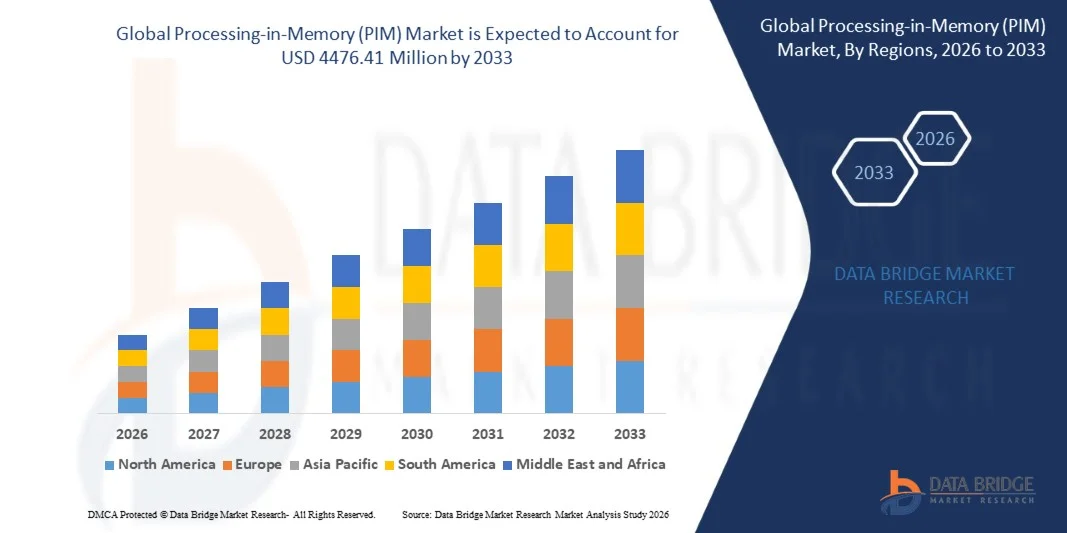
- As per Data Bridge Market Research analysis the processing-in-memory (PIM) market was valued at USD 609.70 Million in 2025 and is projected to reach USD 4476.41 Million by 2033, growing at a CAGR of 28.30% from 2026 to 2033.
- The market is witnessing strong growth driven by the rapid adoption of artificial intelligence (AI), machine learning (ML), and high-performance computing (HPC) applications, which require faster data processing, higher memory bandwidth, and improved energy efficiency. Increasing deployment of AI accelerators and hyperscale data centers is further supporting market expansion.
- Rising investments in advanced semiconductor technologies and high-bandwidth memory (HBM), along with growing demand for edge AI, autonomous vehicles, and data-intensive workloads, are accelerating the adoption of PIM architectures. By integrating computation directly within memory, PIM significantly reduces data movement, lowers power consumption, and overcomes the memory bottleneck, making it a key enabling technology for next-generation computing systems.
Market Size & Forecast
- Market Value (2025): USD 609.70 Million
- Expected Market Value (2033): USD 4476.41 Million
- Forecast CAGR (2026–2033): 28.30%
- Leading Region in 2025: North America
- Fastest Growing Region: Asia-Pacific
What are the Major Takeaways of the Processing-in-Memory (PIM) Market?
- North America dominated the processing-in-memory (PIM) market with the largest revenue share of 42.20% in 2025, driven by substantial investments in artificial intelligence (AI), high-performance computing (HPC), and hyperscale cloud infrastructure. The region benefits from the strong presence of leading semiconductor manufacturers, AI accelerator developers, cloud service providers.
- The Asia-Pacific processing-in-memory (PIM) market is expected to witness the fastest growth rate at a CAGR of 31.20% from 2026 to 2033, supported by the presence of major memory manufacturers, expanding semiconductor fabrication capacity, and increasing investments in AI infrastructure.
- The digital PIM segment held the largest market revenue share of 61.9% in 2025, driven by its superior scalability, reliability, and seamless integration with conventional digital semiconductor manufacturing processes. Its widespread deployment across cloud data centers, AI accelerators, and HPC systems continues to strengthen its market leadership.
- The analog PIM segment is projected to register the fastest growth at a CAGR of 28.9% from 2026 to 2033, driven by rising demand for ultra-low-power AI inference, edge computing, and energy-efficient neural network processing. Increasing adoption in next-generation AI hardware, autonomous systems, and intelligent edge devices is accelerating segment expansion.
- The DRAM-based PIM segment held the largest market revenue share in 2025, driven by its widespread adoption in AI accelerators, hyperscale data centers, and high-performance computing (HPC) applications. DRAM-based PIM solutions are preferred due to their high bandwidth, low latency, seamless compatibility with existing memory infrastructure, and ability to efficiently support large-scale AI model training and inference.
- The MRAM-based PIM segment is projected to register the fastest growth at a CAGR of 35.9% from 2026 to 2033, driven by increasing investments in non-volatile memory technologies for energy-efficient AI computing. Rising adoption across edge AI, automotive electronics, industrial automation, and IoT applications is accelerating segment expansion.
Report Scope and Processing-in-Memory (PIM) Market Segmentation
|
Attributes |
Processing-in-Memory (PIM) Key Market Insights |
|
Segments Covered |
|
|
Countries Covered |
North America
Europe
Asia-Pacific
Middle East and Africa
South America
|
|
Key Market Players |
|
|
Market Opportunities |
|
|
Value Added Data Infosets |
In addition to the insights on market scenarios such as market value, growth rate, segmentation, geographical coverage, and major players, the market reports curated by the Data Bridge Market Research also include in-depth expert analysis, geographically represented company-wise production and capacity, network layouts of distributors and partners, detailed and updated price trend analysis and deficit analysis of supply chain and demand. |
What is the Key Trend in the Processing-in-Memory (PIM) Market?
- Semiconductor manufacturers are increasingly integrating processing-in-memory (PIM) architectures into high-bandwidth memory (HBM) to accelerate AI inference and high-performance computing (HPC) workloads while reducing data movement, latency, and power consumption.
- For instance, in February 2021, Samsung Electronics Co., Ltd. announced the industry's first HBM-PIM (High Bandwidth Memory with Processing-in-Memory) solution, capable of delivering more than 2× system performance while reducing energy consumption by over 70% for AI and HPC applications.
- Technology providers and research organizations are also accelerating the commercialization of PIM platforms to improve the performance of memory-intensive AI and machine learning workloads.
- For instance, in August 2021, Samsung Electronics Co., Ltd. successfully integrated its HBM-PIM into a commercial Xilinx Alveo AI accelerator, demonstrating up to 2.5× higher system performance and over 60% lower energy consumption, highlighting the commercial viability of PIM for next-generation AI infrastructure.
- As AI models, large language models (LLMs), and data-intensive computing continue to evolve, PIM technology is expected to become a core memory architecture for future AI servers, hyperscale data centers, and advanced semiconductor platforms.
What are the Key Drivers of the Processing-in-Memory (PIM) Market?
- The rapid growth of artificial intelligence (AI), generative AI, and high-performance computing (HPC) is significantly increasing demand for processing-in-memory (PIM) technologies that minimize data movement, improve memory bandwidth, and enhance energy efficiency.
- For instance, in January 2020, UPMEM SAS announced the first silicon-based benchmarks for its commercial PIM solution, demonstrating that its PIM modules can deliver up to 10× greater efficiency than standard application servers for data-intensive workloads.
- Semiconductor companies and cloud infrastructure providers are increasingly adopting memory-centric computing architectures to overcome the memory bottleneck and accelerate AI, database, and analytics workloads.
- For instance, Micron Technology, Inc. is expanding its high-bandwidth memory (HBM) portfolio to support AI accelerators and next-generation data center platforms, strengthening the adoption of memory-centric computing for AI applications.
- With increasing investments in AI infrastructure, hyperscale data centers, and advanced memory technologies, processing-in-memory solutions are expected to become a critical component of next-generation computing platforms.
Which Factors are Challenging the Growth of the Processing-in-Memory (PIM) Market?
- Processing-in-memory (PIM) solutions require significant investment in advanced semiconductor fabrication, high-bandwidth memory integration, and specialized software optimization, resulting in high development and deployment costs.
- These high costs limit adoption among small and medium-sized semiconductor companies, research institutions, and organizations with constrained R&D budgets.
- For instance, in February 2024, Micron Technology, Inc. commenced volume production of its HBM3E memory, which utilizes advanced TSV packaging and 3D-stacked memory technologies for AI accelerators. The announcement highlights the substantial manufacturing complexity and capital investment required to commercialize next-generation memory solutions.
- The high capital investment, manufacturing complexity, and limited software ecosystem continue to slow the widespread commercialization of PIM technologies, particularly in cost-sensitive markets, despite rising demand for AI, machine learning, and high-performance computing applications.
How is the Processing-in-Memory (PIM) Market Segmented?
The market is segmented on the basis of computing architecture, memory technology, application, and end-user industry.
- By Computing Architecture
On the basis of computing architecture, the processing-in-memory (PIM) market is segmented into analog PIM, digital PIM, and mixed-signal (AMS) PIM. The digital PIM segment held the largest market revenue share of 61.9% in 2025, driven by its superior scalability, reliability, and seamless integration with conventional digital semiconductor manufacturing processes. Its widespread deployment across cloud data centers, AI accelerators, and HPC systems continues to strengthen its market leadership.
The analog PIM segment is projected to register the fastest growth at a CAGR of 28.9% from 2026 to 2033, driven by rising demand for ultra-low-power AI inference, edge computing, and energy-efficient neural network processing. Increasing adoption in next-generation AI hardware, autonomous systems, and intelligent edge devices is accelerating segment expansion.
- By Memory Technology
On the basis of memory technology, the processing-in-memory (PIM) market is segmented into DRAM-based PIM, SRAM-based PIM, MRAM-based PIM, ReRAM-based PIM, flash-based PIM, and others. The DRAM-based PIM segment held the largest market revenue share in 2025, driven by its widespread adoption in AI accelerators, hyperscale data centers, and high-performance computing (HPC) applications. DRAM-based PIM solutions are preferred due to their high bandwidth, low latency, seamless compatibility with existing memory infrastructure, and ability to efficiently support large-scale AI model training and inference.
The MRAM-based PIM segment is projected to register the fastest growth at a CAGR of 35.9% from 2026 to 2033, driven by increasing investments in non-volatile memory technologies for energy-efficient AI computing. Rising adoption across edge AI, automotive electronics, industrial automation, and IoT applications is accelerating segment expansion.
- By Application
On the basis of application, the processing-in-memory (PIM) market is segmented into AI & ML, HPC & scientific computing, data analytics & database processing, computer vision & image processing, NLP, and others. The AI & ML segment held the largest market revenue share in 2025, driven by the rapid proliferation of generative AI, large language models (LLMs), and deep learning workloads. PIM technology is increasingly adopted to improve inference latency, memory bandwidth, and energy efficiency across hyperscale cloud platforms and enterprise AI infrastructure.
The NLP segment is projected to register the fastest growth at a CAGR of 36.1% from 2026 to 2033, driven by growing adoption of AI assistants, intelligent chatbots, large language models, and real-time language translation solutions. Increasing demand for memory-efficient computing capable of supporting complex transformer-based models is accelerating segment growth.
- By End-User Industry
On the basis of end-user industry, the processing-in-memory (PIM) market is segmented into IT & cloud services, consumer electronics, automotive, telecommunications, industrial, healthcare, aerospace & defense, and others. The IT & cloud services segment held the largest market revenue share in 2025, driven by increasing investments in hyperscale data centers, AI infrastructure, and cloud computing platforms. The growing need for high-bandwidth, low-latency memory architectures to support large-scale AI workloads continues to strengthen demand from this segment.
The automotive segment is projected to register the fastest growth during the forecast period, driven by rising adoption of autonomous driving technologies, advanced driver assistance systems (ADAS), and edge AI computing. Increasing integration of energy-efficient memory architectures into intelligent vehicles is further accelerating segment expansion.
Which Region Holds the Largest Share of the Processing-in-Memory (PIM) Market?
- North America dominated the processing-in-memory (PIM) market with the largest revenue share of 42.20% in 2025, driven by substantial investments in artificial intelligence (AI), high-performance computing (HPC), and hyperscale cloud infrastructure. The region benefits from the strong presence of leading semiconductor manufacturers, AI accelerator developers, cloud service providers, and advanced research institutions, which are accelerating the commercialization and deployment of PIM technologies.
- Growing demand for energy-efficient computing architectures, high-bandwidth memory solutions, and memory-centric processing across data centers is further strengthening market growth. In addition, increasing investments in generative AI, large language models (LLMs), and next-generation semiconductor technologies continue to reinforce North America's leadership in the global processing-in-memory market.
U.S. Processing-in-Memory (PIM) Market Insight
The U.S. processing-in-memory (PIM) market captured the largest revenue share in 2025 within North America, supported by the country's leadership in semiconductor innovation, AI research, and cloud computing infrastructure. Growing investments by technology companies in generative AI, large language models (LLMs), and next-generation AI accelerators are driving demand for high-bandwidth and low-latency memory solutions. The strong presence of companies such as Micron Technology, NVIDIA, Intel, AMD, IBM, and numerous AI chip startups continues to propel market growth.
Asia-Pacific Processing-in-Memory (PIM) Market Insight
The Asia-Pacific processing-in-memory (PIM) market is expected to witness the fastest growth rate at a CAGR of 31.20% from 2026 to 2033, supported by the presence of major memory manufacturers, expanding semiconductor fabrication capacity, and increasing investments in AI infrastructure. Rapid digitalization, government-backed semiconductor initiatives, and growing demand for high-performance computing across China, South Korea, Japan, and Taiwan are further accelerating regional market growth.
Japan Processing-in-Memory (PIM) Market Insight
The Japan processing-in-memory (PIM) market is expected to witness the fastest growth rate from 2026 to 2033, driven by the country's advanced semiconductor research capabilities, increasing adoption of AI in robotics and industrial automation, and strong demand for energy-efficient computing technologies. Continued investments in next-generation memory technologies and high-performance computing are expected to create significant growth opportunities.
China Processing-in-Memory (PIM) Market Insight
The China processing-in-memory (PIM) market accounted for the largest market revenue share in Asia-Pacific in 2025, attributed to rapid expansion of the domestic semiconductor industry, growing AI adoption, and substantial government investments in advanced chip manufacturing. Increasing deployment of AI data centers, cloud computing infrastructure, and intelligent manufacturing solutions, along with rising demand for high-bandwidth memory technologies, continues to strengthen China's position in the regional market.
Europe Processing-in-Memory (PIM) Market Insight
The Europe processing-in-memory (PIM) market is expected to witness the fastest growth rate from 2026 to 2033, driven by increasing investments in semiconductor research, edge AI, and high-performance computing initiatives. Government support for digital transformation, growing adoption of AI across industrial automation and automotive applications, and expanding collaborations between research institutions and semiconductor companies are fostering regional market growth.
U.K. Processing-in-Memory (PIM) Market Insight
The U.K. processing-in-memory (PIM) market is expected to witness the fastest growth rate from 2026 to 2033, driven by increasing adoption of AI-powered data analytics, cloud computing, and advanced semiconductor research. Rising investments in AI infrastructure, coupled with growing demand for energy-efficient computing platforms across enterprise and research applications, are expected to support market expansion.
Germany Processing-in-Memory (PIM) Market Insight
The Germany processing-in-memory (PIM) market is expected to witness the fastest growth rate from 2026 to 2033, supported by the country's strong semiconductor ecosystem, advanced automotive manufacturing, and Industry 4.0 initiatives. Increasing deployment of AI-enabled industrial automation, autonomous driving technologies, and edge computing solutions is accelerating the adoption of advanced memory architectures across multiple industries.
Which are the Top Companies in Processing-in-Memory (PIM) Market?
The processing-in-memory (PIM) industry is primarily led by well-established companies, including:
- Samsung Electronics Co., Ltd. (South Korea)
- SK hynix Inc. (South Korea)
- Micron Technology, Inc. (U.S.)
- Intel Corporation (U.S.)
- NVIDIA Corporation (U.S.)
- IBM Corporation (U.S.)
- Advanced Micro Devices, Inc. (U.S.)
- Qualcomm Incorporated (U.S.)
- Taiwan Semiconductor Manufacturing Company Limited (Taiwan)
- Kioxia Holdings Corporation (Japan)
- UPMEM SAS (France)
- Mythic, Inc. (U.S.)
- d-Matrix Corporation (U.S.)
- SynSense AG (Switzerland)
What are Latest Developments in Processing-in-Memory (PIM) Market?
- In May 2026, Syntiant introduced its latest neural-processing silicon designed for always-on AI applications, delivering ultra-low-power edge inference for IoT, automotive, and wearable devices through a highly memory-efficient computing architecture.
- In March 2026, SK hynix Inc. announced the completion of development and the commencement of mass production of its 12-layer HBM4 AI memory. The solution is engineered to support next-generation AI servers and processing-in-memory (PIM) applications by providing higher bandwidth, improved power efficiency, and faster memory access to reduce data transfer bottlenecks.
- In February 2026, Samsung Electronics Co., Ltd. unveiled its next-generation AI memory portfolio, featuring HBM4 and advanced AI/HPC memory solutions at the International Solid-State Circuits Conference (ISSCC) 2026. The portfolio incorporates processing-in-memory (PIM) technology to enhance AI inference performance, improve energy efficiency, and optimize memory-processing integration for data-intensive computing workloads.

- Interactive Data Analysis Dashboard
- Company Analysis Dashboard for high growth potential opportunities
- Research Analyst Access for customization & queries
- Competitor Analysis with Interactive dashboard
- Latest News, Updates & Trend analysis
- Harness the Power of Benchmark Analysis for Comprehensive Competitor Tracking
Data collection and base year analysis are done using data collection modules with large sample sizes. The stage includes obtaining market information or related data through various sources and strategies. It includes examining and planning all the data acquired from the past in advance. It likewise envelops the examination of information inconsistencies seen across different information sources. The market data is analysed and estimated using market statistical and coherent models. Also, market share analysis and key trend analysis are the major success factors in the market report. To know more, please request an analyst call or drop down your inquiry.
The key research methodology used by DBMR research team is data triangulation which involves data mining, analysis of the impact of data variables on the market and primary (industry expert) validation. Data models include Vendor Positioning Grid, Market Time Line Analysis, Market Overview and Guide, Company Positioning Grid, Patent Analysis, Pricing Analysis, Company Market Share Analysis, Standards of Measurement, Global versus Regional and Vendor Share Analysis. To know more about the research methodology, drop in an inquiry to speak to our industry experts.
Data Bridge Market Research is a leader in advanced formative research. We take pride in servicing our existing and new customers with data and analysis that match and suits their goal. The report can be customized to include price trend analysis of target brands understanding the market for additional countries (ask for the list of countries), clinical trial results data, literature review, refurbished market and product base analysis. Market analysis of target competitors can be analyzed from technology-based analysis to market portfolio strategies. We can add as many competitors that you require data about in the format and data style you are looking for. Our team of analysts can also provide you data in crude raw excel files pivot tables (Fact book) or can assist you in creating presentations from the data sets available in the report.












