


Produced Water Reuse & Recycling Market Overview
As per Data Bridge Market Research Analysis the Produced Water Reuse & Recycling Market was valued at USD 9.30 billion in 2025 and is projected to reach USD 3.635 billion 2033, growing at a CAGR of 11% from 2026 to 2033. The market is experiencing significant growth driven by increasing water scarcity, stringent environmental regulations regarding wastewater discharge, and the rising volume of produced water generated from oil and gas extraction activities worldwide.
Produced water, which is the largest waste stream associated with oil and gas production, contains various contaminants including hydrocarbons, heavy metals, and high salinity. The growing recognition of produced water as a valuable alternative water source rather than a waste product is accelerating the adoption of reuse and recycling solutions. Industries and municipalities are increasingly investing in advanced treatment technologies that enable the safe reuse of produced water for agricultural irrigation, industrial processes, aquifer recharge, and other beneficial applications. Furthermore, the expansion of unconventional oil and gas extraction, coupled with rising environmental awareness and corporate sustainability commitments, is creating substantial opportunities for market growth across both developed and emerging regions.
Key Market Trends & Insights
- Asia-Pacific dominated the Produced Water Reuse & Recycling Market with the largest revenue share in 2025, supported by rapid urbanization, large-scale industrial expansion, high population density driving freshwater demand, and extensive government-backed investments in wastewater treatment infrastructure across countries such as China, India, and Australia.
- North America is a significant market, driven by extensive oil and gas operations, particularly in unconventional plays such as the Permian Basin, and increasing regulatory pressure to reduce freshwater consumption and manage wastewater effectively. The United States accounts for approximately 34% market share, supported by mature oilfields and widespread hydraulic fracturing operations.
- The Tertiary Treatment segment accounted for the largest market share in 2025, owing to its critical role in producing high-quality treated water suitable for a wide range of reuse applications including potable reuse, industrial processes, and agricultural irrigation. Advanced systems such as membrane filtration, reverse osmosis, and disinfection technologies dominate due to their ability to meet stringent water quality standards.
- Membrane Filtration technologies are projected to register the fastest growth from 2026 to 2033, driven by their ability to remove fine particles, pathogens, and dissolved contaminants, enabling the production of high-quality recycled water for diverse applications.
- The Industrial segment dominated the end-user category in 2025, as industries such as power generation, chemicals, textiles, and oil and gas continue to implement closed-loop water systems and advanced treatment solutions to reduce freshwater withdrawal, minimize disposal costs, and meet stringent environmental standards.
- The Domestic and Commercial segment is anticipated to witness significant growth, driven by increasing adoption of greywater recycling systems for non-drinking applications, such as toilet flushing, landscape irrigation, and cooling processes, supported by regulatory incentives and green building certification programs.
Market Size & Forecast
- Global Market Value (2025): USD 9.30 Billion
- Expected Market Value (2033): USD 3.635 Billion
- Forecast CAGR (2026–2033): 11%
- Leading Region in 2025: Asia-Pacific
- Fastest Growing Region: Asia-Pacific
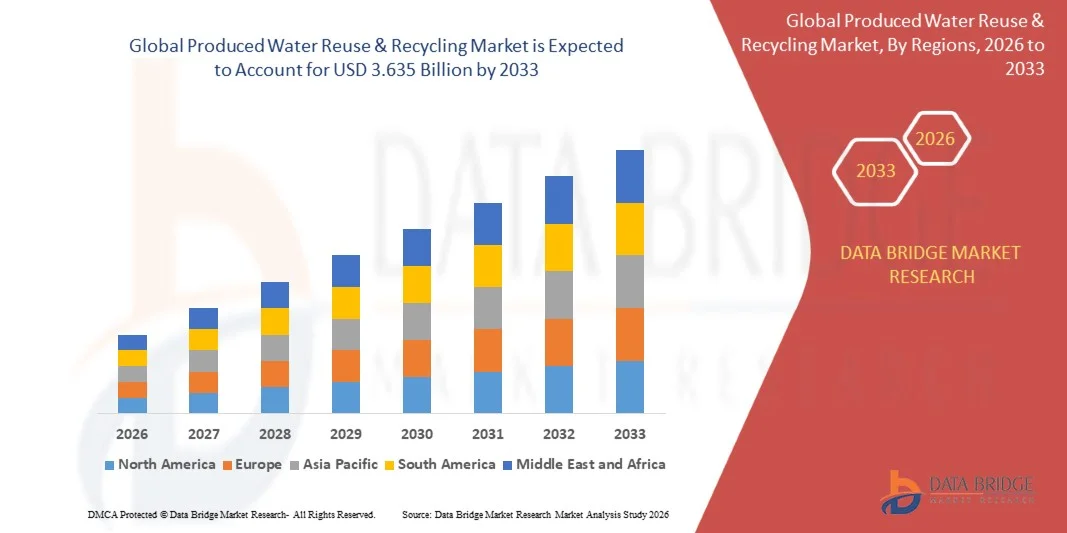
Report Scope and Produced Water Reuse & Recycling Market Segmentation
|
Attributes |
Produced Water Reuse & Recycling Key Market Insights |
|
Segments Covered |
|
|
Countries Covered |
North America · U.S. · Canada · Mexico Europe · Germany · France · U.K. · Netherlands · Switzerland · Belgium · Russia · Italy · Spain · Turkey · Rest of Europe Asia-Pacific · China · Japan · India · South Korea · Singapore · Malaysia · Australia · Thailand · Indonesia · Philippines · Rest of Asia-Pacific Middle East and Africa · Saudi Arabia · U.A.E. · South Africa · Egypt · Israel · Rest of Middle East and Africa South America · Brazil · Argentina · Rest of South America |
|
Key Market Players |
· Veolia Environnement S.A. (France) · Ecolab Inc. (U.S.) · Xylem Inc. (U.S.) · DuPont de Nemours, Inc. (U.S.) · Siemens AG (Germany) · Alfa Laval AB (Sweden) · Hitachi Zosen Corporation (Japan) · Evoqua Water Technologies LLC (U.S.) · Fluence Corporation Limited (Australia) · Aquatech International LLC (U.S.) · Praj Industries Limited (India) · Thermax Limited (India) · Pentair plc (U.K.) · Lenntech B.V. (Netherlands) · DeLoach Industries Inc. (U.S.) · Samco Technologies Inc. (U.S.) · Element Solutions Inc. (U.S.) · Industrial Water Equipment Ltd. (U.K.) · Kubota Corporation (Japan) · Mita Water Technologies S.R.L. (Italy) · WaterTectonics Inc. (U.S.) · Boson Whitewater (India) · Marathon Water Technologies (U.S.) |
|
Market Opportunities |
· Integration of artificial intelligence and IoT in water quality monitoring and treatment optimization · Growing demand for zero-liquid discharge systems in industrial applications · Expansion of potable reuse programs in water-stressed regions · Development of decentralized and modular treatment systems for remote operations · Increasing investment in produced water recycling infrastructure in emerging markets |
|
Value Added Data Info sets |
In addition to the insights on market scenarios such as market value, growth rate, segmentation, geographical coverage, and major players, the market reports curated by the Data Bridge Market Research also include import export analysis, production capacity overview, production consumption analysis, price trend analysis, climate change scenario, supply chain analysis, value chain analysis, raw material/consumables overview, vendor selection criteria, PESTLE Analysis, Porter Analysis, and regulatory framework. |
Produced Water Reuse & Recycling Market Trends
Trend: Increasing Adoption of Zero-Liquid Discharge Systems
The growing emphasis on environmental sustainability and stringent discharge regulations is driving the adoption of zero-liquid discharge (ZLD) systems in the produced water treatment market. ZLD systems enable the complete recovery of water and the conversion of wastewater into solid waste, eliminating the environmental risks associated with disposal. Industries such as oil and gas, power generation, and chemicals are increasingly investing in ZLD technologies to meet regulatory requirements, reduce freshwater consumption, and enhance their sustainability credentials.
Produced Water Reuse & Recycling Market Dynamics
Key Market Driver: Rising Water Scarcity and Growing Pressure on Freshwater Resources
Growing water scarcity and increasing pressure on freshwater resources are primary drivers of the produced water reuse & recycling market. Rapid population growth, urbanization, and industrial expansion have intensified demand for clean water, while climate change and irregular rainfall patterns have reduced the availability of natural freshwater sources. The United Nations reports that approximately 4 billion people experience water shortages for at least one month each year. By 2025, an estimated 1.8 billion people will face severe water shortages.
Industries such as oil and gas, power generation, and agriculture are increasingly turning to alternative water sources, including treated produced water, to meet their water needs. The use of recycled produced water reduces dependence on freshwater supplies, lowers operational costs, and supports environmental conservation by decreasing wastewater discharge. Additionally, rising awareness about water conservation and sustainability initiatives among governments and consumers is further encouraging the adoption of produced water reuse solutions, creating significant opportunities for market growth.
Key Restraint/Challenge: High Capital and Operational Costs
The high cost of installing and operating produced water treatment and recycling equipment is a significant restraint for the market. Advanced treatment systems, including membrane filtration, reverse osmosis, thermal treatment, and chemical disinfection units, require substantial capital investment, which can be a barrier, particularly for small- and medium-sized operators. Beyond the initial investment, ongoing costs for operation, maintenance, energy consumption, and skilled labor further increase the financial burden. Additionally, the complexity of treating produced water, which contains a wide range of contaminants, requires sophisticated technologies that are expensive to deploy and operate.
Key Market Opportunity: Expansion of Potable Reuse Programs
The expansion of potable reuse programs presents a significant opportunity for the produced water reuse & recycling market. Potable reuse involves treating wastewater, including produced water, to a high standard, making it safe for human consumption, either directly or indirectly. With increasing urbanization, population growth, and climate-induced water stress, traditional freshwater sources are becoming insufficient to meet demand. Governments and municipalities worldwide are investing in potable reuse programs to ensure a reliable, sustainable, and safe water supply for communities.
Produced Water Reuse & Recycling Market Scope
The produced water reuse & recycling market is segmented on the basis of treatment technology, application, capacity, source, end user, and service type.
-
By Treatment Technology
On the basis of treatment technology, the Produced Water Reuse & Recycling Market is segmented into primary treatment, secondary treatment, tertiary treatment, advanced oxidation, membrane filtration, and thermal treatment. The Tertiary Treatment segment dominated the market in 2025, owing to its critical role in producing high-quality treated water suitable for a wide range of reuse applications. Unlike primary and secondary treatment, which primarily remove solids and organic matter, tertiary treatment ensures advanced purification by eliminating pathogens, dissolved salts, nutrients, and other contaminants to meet stringent regulatory and safety standards. The rising adoption of advanced technologies such as membrane filtration, reverse osmosis, and ultraviolet disinfection has further strengthened the dominance of tertiary treatment.
The Membrane Filtration segment is expected to witness the fastest growth from 2026 to 2033, driven by its ability to remove fine particles, pathogens, and dissolved contaminants, enabling the production of high-quality recycled water for diverse applications. Membrane technologies offer efficient and reliable treatment solutions that meet the increasing demand for safe water reuse across industries and municipalities.
-
By Application
On the basis of application, the Produced Water Reuse & Recycling Market is segmented into agricultural irrigation, industrial reuse, aquifer recharge, surface water augmentation, oil & gas operations, and power generation cooling. The Oil & Gas Operations segment dominated the market in 2025, as the industry continues to implement closed-loop water systems and advanced treatment solutions to reduce freshwater withdrawal, minimize disposal costs, and meet stringent environmental standards.
The Agricultural Irrigation segment is anticipated to witness significant growth, driven by increasing water scarcity in farming regions and the growing acceptance of treated produced water as a reliable, cost-effective alternative water source for crop irrigation. As agriculture accounts for approximately 80% of global freshwater consumption, the adoption of treated produced water for irrigation represents a substantial opportunity to reduce pressure on freshwater resources.
-
By Capacity
On the basis of capacity, the Produced Water Reuse & Recycling Market is segmented into less than 50,000 liters/day, 50,001–200,000 liters/day, 200,001–500,000 liters/day, and above 500,000 liters/day. The Above 500,000 Liters/Day segment dominated the market in 2025, as large-scale systems are essential to meet the water demands of major oil and gas operations, industrial facilities, and municipal utilities. These systems are often integrated into centralized treatment plants and large-scale infrastructure projects where economies of scale reduce per-unit costs of water treatment.
-
By Source
On the basis of source, the Produced Water Reuse & Recycling Market is segmented into onshore operations, offshore operations, and unconventional extraction. The Onshore Operations segment dominated the market in 2025, reflecting the extensive onshore oil and gas activities worldwide and the higher volumes of produced water generated from onshore wells compared to offshore operations.
-
By End User
On the basis of end user, the Produced Water Reuse & Recycling Market is segmented into oil & gas companies, municipalities, industrial facilities, agricultural operations, and power plants. The Oil & Gas Companies segment dominated the market in 2025, as the industry is the primary generator of produced water and faces increasing regulatory and sustainability pressure to manage this waste stream effectively.
The Industrial segment is expected to witness significant growth, driven by high water consumption in manufacturing, power generation, and processing industries, combined with strict discharge regulations. Industries are increasingly adopting advanced water treatment technologies to enhance the efficiency of water recycling and reuse systems.
-
By Service Type
On the basis of service type, the Produced Water Reuse & Recycling Market is segmented into design & engineering, operation & maintenance, consulting & advisory, and monitoring & testing. The Operation & Maintenance segment dominated the market in 2025, driven by the need for ongoing support to ensure the efficient and reliable operation of treatment systems. Monitoring & Testing services are expected to witness significant growth, driven by the increasing emphasis on water quality compliance and the adoption of digital monitoring technologies.
Produced Water Reuse & Recycling Market Regional Analysis
Asia-Pacific Produced Water Reuse & Recycling Market Insight
Asia-Pacific dominated the produced water reuse & recycling market and accounted for the largest revenue share in 2025, supported by rapid urbanization, large-scale industrial expansion, high population density driving freshwater demand, and extensive government-backed investments in wastewater treatment infrastructure. The region's growth is driven by increasing water scarcity, strong government support, rising infrastructure investments, and stricter environmental regulations accelerating the adoption of recycling solutions across both municipal and industrial sectors.
Countries such as China, Japan, and India are implementing strict regulations to curb freshwater extraction and promote wastewater reuse. Japan's advanced wastewater treatment facilities and Singapore's NEWater initiative serve as benchmarks for effective industrial water management. The region's growth is further supported by significant investments in infrastructure to treat and recycle wastewater efficiently.
China Produced Water Reuse & Recycling Market Insight
The China produced water reuse & recycling market is growing rapidly, driven by the country's increasing energy demand, expanding industrial sector, and rising focus on environmental sustainability. Government initiatives promoting water conservation and the implementation of stricter environmental regulations are encouraging industries to invest in produced water treatment and recycling solutions. China is advanced in terms of wastewater reuse compared with some countries, such as Spain, where the volume of reclaimed water is about 368.2 Hm3 per year.
India Produced Water Reuse & Recycling Market Insight
The India produced water reuse & recycling market is expected to register the highest CAGR, driven by rapid industrialization, increasing water scarcity, and rising government focus on sustainable water management. Growing awareness of the importance of water conservation and the need for alternative water sources for industrial and municipal applications are encouraging investments in produced water treatment and recycling infrastructure.
Japan Produced Water Reuse & Recycling Market Insight
The Japan produced water reuse & recycling market is gaining significant momentum due to its health-focused industrial base and the popularity of advanced wastewater treatment facilities. Japan's advanced wastewater treatment facilities serve as benchmarks for effective industrial water management.
Australia Produced Water Reuse & Recycling Market Insight
The Australia produced water reuse & recycling market is experiencing robust growth, driven by the country's extensive mining and oil and gas operations, increasing focus on water conservation, and growing adoption of advanced treatment technologies across industrial sectors.
North America Produced Water Reuse & Recycling Market Insight
North America is a significant market for produced water reuse & recycling, driven by extensive oil and gas operations, particularly in unconventional plays such as the Permian Basin, and increasing regulatory pressure to reduce freshwater consumption and manage wastewater effectively. The United States accounts for approximately 34% market share, supported by mature oilfields and widespread hydraulic fracturing operations. Operators increasingly adopt treatment technologies to enable water reuse and reduce disposal costs.
U.S. Produced Water Reuse & Recycling Market Insight
The U.S. produced water reuse & recycling market is experiencing robust growth, driven by the expansion of unconventional oil and gas extraction, rising regulatory pressure on wastewater disposal, and growing corporate sustainability commitments. The Permian Basin, in particular, has seen significant investment in produced water recycling infrastructure, with operators implementing large-scale treatment facilities to reduce freshwater consumption and minimize disposal costs. Federal and state policies, including the U.S. Clean Water Act and various state-level regulations, are further encouraging the adoption of recycling solutions across the industry.
In March 2025, El Paso Water began construction on the $295 million Pure Water Center in El Paso, Texas, the nation's first direct-to-distribution wastewater reuse facility. This innovative facility planned to treat wastewater for direct reuse, providing a sustainable source of drinking water for the community.
Canada Produced Water Reuse & Recycling Market Insight
The Canada produced water reuse & recycling market is expanding steadily, supported by extensive oil sands operations, growing environmental awareness, and increasing government focus on sustainable water management. Canadian operators are investing in advanced water treatment technologies to reduce freshwater withdrawal and manage produced water from oil sands extraction.
Europe Produced Water Reuse & Recycling Market Insight
The Europe produced water reuse & recycling market is witnessing steady growth, driven by stringent environmental regulations, increasing water scarcity in southern European countries, and growing awareness of the importance of sustainable water management. Countries such as France, the U.K., and Germany are leading the adoption of advanced water treatment technologies, while Mediterranean countries are increasingly exploring water reuse solutions to address water scarcity challenges.
Germany Produced Water Reuse & Recycling Market Insight
The Germany produced water reuse & recycling market is expanding, driven by strong environmental regulations, advanced industrial infrastructure, and increasing adoption of sustainable water management practices. Germany accounts for approximately 6% of Europe's market, supported by its robust manufacturing sector and commitment to environmental sustainability.
United Kingdom Produced Water Reuse & Recycling Market Insight
The United Kingdom produced water reuse & recycling market is experiencing growth, supported by the push for Net-Zero Water Utilities and increasing adoption of circular water management strategies. The U.K. accounts for approximately 5% of Europe's market.
Middle East and Africa Produced Water Reuse & Recycling Market Insight
The Middle East and Africa produced water reuse & recycling market is gradually emerging, driven by severe water scarcity, increasing oil and gas activities, and growing government investments in sustainable water management. Countries such as Saudi Arabia, UAE, and Qatar are investing in large-scale water recycling projects to address acute freshwater shortages and support economic development.
In 2025, SATORP partnered with Marafiq, Veolia, and Lamar to develop a USD 500 million wastewater recycling project in Jubail, Saudi Arabia, designed to treat and reuse 8.76 million cubic meters of industrial wastewater annually. Scheduled for completion in 2028, this initiative aligns with Vision 2030 goals by supporting sustainable resource management and circular economy practices.
South America Produced Water Reuse & Recycling Market Insight
The South America produced water reuse & recycling market is expanding, driven by increasing oil and gas activities, rising environmental awareness, and growing government focus on sustainable water management. Countries such as Brazil and Argentina are investing in water treatment infrastructure to manage produced water from their growing energy sectors and address water quality concerns.
Produced Water Reuse & Recycling Market Share
The produced water reuse & recycling industry is primarily led by well-established companies, including:
- Veolia Environnement S.A. (France)
- Ecolab Inc. (U.S.)
- Xylem Inc. (U.S.)
- DuPont de Nemours, Inc. (U.S.)
- Siemens AG (Germany)
- Alfa Laval AB (Sweden)
- Hitachi Zosen Corporation (Japan)
- Evoqua Water Technologies LLC (U.S.)
- Fluence Corporation Limited (Australia)
- Aquatech International LLC (U.S.)
- Praj Industries Limited (India)
- Thermax Limited (India)
- Pentair plc (U.K.)
- Lenntech B.V. (Netherlands)
- DeLoach Industries Inc. (U.S.)
- Samco Technologies Inc. (U.S.)
- Element Solutions Inc. (U.S.)
- Industrial Water Equipment Ltd. (U.K.)
- Kubota Corporation (Japan)
- Mita Water Technologies S.R.L. (Italy)
- WaterTectonics Inc. (U.S.)
- Boson Whitewater (India)
- Marathon Water Technologies (U.S.)
Latest Developments in Produced Water Reuse & Recycling Market
- In November 2025, Transition Industries' Pacifico Mexinol project, in collaboration with Veolia, launched one of the world's largest industrial wastewater reuse initiatives in Ahome, Mexico. This partnership aimed to treat 32,300 cubic meters of municipal wastewater daily, preserving local freshwater for other uses while supporting industrial water needs. The advanced water treatment plant, set to become the largest ultra-low carbon chemical facility globally, represents a major step forward in water circularity and sustainable resource management.
- In August 2025, Veolia partnered with Brazil to launch an advanced water reuse system in Vitória, designed to recycle 85% of the region's wastewater for industrial use. The facility planned to process 450 liters per second, providing reclaimed water equivalent to the needs of 200,000 people, supporting sustainability and water conservation efforts. This pioneering project marked a significant step towards addressing water scarcity and establishing a new standard for water reuse in Brazil.
- In March 2025, El Paso Water began construction on the $295 million Pure Water Center in El Paso, Texas, the nation's first direct-to-distribution wastewater reuse facility. This innovative facility planned to treat wastewater for direct reuse, providing a sustainable source of drinking water for the community. The project represents a significant step toward enhancing water resilience and sustainability in the region.
- In October 2025, WaterTectonics, in collaboration with Clearvale Capital, launched WT Oil & Gas to deliver high-performance water treatment solutions for the oil and gas sector. Based in Midland, Texas, the subsidiary focused on high-volume produced water recycling and reuse across the Permian and Delaware Basins, addressing the operational and environmental challenges of large-scale oilfield activity.
- In October 2025, Maharashtra's cabinet approved a circular economy policy to process and reuse sewage and wastewater across 424 urban local bodies, supporting non-drinking applications, such as industrial operations and agricultural irrigation. The state allocated INR 500 Crore for implementation, reflecting a significant commitment to sustainable water management and pollution reduction.
- In November 2025, the Bangalore Water Supply and Sewerage Board opened its wastewater treatment plants to start-ups to accelerate development of advanced recycling technologies. The first collaboration with Boson Whitewater at the Kadubeesanahalli plant was designed to test purification systems under real operating conditions and support Bengaluru's reuse expansion by supplying up to 70,000 liters of high-quality treated water daily.
- In 2025, SATORP partnered with Marafiq, Veolia, and Lamar to develop a USD 500 million wastewater recycling project in Jubail, Saudi Arabia, designed to treat and reuse 8.76 million cubic meters of industrial wastewater annually. Scheduled for completion in 2028, this initiative aligns with Vision 2030 goals by supporting sustainable resource management and circular economy practices.
- In January 2025, Chandra Asri Group launched a comprehensive Water Stewardship Program aimed at reducing water usage and advancing recycling practices. The initiative included the installation of wastewater treatment systems in schools and villages, as well as rainwater harvesting systems in public parks, contributing to meaningful reductions in clean water usage.
- In July 2025, Bangladesh's Ready-Made Garment industry established the country's largest Water Reuse and Wastewater Management Demonstration Site at Fakir Knitwears Ltd, targeting a 30% reduction in freshwater extraction and the reuse of 438,000 cubic meters of water annually in line with national sustainability objectives.

- Interactive Data Analysis Dashboard
- Company Analysis Dashboard for high growth potential opportunities
- Research Analyst Access for customization & queries
- Competitor Analysis with Interactive dashboard
- Latest News, Updates & Trend analysis
- Harness the Power of Benchmark Analysis for Comprehensive Competitor Tracking
Global Produced Water Reuse And Recycling Market, Supply Chain Analysis and Ecosystem Framework
To support market growth and help clients navigate the impact of geopolitical shifts, DBMR has integrated in-depth supply chain analysis into its Global Produced Water Reuse And Recycling Market research reports. This addition empowers clients to respond effectively to global changes affecting their industries. The supply chain analysis section includes detailed insights such as Global Produced Water Reuse And Recycling Market consumption and production by country, price trend analysis, the impact of tariffs and geopolitical developments, and import and export trends by country and HSN code. It also highlights major suppliers with data on production capacity and company profiles, as well as key importers and exporters. In addition to research, DBMR offers specialized supply chain consulting services backed by over a decade of experience, providing solutions like supplier discovery, supplier risk assessment, price trend analysis, impact evaluation of inflation and trade route changes, and comprehensive market trend analysis.
Data collection and base year analysis are done using data collection modules with large sample sizes. The stage includes obtaining market information or related data through various sources and strategies. It includes examining and planning all the data acquired from the past in advance. It likewise envelops the examination of information inconsistencies seen across different information sources. The market data is analysed and estimated using market statistical and coherent models. Also, market share analysis and key trend analysis are the major success factors in the market report. To know more, please request an analyst call or drop down your inquiry.
The key research methodology used by DBMR research team is data triangulation which involves data mining, analysis of the impact of data variables on the market and primary (industry expert) validation. Data models include Vendor Positioning Grid, Market Time Line Analysis, Market Overview and Guide, Company Positioning Grid, Patent Analysis, Pricing Analysis, Company Market Share Analysis, Standards of Measurement, Global versus Regional and Vendor Share Analysis. To know more about the research methodology, drop in an inquiry to speak to our industry experts.
Data Bridge Market Research is a leader in advanced formative research. We take pride in servicing our existing and new customers with data and analysis that match and suits their goal. The report can be customized to include price trend analysis of target brands understanding the market for additional countries (ask for the list of countries), clinical trial results data, literature review, refurbished market and product base analysis. Market analysis of target competitors can be analyzed from technology-based analysis to market portfolio strategies. We can add as many competitors that you require data about in the format and data style you are looking for. Our team of analysts can also provide you data in crude raw excel files pivot tables (Fact book) or can assist you in creating presentations from the data sets available in the report.













