


What is the Production Animal Medicine Market Size and Overview ?
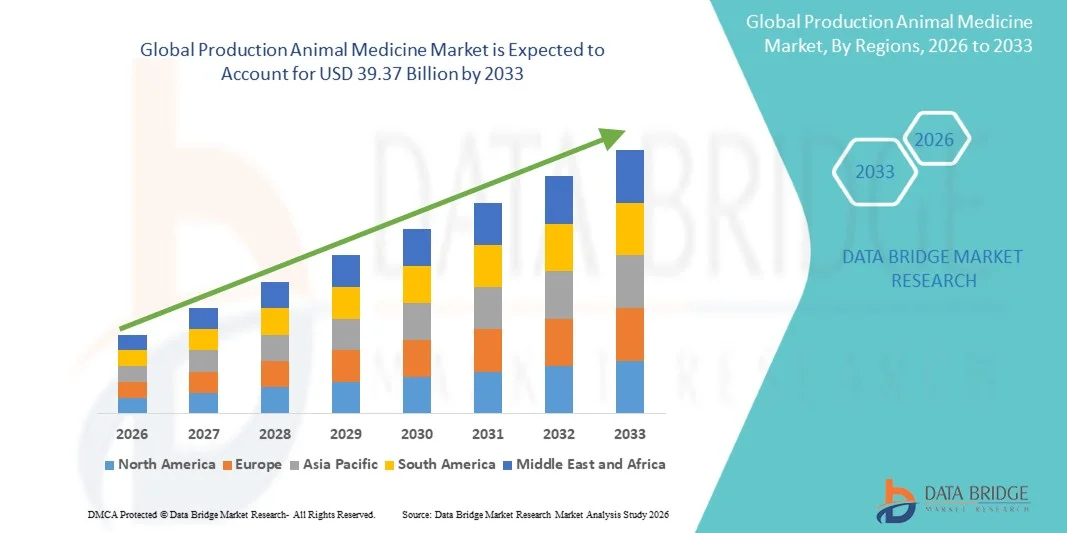
- As per Data Bridge Market Research Analysis the Global production animal medicine market was valued at USD 26.84 billion in 2025 and is projected to reach USD 39.37 billion by 2033, growing at a CAGR of 4.90% from 2026 to 2033. Growth is underpinned by rising global meat, dairy, and egg consumption, expanding commercial livestock and poultry operations, and increasing government emphasis on food safety, herd productivity, and disease surveillance across major producing regions.
- The rising incidence of infectious and zoonotic diseases in cattle, swine, and poultry, combined with tightening biosecurity and antimicrobial-use regulations, is compelling livestock producers, veterinary hospitals, and feed mills to adopt advanced vaccines, parasiticides, and medicated feed additives. Growing intensification of farming, expansion of aquaculture, and increasing veterinary infrastructure investment in emerging economies are further replacing reactive treatment with preventive herd-health management programs.
Market Size & Forecast
- Global Market Value (2025): USD 26.84 Billion
- Expected Market Value (2033): USD 39.37 Billion
- Forecast CAGR (2026–2033): 4.90%
- Leading Region in 2025: North America
- Fastest Growing Region: Asia-Pacific
Key Market Trends & Insights
- North America dominated the global production animal medicine market with the largest revenue share of 34.60% in 2025, supported by large-scale commercial livestock operations, strong biosecurity regulation, and the presence of leading animal health companies.
- The pharmaceuticals segment led the market with a 52.38% share in 2025, driven by widespread use of anti-infectives, parasiticides, and anti-inflammatory drugs across herd-health management programs.
- Asia-Pacific is expected to be the fastest-growing region at a CAGR of 6.10% from 2026 to 2033, fueled by expanding livestock and poultry populations, rising protein consumption, and growing veterinary infrastructure investment in China, India, and Southeast Asia.
- Biologics are the fastest-growing product type, projected to register a CAGR of 5.90%, reflecting rising adoption of vaccines and monoclonal antibodies for preventive disease control and reduced antibiotic dependence.
- The cattle segment dominates the animal type category with a 34.72% revenue share in 2025, led by large dairy and beef herds requiring routine vaccination, parasiticide, and reproductive-health treatments.
- Parenteral administration accounts for 47.65% of the market, preferred for its fast onset of action, precise dosing, and suitability for mass herd and flock treatment programs.
Report Scope and Production Animal Medicine Market Segmentation
|
Attributes |
Production Animal Medicine Key Market Insights |
|
Segments Covered |
|
|
Countries Covered |
North America
Europe
Asia-Pacific
Middle East and Africa
South America
|
|
Key Market Players |
|
|
Market Opportunities |
|
|
Value Added Data Infosets |
In addition to the insights on market scenarios such as market value, growth rate, segmentation, geographical coverage, and major players, the market reports curated by the Data Bridge Market Research also include in-depth expert analysis, geographically represented company-wise production and capacity, network layouts of distributors and partners, detailed and updated price trend analysis and deficit analysis of supply chain and demand. |
Production Animal Medicine Market Dynamics
Trend: Growing adoption of preventive biologics and precision livestock health management
Livestock producers are increasingly shifting from therapeutic disease treatment toward preventive herd-health management through the adoption of advanced biologics, next-generation vaccines, precision diagnostics, and digital livestock monitoring technologies. The growing emphasis on reducing antimicrobial use while improving animal productivity is accelerating investment in recombinant vaccines, autogenous vaccines, immune-enhancing biologics, and precision health solutions across cattle, poultry, swine, and aquaculture production systems. Technologies such as wearable livestock sensors, artificial intelligence (AI)-enabled disease surveillance, and real-time health monitoring are enabling early disease detection and targeted intervention, reducing production losses and improving feed conversion efficiency.
For instance, Merck Animal Health continues to expand its digital livestock portfolio through SenseHub and Allflex Livestock Intelligence, allowing producers to monitor animal health, reproduction, and welfare in real time. Similarly, Boehringer Ingelheim continues to strengthen its poultry and swine vaccine portfolio through advanced biologics that support preventive disease management and reduce dependence on antibiotics.
These developments are positioning preventive biologics and precision livestock health technologies as fundamental components of modern animal production systems, supporting sustainable livestock farming while enhancing productivity and food security.
Key Market Driver: Rising Global Demand for Animal Protein and Intensification of Livestock Production
Growing global demand for meat, dairy products, eggs, and aquaculture products is driving the intensification of cattle, poultry, swine, and fish production, increasing the need for preventive and therapeutic animal health solutions that protect herd productivity and improve production efficiency. Expanding commercial livestock operations are increasingly adopting vaccines, parasiticides, anti-infectives, reproductive health products, and medicated feed additives as integral components of herd-health programs to reduce disease-related economic losses and improve feed conversion ratios.
According to the Food and Agriculture Organization (FAO), global demand for animal-source foods is expected to continue increasing over the coming decades due to population growth, urbanization, and rising household incomes, creating sustained demand for production animal medicines. In addition, increasing government investment in livestock disease surveillance, national vaccination campaigns, and biosecurity initiatives following outbreaks of avian influenza, African swine fever, and foot-and-mouth disease is further supporting market expansion.
These factors continue to strengthen long-term demand for advanced veterinary pharmaceuticals and biologics across global livestock industries.
Key Restraint/Challenge: Tightening Antimicrobial-Use Regulations and High Cost of Advanced Biologics
A significant restraint in the global production animal medicine market is the increasing regulatory restriction on antimicrobial use in food-producing animals, particularly regarding medically important antibiotics used for growth promotion and routine disease prevention. Regulatory authorities across North America, Europe, and several Asia-Pacific countries continue implementing stricter antimicrobial stewardship programs to combat antimicrobial resistance (AMR), requiring livestock producers to adopt alternative disease prevention strategies. At the same time, advanced biologics, recombinant vaccines, monoclonal antibody therapeutics, and next-generation immunological products involve substantial research, manufacturing, quality assurance, and cold-chain distribution costs, limiting their accessibility for smallholder farms and cost-sensitive producers in emerging economies.
For instance, the World Health Organization (WHO) and the World Organisation for Animal Health (WOAH) continue promoting responsible antimicrobial use in food animals as part of global efforts to reduce antimicrobial resistance.
Furthermore, maintaining high-capacity biologics manufacturing facilities and vaccine distribution infrastructure requires significant long-term capital investment, creating considerable barriers for smaller regional manufacturers while increasing overall market entry costs.
Key Market Opportunity: Expansion of Preventive Biologics and Aquaculture Health Management
The global transition from therapeutic disease treatment toward preventive vaccination presents significant opportunities for manufacturers of veterinary biologics, diagnostics, and advanced animal health products. Increasing producer awareness regarding disease prevention, combined with stricter antimicrobial regulations, is accelerating the adoption of vaccines, immune modulators, and precision livestock health solutions across commercial production systems. Rapid expansion of aquaculture production, particularly in China, India, Vietnam, Indonesia, Norway, and Latin America, is generating substantial demand for fish vaccines, water-quality management solutions, diagnostics, and medicated feed additives designed specifically for aquatic species.
According to the FAO, aquaculture remains one of the fastest-growing food production sectors globally, creating attractive opportunities for manufacturers specializing in aquatic animal health products. In addition, growing government investment in veterinary healthcare infrastructure, disease surveillance programs, and livestock modernization initiatives across Asia-Pacific, Latin America, and Africa is supporting broader adoption of preventive biologics.
Continuous innovation in recombinant vaccines, RNA-based vaccine technologies, precision diagnostics, and digital herd-health management platforms is expected to further expand commercial opportunities for production animal medicine manufacturers throughout the forecast period.
Production Animal Medicine Market Scope
The production animal medicine market is segmented on the basis of product type, animal type, route of administration, disease/indication, distribution channel, and end user.
- By Product Type
On the basis of product type, the global production animal medicine market is segmented into biologics, pharmaceuticals, medicated feed additives, and other products.
The pharmaceuticals segment dominated the market with a 52.38% share in 2025, owing to the widespread use of anti-infectives, antiparasitic agents, anti-inflammatory drugs, reproductive health products, and nutritional therapeutics across cattle, poultry, swine, and aquaculture production systems. Pharmaceuticals remain the primary treatment option for managing bacterial, parasitic, and metabolic diseases due to their broad therapeutic applicability, rapid clinical response, and established distribution networks. Increasing commercial livestock production, rising disease prevalence, and continuous product innovation in long-acting formulations and combination therapies further support the segment's market leadership.
The biologics segment is projected to register the fastest growth at a CAGR of 5.90% from 2026 to 2033, driven by increasing adoption of preventive vaccination programs and growing demand for recombinant vaccines, monoclonal antibodies, and immune-modulating therapies. Rising regulatory restrictions on antibiotic use, expanding disease surveillance programs, and increasing investment in advanced veterinary biologics are encouraging livestock producers to adopt preventive herd-health strategies that improve productivity while reducing antimicrobial dependence.
- By Animal Type
On the basis of animal type, the global production animal medicine market is segmented into cattle, poultry, swine, sheep & goats, aquaculture, and other animals.
The cattle segment led the market with a 34.72% share in 2025, supported by the extensive use of vaccines, parasiticides, reproductive-health products, nutritional supplements, and anti-infectives across dairy and beef production systems. Increasing global demand for milk and beef, coupled with rising investments in disease prevention, reproductive efficiency, and herd productivity, continues to drive medicine consumption within the cattle sector. Government-supported vaccination campaigns and growing adoption of precision livestock management technologies further strengthen segment growth.
The poultry segment is expected to witness the fastest growth at a CAGR of 5.60% from 2026 to 2033, driven by rapid expansion of commercial broiler and layer production, particularly across Asia-Pacific, Latin America, and the Middle East. Rising poultry meat and egg consumption, increasing concerns regarding avian influenza and Newcastle disease, and growing adoption of vaccination and biosecurity programs are accelerating demand for poultry health products globally.
- By Route of Administration
On the basis of route of administration, the global production animal medicine market is segmented into oral, parenteral, topical, and other routes.
The parenteral segment dominated the market with a 47.65% share in 2025, owing to its rapid onset of action, accurate dosing, high bioavailability, and suitability for administering vaccines, antibiotics, hormones, and biologics across large livestock populations. Injectable products remain the preferred choice for disease prevention and treatment programs because they provide consistent therapeutic outcomes while supporting large-scale vaccination campaigns conducted by veterinary professionals.
The oral segment is anticipated to witness the fastest CAGR of 5.40% from 2026 to 2033, driven by the convenience of administering medicines through feed or drinking water in commercial poultry and swine operations. Oral administration significantly reduces labor requirements, minimizes animal handling stress, and enables efficient mass medication during disease outbreaks. Continuous innovation in medicated feed additives, oral vaccines, and nutritional supplements is further supporting market growth.
- By Disease/Indication
On the basis of disease/indication, the global production animal medicine market is segmented into infectious diseases, parasitic diseases, reproductive disorders, nutritional deficiencies, and other indications.
The infectious diseases segment dominated the market with a 33.92% share in 2025, reflecting the substantial economic impact of bacterial, viral, and fungal diseases on livestock productivity worldwide. Diseases such as avian influenza, foot-and-mouth disease, African swine fever, bovine respiratory disease, and porcine reproductive and respiratory syndrome continue to drive demand for vaccines, anti-infectives, diagnostics, and herd-health management solutions. Increasing government surveillance and mandatory vaccination programs further contribute to the segment's dominance.
The parasitic diseases segment is expected to register the fastest CAGR of 5.50% from 2026 to 2033, driven by the increasing prevalence of internal and external parasites affecting grazing livestock and aquaculture species. Rising adoption of broad-spectrum parasiticides, integrated parasite management programs, and routine preventive treatments is helping producers reduce productivity losses, improve animal welfare, and enhance feed efficiency across commercial livestock operations.
- By Distribution Channel
On the basis of distribution channel, the global production animal medicine market is segmented into veterinary hospitals & clinics, retail & farm supply stores, e-commerce/online pharmacies, and feed mills.
The retail & farm supply stores segment dominated the market with a 39.84% share in 2025, owing to their extensive geographic reach and direct accessibility for livestock producers seeking routine veterinary medicines, vaccines, nutritional supplements, and medicated feed additives. These outlets play a critical role in supplying animal health products to both commercial and smallholder farms, particularly in rural and agricultural regions. Strong relationships with veterinary practitioners and livestock producers further support continued segment growth.
The e-commerce/online pharmacies segment is expected to witness the fastest CAGR of 6.30% from 2026 to 2033, driven by increasing digitalization of veterinary services, expanding internet penetration, and growing preference for convenient procurement of animal health products. Online platforms offer broader product availability, competitive pricing, doorstep delivery, and easier access to veterinary medicines, making them increasingly attractive to livestock producers and veterinary professionals..
- By End User
On the basis of end user, the global production animal medicine market is segmented into livestock farms & ranches, veterinary hospitals & clinics, research institutes & universities, and government & regulatory bodies.
The livestock farms & ranches segment dominated the market with a 44.15% share in 2025, reflecting the direct and recurring demand for vaccines, pharmaceuticals, biologics, parasiticides, and medicated feed additives required to maintain herd health, maximize productivity, and minimize disease-related economic losses. Increasing herd sizes, commercial farming practices, and investments in preventive healthcare continue to strengthen medicine consumption at the production level.
The research institutes & universities segment is expected to witness the fastest CAGR of 5.70% from 2026 to 2033, driven by increasing public and private investment in veterinary research, next-generation vaccines, antimicrobial alternatives, precision livestock health technologies, and disease surveillance systems. Growing collaboration between academic institutions, government agencies, and animal health companies is accelerating innovation in biologics, diagnostics, and sustainable livestock disease management solutions, supporting long-term market growth.
Production Animal Medicine Market Regional Analysis
North America dominated the production animal medicine market and accounted for the largest revenue share of 34.60% in 2025, supported by large-scale commercial cattle, poultry, and swine operations, advanced veterinary healthcare infrastructure, and stringent food safety and biosecurity regulations. The region benefits from the presence of leading animal health companies, strong investment in biologics manufacturing, and widespread adoption of preventive vaccination programs. Increasing concerns regarding antimicrobial resistance have accelerated the adoption of vaccines, diagnostics, and alternative disease prevention strategies across livestock production systems. The U.S. continues to lead the regional market owing to its extensive livestock population, high veterinary healthcare expenditure, and continuous investment in innovative animal health technologies. In addition, increasing use of precision livestock farming solutions, digital herd monitoring platforms, and advanced disease surveillance programs is improving production efficiency and supporting sustained demand for veterinary pharmaceuticals and biologics across North America.
U.S. Production Animal Medicine Market Insight
The U.S. production animal medicine market is witnessing steady growth, driven by one of the world's largest commercial cattle, poultry, and swine industries and increasing investment in disease prevention and herd productivity. The country has well-established veterinary healthcare infrastructure, extensive vaccination programs, and strong regulatory oversight supporting the adoption of high-quality animal medicines. Rising concerns regarding highly pathogenic avian influenza, bovine respiratory disease, and African swine fever preparedness continue to encourage producers to strengthen biosecurity and preventive healthcare practices. The presence of major animal health companies, including Zoetis, Merck Animal Health, Elanco, and Boehringer Ingelheim Animal Health USA, further supports continuous product innovation and commercialization. Additionally, increasing adoption of precision livestock technologies, wearable animal monitoring systems, and digital herd management platforms is enhancing disease detection, reproductive efficiency, and overall livestock productivity, supporting continued market expansion.
Europe Production Animal Medicine Market Insight
The Europe production animal medicine market remains a significant contributor to global revenue, supported by stringent animal welfare regulations, strong veterinary healthcare systems, and well-established dairy, poultry, and swine industries. Regulatory initiatives promoting responsible antimicrobial use and preventive vaccination continue to encourage the adoption of biologics and alternative disease management strategies. Countries across the region are increasingly investing in sustainable livestock farming practices that improve animal health while reducing environmental impact. Germany, France, the U.K., Spain, and the Netherlands represent major regional markets due to their advanced livestock industries and strong veterinary research capabilities. Growing investment in recombinant vaccines, diagnostic technologies, and precision livestock health management is further strengthening the adoption of advanced production animal medicines throughout Europe.
Germany Production Animal Medicine Market Insight
The Germany production animal medicine market is expanding steadily, supported by its advanced livestock production systems, particularly in swine, dairy cattle, and poultry farming. The country benefits from strong veterinary research institutions, well-developed pharmaceutical manufacturing capabilities, and rigorous animal health regulations that promote preventive healthcare and responsible antimicrobial use. Increasing adoption of vaccination programs, parasite control strategies, and digital herd-health monitoring technologies is improving disease prevention and livestock productivity. Germany's emphasis on sustainable agriculture, food safety, and animal welfare continues to encourage investment in innovative biologics and advanced veterinary pharmaceuticals. Furthermore, ongoing collaboration between research institutes, veterinary organizations, and animal health manufacturers is accelerating the development of next-generation production animal medicines.
Asia-Pacific Production Animal Medicine Market Insight
The Asia-Pacific production animal medicine market is expected to witness the fastest growth during the forecast period, driven by expanding poultry, swine, cattle, and aquaculture production across China, India, Southeast Asia, and Australia. Rapid urbanization, rising disposable incomes, and increasing consumption of meat, dairy products, eggs, and seafood are encouraging producers to improve livestock productivity through preventive healthcare and disease management programs. Governments across the region are investing significantly in veterinary healthcare infrastructure, disease surveillance, and national vaccination campaigns to strengthen food security and reduce economic losses caused by livestock diseases. In addition, growing awareness regarding biosecurity, antimicrobial stewardship, and preventive vaccination is increasing the adoption of biologics, pharmaceuticals, and medicated feed additives. Expanding domestic pharmaceutical manufacturing capacity and increasing investment by multinational animal health companies continue to position Asia-Pacific as one of the fastest-growing regional markets.
China Production Animal Medicine Market Insight
The China production animal medicine market is growing rapidly, supported by the country's large commercial swine, poultry, cattle, and aquaculture industries. Government initiatives aimed at improving food safety, strengthening biosecurity, and modernizing livestock production are driving demand for vaccines, veterinary pharmaceuticals, and advanced animal health products. Following previous outbreaks of African swine fever and avian influenza, producers have significantly increased investment in preventive vaccination, disease surveillance, and farm biosecurity measures to minimize production risks. The expansion of intensive livestock farming, modernization of veterinary distribution networks, and increasing adoption of precision farming technologies are further supporting market growth. Moreover, rising investment by domestic and international animal health companies in vaccine development, biologics manufacturing, and veterinary diagnostics is strengthening China's position as one of the largest and fastest-growing production animal medicine markets globally.
India Production Animal Medicine Market Insight
The India production animal medicine market is expanding steadily, driven by the country's large cattle, buffalo, poultry, sheep, goat, and aquaculture populations, along with increasing government initiatives to improve livestock health and productivity. Programs supporting vaccination, disease surveillance, and livestock disease control are encouraging wider adoption of veterinary pharmaceuticals, biologics, and feed additives across both commercial farms and smallholder production systems. Rising demand for milk, poultry meat, eggs, and animal protein, combined with increasing awareness among farmers regarding preventive healthcare and parasite management, is supporting sustained market growth. In addition, expanding investment by domestic and multinational animal health companies, improving veterinary healthcare infrastructure, and increasing adoption of modern livestock management practices are expected to continue driving demand for production animal medicines across the country during the forecast period.
Production Animal Medicine Market Share
The production animal medicine industry is primarily led by well-established companies, including:
- Zoetis Inc. (U.S.)
- Elanco Animal Health Incorporated (U.S.)
- Boehringer Ingelheim International GmbH (Germany)
- Merck & Co., Inc. – Merck Animal Health (U.S.)
- Ceva Santé Animale (France)
- Virbac S.A. (France)
- Dechra Pharmaceuticals PLC (U.K.)
- Phibro Animal Health Corporation (U.S.)
- Huvepharma EOOD (Bulgaria)
- Vetoquinol S.A. (France)
- Norbrook Laboratories Ltd. (U.K.)
- Bimeda Inc. (Ireland)
- Neogen Corporation (U.S.)
- Alivira Animal Health Limited (India)
- Zydus Animal Health (India)
- Kemin Industries, Inc. (U.S.)
- Biogénesis Bagó S.A. (Argentina)
- Ourofino Saúde Animal (Brazil)
- Indian Immunologicals Ltd. (India)
- Hester Biosciences Limited (India)
Latest Developments in Production Animal Medicine Market
- In July 2025, Boehringer Ingelheim launched VAXXITEK HVT+IBD+H5, a trivalent poultry vaccine that provides protection against Marek's disease, infectious bursal disease (IBD), and H5 avian influenza through a single vaccination. The launch strengthened the company's poultry biologics portfolio and supported commercial poultry producers in enhancing disease prevention and flock productivity.
- In October 2024, Boehringer Ingelheim completed the acquisition of Elanco Animal Health's U.S. poultry portfolio, including vaccines, equipment, research assets, and related intellectual property. The acquisition expanded Boehringer Ingelheim's poultry vaccine business, strengthened its hatchery vaccination capabilities, and enhanced its position in the North American poultry health market.
- In 2024, Boehringer Ingelheim acquired Elanco Animal Health's U.S. poultry portfolio, consolidating hatchery spray-vaccination systems and reinforcing its position among the top poultry vaccine suppliers in North America.
- In April 2025, Merck Animal Health announced the commercial launch of NOBILIS MULTRIVA IBm+ND, an innovative poultry vaccine designed to provide broad protection against Newcastle disease and infectious bronchitis. The launch further expanded the company's poultry vaccine portfolio and reinforced its commitment to preventive animal healthcare solutions.
- In 2025, Virbac launched oral vaccines targeting ETEC F4 and F18 strains in Thailand to prevent piglet diarrhea, expanding needle-free immunization options for swine producers across Southeast Asia.

- Interactive Data Analysis Dashboard
- Company Analysis Dashboard for high growth potential opportunities
- Research Analyst Access for customization & queries
- Competitor Analysis with Interactive dashboard
- Latest News, Updates & Trend analysis
- Harness the Power of Benchmark Analysis for Comprehensive Competitor Tracking
Data collection and base year analysis are done using data collection modules with large sample sizes. The stage includes obtaining market information or related data through various sources and strategies. It includes examining and planning all the data acquired from the past in advance. It likewise envelops the examination of information inconsistencies seen across different information sources. The market data is analysed and estimated using market statistical and coherent models. Also, market share analysis and key trend analysis are the major success factors in the market report. To know more, please request an analyst call or drop down your inquiry.
The key research methodology used by DBMR research team is data triangulation which involves data mining, analysis of the impact of data variables on the market and primary (industry expert) validation. Data models include Vendor Positioning Grid, Market Time Line Analysis, Market Overview and Guide, Company Positioning Grid, Patent Analysis, Pricing Analysis, Company Market Share Analysis, Standards of Measurement, Global versus Regional and Vendor Share Analysis. To know more about the research methodology, drop in an inquiry to speak to our industry experts.
Data Bridge Market Research is a leader in advanced formative research. We take pride in servicing our existing and new customers with data and analysis that match and suits their goal. The report can be customized to include price trend analysis of target brands understanding the market for additional countries (ask for the list of countries), clinical trial results data, literature review, refurbished market and product base analysis. Market analysis of target competitors can be analyzed from technology-based analysis to market portfolio strategies. We can add as many competitors that you require data about in the format and data style you are looking for. Our team of analysts can also provide you data in crude raw excel files pivot tables (Fact book) or can assist you in creating presentations from the data sets available in the report.












