What is the Professional Haircare Market Size and Growth Rate?
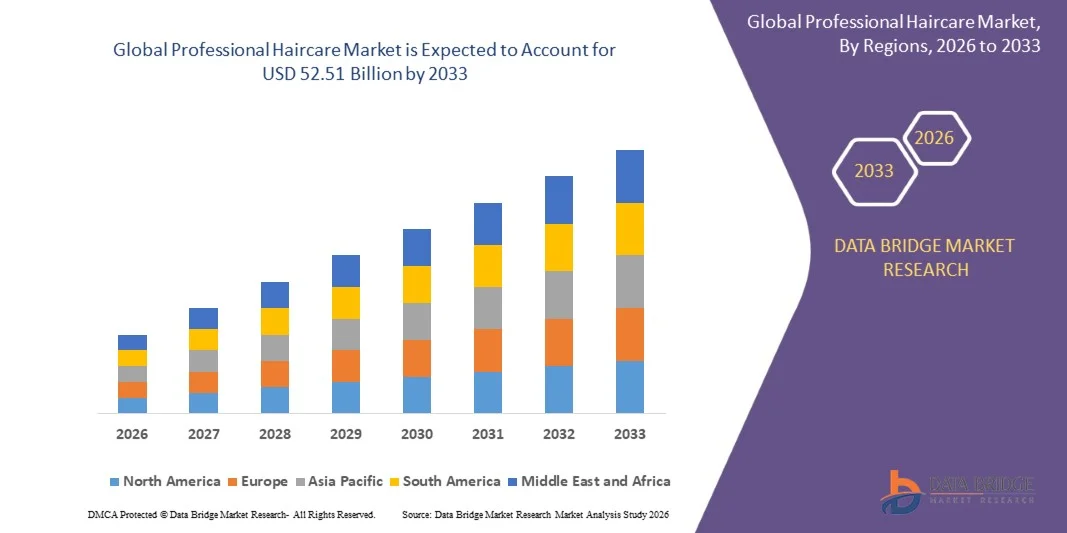
- As per Data Bridge Market Research analysis, the professional haircare market was valued at USD 37.78 billion in 2025 and is projected to reach USD 52.51 billion by 2033, growing at a CAGR of 4.20% from 2026 to 2033.
- The market is experiencing steady growth driven by the increasing consumer focus on personal grooming, rising demand for salon-grade products, and growing awareness about hair and scalp health.
- The professional haircare market has evolved significantly, with consumers becoming more ingredient-conscious and demanding products enriched with natural and organic components such as argan oil, keratin, and biotin. The shift towards personalized and inclusive beauty standards has further stimulated product innovation, with brands developing targeted treatments catering to diverse hair types and concerns such as hair thinning, dandruff, and scalp sensitivity. The global professional haircare market is poised for continued expansion in the coming years, driven by the escalating demand for premium and salon-grade products and the rapid growth of the e-commerce sector.
Market Size & Forecast
- Global Market Value (2025): USD 37.78 Billion
- Expected Market Value (2033): USD 52.51 Billion
- Forecast CAGR (2026 to 2033): 4.20%
- Leading Region in 2025: North America
- Fastest Growing Region: Asia-Pacific
What are the Major Takeaways of the Professional Haircare Market?
- North America dominated the global professional haircare market with the largest revenue share of 36.7% in 2025, supported by a well-established beauty and personal care industry, strong presence of salon and hair care facilities, and increasing awareness pertaining to various brands across the region.
- Asia-Pacific is expected to be the fastest-growing region, fueled by rapid urbanization, rising disposable incomes, expanding middle-class population, and increasing popularity of Western beauty trends. Countries such as China, India, and Japan are at the forefront of this transformation
- The shampoo segment accounted for a dominant share of 38.9% in 2025, driven by its essential role in daily hair hygiene and the wide range of specialized formulations targeting different hair types and concerns such as anti-dandruff and volumizing.
- The salon distribution channel represents a major strategic growth area for professional haircare products, with professional salons serving as the primary point of contact between consumers and expert hair care services.
- The global professional haircare products market is witnessing increased retail availability and e-commerce penetration, which have significantly amplified product accessibility. Online channels are gaining traction, especially among millennials and gen z consumers, who increasingly prefer the convenience of purchasing professional-grade products through digital platforms.
- The rising demand for organic and sustainable products, driven by growing environmental consciousness among consumers, is reshaping the professional haircare landscape. Brands are introducing eco-friendly packaging and cruelty-free formulations to align with consumer expectations for clean beauty.
Report Scope and Professional Haircare Market Segmentation
|
Attributes |
Professional Haircare Key Market Insights |
|
Segments Covered |
|
|
Countries Covered |
North America
Europe
Asia-Pacific
Middle East and Africa
South America
|
|
Key Market Players |
|
|
Market Opportunities |
|
|
Value Added Data Infosets |
In addition to the insights on market scenarios such as market value, growth rate, segmentation, geographical coverage, and major players, the market reports curated by the Data Bridge Market Research also include in-depth expert analysis, pricing analysis, brand share analysis, consumer survey, demography analysis, supply chain analysis, value chain analysis, raw material/consumables overview, vendor selection criteria, PESTLE Analysis, Porter Analysis, and regulatory framework. |
What is the Key Trend in the Professional Haircare Market?
- The professional haircare market is being reshaped by rising premium product demand, ingredient transparency, and digital service innovations. Products above USD 30 are growing at three times the rate of lower-priced items. Personalization is accelerating through AI diagnostic tools. Kérastase's K-Scan uses a 4K camera and AI trained on 12,000+ images to analyze scalp and hair in under five minutes, delivering personalized treatment recommendations at authorized salons. The professional haircare market is witnessing increased retail availability and e-commerce penetration, which have significantly amplified product accessibility.
- Sustainability is driving eco-innovation. L'Oréal Professionnel launched shampoo bottles made from 95% recycled plastic.Wella expanded vegan-certified color lines and launched WELLOXON PERFECT with a vegan formula. The convergence of hair care with skin care science, often referred to as "skinification," is accelerating product innovation. Ingredients from skin care are increasingly being incorporated into hair care formulations, with scalp health gaining significant traction.
What are the Key Drivers of the Professional Haircare Market?
- The global professional hair care market is projected to expand from USD 24.18 billion in 2025 to USD 36.66 billion by 2031, achieving a CAGR of 7.18%, fueled by increasing consumer awareness regarding scalp health and ingredient efficacy. The premium hair care market was valued at USD 37.1 billion in 2025 and is estimated to reach USD 68.1 billion by 2035, growing at a CAGR of 6.2%.
- Rising consumer awareness regarding scalp health and ingredient efficacy is driving demand. The global hair and scalp care market was estimated at USD 88.20 billion in 2025 and is projected to reach USD 150.45 billion by 2033, growing at a CAGR of 7.0%, driven by increasing prevalence of dandruff, hair loss, scalp sensitivity, and dryness.
- The professional haircare market is witnessing increased retail availability and e-commerce penetration. Prestige hair-care sales in the U.S. grew by 8% in Q3 2025, with professional brands like K18 and Colorscience reporting over 100% growth on Amazon. The global professional haircare products market is projected to grow at a CAGR of 7.93% to reach USD 40.26 billion by 2032.
- Growing consumer preference for natural, organic, and clean-label products is driving demand. The global natural and organic hair care products market is expected to reach USD 5.9 billion by 2032, growing at a CAGR of 9.9%. The organic hair care products market was valued at USD 11.53 billion in 2025.
- Social media and digital beauty content have become powerful demand drivers, significantly shaping consumer awareness and purchase decisions. 92% of Gen Z women say at least one of their beauty routines has been influenced by creator recommendations, while 41% of US beauty and personal care sales are now driven by e-commerce.
Which Factors are Challenging the Growth of the Professional Haircare Products Market?
- High costs of premium hair care products and the availability of cheap alternatives may hinder the market growth. Professional-grade products are often priced at a premium, which can limit their accessibility to price-sensitive consumers, particularly in emerging markets.
- The professional hair care market faces challenges from strict regulations and compliance requirements. Regulatory scrutiny around ingredient claims and packaging sustainability requires tighter cross-functional coordination across R&D, legal, and commercial teams.
- Economic volatility constitutes a primary obstacle to the expansion of the professional haircare market. As inflationary pressures rise, consumers often reduce the frequency of professional services or switch to lower-cost mass-market alternatives.
- Hair coloring, once the industry's growth engine, has slipped from flat in 2024 to decline in early 2025, with total color services falling by 2.16% in 2025. Despite this volume decline, revenue from color services increased by 0.94% due to a 3.2% uptick in the average color service ticket as salons raised prices.Counterfeit product penetration in emerging markets poses a significant challenge. The availability of fake or substandard professional haircare products undermines consumer trust and brand reputation, while also posing potential health risks to users.
How is the Professional Haircare Market Segmented?
The professional haircare market is segmented on the basis of product type, distribution channel, and end user.
- By Product Type
On the basis of product type, the global professional haircare market is segmented into hair coloring, shampoo, styling agents, and straightening and perming products. The shampoo segment accounted for a dominant share of 38.9% in the professional haircare market in 2025, driven by its essential role in daily hair hygiene and the wide range of specialized formulations targeting different hair types and concerns such as anti-dandruff and volumizing. Hair care experts use shampoos containing high-quality ingredients to help consumers boost their hair health by removing dirt, oil, and roughness. Hair-related issues such as dandruff, hair fall, and split ends can be treated using salon-grade shampoos.
The hair coloring segment represents a significant portion of the professional haircare market, with professional color services remaining a key revenue driver for salons. The styling agents segment includes products such as hair wax, gels, and sprays used for creating and maintaining hairstyles. The straightening and perming products segment caters to consumers seeking chemical treatments for hair texture modification.
- By Distribution Channel
On the basis of distribution channel, the global professional haircare market is segmented into hypermarkets/supermarkets, e-commerce, salons, pharmacy, specialty stores, and others. Salons represent a major strategic growth area for professional haircare products, serving as the primary point of contact between consumers and expert hair care services. The growing footfall across salons is driving the demand for hair care products that can address scalp issues and cater to different hair types.
The e-commerce segment is gaining significant traction, especially among millennials and Gen Z consumers, who increasingly prefer the convenience of purchasing professional-grade products through digital platforms. The thriving e-commerce sector is increasing the accessibility to a wide range of professional hair care products, with innovative branding and advertising at supermarkets and convenience stores also promoting impulse buying.
- By End User
On the basis of end user, the global professional haircare market is segmented into individual consumers, and salons and spa centers. Individual consumers represent a growing segment, driven by the increasing retail availability of professional-grade products and the rising trend of at-home salon-quality treatments. Salons and spa centers remain the dominant end-user segment, generating the majority of revenue through professional services and product sales.
Which Region Holds the Largest Share of the Professional Haircare Market?
- North America dominated the global professional haircare market with the largest revenue share of 36.7% in 2025, supported by a well-established beauty and personal care industry, strong presence of salon and hair care facilities, and increasing awareness pertaining to various brands across the region. The United States leads the market with high consumer spending on professional hair care products and services, driven by a strong focus on personal grooming and appearance.
U.S. Professional Haircare Market Insight
The U.S. professional haircare market is witnessing steady growth, driven by rising consumer spending on premium haircare products, expanding salon and beauty service industries, and increasing awareness of specialized hair treatments. Growing demand for professional shampoos, conditioners, hair colorants, styling products, and scalp-care solutions is supporting market expansion across salons and individual consumers. Additionally, increasing adoption of clean and sustainable haircare formulations, growing influence of social media and beauty trends, and continuous product innovation by established and emerging brands are further contributing to market growth.
Asia-Pacific Professional Haircare Market Insight
The Asia-Pacific professional haircare market is expected to witness significant growth, driven by rising disposable incomes, increasing awareness of professional haircare products, and expanding salon and beauty service industries across countries such as China, India, Japan, and South Korea. Growing consumer interest in premium hair treatments, styling products, and customized haircare solutions is supporting regional market expansion. Additionally, increasing urbanization, the influence of social media and beauty trends, and the growing presence of international and domestic professional haircare brands are accelerating product adoption across salons and individual consumers.
Japan Professional Haircare Market Insight
The Japan professional haircare market is witnessing steady growth due to increasing demand for premium haircare products, advanced salon treatments, and specialized solutions for hair damage, coloring, and scalp care. Professional salons and consumers are increasingly adopting high-quality shampoos, conditioners, hair treatments, and styling products that emphasize hair health and long-term care. Moreover, Japan's strong beauty and personal care industry, technological advancements in cosmetic formulations, and growing consumer preference for innovative and premium haircare solutions are further contributing to market growth.
China Professional Haircare Market Insight
The China professional haircare market is growing rapidly, driven by rising disposable incomes, expanding salon networks, and increasing consumer awareness regarding professional hair treatments and hair health. Growing demand for premium haircare, hair coloring, styling, and scalp-care products is significantly boosting market demand across urban and emerging consumer markets. In addition, the rapid growth of e-commerce and social commerce, increasing influence of beauty trends, and rising investments by domestic and international brands in innovative formulations are positioning China as one of the fastest-growing professional haircare markets in the region.
Which are the Top Companies in Professional Haircare Market?
The professional haircare industry is primarily led by well-established companies, including:
- L'Oréal Group (France)
- Procter & Gamble (U.S.)
- Henkel AG & Co. KGaA (Germany)
- Unilever PLC (U.K.)
- Estée Lauder Companies Inc. (U.S.)
- Kao Corporation (Japan)
- Shiseido Company, Limited (Japan)
- Revlon Inc. (U.S.)
- Coty Inc. (U.S.)
- Johnson & Johnson (U.S.)
- Amway Corporation (U.S.)
- Aveda Corporation (U.S.)
- Avon Products Inc (U.S.)
- Natura & Co. (Brazil)
What are Latest Developments in Professional Haircare Market?
- In July 2026, Storskogen, an international group of businesses, acquired 100 percent of the shares in Verdant AS, a Norwegian distributor of premium professional haircare brands including KEVIN.MURPHY, K18Hair, Eleven Australia and Davines. The acquisition was completed in July 2026 and is expected to have a marginally positive impact on Storskogen's earnings.
- In July 2026, Henkel successfully completed its acquisition of premium hair care brand Olaplex following the fulfilment of all closing conditions and regulatory approvals. The brand generated approximately €370 million (USD 423 million) in sales in fiscal year 2025. The deal strengthens Henkel's premium hair care portfolio and expands its North American footprint. Earlier in 2026, Henkel also completed the acquisition of Not Your Mother's (NYM), a hair care and styling brand in North America, boosting its US hair portfolio.
- In March 2026, Henkel agreed to buy Nasdaq-listed Olaplex in a USD 1.4 billion deal to strengthen its premium hair care business. Henkel offered USD 2.06 per share in cash for an equity value of USD 1.4 billion, a premium of about 55 percent over the closing price. Private equity group Advent agreed to fully sell its stake, which is about 75 percent. The transaction marked a significant step in Henkel's purposeful growth agenda, with the company adding back size and scale after streamlining its portfolio over the past years.
- In August 2026, market research firm Circana reported that in prestige beauty, hair care was the fastest-growing category, up 11 percent versus the year prior. For the full year 2025, prestige haircare sales rose 8 percent, compared to 5 percent for fragrance, 3 percent for skincare and 4 percent for makeup. Treatments were the biggest growth driver in prestige hair, with sales of scalp care treatments increasing by a high double-digit percentage.
- In September 2025, Unilever acquired K18 Hair, a biomimetic haircare brand, for an undisclosed amount. The transaction marked a significant move for Unilever to expand its portfolio in the prestige and science-backed hair treatment sector. K18 Hair has distinguished itself through its patented K18Peptide technology, which is clinically proven to reverse hair damage.

- Interactive Data Analysis Dashboard
- Company Analysis Dashboard for high growth potential opportunities
- Research Analyst Access for customization & queries
- Competitor Analysis with Interactive dashboard
- Latest News, Updates & Trend analysis
- Harness the Power of Benchmark Analysis for Comprehensive Competitor Tracking
Data collection and base year analysis are done using data collection modules with large sample sizes. The stage includes obtaining market information or related data through various sources and strategies. It includes examining and planning all the data acquired from the past in advance. It likewise envelops the examination of information inconsistencies seen across different information sources. The market data is analysed and estimated using market statistical and coherent models. Also, market share analysis and key trend analysis are the major success factors in the market report. To know more, please request an analyst call or drop down your inquiry.
The key research methodology used by DBMR research team is data triangulation which involves data mining, analysis of the impact of data variables on the market and primary (industry expert) validation. Data models include Vendor Positioning Grid, Market Time Line Analysis, Market Overview and Guide, Company Positioning Grid, Patent Analysis, Pricing Analysis, Company Market Share Analysis, Standards of Measurement, Global versus Regional and Vendor Share Analysis. To know more about the research methodology, drop in an inquiry to speak to our industry experts.
Data Bridge Market Research is a leader in advanced formative research. We take pride in servicing our existing and new customers with data and analysis that match and suits their goal. The report can be customized to include price trend analysis of target brands understanding the market for additional countries (ask for the list of countries), clinical trial results data, literature review, refurbished market and product base analysis. Market analysis of target competitors can be analyzed from technology-based analysis to market portfolio strategies. We can add as many competitors that you require data about in the format and data style you are looking for. Our team of analysts can also provide you data in crude raw excel files pivot tables (Fact book) or can assist you in creating presentations from the data sets available in the report.