


Proopiomelanocortin Deficiency Treatment Market Overview
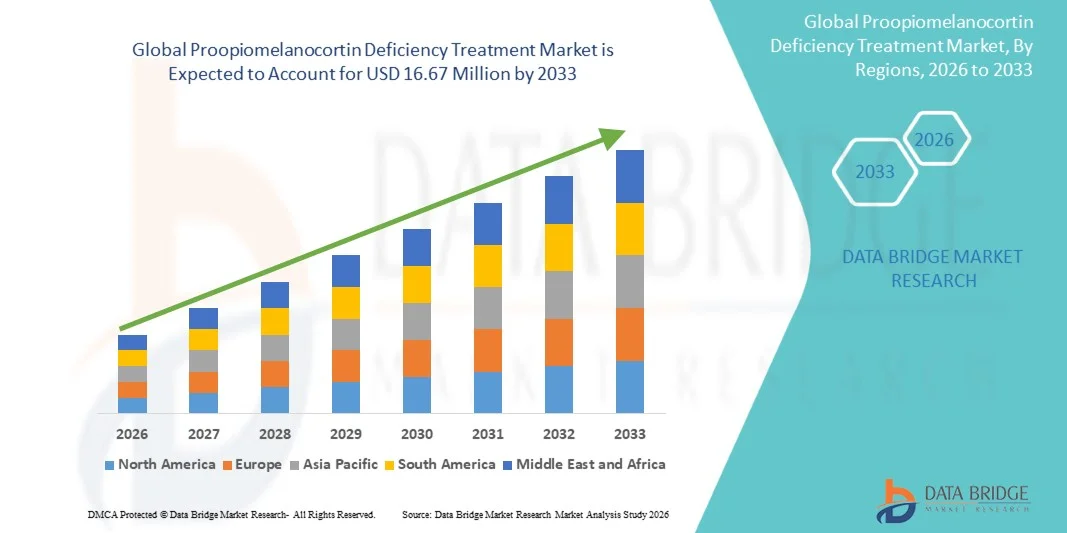
The Proopiomelanocortin Deficiency Treatment Market was valued at USD 11.11 million in 2025 and is projected to reach USD 16.67 million by 2033, growing at a CAGR of 5.20% from 2026 to 2033. The market is experiencing steady growth driven by rising diagnosis rates of POMC deficiency, increasing healthcare expenditure, and rapid advancements in melanocortin receptor-targeted therapeutics. Growing government funding and rising initiatives by public and private organizations to spread awareness about the disease are further fueling expansion. The increasing adoption of early genetic testing, rising demand for effective hyperphagia and obesity management therapies, and growing R&D activities focused on launching targeted treatments are creating beneficial opportunities. In addition, the high unmet need of current treatments and continuous developments in precision medicine are expected to escalate market growth over the forecast period.
Key Market Trends & Insights
- North America dominated the Proopiomelanocortin Deficiency Treatment Market in 2025, supported by advanced rare disease diagnostic infrastructure, high healthcare expenditure, strong presence of specialized treatment centers, and robust government funding for rare genetic disorder research.
- Europe is expected to be the fastest-growing regional market during the forecast period, driven by improving healthcare access, increasing awareness of rare genetic disorders, and expanding diagnostic capabilities.
- The Setmelanotide segment led the treatment market in 2025, owing to its FDA approval as the first targeted therapy for POMC deficiency and its demonstrated efficacy in reducing hyperphagia and body weight.
- The Genetic Tests segment is anticipated to be the fastest-growing diagnosis category, driven by rising adoption of next-generation sequencing and increasing emphasis on early disease identification.
- The Injection segment dominated the dosage category in 2025, supported by the subcutaneous administration of setmelanotide as the primary treatment modality.
- The Neonatal segment accounted for the largest share of the age of onset category, driven by the typical early-life presentation of POMC deficiency symptoms including hypocortisolism and hypoglycemia.
- The Parenteral segment led the route of administration category in 2025, owing to the injectable nature of melanocortin-4 receptor agonist therapies.
- The Hospital segment accounted for the largest share of the end-user category in 2025, driven by multidisciplinary management requirements and access to specialized healthcare professionals.
Market Size & Forecast
- Global Market Value (2025): USD 11.11 Million
- Expected Market Value (2033): USD 16.67 Million
- Forecast CAGR (2026–2033): 5.20%
- Leading Region in 2025: North America
- Fastest Growing Region: Europe
Report Scope and Proopiomelanocortin Deficiency Treatment Market Segmentation
|
Attributes |
Proopiomelanocortin Deficiency Treatment Key Market Insights |
|
Segments Covered |
· By Treatment: Hydrocortisone Substitution Therapy, Setmelanotide, Genetic Counseling and Others · By Age of Onset: Infancy and Neonatal · By Diagnosis: Blood Tests, Genetic Tests and Others · By Dosage: Injection, Tablets and Others · By Route of Administration: Oral, Parenteral and Others · By End-Users: Clinic, Hospital and Others · By Distribution Channel: Hospital Pharmacy, Retail Pharmacy and Online Pharmacy |
|
Countries Covered |
North America · U.S. · Canada · Mexico Europe · Germany · France · U.K. · Netherlands · Switzerland · Belgium · Russia · Italy · Spain · Turkey · Rest of Europe Asia-Pacific · China · Japan · India · South Korea · Singapore · Malaysia · Australia · Thailand · Indonesia · Philippines · Rest of Asia-Pacific Middle East and Africa · Saudi Arabia · U.A.E. · South Africa · Egypt · Israel · Rest of Middle East and Africa South America · Brazil · Argentina · Rest of South America |
|
Key Market Players |
· Rhythm Pharmaceuticals, Inc. (U.S.) · Novo Nordisk A/S (Denmark) · Eli Lilly and Company (U.S.) · Pfizer Inc. (U.S.) · Ipsen Pharma (France) · Recordati Rare Diseases (Italy) · BioMarin Pharmaceutical Inc. (U.S.) · Ultragenyx Pharmaceutical Inc. (U.S.) · Takeda Pharmaceutical Company Limited (Japan) · Sanofi (France) · Alexion Pharmaceuticals, Inc. (U.S.) · Horizon Therapeutics plc (Ireland) · Alnylam Pharmaceuticals, Inc. (U.S.) · Vertex Pharmaceuticals Incorporated (U.S.) · Amicus Therapeutics, Inc. (U.S.) · Chiesi Farmaceutici S.p.A. (Italy) |
|
Market Opportunities |
· Advancements in melanocortin receptor-targeted therapeutics and precision medicine approaches for rare genetic obesity disorders · Increasing investment in orphan drug development and rare disease research programs |
|
Value Added Data Infosets |
In addition to the insights on market scenarios such as market value, growth rate, segmentation, geographical coverage, and major players, the market reports curated by the Data Bridge Market Research also include depth expert analysis, patient epidemiology, pipeline analysis, pricing analysis, and regulatory framework. |
Proopiomelanocortin Deficiency Treatment Market Trends
Trend: Growing Adoption of Melanocortin-4 Receptor Agonists for Targeted Obesity Treatment
The increasing adoption of melanocortin-4 receptor (MC4R) agonists is emerging as a major trend in the Proopiomelanocortin Deficiency Treatment Market. Healthcare providers are increasingly utilizing targeted MC4R agonist therapies to address the underlying pathophysiology of POMC deficiency, enabling mechanism-based treatment of hyperphagia and severe obesity. The growing availability of setmelanotide and advancing pipeline candidates is helping clinicians achieve sustainable weight loss and hunger reduction in affected patients.
For instance,
In November 2020, Rhythm Pharmaceuticals received FDA approval for Imcivree (setmelanotide) for the treatment of obesity due to POMC, PCSK1, or leptin receptor (LEPR) deficiency, marking the first targeted therapy for these rare genetic obesity disorders. In addition, in September 2022, the European Medicines Agency granted marketing authorization for setmelanotide across the EU, expanding patient access to targeted treatment.
In addition, the integration of artificial intelligence-based genetic variant interpretation, cloud-enabled genomic analytics, advanced sequencing platforms, and genetic counseling services is enhancing diagnostic efficiency and supporting personalized care pathways for rare genetic conditions, including Proopiomelanocortin Deficiency. These advancements are improving clinical decision-making, accelerating treatment planning, and strengthening the overall rare disease management ecosystem.
Proopiomelanocortin Deficiency Treatment Market Dynamics
Key Market Driver: FDA Approval of Setmelanotide as First Targeted Therapy
The FDA approval of setmelanotide (Imcivree) as the first targeted therapy for POMC deficiency obesity is significantly driving the Proopiomelanocortin Deficiency Treatment Market. Healthcare providers are increasingly utilizing this melanocortin-4 receptor agonist to enable mechanism-based treatment of hyperphagia and severe early-onset obesity in affected patients. Rising awareness of rare genetic obesity disorders, expanding access to genetic testing, and increasing investments in precision medicine are further supporting market growth.
For instance,
In November 2020, Rhythm Pharmaceuticals received FDA approval for Imcivree (setmelanotide) for the treatment of obesity due to POMC, PCSK1, or LEPR deficiency. The approval highlights the increasing global focus on developing targeted therapies for rare monogenic obesity disorders.
Key Restraint/Challenge: Extremely Rare Patient Population and High Treatment Costs
A major challenge in the Proopiomelanocortin Deficiency Treatment Market is the extremely low prevalence of the disorder and the high cost of advanced genetic testing and targeted therapies required for accurate diagnosis and treatment. Limited disease awareness among healthcare providers and delayed diagnosis further restrict treatment adoption and market growth.
For instance,
In March 2023, the National Organization for Rare Disorders (NORD) highlighted the persistent challenges associated with diagnosing POMC deficiency, emphasizing the need for broader access to affordable genetic testing and specialized diagnostic services.
KeyMarket Opportunity: Advancements in Rare Disease Genomics and MC4R-Targeted Therapeutics
The growing adoption of next-generation sequencing, genetic counseling, and melanocortin receptor-targeted precision medicine presents significant opportunities for the market. Increasing investments in rare disease research and genomic diagnostics are expected to improve early detection, personalized treatment approaches, and long-term patient management worldwide.
For instance,
In March 2025, MyOme expanded its whole-genome sequencing-based rare disease diagnostic platform to support earlier identification of inherited genetic disorders, reflecting the growing industry focus on precision medicine and advanced genomic diagnostics for rare disease management.
Proopiomelanocortin Deficiency Treatment Market Scope
The proopiomelanocortin deficiency treatment market is segmented on the basis of treatment, age of onset, diagnosis, dosage, route of administration, end-users, and distribution channel.
- By Treatment
On the basis of treatment, the Proopiomelanocortin Deficiency Treatment Market is segmented into hydrocortisone substitution therapy, setmelanotide, genetic counseling, and others. The setmelanotide segment dominated the market with 48.2% share in 2025 due to its FDA approval as the first targeted therapy for POMC deficiency and its demonstrated efficacy in reducing hyperphagia and body weight. The mechanism-based approach of MC4R agonism and favorable clinical trial outcomes have supported widespread adoption among healthcare providers.
The genetic counseling segment is expected to witness the fastest growth from 2026 to 2033, driven by rising adoption of precision medicine and growing awareness of inherited genetic obesity disorders. Increasing utilization of genetic testing services, expanding availability of specialized counseling programs, and growing emphasis on early diagnosis and family risk assessment are further supporting segment growth. Healthcare providers are increasingly integrating genetic counseling into rare disease management to improve clinical outcomes and informed decision-making.
- By Age of Onset
On the basis of age of onset, the Proopiomelanocortin Deficiency Treatment Market is segmented into infancy and neonatal. The neonatal segment dominated the market with 62.3% share in 2025 due to the typical early-life presentation of POMC deficiency symptoms including hypocortisolism, hypoglycemia, hyperbilirubinemia, and cholestasis requiring immediate medical intervention.
The infancy segment is expected to witness steady growth from 2026 to 2033, driven by increasing identification of hyperphagia and early-onset obesity manifestations during the first year of life. Growing adoption of genetic screening in infants with unexplained severe obesity and expanding access to specialized metabolic treatment centers are further supporting segment growth.
- By Diagnosis
On the basis of diagnosis, the Proopiomelanocortin Deficiency Treatment Market is segmented into blood tests, genetic tests, and others. The blood tests segment dominated the market with 45.8% share in 2025 due to its role as the primary method for initial clinical assessment, including measurement of corticotropin (ACTH) and cortisol levels.
The genetic tests segment is expected to witness the fastest growth from 2026 to 2033, driven by increasing utilization of next-generation sequencing technologies and expanding access to molecular diagnostics. Growing demand for accurate and early diagnosis of rare genetic disorders, advancements in genomic research, and declining sequencing costs are further accelerating adoption. Increased investments in precision medicine and broader availability of genetic screening programs are also contributing significantly to segment expansion.
- By Dosage
On the basis of dosage, the Proopiomelanocortin Deficiency Treatment Market is segmented into injection, tablets, and others. The injection segment dominated the market with 58.9% share in 2025 due to the subcutaneous administration of setmelanotide as the primary treatment modality for POMC deficiency obesity. The injectable formulation ensures consistent drug delivery and optimal therapeutic outcomes for affected patients.
The tablets segment is expected to witness steady growth from 2026 to 2033, driven by the continued use of oral hydrocortisone for adrenal insufficiency management. Rising demand for convenient oral formulations and ongoing research into alternative oral MC4R agonists are expected to support segment expansion during the forecast period.
- By Route of Administration
On the basis of route of administration, the Proopiomelanocortin Deficiency Treatment Market is segmented into oral, parenteral, and others. The parenteral segment dominated the market with 55.51% share in 2025 owing to the injectable nature of setmelanotide and its role as the cornerstone of targeted POMC deficiency treatment. Subcutaneous injection ensures reliable drug absorption and sustained therapeutic effect.
The oral segment is expected to witness steady growth from 2026 to 2033, driven by the continued use of oral hydrocortisone for managing adrenal insufficiency. Growing patient preference for non-invasive administration routes and ongoing development of oral MC4R-targeted therapeutics are expected to support segment growth.
- By End-Users
On the basis of end-users, the Proopiomelanocortin Deficiency Treatment Market is segmented into clinic, hospital, and others. The hospital segment dominated the market with 68.4% share in 2025 due to the multidisciplinary care requirements associated with the disease and the availability of specialized healthcare professionals. Hospitals play a critical role in the diagnosis, treatment, and long-term management of POMC deficiency by providing access to endocrinologists, geneticists, pediatric specialists, and advanced diagnostic facilities. Their ability to deliver comprehensive care for complex and severe cases has contributed significantly to segment dominance.
The clinic segment is expected to witness the fastest growth from 2026 to 2033, driven by improving access to outpatient rare disease management services. Increasing availability of specialized endocrinology and genetic counseling clinics, shorter waiting times, cost-effective treatment options, and growing patient preference for convenient outpatient care are expected to support strong segment expansion during the forecast period.
- By Distribution Channel
On the basis of distribution channel, the Proopiomelanocortin Deficiency Treatment Market is segmented into hospital pharmacy, retail pharmacy, and online pharmacy. The hospital pharmacy segment dominated the market with 72.7% share in 2025 due to the concentration of specialist-prescribed treatments within hospital settings. Hospital pharmacies serve as the primary distribution channel for medications used in the management of POMC deficiency, particularly for patients requiring specialized care and continuous medical supervision. Their integration with multidisciplinary healthcare teams and access to prescription therapies have further strengthened their market position.
The online pharmacy segment is expected to witness the fastest growth from 2026 to 2033, driven by expanding digital healthcare platforms and increasing patient preference for convenient medication access. Growing internet penetration, rising adoption of e-pharmacy services, home delivery options, and improved availability of prescription medications through online channels are expected to support significant growth in this segment throughout the forecast period.
Proopiomelanocortin Deficiency Treatment Market Regional Analysis
North America dominated the proopiomelanocortin deficiency treatment market in 2025, supported by advanced healthcare infrastructure, widespread availability of genetic testing services, strong rare disease research activities, and the presence of leading pharmaceutical and biotechnology companies. The region also benefits from high awareness of rare genetic disorders, favorable reimbursement frameworks, and increasing adoption of precision medicine approaches. Growing investments in genomic research, genetic counseling, and specialized treatment centers continue to strengthen North America's leadership position in the global market.
U.S. Proopiomelanocortin Deficiency Treatment Market Insight
The U.S. proopiomelanocortin deficiency treatment market is witnessing steady growth due to increasing adoption of genetic testing technologies, rising awareness of rare genetic obesity disorders, and expanding investments in precision medicine. The country's well-established healthcare system, strong research ecosystem, and availability of specialized rare disease treatment centers are supporting market expansion. In addition, growing focus on early diagnosis and personalized treatment strategies is improving patient outcomes and driving demand for advanced diagnostic and therapeutic solutions.
Europe Proopiomelanocortin Deficiency Treatment Market Insight
The Europe proopiomelanocortin deficiency treatment market remains a major contributor to global revenue, driven by strong healthcare systems, increasing government support for rare disease management, and growing adoption of genetic diagnostics. The presence of specialized research institutions and collaborative rare disease networks is supporting advancements in diagnosis and treatment. Furthermore, favorable regulatory initiatives and increasing investments in genomic medicine continue to enhance market growth across the region.
U.K. Proopiomelanocortin Deficiency Treatment Market Insight
The U.K. proopiomelanocortin deficiency treatment market is experiencing steady growth, supported by increasing awareness of rare genetic obesity disorders, expanding access to genetic counseling services, and rising investments in genomic healthcare programs. Growing integration of advanced molecular diagnostics and personalized medicine approaches is improving disease identification and management. In addition, ongoing research initiatives and support from healthcare organizations are contributing to market development.
Germany Proopiomelanocortin Deficiency Treatment Market Insight
The Germany proopiomelanocortin deficiency treatment market is expanding steadily due to the country's advanced healthcare infrastructure, strong focus on rare disease research, and increasing adoption of next-generation sequencing technologies. Healthcare providers are increasingly utilizing genetic testing and multidisciplinary treatment approaches to improve patient care. Continuous advancements in genomic medicine and growing investments in specialized healthcare services are further supporting market growth in Germany.
Asia-Pacific Proopiomelanocortin Deficiency Treatment Market Insight
The Asia-Pacific proopiomelanocortin deficiency treatment market is expected to witness rapid growth, driven by improving healthcare infrastructure, increasing awareness of rare genetic obesity disorders, and expanding access to diagnostic services across countries such as China, India, and Japan. Growing investments in precision medicine, rising adoption of genetic testing technologies, and increasing government initiatives aimed at improving rare disease management are supporting regional market expansion.
Japan Proopiomelanocortin Deficiency Treatment Market Insight
The Japan proopiomelanocortin deficiency treatment market is witnessing consistent growth due to increasing investments in genomic research, advanced healthcare technologies, and rare disease diagnostics. Healthcare institutions are increasingly adopting molecular testing and personalized treatment approaches to improve disease management. Moreover, strong government support for rare disease research and innovation is further contributing to market growth.
China Proopiomelanocortin Deficiency Treatment Market Insight
The China proopiomelanocortin deficiency treatment market is growing rapidly, driven by expanding healthcare infrastructure, increasing adoption of genetic testing technologies, and rising awareness of rare inherited obesity disorders. Growing investments in biotechnology research, precision medicine initiatives, and advanced diagnostic capabilities are significantly boosting market development. In addition, supportive healthcare reforms and increasing access to specialized medical services are positioning China as one of the fastest-growing markets for rare disease diagnostics and treatment.
Proopiomelanocortin Deficiency Treatment Market Share
The proopiomelanocortin deficiency treatment industry is primarily led by well-established companies, including:
- Rhythm Pharmaceuticals, Inc. (U.S.)
- Novo Nordisk A/S (Denmark)
- Eli Lilly and Company (U.S.)
- Pfizer Inc. (U.S.)
- Ipsen Pharma (France)
- Recordati Rare Diseases (Italy)
- BioMarin Pharmaceutical Inc. (U.S.)
- Ultragenyx Pharmaceutical Inc. (U.S.)
- Takeda Pharmaceutical Company Limited (Japan)
- Sanofi (France)
- Alexion Pharmaceuticals, Inc. (U.S.)
- Horizon Therapeutics plc (Ireland)
- Alnylam Pharmaceuticals, Inc. (U.S.)
- Vertex Pharmaceuticals Incorporated (U.S.)
- Amicus Therapeutics, Inc. (U.S.)
- Chiesi Farmaceutici S.p.A. (Italy)
Latest Developments in Proopiomelanocortin Deficiency Treatment Market
- In March 2026, Rhythm Pharmaceuticals announced positive long-term data from its Phase 3 clinical trial evaluating setmelanotide in patients with POMC deficiency, demonstrating sustained weight loss and hunger reduction over 52 weeks of treatment. The data supports continued regulatory discussions for expanded label indications
- In January 2026, Novo Nordisk A/S announced advancement of its MC4R-pathway obesity drug pipeline into Phase II clinical trials, targeting rare monogenic obesity disorders including POMC deficiency. The initiative reflects growing industry investment in melanocortin receptor-targeted therapeutics
- In October 2025, GeneDx acquired Fabric Genomics, an AI-powered genomic interpretation company, to enhance genetic data analysis and rare disease diagnostics. The integration improves variant interpretation accuracy, accelerates diagnosis, and supports more personalized treatment strategies for patients with inherited disorders
- In September 2025, Rhythm Pharmaceuticals expanded its global access programs for setmelanotide to additional European markets, improving treatment availability for patients with rare genetic obesity disorders including POMC deficiency
- In July 2025, the European Medicines Agency approved a label extension for setmelanotide to include additional MC4R pathway-related obesity indications, strengthening the therapeutic landscape for rare genetic obesity management
- In February 2025, MedGenome launched its #CarefortheRare campaign to promote awareness and early diagnosis of rare genetic diseases through expanded access to genetic testing services. The initiative highlights the increasing global focus on improving rare disease detection and patient outcomes through advanced genomic diagnostics

- Interactive Data Analysis Dashboard
- Company Analysis Dashboard for high growth potential opportunities
- Research Analyst Access for customization & queries
- Competitor Analysis with Interactive dashboard
- Latest News, Updates & Trend analysis
- Harness the Power of Benchmark Analysis for Comprehensive Competitor Tracking
Data collection and base year analysis are done using data collection modules with large sample sizes. The stage includes obtaining market information or related data through various sources and strategies. It includes examining and planning all the data acquired from the past in advance. It likewise envelops the examination of information inconsistencies seen across different information sources. The market data is analysed and estimated using market statistical and coherent models. Also, market share analysis and key trend analysis are the major success factors in the market report. To know more, please request an analyst call or drop down your inquiry.
The key research methodology used by DBMR research team is data triangulation which involves data mining, analysis of the impact of data variables on the market and primary (industry expert) validation. Data models include Vendor Positioning Grid, Market Time Line Analysis, Market Overview and Guide, Company Positioning Grid, Patent Analysis, Pricing Analysis, Company Market Share Analysis, Standards of Measurement, Global versus Regional and Vendor Share Analysis. To know more about the research methodology, drop in an inquiry to speak to our industry experts.
Data Bridge Market Research is a leader in advanced formative research. We take pride in servicing our existing and new customers with data and analysis that match and suits their goal. The report can be customized to include price trend analysis of target brands understanding the market for additional countries (ask for the list of countries), clinical trial results data, literature review, refurbished market and product base analysis. Market analysis of target competitors can be analyzed from technology-based analysis to market portfolio strategies. We can add as many competitors that you require data about in the format and data style you are looking for. Our team of analysts can also provide you data in crude raw excel files pivot tables (Fact book) or can assist you in creating presentations from the data sets available in the report.












