Propineb Market Size
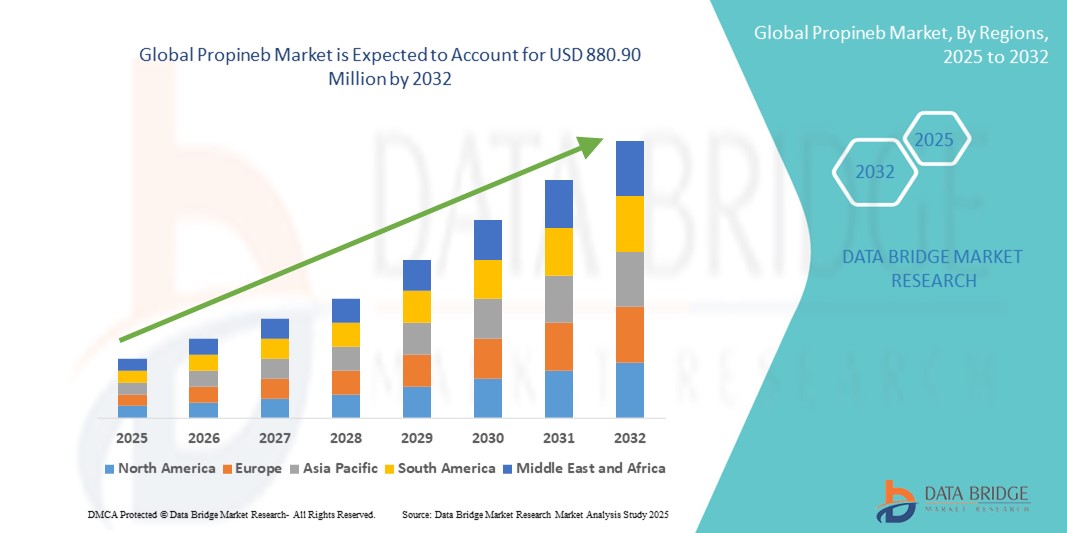
- The global propineb market size was valued at USD 624.2 million in 2024 and is expected to reach USD 880.90 million by 2032, at a CAGR of 4.4% during the forecast period
- The market growth is largely fuelled by the increasing demand for effective fungicides in agriculture, particularly in fruit, vegetable, and cereal crop protection, driven by growing concerns over crop yield, quality, and food security
- The expanding global agricultural sector, especially in emerging economies, is creating a consistent need for crop protection chemicals such as propineb, which are vital for maintaining productivity and minimizing losses caused by fungal infections
Propineb Market Analysis
- The propineb market is witnessing steady growth due to its broad-spectrum efficacy against fungal diseases such as early and late blight, downy mildew, and leaf spots
- Its compatibility with other agrochemicals and suitability for integrated pest management practices have contributed to widespread adoption among farmers across developing and developed nations
- Asia-Pacific dominated the global propineb market with the largest revenue share in 2024, driven by the high prevalence of fungal infections in crops and increasing focus on agricultural productivity
- North America region is expected to witness the highest growth rate in the global propineb market, driven by the rising need for effective fungicide solutions, expanding horticulture and vegetable farming, and strong investment in agricultural research and development
- The Propineb 80% min segment dominated the market with the largest market revenue share in 2024, owing to its widespread application across various crops and ease of formulation into wettable powders and suspension concentrates. It is commonly used by farmers for its balanced effectiveness against a broad spectrum of fungal diseases, particularly in potatoes, grapes, and onions. Its availability at competitive prices and its compatibility with other fungicides have also made it a preferred choice for integrated disease management programs
Report Scope and Propineb Market Segmentation
|
Attributes |
Propineb Key Market Insights |
|
Segments Covered |
|
|
Countries Covered |
North America
Europe
Asia-Pacific
Middle East and Africa
South America
|
|
Key Market Players |
|
|
Market Opportunities |
• Growing Demand for Fungicides in Organic Farming Practices • Expansion of Agricultural Activities in Emerging Economies |
|
Value Added Data Infosets |
In addition to the insights on market scenarios such as market value, growth rate, segmentation, geographical coverage, and major players, the market reports curated by the Data Bridge Market Research also include import export analysis, production capacity overview, production consumption analysis, price trend analysis, climate change scenario, supply chain analysis, value chain analysis, raw material/consumables overview, vendor selection criteria, PESTLE Analysis, Porter Analysis, and regulatory framework. |
Propineb Market Trends
Rising Demand for Integrated Fungicide Solutions in Sustainable Agriculture
• The increasing emphasis on sustainable farming has elevated the demand for fungicides such as propineb that can be used as part of integrated pest management (IPM) programs. These programs focus on minimizing environmental damage while maintaining crop health, making propineb a reliable multi-site fungicide in rotational strategies
• Propineb is often combined with systemic fungicides or biocontrol agents to enhance spectrum and resistance management. This reduces the likelihood of pathogen adaptation, offering longer-term efficacy for crops such as grapes, potatoes, and tomatoes, which are highly susceptible to fungal infections
• Regulatory environments in Europe and North America are pushing growers to adopt low-residue and eco-friendly fungicide combinations. Propineb’s compatibility with other actives makes it a strategic component in markets with strict sustainability mandates and residue restrictions.
• For instance, In 2023, Californian vineyards integrated propineb with Trichoderma-based biofungicides to manage powdery mildew while complying with local residue regulations and export standards.
• The rise in integrated fungicide use is expected to shape future product formulations and agricultural extension services. Companies that align with this trend will likely gain a competitive advantage in high-regulation markets focused on sustainable agriculture.
Propineb Market Dynamics
Driver
Increasing Global Food Demand and Need for Crop Protection
• With global population growth and urban expansion, the need to increase per-acre crop productivity is at an all-time high. Propineb plays a crucial role in protecting high-yielding crops from devastating fungal outbreaks, especially in vulnerable tropical and subtropical zones
• Farmers are under mounting pressure to secure harvests against climate-induced disease pressures, making reliable, broad-spectrum fungicides indispensable. Propineb’s protective action against early and late blight, rusts, and mildews ensures optimal crop survival and marketability
• Governments in developing economies are promoting crop protection awareness through subsidies and training programs. This has increased the adoption of fungicides such as propineb, particularly among smallholder farmers seeking low-cost, high-efficacy solutions
• For instance, In 2022, the Indian government distributed subsidized propineb formulations in eastern states to support paddy and vegetable farmers battling fungal infections due to excessive monsoon moisture
• As food security becomes a top policy agenda globally, the importance of reliable fungicides such as propineb will continue to rise, offering manufacturers steady demand in both mature and emerging agricultural markets
Restraint/Challenge
Regulatory Pressure and Health Concerns Surrounding Chemical Residues
• Growing health awareness and tighter food safety laws are challenging the use of certain chemical fungicides, including propineb. Its degradation product, ethylene thiourea (ETU), is under review for its potential health hazards, including endocrine disruption and carcinogenic risks
• The European Union has adopted precautionary restrictions on various dithiocarbamates, impacting both usage volumes and trade opportunities. Such regulatory moves force manufacturers to invest more in compliance, reformulations, and residue mitigation strategies
• Consumer demand is shifting toward organically grown produce, putting pressure on conventional agriculture to reduce dependency on synthetic fungicides. This changing preference could impact the market share of propineb unless paired with integrated or eco-certified applications
• For instance, In 2021, the European Commission began withdrawing propineb’s approval citing insufficient toxicological data on ETU, prompting several agribusinesses to pivot toward alternative fungicides or organic products
• Without proactive measures in formulation innovation, public awareness, and safe usage protocols, regulatory and reputational risks will continue to weigh on the propineb market’s long-term prospects, particularly in high-value export regions
Propineb Market Scope
The market is segmented on the basis of product type and end user.
- By Product Type
On the basis of product type, the propineb market is segmented into Propineb 80% min and Propineb 89% min. The Propineb 80% min segment dominated the market with the largest market revenue share in 2024, owing to its widespread application across various crops and ease of formulation into wettable powders and suspension concentrates. It is commonly used by farmers for its balanced effectiveness against a broad spectrum of fungal diseases, particularly in potatoes, grapes, and onions. Its availability at competitive prices and its compatibility with other fungicides have also made it a preferred choice for integrated disease management programs.
The Propineb 89% min segment is expected to witness the fastest growth rate from 2025 to 2032, driven by its higher active ingredient concentration, which allows for reduced application volumes and improved efficacy in high-disease-pressure environments. Its growing usage in high-value horticultural crops and its appeal among commercial farmers seeking premium performance with fewer residues are contributing factors to its expanding adoption across key agricultural economies.
- By End User
On the basis of end user, the propineb market is segmented into fruits, vegetables, and others. The fruits segment accounted for the largest market revenue share in 2024, largely supported by the rising demand for high-value fruits such as apples, grapes, and citrus, which are highly susceptible to fungal diseases. The need for consistent quality, export compliance, and prolonged shelf life has made propineb a reliable fungicide in orchard and vineyard management practices.
The vegetables segment is expected to witness the fastest growth rate from 2025 to 2032, driven by increasing vegetable cultivation and the rising threat of fungal pathogens in densely planted fields. Leafy greens, tomatoes, onions, and cucurbits frequently rely on propineb-based treatments to ensure crop protection and marketable yields. Growing awareness among farmers, along with government-backed training on fungicide application, is boosting the segment's growth potential in both developed and emerging regions.
Propineb Market Regional Analysis
• Asia-Pacific dominated the global propineb market with the largest revenue share in 2024, driven by the high prevalence of fungal infections in crops and increasing focus on agricultural productivity
• Countries such as China, India, and Japan are seeing growing adoption of fungicides, including propineb, to control diseases in fruits and vegetables while ensuring better yield and export quality
• The region's dominance is further supported by favorable climatic conditions, rising population pressure, and supportive government schemes promoting crop protection practices
China Propineb Market Insight
The China propineb market accounted for the largest revenue share in Asia-Pacific in 2024, fueled by the country’s massive fruit and vegetable cultivation and growing emphasis on food security. Widespread use of propineb to manage early and late blight, especially in potatoes and tomatoes, supports market growth. In addition, China’s robust agrochemical manufacturing base ensures affordable product availability and widespread distribution, further reinforcing its market dominance
Japan Propineb Market Insight
Japan’s propineb market is expected to witness the fastest growth rate from 2025 to 2032, driven by the country’s demand for high-quality agricultural produce and strict standards in pest and disease management. Propineb is commonly used in vineyards, tea plantations, and vegetable farms to protect crops from fungal diseases. The market is also supported by advancements in controlled-environment agriculture and an aging farming population seeking efficient crop protection solutions
Europe Propineb Market Insight
The Europe propineb market is expected to witness the fastest growth rate from 2025 to 2032, supported by rising demand for effective, low-residue fungicides in the agriculture sector. Countries such as France, Italy, and Spain are actively using propineb in vineyards and fruit orchards to maintain high crop quality. Furthermore, increasing awareness regarding integrated pest management and crop sustainability practices is promoting the adoption of such fungicides
Germany Propineb Market Insight
Germany’s propineb market is expected to witness the fastest growth rate from 2025 to 2032, due to its strong horticulture and viticulture sectors, where protection from fungal diseases is critical. Growers are increasingly turning to propineb to maintain yield consistency while complying with residue regulations. The country’s emphasis on precision farming and environmentally conscious practices is also contributing to steady market adoption, particularly in controlled field applications
U.K. Propineb Market Insight
The U.K. propineb market is expected to witness the fastest growth rate from 2025 to 2032, supported by increasing adoption in greenhouse and open-field cultivation of fruits and vegetables. British farmers are gradually shifting toward preventive disease management, and propineb plays a key role in protecting crops such as apples and brassicas. The market is further supported by research-driven agricultural practices and the rising demand for high-quality local produce
North America Propineb Market Insight
The North America propineb market is expected to witness the fastest growth rate from 2025 to 2032, led by extensive horticulture practices in the U.S. and Mexico. The region’s need to combat fungal infections such as downy mildew and rust, especially in grape and tomato cultivation, drives fungicide adoption. In addition, growing concerns over crop losses and the increased focus on maximizing yield per acre are creating favorable conditions for propineb usage
U.S. Propineb Market Insight
The U.S. propineb market captured the largest share in North America in 2024, driven by its technologically advanced farming sector and widespread production of high-value crops. The growing use of propineb in disease-prone crops such as grapes, lettuce, and potatoes supports market expansion. Moreover, increased demand for disease-free produce across retail and export markets encourages the application of effective fungicides such as propineb in both large-scale and specialty farms
Propineb Market Share
The Propineb industry is primarily led by well-established companies, including:
- Bayer AG (Germany)
- UPL Limited (India)
- Nufarm Limited (Australia)
- Corteva Agriscience (U.S.)
- BASF SE (Germany)
- Jiangsu Flag Chemical Industry Co., Ltd. (China)
- Syngenta AG (Switzerland)
- Indofil Industries Limited (India)
- Dow AgroSciences LLC (U.S.)
- ADAMA Agricultural Solutions Ltd. (Israel)

- Interactive Data Analysis Dashboard
- Company Analysis Dashboard for high growth potential opportunities
- Research Analyst Access for customization & queries
- Competitor Analysis with Interactive dashboard
- Latest News, Updates & Trend analysis
- Harness the Power of Benchmark Analysis for Comprehensive Competitor Tracking
Data collection and base year analysis are done using data collection modules with large sample sizes. The stage includes obtaining market information or related data through various sources and strategies. It includes examining and planning all the data acquired from the past in advance. It likewise envelops the examination of information inconsistencies seen across different information sources. The market data is analysed and estimated using market statistical and coherent models. Also, market share analysis and key trend analysis are the major success factors in the market report. To know more, please request an analyst call or drop down your inquiry.
The key research methodology used by DBMR research team is data triangulation which involves data mining, analysis of the impact of data variables on the market and primary (industry expert) validation. Data models include Vendor Positioning Grid, Market Time Line Analysis, Market Overview and Guide, Company Positioning Grid, Patent Analysis, Pricing Analysis, Company Market Share Analysis, Standards of Measurement, Global versus Regional and Vendor Share Analysis. To know more about the research methodology, drop in an inquiry to speak to our industry experts.
Data Bridge Market Research is a leader in advanced formative research. We take pride in servicing our existing and new customers with data and analysis that match and suits their goal. The report can be customized to include price trend analysis of target brands understanding the market for additional countries (ask for the list of countries), clinical trial results data, literature review, refurbished market and product base analysis. Market analysis of target competitors can be analyzed from technology-based analysis to market portfolio strategies. We can add as many competitors that you require data about in the format and data style you are looking for. Our team of analysts can also provide you data in crude raw excel files pivot tables (Fact book) or can assist you in creating presentations from the data sets available in the report.