Propionic Acid for Animal Feed Market Size
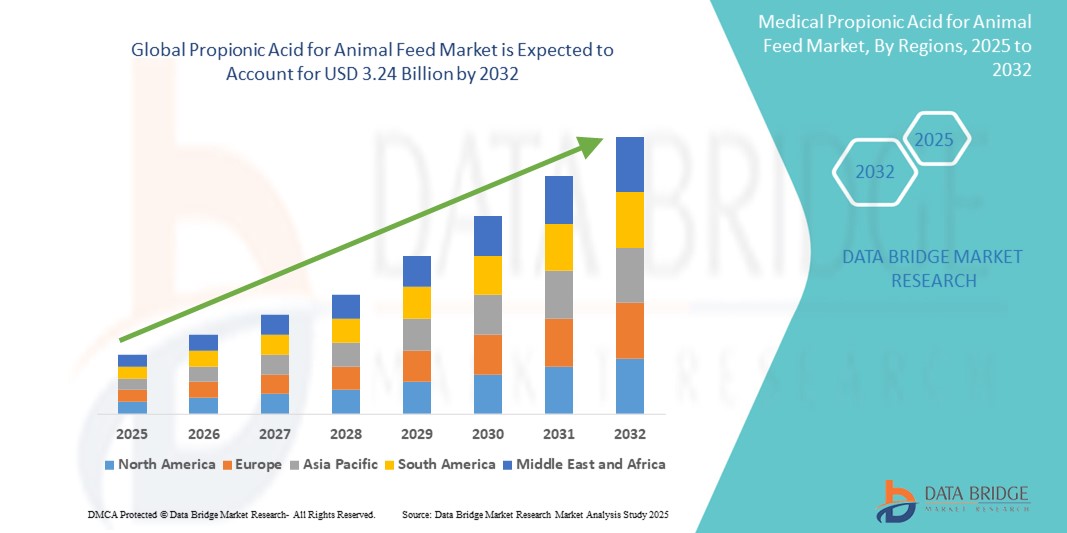
- The global propionic acid for animal feed market size was valued at USD 2.13 billion in 2024 and is expected to reach USD 3.24 billion by 2032, at a CAGR of 5.40% during the forecast period
- The market growth is primarily driven by increasing demand for safe and high-quality animal feed, coupled with advancements in feed preservation technologies, which enhance the shelf life and safety of animal feed products
- Rising awareness of animal health, growing livestock production, and the need for effective feed preservatives to prevent mold and bacterial growth are key factors boosting the adoption of propionic acid in the animal feed industry
Propionic Acid for Animal Feed Market Analysis
- Propionic acid is widely used as a feed preservative due to its antimicrobial properties, which help extend the shelf life of animal feed by inhibiting mold and bacterial growth, ensuring feed safety and quality
- The demand for propionic acid in animal feed is fueled by the expansion of the livestock industry, increasing focus on animal nutrition, and stringent regulations on feed safety and quality across the globe
- Europe dominated the propionic acid for animal feed market with the largest revenue share of 38.5% in 2024, driven by advanced agricultural practices, high livestock production, and strict regulatory standards for feed safety. Countries such as Germany, France, and the Netherlands are key contributors to this dominance
- Asia-Pacific is expected to be the fastest-growing region during the forecast period due to rapid urbanization, rising meat consumption, and increasing investments in modern livestock farming practices
- The biotech/analytical (high purity) segment dominated the largest market revenue share of 60% in 2024, driven by its high effectiveness in ensuring feed preservation and preventing mold growth in animal feed applications
Report Scope and Propionic Acid for Animal Feed Market Segmentation
|
Attributes |
Propionic Acid for Animal Feed Key Market Insights |
|
Segments Covered |
|
|
Countries Covered |
North America
Europe
Asia-Pacific
Middle East and Africa
South America
|
|
Key Market Players |
|
|
Market Opportunities |
|
|
Value Added Data Infosets |
In addition to the insights on market scenarios such as market value, growth rate, segmentation, geographical coverage, and major players, the market reports curated by the Data Bridge Market Research also include import export analysis, production capacity overview, production consumption analysis, price trend analysis, climate change scenario, supply chain analysis, value chain analysis, raw material/consumables overview, vendor selection criteria, PESTLE Analysis, Porter Analysis, and regulatory framework. |
Propionic Acid for Animal Feed Market Trends
“Increasing Integration of AI and Big Data Analytics”
- The global propionic acid for animal feed market is witnessing a significant trend of integrating Artificial Intelligence (AI) and Big Data analytics
- These technologies enable advanced data processing and analysis, providing deeper insights into animal health, nutrition, and feed efficiency
- AI-powered solutions allow for more proactive problem-solving, such as early disease detection, by analyzing animal behavior, physiological data, and environmental conditions
- For instance, companies are developing AI-driven platforms that analyze feed consumption patterns to optimize feed formulations, reduce waste, and improve feed conversion ratios
- This trend is enhancing the value proposition of propionic acid as part of a comprehensive feed management strategy, making it more attractive to livestock farmers seeking to maximize productivity and profitability
- Machine learning algorithms can analyze a vast array of data points to predict feed efficiency or detect early signs of illness, providing increasingly precise recommendations
Propionic Acid for Animal Feed Market Dynamics
Driver
“Rising Demand for High-Quality Animal Feed and Sustainable Farming Practices”
- The increasing global demand for meat, dairy, and eggs is a major driver for the propionic acid for animal feed market, as it fuels the need for high-quality, preserved feed
- Propionic acid is a crucial preservative that prevents mold, fungal, and bacterial growth in animal feed and grains, thereby maintaining nutritional value and extending shelf life
- The push for sustainable farming practices is also driving the use of propionic acid. As a natural preservative, it supports eco-friendly methods by reducing the need for synthetic chemicals and aligning with consumer preferences for environmentally responsible practices
- Government mandates and regulations, particularly in regions such as Europe, are contributing to the widespread adoption of propionic acid as a safe and effective feed additive. The European Food Safety Authority (EFSA) regulates its use and sets acceptable daily intake (ADI) levels to ensure consumer and animal safety
- Innovations in production processes, such as improved fermentation techniques and advanced catalysts, are enhancing the purity and reducing the cost of propionic acid, making it a more viable option for feed manufacturers
Restraint/Challenge
“High Cost of Implementation and Data Security Concerns”
- The substantial initial investment required for more advanced feed management systems that utilize propionic acid, including equipment for application and storage, can be a significant barrier to adoption for small-scale farmers and companies, particularly in emerging markets
- Integrating new feed preservatives into existing production and storage systems can be complex and costly
- In addition, data security and privacy concerns pose a major challenge. The increasing use of AI and IoT in livestock farming and feed production leads to the collection of vast amounts of sensitive data, raising concerns about potential breaches, misuse of information, and compliance with data protection regulations
- Cyber threats such as ransomware attacks, hacktivism, and state-sponsored espionage targeting farm management systems and supply chains could disrupt critical operations such as feed formulation and distribution, leading to economic losses and animal welfare crises
- These factors can deter potential buyers and limit market expansion, particularly in regions where awareness of data privacy is high or where cost sensitivity is a significant factor
Propionic Acid for Animal Feed market Scope
The market is segmented on the basis of grade, process, and end-user.
- By Grade
On the basis of grade, the global propionic acid for animal feed market is segmented into biotech/analytical (high purity) and technical (low purity). The biotech/analytical (high purity) segment dominated the largest market revenue share of 60% in 2024, driven by its high effectiveness in ensuring feed preservation and preventing mold growth in animal feed applications. Its superior quality and efficacy make it a preferred choice for premium feed manufacturers aiming to maintain high standards of feed hygiene and safety.
The technical (low purity) segment is expected to witness the fastest growth rate of around 6.8% from 2025 to 2032. This growth is fueled by its cost-effectiveness, making it suitable for cost-sensitive applications in large-scale livestock farming and feed production, particularly in emerging markets.
- By Process
On the basis of process, the market is segmented into oxo process, reppe process, and by-product process. The oxo process segment dominated the market with a revenue share of approximately 65% in 2024, attributed to its efficiency, scalability, and ability to produce high-quality propionic acid suitable for animal feed applications. Its widespread adoption by major manufacturers ensures consistent supply and quality.
The by-product process segment is anticipated to experience the fastest growth rate of approximately 7.2% from 2025 to 2032. This growth is driven by its cost-effectiveness and sustainability, as it leverages fermentation of sugars or carbohydrates, appealing to manufacturers focusing on eco-friendly production methods.
- By End-User
On the basis of end-user, the market is segmented into chemical, agriculture, healthcare, personal care, and food and beverages. The agriculture segment accounted for the largest market revenue share of approximately 70% in 2024, driven by the extensive use of propionic acid as a preservative in animal feed and grain to prevent microbial and fungal growth. The rising global demand for high-quality animal feed, fueled by increasing livestock production, supports this dominance.
The food and beverages segment is expected to witness the fastest growth rate of approximately 8.5% from 2025 to 2032. This is propelled by the increasing demand for propionic acid as a natural preservative in packaged foods, such as baked goods and dairy products, driven by consumer preferences for clean-label ingredients and extended shelf life.
Propionic Acid for Animal Feed Market Regional Analysis
- Europe dominated the propionic acid for animal feed market with the largest revenue share of 38.5% in 2024, driven by advanced agricultural practices, high livestock production, and strict regulatory standards for feed safety. Countries such as Germany, France, and the Netherlands are key contributors to this dominance
- Consumers prioritize propionic acid for its antimicrobial properties, which prevent mold and bacterial growth in animal feed, ensuring animal health and feed longevity, particularly in regions with high livestock production
- Growth is supported by advancements in production technologies, such as improved fermentation and purification methods, alongside rising adoption in both large-scale and small-scale livestock farming operations
U.S. Propionic Acid for Animal Feed Market Insight
The U.S. propionic acid for animal feed market is expected to witness significant growth, fueled by robust demand from the livestock sector and increasing awareness of feed preservation benefits. The trend toward sustainable farming practices and stringent food safety regulations further boosts market expansion. The integration of propionic acid in both commercial feed production and on-farm applications creates a diverse market ecosystem.
Europe Propionic Acid for Animal Feed Market Insight
The Europe is expected to maintain its dominance in the global propionic acid for animal feed market, supported by favorable government regulations and a focus on animal nutrition. The demand for high-purity propionic acid is prominent in both new feed formulations and existing feed preservation systems, with countries such as Germany and France showing significant adoption due to their advanced agricultural sectors and environmental policies.
U.K. Propionic Acid for Animal Feed Market Insight
The U.K. market for propionic acid in animal feed is expected to witness steady growth, driven by the need for enhanced feed safety and quality in livestock farming. Increased awareness of propionic acid’s role in mild prevention and animal health encourages adoption. Evolving regulations on feed additives influence consumer choices, balancing efficacy with compliance to safety standards.
Germany Propionic Acid for Animal Feed Market Insight
Germany is expected to maintain a strong position in the European propionic acid for animal feed market, attributed to its advanced livestock and feed manufacturing sectors. German producers prioritize high-purity propionic acid to ensure feed safety and contribute to efficient livestock production. The integration of advanced production processes, such as the Oxo process, supports sustained market growth.
Asia-Pacific Propionic Acid for Animal Feed Market Insight
The Asia-Pacific region is expected to witness the fastest growth rate, driven by expanding livestock production and rising demand for feed preservatives in countries such as China, India, and Japan. Increasing awareness of animal health, feed safety, and the need for cost-effective preservation solutions boosts demand. Government initiatives promoting sustainable agriculture further encourage the use of propionic acid.
Japan Propionic Acid for Animal Feed Market Insight
Japan’s propionic acid for animal feed market is expected to experience rapid growth due to strong consumer preference for high-quality feed additives that enhance animal health and productivity. The presence of advanced agricultural practices and the integration of propionic acid in commercial feed production accelerate market penetration. Growing interest in sustainable farming also contributes to market growth.
China Propionic Acid for Animal Feed Market Insight
China holds the largest share of the Asia-Pacific propionic acid for animal feed market, propelled by rapid growth in livestock farming, rising meat consumption, and increasing demand for feed preservation solutions. The country’s expanding agricultural sector and focus on food security support the adoption of propionic acid. Strong domestic manufacturing capabilities and competitive pricing enhance market accessibility.
Propionic Acid for Animal Feed Market Share
The propionic acid for animal feed industry is primarily led by well-established companies, including:
- Dow (U.S.)
- BASF SE (Germany)
- Perstorp (Sweden)
- Eastman Chemical Company (U.S.)
- Niacet, A Kerry Company (U.S.)
- Macco Organiques Inc. (Canada)
- Mitsubishi Chemical Corporation (Japan)
- Hawkins (U.S.)
- ADDCON GmbH (Germany)
- Impextraco NV (Belgium)
- Kemin Industries, Inc. (U.S.)
- Krishna Chemicals (India)
- Prathista Industries Limited (India)
- OXEA GmbH (Germany)
- Merck KGaA (Germany)
What are the Recent Developments in Global Propionic Acid for Animal Feed Market?
- In March 2025, BASF SE announced the expansion of its propionic acid production capacity at the BASF-YPC Verbund site in Nanjing, China, a 50-50 joint venture with Sinopec. This strategic move addresses the rising global demand for bio-based and sustainable propionic acid, widely used in animal feed, food preservation, and pharmaceuticals. The upgraded facilities utilize renewable electricity, enabling a 40% reduction in product carbon footprint compared to coal-based alternatives. This initiative supports BASF’s broader commitment to climate-friendly chemical production and reinforces its leadership in low-carbon industrial solutions across Asia
- In April 2024, Eastman Chemical Company partnered with Sealed Air to launch a bio-based, compostable food packaging tray designed as a sustainable alternative to traditional polystyrene foam trays. Made from Eastman Aventa™ Renew—a material derived from sustainably sourced wood pulp and certified recycled content—the trays are fully compostable in both home and industrial environments. This innovation supports the companies’ shared commitment to the circular economy, offering high performance while reducing environmental impact. The trays are already in use across several market applications, demonstrating real-world viability and scalability
- In March 2023, Perstorp Holding AB announced the expansion of its propionic acid production capacity at its Malmö, Sweden facility to address the growing global demand for sustainable preservatives in the animal feed and food industries. This strategic investment is part of Perstorp’s broader commitment to bio-based solutions and sustainable manufacturing, reinforcing its role as a key supplier of high-purity propionic acid used for preservation, flavoring, and antimicrobial protection. The move also supports the company’s long-term sustainability goals and strengthens its position in the specialty chemicals market
- In September 2022, BASF launched a zero-carbon footprint version of propionic acid (PA ZeroPCF), produced at its Ludwigshafen Verbund site in Germany. This sustainable innovation was achieved through BASF’s biomass balance (BMB) approach, which replaces fossil feedstocks with waste-based renewable raw materials at the start of production. The result is a cradle-to-gate product carbon footprint of zero, certified by the Carbon Trust. Identical in quality to conventional propionic acid, PA ZeroPCF can be seamlessly integrated into existing processes, supporting eco-friendly applications in animal feed, food preservation, and agriculture
- In April 2022, Perstorp unveiled plans to build a new carboxylic acid manufacturing plant at its existing site in Stenungsund, Sweden, with a projected capacity of 70,000 metric tons per year. The facility will produce naturally occurring carboxylic acids, including propionic acid, to meet rising global demand in sectors such as animal feed, food preservation, and specialty chemicals. Fully integrated into Perstorp’s Oxo production platform, the plant will support the company’s strategy to deliver sustainable, high-purity ingredients and reinforce its leadership in bio-based chemical solutions. The plant is expected to be operational by 2024

- Interactive Data Analysis Dashboard
- Company Analysis Dashboard for high growth potential opportunities
- Research Analyst Access for customization & queries
- Competitor Analysis with Interactive dashboard
- Latest News, Updates & Trend analysis
- Harness the Power of Benchmark Analysis for Comprehensive Competitor Tracking
Data collection and base year analysis are done using data collection modules with large sample sizes. The stage includes obtaining market information or related data through various sources and strategies. It includes examining and planning all the data acquired from the past in advance. It likewise envelops the examination of information inconsistencies seen across different information sources. The market data is analysed and estimated using market statistical and coherent models. Also, market share analysis and key trend analysis are the major success factors in the market report. To know more, please request an analyst call or drop down your inquiry.
The key research methodology used by DBMR research team is data triangulation which involves data mining, analysis of the impact of data variables on the market and primary (industry expert) validation. Data models include Vendor Positioning Grid, Market Time Line Analysis, Market Overview and Guide, Company Positioning Grid, Patent Analysis, Pricing Analysis, Company Market Share Analysis, Standards of Measurement, Global versus Regional and Vendor Share Analysis. To know more about the research methodology, drop in an inquiry to speak to our industry experts.
Data Bridge Market Research is a leader in advanced formative research. We take pride in servicing our existing and new customers with data and analysis that match and suits their goal. The report can be customized to include price trend analysis of target brands understanding the market for additional countries (ask for the list of countries), clinical trial results data, literature review, refurbished market and product base analysis. Market analysis of target competitors can be analyzed from technology-based analysis to market portfolio strategies. We can add as many competitors that you require data about in the format and data style you are looking for. Our team of analysts can also provide you data in crude raw excel files pivot tables (Fact book) or can assist you in creating presentations from the data sets available in the report.