


Public Key Infrastructure (PKI) Market Size
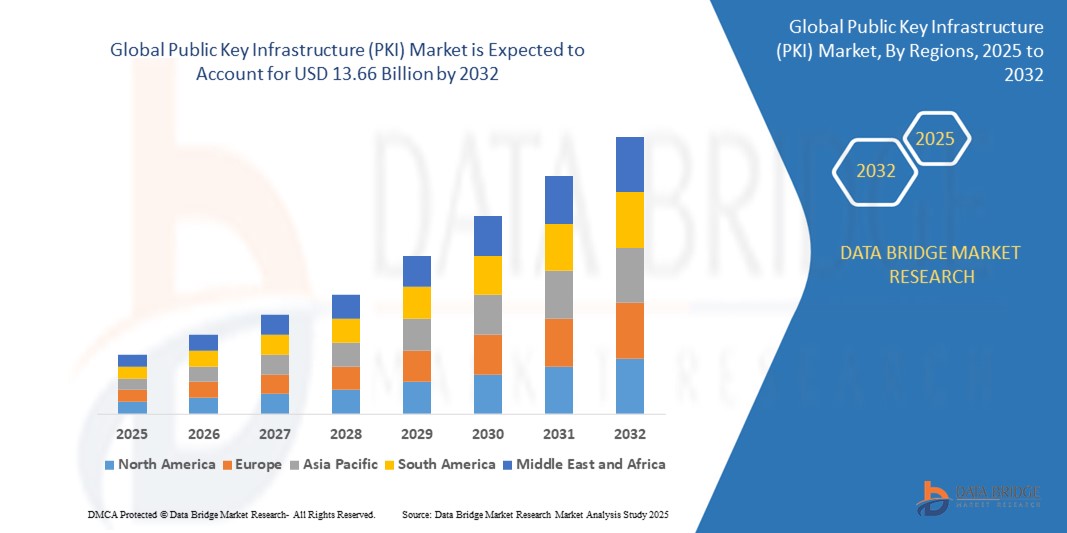
- The global public key infrastructure (PKI) market size was valued at USD 7.18 billion in 2024 and is expected to reach USD 13.66 billion by 2032, at a CAGR of 8.37% during the forecast period
- The market growth is largely fuelled by the increasing need for secure digital communication, rising data breaches, and the widespread adoption of cloud-based services across industries
- The rising adoption of Internet of Things (IoT) devices and the growing demand for authentication and encryption solutions across sectors such as BFSI, healthcare, and government are further propelling the growth of the PKI market
Public Key Infrastructure (PKI) Market Analysis
- The public key infrastructure market is expanding as more organizations prioritize digital certificate management to secure online transactions and internal communications
- Growing investments in cybersecurity frameworks are encouraging businesses to implement scalable public key infrastructure solutions across various sectors
- North America dominated the public key infrastructure market with the largest revenue share in 2024, driven by the increasing adoption of digital identity solutions, regulatory mandates, and robust cybersecurity infrastructure
- Asia-Pacific region is expected to witness the highest growth rate in the global public key infrastructure (PKI) market, driven by rising digital transformation initiatives, expanding e-governance programs, and increased investments in cybersecurity infrastructure across developing economies
- The solution segment accounted for the largest market revenue share in 2024, driven by the growing demand for digital identity authentication, secure email, document signing, and encrypted transactions across industries. Organizations are increasingly deploying PKI solutions to ensure the confidentiality, integrity, and authenticity of digital interactions, especially in highly regulated sectors. The rise in digital transformation and remote operations further strengthens the need for scalable and centralized PKI solutions
Report Scope and Public Key Infrastructure (PKI) Market Segmentation
|
Attributes |
Public Key Infrastructure (PKI) Key Market Insights |
|
Segments Covered |
|
|
Countries Covered |
North America
Europe
Asia-Pacific
Middle East and Africa
South America
|
|
Key Market Players |
|
|
Market Opportunities |
|
|
Value Added Data Infosets |
In addition to the market insights such as market value, growth rate, market segments, geographical coverage, market players, and market scenario, the market report curated by the Data Bridge Market Research team includes in-depth expert analysis, import/export analysis, pricing analysis, production consumption analysis, and pestle analysis. |
Public Key Infrastructure (PKI) Market Trends
“Growing Integration of Public Key Infrastructure with Cloud and IoT Security”
- Cloud migration is increasing demand for centralized certificate and key management, with platforms such as Google Cloud offering built-in public key infrastructure tools to support secure digital operations
- Public key infrastructure plays a critical role in authenticating Internet of Things devices across diverse networks, especially in sectors such as smart manufacturing and connected healthcare
- Tech companies are embedding public key infrastructure into smart home ecosystems, such as Amazon’s Ring and Google Nest, to enhance user authentication and data protection
- Industrial IoT systems are implementing public key infrastructure to secure real-time communication between connected sensors and control units, improving operational safety and integrity
- Leading cloud platforms including Microsoft Azure and AWS are integrating public key infrastructure to automate encryption, identity verification, and secure access control for enterprise clients
Public Key Infrastructure (PKI) Market Dynamics
Driver
“Rising Need for Secured Digital Identity Management”
- The growing shift toward digital platforms and remote work has heightened the demand for secure digital identity management, with public key infrastructure emerging as a trusted solution for authentication and encryption
- Public key infrastructure enables secure communication, digital signatures, and protection of sensitive data, making it essential in regulated industries such as finance, government, and healthcare
- The expansion of cloud computing, mobile devices, and Internet of Things technologies has increased the need for efficient certificate and key lifecycle management using public key infrastructure
- Regulatory frameworks such as GDPR in Europe, HIPAA in the U.S., and eIDAS are compelling enterprises to implement encryption and digital identity solutions through public key infrastructure
- For instance, hospitals use public key infrastructure to encrypt patient records while banks deploy it to validate and secure online transactions, reinforcing digital trust across sectors
Restraint/Challenge
“Complexity in Deployment and Management”
- Implementing public key infrastructure is complex, involving certificate authority design, certificate issuance, and strict policy adherence, which requires specialized expertise and significant resources
- Small and medium-sized enterprises often struggle with public key infrastructure due to limited IT capabilities, making setup and maintenance challenging without external support
- Ongoing management tasks such as certificate renewal, revocation, and auditing can overwhelm organizations, and failure in these areas may lead to outages or security risks
- Integrating public key infrastructure with legacy systems and multi-cloud environments poses compatibility challenges, requiring customized solutions and policy coordination
- For instance, businesses operating across AWS and Azure platforms face difficulty aligning public key infrastructure policies due to differing security protocols, often delaying or weakening deployment efforts
Public Key Infrastructure (PKI) Market Scope
The market is segmented on the basis of component, deployment, organization size, and end user.
• By Component
On the basis of component, the public key infrastructure market is segmented into solution and services. The solution segment accounted for the largest market revenue share in 2024, driven by the growing demand for digital identity authentication, secure email, document signing, and encrypted transactions across industries. Organizations are increasingly deploying PKI solutions to ensure the confidentiality, integrity, and authenticity of digital interactions, especially in highly regulated sectors. The rise in digital transformation and remote operations further strengthens the need for scalable and centralized PKI solutions.
The services segment is expected to witness at the fastest growth rate from 2025 to 2032, supported by the increasing need for consulting, implementation, and managed PKI services. Many businesses, especially small and medium enterprises, rely on external expertise to deploy and maintain PKI infrastructure efficiently. Service providers also offer certificate lifecycle management and compliance support, enabling businesses to meet evolving security requirements.
• By Deployment
On the basis of deployment, the public key infrastructure market is segmented into cloud and on-premise. The on-premise segment led the market in 2024 due to its strong adoption among large enterprises that require high control, data residency, and customization. Organizations in sectors such as finance and defense often prefer on-premise PKI deployment to ensure compliance and reduce third-party risks. These deployments offer enhanced control over the root certificate authority and enable tight integration with internal systems.
The cloud segment is expected to witness at the fastest growth rate from 2025 to 2032, driven by the shift toward SaaS-based models and remote work environments. Cloud PKI platforms provide scalability, reduced infrastructure costs, and simplified certificate management through automation. They are particularly attractive to modern digital businesses seeking agility and rapid deployment without compromising security.
• By Organization Size
On the basis of organization size, the public key infrastructure market is segmented into small and medium enterprises and large enterprises. The large enterprises segment dominated the market revenue in 2024 due to their extensive need for digital certificates to secure a wide range of applications, including VPNs, internal portals, email, and IoT devices. These enterprises also allocate substantial budgets for advanced cybersecurity measures, with PKI being a foundational component of their digital trust strategies.
The small and medium enterprises segment is expected to witness at the fastest growth rate from 2025 to 2032, as these businesses adopt PKI for secure communication and regulatory compliance. The availability of cost-effective cloud-based PKI solutions is making it more accessible to SMEs, helping them to safeguard digital assets and reduce cyber risks while ensuring operational efficiency.
• By End User
On the basis of end user, the public key infrastructure market is segmented into BFSI, telecom and IT, retail and e-commerce, healthcare and life sciences, manufacturing and automotive, education, government and defense, and others. The BFSI segment held the largest market share in 2024, driven by the critical need to protect customer data, secure financial transactions, and comply with strict regulatory frameworks. PKI enables secure mobile banking, digital onboarding, and e-signature capabilities in banking applications.
The healthcare and life sciences segment is expected to witness at the fastest growth rate from 2025 to 2032, due to the increasing use of PKI for securing patient records, enabling telemedicine, and ensuring HIPAA compliance. Hospitals and medical research institutions are adopting PKI to protect sensitive data exchanges and maintain trust in digital health ecosystems.
Public Key Infrastructure (PKI) Market Regional Analysis
• North America dominated the public key infrastructure market with the largest revenue share in 2024, driven by the increasing adoption of digital identity solutions, regulatory mandates, and robust cybersecurity infrastructure
• Organizations in the region are leveraging public key infrastructure for secure communications, device authentication, and digital signature management, especially in finance, government, and healthcare sectors
• High awareness of data privacy, strong presence of key technology providers, and the growing shift toward zero trust security models continue to support widespread public key infrastructure adoption across industries
U.S. Public Key Infrastructure Market Insight
The U.S. public key infrastructure market accounted for the largest revenue share in North America in 2024, supported by stringent compliance requirements and a high volume of digital transactions. With expanding cloud adoption and remote work culture, enterprises are focusing on securing digital identities through scalable certificate management. Public and private sectors are increasingly integrating public key infrastructure into their cybersecurity strategies to ensure secure data access and communications
Europe Public Key Infrastructure Market Insight
The Europe public key infrastructure market is expected to witness at the fastest growth rate from 2025 to 2032, influenced by strong privacy regulations such as GDPR and an increasing demand for encrypted communications. Governments and enterprises across the region are implementing public key infrastructure solutions to meet compliance and enhance digital trust. The adoption is notably rising in industries such as finance, telecom, and public services, where data security is critical
U.K. Public Key Infrastructure Market Insight
The U.K. public key infrastructure market is expected to witness at the fastest growth rate from 2025 to 2032, driven by the increasing digitalization of services and the emphasis on secure authentication. With government-led initiatives to boost cybersecurity resilience and the rise in e-commerce, organizations are implementing public key infrastructure to protect sensitive transactions and enhance consumer trust. The trend is supported by the presence of established IT infrastructure and rising awareness of digital certificate use
Germany Public Key Infrastructure Market Insight
The Germany public key infrastructure market is witnessing considerable growth, fueled by the nation’s focus on industrial digitization and data protection. Enterprises in Germany are adopting public key infrastructure to secure industrial control systems and implement identity-based access protocols. The market benefits from Germany's regulatory standards, advanced manufacturing sector, and integration of public key infrastructure into smart infrastructure and Industry 4.0 initiatives
Asia-Pacific Public Key Infrastructure Market Insight
The Asia-Pacific public key infrastructure market is expected to witness at the fastest growth rate from 2025 to 2032, driven by increasing cybersecurity concerns, digitization efforts, and regulatory compliance across emerging economies. Countries such as China, Japan, and India are heavily investing in secure infrastructure for banking, government, and telecommunications. The rise of e-governance and smart cities is accelerating demand for robust certificate-based security systems
Japan Public Key Infrastructure Market Insight
The Japan public key infrastructure market is expected to witness at the fastest growth rate from 2025 to 2032, supported by the country’s digital transformation goals and focus on advanced security frameworks. With increasing deployment of connected systems across sectors such as banking, healthcare, and government, public key infrastructure is being used to ensure secure communications and data integrity. The market is also benefitting from Japan’s strong technological base and emphasis on automation
China Public Key Infrastructure Market Insight
The China public key infrastructure market held the largest revenue share in Asia Pacific in 2024, driven by aggressive digitization, national cybersecurity initiatives, and the growth of online services. Government programs supporting data security and the expansion of smart city projects are key contributors to public key infrastructure deployment. In addition, the widespread use of digital payments and e-commerce is prompting companies to adopt scalable certificate management systems to secure transactions and protect user data.
Public Key Infrastructure (PKI) Market Share
The Public Key Infrastructure (PKI) industry is primarily led by well-established companies, including:
- Thales Group (U.S.)
- Technology Nexus Secured Business Solutions AB (Sweden)
- VeriSign, Inc. (U.S.)
- Entrust Datacard Corporation (U.S.)
- DigiCert, Inc. (U.S.)
- Futurex (U.S.)
- Comodo Security Solutions, Inc. (U.S.)
- GlobalSign (U.K.)
- WISeKey (Switzerland)
- Expedient (U.S.)
- BIOS Middle East Group (U.A.E.)
- Veeam Software (Switzerland)
- Internap Holding LLC (U.S.)
- Fine Telecommunications, Inc. (Japan)
Latest Developments in Global Public Key Infrastructure (PKI) Market
- In August 2022, Thales announced the implementation of Certificate Authority/Public Key Infrastructure across UK Rail Network. This will allow NRT to assign and centrally manage digital certificates and authentication to services across the entire Network Rail operation.

- Interactive Data Analysis Dashboard
- Company Analysis Dashboard for high growth potential opportunities
- Research Analyst Access for customization & queries
- Competitor Analysis with Interactive dashboard
- Latest News, Updates & Trend analysis
- Harness the Power of Benchmark Analysis for Comprehensive Competitor Tracking
Data collection and base year analysis are done using data collection modules with large sample sizes. The stage includes obtaining market information or related data through various sources and strategies. It includes examining and planning all the data acquired from the past in advance. It likewise envelops the examination of information inconsistencies seen across different information sources. The market data is analysed and estimated using market statistical and coherent models. Also, market share analysis and key trend analysis are the major success factors in the market report. To know more, please request an analyst call or drop down your inquiry.
The key research methodology used by DBMR research team is data triangulation which involves data mining, analysis of the impact of data variables on the market and primary (industry expert) validation. Data models include Vendor Positioning Grid, Market Time Line Analysis, Market Overview and Guide, Company Positioning Grid, Patent Analysis, Pricing Analysis, Company Market Share Analysis, Standards of Measurement, Global versus Regional and Vendor Share Analysis. To know more about the research methodology, drop in an inquiry to speak to our industry experts.
Data Bridge Market Research is a leader in advanced formative research. We take pride in servicing our existing and new customers with data and analysis that match and suits their goal. The report can be customized to include price trend analysis of target brands understanding the market for additional countries (ask for the list of countries), clinical trial results data, literature review, refurbished market and product base analysis. Market analysis of target competitors can be analyzed from technology-based analysis to market portfolio strategies. We can add as many competitors that you require data about in the format and data style you are looking for. Our team of analysts can also provide you data in crude raw excel files pivot tables (Fact book) or can assist you in creating presentations from the data sets available in the report.













