


Pulp Washing Equipment Market Overview
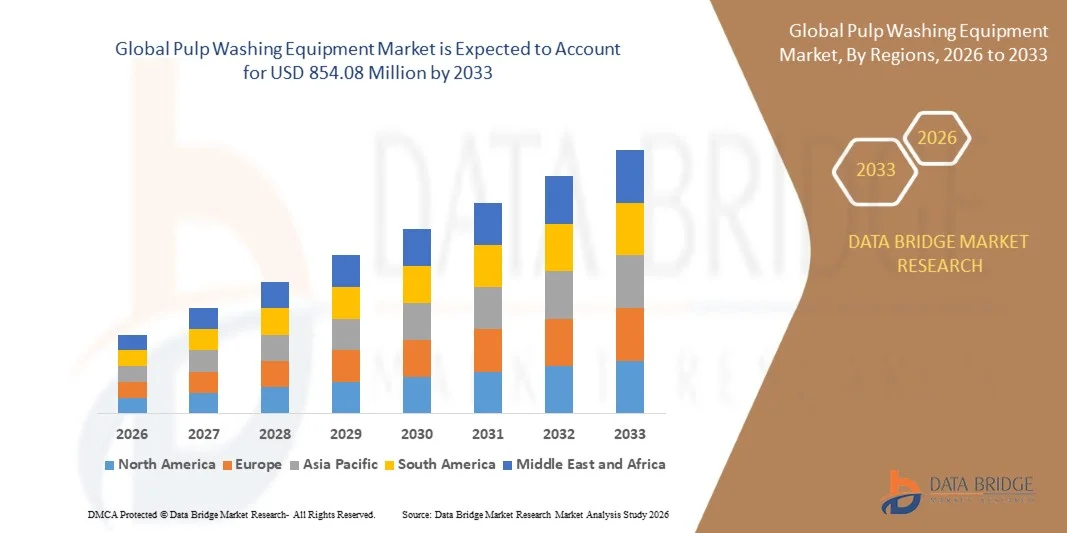
The Pulp Washing Equipment Market was valued at USD 591.46 million in 2025 and is projected to reach USD 854.08 million by 2033, growing at a CAGR of 4.70% from 2026 to 2033. The market is experiencing steady growth driven by increasing demand for high-quality pulp production, rising investments in modern pulp and paper manufacturing facilities, and growing emphasis on improving operational efficiency and resource utilization across the paper industry.
The expansion of sustainable paper packaging, tissue products, and specialty paper applications is encouraging pulp producers to adopt advanced washing equipment capable of enhancing pulp purity while reducing chemical consumption and water usage. Modern pulp washing systems are increasingly replacing conventional technologies by offering improved contaminant removal, higher fiber recovery rates, and lower environmental impact. In addition, stringent environmental regulations regarding wastewater discharge and industrial emissions are compelling manufacturers to invest in energy-efficient and environmentally compliant pulp processing equipment, supporting continued market growth across developed and emerging economies.
Key Market Trends & Insights
- North America dominated the pulp washing equipment market with the largest revenue share of 34.86% in 2025, supported by the presence of advanced pulp and paper manufacturing facilities, strong investments in mill modernization, and increasing implementation of water-efficient and environmentally compliant processing technologies.
- Asia-Pacific is expected to be the fastest-growing region, recording a CAGR of 5.6% from 2026 to 2033. Growth is driven by expanding paper production capacity, rising demand for packaging and tissue products, increasing industrialization, and substantial investments in new pulp mills and manufacturing infrastructure.
- The Vacuum Pulp Washer segment held the largest market revenue share of approximately 41.7% in 2025 driven by its widespread adoption across kraft pulp mills and paper manufacturing facilities. These systems are preferred for their ability to efficiently remove dissolved solids and chemicals while maintaining cost-effective operation in large-scale pulp processing environments.
- The Pressure Pulp Washer segment is projected to register the fastest growth at a CAGR of 5.6% from 2026 to 2033, driven by increasing demand for high-efficiency washing technologies capable of reducing water consumption and chemical carryover. Growing investments in sustainable pulp production and modern mill upgrades are accelerating segment expansion.
- The Manufacturers segment accounted for the largest market revenue share of approximately 63.9% in 2025 driven by direct procurement practices among large pulp and paper producers. Manufacturers provide customized equipment solutions, technical support, installation services, and long-term maintenance agreements, making direct sourcing the preferred procurement channel.
- The E-Retail segment is expected to witness the fastest growth at a CAGR of 6.1% from 2026 to 2033, driven by increasing digitalization of industrial procurement processes and expanding availability of equipment components and replacement parts through online platforms. Greater transparency in product specifications and pricing is supporting segment growth.
- The Carton Manufacturer segment held the largest market revenue share of approximately 48.5% in 2025 driven by rising global demand for corrugated packaging, e-commerce shipping materials, and sustainable paper-based packaging products. Pulp washing equipment plays a critical role in ensuring high-quality pulp production required for durable carton manufacturing.
- The Toilet Paper Maker segment is projected to register the fastest growth at a CAGR of 5.3% from 2026 to 2033, driven by increasing consumption of tissue and hygiene products across both developed and emerging economies. Rising urbanization, population growth, and improving hygiene awareness are contributing to the expansion of tissue manufacturing capacity, supporting demand for advanced pulp washing systems.
Market Size & Forecast
- Global Market Value (2025): USD 591.46 Million
- Expected Market Value (2033): USD 854.08 Million
- Forecast CAGR (2026–2033): 4.70%
- Leading Region in 2025: North America
- Fastest Growing Region: Asia-Pacific
Report Scope and Pulp Washing Equipment Market Segmentation
|
Attributes |
Pulp Washing Equipment Key Market Insights |
|
Segments Covered |
· By Product Type: Vacuum Pulp Washer, Pressure Pulp Washer, Displacement Drum Washer, and Others · By Distribution Channel: Manufacturers, Distributors, and E-Retail · By Application: Carton Manufacturer, Toilet Paper Maker, and Others |
|
Countries Covered |
North America · U.S. · Canada · Mexico Europe · Germany · France · U.K. · Netherlands · Switzerland · Belgium · Russia · Italy · Spain · Turkey · Rest of Europe Asia-Pacific · China · Japan · India · South Korea · Singapore · Malaysia · Australia · Thailand · Indonesia · Philippines · Rest of Asia-Pacific Middle East and Africa · Saudi Arabia · U.A.E. · South Africa · Egypt · Israel · Rest of Middle East and Africa South America · Brazil · Argentina · Rest of South America |
|
Key Market Players |
• Anyang Machinery Co., Ltd. (China) |
|
Market Opportunities |
• Increasing Adoption Of Sustainable And Water-Efficient Pulp Processing Technologies |
|
Value Added Data Infosets |
In addition to the insights on market scenarios such as market value, growth rate, segmentation, geographical coverage, and major players, the market reports curated by the Data Bridge Market Research also include import export analysis, production capacity overview, production consumption analysis, price trend analysis, climate change scenario, supply chain analysis, value chain analysis, raw material/consumables overview, vendor selection criteria, PESTLE Analysis, Porter Analysis, and regulatory framework. |
Pulp Washing Equipment Market Trends
Trend: Increasing Adoption Of Sustainable Pulp Processing And Water Conservation Technologies
Growing pressure on pulp and paper manufacturers to reduce water consumption, improve fiber recovery, and comply with environmental regulations is accelerating the adoption of advanced pulp washing equipment. Traditional pulp washing systems often require large volumes of water and chemicals while generating significant wastewater, encouraging mills to invest in high-efficiency washing technologies capable of improving process sustainability and operational performance.
Modern pulp mills are increasingly deploying advanced pulp washing equipment, For instance drum washers, pressure washers, and diffusion washers, to improve contaminant removal and reduce chemical carryover into downstream bleaching operations. According to industry estimates, pulp washing can account for up to 30% of total water consumption in a kraft pulp mill, making efficiency improvements a key operational priority. Leading pulp producers in Scandinavia, Canada, and Brazil are investing in closed-loop water systems integrated with advanced washing technologies to reduce freshwater usage and wastewater generation.
The growing demand for sustainable packaging materials and paper products is further increasing investments in efficient pulp processing infrastructure. In 2024, several large-scale pulp mill modernization projects across Europe and South America reported reductions of more than 15–20% in process water consumption after upgrading to advanced pulp washing systems, supporting industry-wide adoption.
Pulp Washing Equipment Market Dynamics
Key Market Driver: Rising Investments In Pulp Mill Modernization And Capacity Expansion
Pulp and paper manufacturers worldwide are increasingly investing in modernization projects to improve production efficiency, enhance pulp quality, and comply with stricter environmental standards. Aging mill infrastructure and rising demand for paper packaging products are creating strong demand for advanced pulp washing equipment capable of supporting high-capacity and resource-efficient operations.
Manufacturers are increasingly installing modern pulp washing systems, For instance multi-stage drum washers and pressure diffusion washers, to maximize washing efficiency and reduce chemical losses during pulp processing. The global paper and packaging industry continues to expand with growing demand for corrugated packaging, tissue products, and specialty papers. Countries such as China, Brazil, and Indonesia are investing heavily in new pulp production facilities to support domestic and export demand.
Similarly, major pulp producers are upgrading existing facilities to improve fiber recovery and lower operating costs. Real-world mill modernization projects completed during 2024 demonstrated reductions of approximately 10–15% in chemical consumption and improvements in pulp cleanliness following installation of advanced washing equipment, strengthening demand across the market.
Key Restraint/Challenge: High Capital Investment And Complex Equipment Integration
Advanced pulp washing systems require significant upfront investment, creating financial challenges for small and medium-sized pulp producers. The installation of modern washing equipment often involves modifications to existing production lines, increasing implementation costs and project complexity.
In addition, integrating new washing technologies into aging mill infrastructure can require extended shutdown periods, engineering modifications, and workforce training. Operational disruptions during installation and commissioning can affect production schedules and profitability. Maintenance requirements for sophisticated washing systems also add to total ownership costs, particularly in regions with limited technical expertise.
Industry assessments indicate that large-scale pulp washing system upgrades can require capital expenditures running into several million dollars depending on mill size and production capacity. These financial and operational considerations continue to influence purchasing decisions across cost-sensitive markets.
Key Market Opportunity: Growing Demand For Sustainable Packaging And Resource-Efficient Manufacturing
The rapid expansion of sustainable packaging applications and increasing focus on circular economy initiatives are creating significant opportunities for pulp washing equipment manufacturers. Paper-based packaging is increasingly replacing plastic packaging across food, consumer goods, and e-commerce sectors, driving demand for high-quality pulp production.
Pulp producers are increasingly adopting advanced washing technologies, For instance low-water-consumption washers and high-efficiency contaminant removal systems, to improve sustainability performance while maintaining product quality. Global paper and paperboard production continues to exceed 400 million metric tons annually, creating substantial opportunities for equipment suppliers serving pulp processing operations.
In addition, advancements in automation, process monitoring, and digital control technologies are enabling smarter and more efficient pulp washing operations. Modern pulp mills commissioned in 2025 across Asia-Pacific and Latin America reported improvements of approximately 5–10% in fiber recovery rates and significant reductions in water consumption after integrating next-generation pulp washing equipment, supporting long-term market growth opportunities.
Pulp Washing Equipment Market Scope
The market is segmented on the basis of product type, distribution channel, and application.
- By Product Type
On the basis of product type, the pulp washing equipment market is segmented into Vacuum Pulp Washer, Pressure Pulp Washer, Displacement Drum Washer, and Others. The Vacuum Pulp Washer segment held the largest market revenue share of approximately 41.7% in 2025 driven by its widespread adoption across kraft pulp mills and paper manufacturing facilities. These systems are preferred for their ability to efficiently remove dissolved solids and chemicals while maintaining cost-effective operation in large-scale pulp processing environments.
The Pressure Pulp Washer segment is projected to register the fastest growth at a CAGR of 5.6% from 2026 to 2033, driven by increasing demand for high-efficiency washing technologies capable of reducing water consumption and chemical carryover. Growing investments in sustainable pulp production and modern mill upgrades are accelerating segment expansion.
- By Distribution Channel
On the basis of distribution channel, the pulp washing equipment market is segmented into Manufacturers, Distributors, and E-Retail. The Manufacturers segment accounted for the largest market revenue share of approximately 63.9% in 2025 driven by direct procurement practices among large pulp and paper producers. Manufacturers provide customized equipment solutions, technical support, installation services, and long-term maintenance agreements, making direct sourcing the preferred procurement channel.
The E-Retail segment is expected to witness the fastest growth at a CAGR of 6.1% from 2026 to 2033, driven by increasing digitalization of industrial procurement processes and expanding availability of equipment components and replacement parts through online platforms. Greater transparency in product specifications and pricing is supporting segment growth.
- By Application
On the basis of application, the pulp washing equipment market is segmented into Carton Manufacturer, Toilet Paper Maker, and Others. The Carton Manufacturer segment held the largest market revenue share of approximately 48.5% in 2025 driven by rising global demand for corrugated packaging, e-commerce shipping materials, and sustainable paper-based packaging products. Pulp washing equipment plays a critical role in ensuring high-quality pulp production required for durable carton manufacturing.
The Toilet Paper Maker segment is projected to register the fastest growth at a CAGR of 5.3% from 2026 to 2033, driven by increasing consumption of tissue and hygiene products across both developed and emerging economies. Rising urbanization, population growth, and improving hygiene awareness are contributing to the expansion of tissue manufacturing capacity, supporting demand for advanced pulp washing systems.
Pulp Washing Equipment Market Regional Analysis
North America Pulp Washing Equipment Market Insight
North America dominated the pulp washing equipment market with the largest revenue share of 34.86% in 2025, supported by the presence of advanced pulp and paper manufacturing facilities, increasing investments in mill modernization, and strong adoption of resource-efficient processing technologies. Manufacturers across the region are focused on improving pulp quality, reducing water consumption, and enhancing operational efficiency through advanced washing systems. Stringent environmental regulations regarding wastewater treatment and industrial emissions further support the adoption of modern pulp washing equipment across large-scale production facilities.
U.S. Pulp Washing Equipment Market Insight
The U.S. pulp washing equipment market captured the largest revenue share in 2025 within North America, fueled by ongoing investments in paper packaging production and modernization of existing pulp mills. Manufacturers are increasingly implementing advanced washing technologies to improve fiber recovery, reduce chemical losses, and comply with sustainability objectives. The growing demand for corrugated packaging, tissue products, and environmentally responsible paper manufacturing processes continues to support market expansion throughout the country.
Europe Pulp Washing Equipment Market Insight
The Europe pulp washing equipment market is expected to witness the fastest growth rate from 2026 to 2033, primarily driven by stringent environmental regulations, increasing adoption of sustainable manufacturing practices, and rising investments in energy-efficient pulp processing technologies. Paper producers across the region are actively upgrading production facilities to reduce water consumption and improve operational performance. Growing demand for recyclable packaging materials is further accelerating investments in advanced pulp washing infrastructure.
U.K. Pulp Washing Equipment Market Insight
The U.K. pulp washing equipment market is expected to witness the fastest growth rate from 2026 to 2033, driven by increasing focus on sustainable paper production and rising demand for environmentally friendly packaging solutions. Manufacturers are investing in advanced process equipment to enhance production efficiency and reduce environmental impact. The country's growing emphasis on circular economy initiatives and resource conservation continues to stimulate demand for modern pulp processing technologies.
Germany Pulp Washing Equipment Market Insight
The Germany pulp washing equipment market is expected to witness the fastest growth rate from 2026 to 2033, fueled by strong industrial infrastructure, technological innovation, and increasing investments in sustainable pulp and paper manufacturing. German producers are adopting advanced washing systems to improve pulp cleanliness, optimize resource utilization, and reduce chemical consumption. The country's leadership in industrial automation and environmental compliance further supports market growth.
Asia-Pacific Pulp Washing Equipment Market Insight
The Asia-Pacific pulp washing equipment market is expected to witness the fastest growth rate from 2026 to 2033, supported by rapid industrialization, expanding paper production capacity, and increasing demand for packaging and tissue products across countries such as China, Japan, and India. Rising investments in new pulp mills and modernization projects are encouraging the adoption of advanced washing technologies. Growing environmental awareness and stricter regulatory requirements are also contributing to market expansion throughout the region.
Japan Pulp Washing Equipment Market Insight
The Japan pulp washing equipment market is expected to witness the fastest growth rate from 2026 to 2033 due to the country's focus on high-efficiency manufacturing, resource optimization, and sustainable industrial practices. Japanese pulp and paper manufacturers are increasingly investing in advanced washing technologies to improve product quality while minimizing water and chemical consumption. The growing demand for premium paper products and environmentally responsible production methods is supporting continued market growth.
China Pulp Washing Equipment Market Insight
The China pulp washing equipment market accounted for the largest market revenue share in Asia-Pacific in 2025, attributed to the country's massive pulp and paper manufacturing sector, expanding packaging industry, and increasing investments in production capacity expansion. China remains one of the world's largest producers of paper and paperboard products, creating substantial demand for efficient pulp processing equipment. Government initiatives promoting cleaner industrial operations and growing adoption of advanced manufacturing technologies are key factors propelling market growth in China.
Pulp Washing Equipment Market Share
The Pulp Washing Equipment industry is primarily led by well-established companies, including:
• Anyang Machinery Co., Ltd. (China)
• Valmet Oyj (Finland)
• Wenrui Machinery (China)
• ANDRITZ AG (Austria)
• Kadant Inc. (U.S.)
• Leizhan Paper Pulp Machinery Company (China)
• Zhengzhou Guangmao Machinery Manufacture Co., Ltd. (China)
• GL&V Inc. (Canada)
• Comertek S.r.l. (Italy)
• Taizen Co., Ltd. (South Korea)
• Anyang Machinery Co., Ltd. (China)
• O2COOL, LLC (U.S.)
• Bubba Brands, Inc. (U.S.)
• LocknLock Co., Ltd. (South Korea)
• ProMach, Inc. (U.S.)
• Magnum Group (India)
• KraussMaffei Technologies GmbH (Germany)
• SIPA S.p.A. (Italy)
• IBO S.R.L. (Italy)
• RESILUX NV (Belgium)
• SGT (France)
• Taiwan Hon Chuan Enterprise Co., Ltd. (Taiwan)
• Logoplaste (Portugal)
Latest Developments in Pulp Washing Equipment Market
- In January 2024, Valmet, ANDRITZ AG, and Kadant Inc. highlighted advancements in eco-friendly pulp washing technologies through industry initiatives focused on improving washing efficiency and reducing environmental impact. The development emphasizes advanced equipment capable of lowering water consumption, minimizing chemical carryover, and improving pulp quality across manufacturing operations. These innovations help pulp producers reduce operational costs while meeting increasingly stringent sustainability and regulatory requirements. The trend is expected to accelerate modernization investments across pulp and paper mills and strengthen demand for next-generation pulp washing equipment globally.

- Interactive Data Analysis Dashboard
- Company Analysis Dashboard for high growth potential opportunities
- Research Analyst Access for customization & queries
- Competitor Analysis with Interactive dashboard
- Latest News, Updates & Trend analysis
- Harness the Power of Benchmark Analysis for Comprehensive Competitor Tracking
Global Pulp Washing Equipment Market, Supply Chain Analysis and Ecosystem Framework
To support market growth and help clients navigate the impact of geopolitical shifts, DBMR has integrated in-depth supply chain analysis into its Global Pulp Washing Equipment Market research reports. This addition empowers clients to respond effectively to global changes affecting their industries. The supply chain analysis section includes detailed insights such as Global Pulp Washing Equipment Market consumption and production by country, price trend analysis, the impact of tariffs and geopolitical developments, and import and export trends by country and HSN code. It also highlights major suppliers with data on production capacity and company profiles, as well as key importers and exporters. In addition to research, DBMR offers specialized supply chain consulting services backed by over a decade of experience, providing solutions like supplier discovery, supplier risk assessment, price trend analysis, impact evaluation of inflation and trade route changes, and comprehensive market trend analysis.
Data collection and base year analysis are done using data collection modules with large sample sizes. The stage includes obtaining market information or related data through various sources and strategies. It includes examining and planning all the data acquired from the past in advance. It likewise envelops the examination of information inconsistencies seen across different information sources. The market data is analysed and estimated using market statistical and coherent models. Also, market share analysis and key trend analysis are the major success factors in the market report. To know more, please request an analyst call or drop down your inquiry.
The key research methodology used by DBMR research team is data triangulation which involves data mining, analysis of the impact of data variables on the market and primary (industry expert) validation. Data models include Vendor Positioning Grid, Market Time Line Analysis, Market Overview and Guide, Company Positioning Grid, Patent Analysis, Pricing Analysis, Company Market Share Analysis, Standards of Measurement, Global versus Regional and Vendor Share Analysis. To know more about the research methodology, drop in an inquiry to speak to our industry experts.
Data Bridge Market Research is a leader in advanced formative research. We take pride in servicing our existing and new customers with data and analysis that match and suits their goal. The report can be customized to include price trend analysis of target brands understanding the market for additional countries (ask for the list of countries), clinical trial results data, literature review, refurbished market and product base analysis. Market analysis of target competitors can be analyzed from technology-based analysis to market portfolio strategies. We can add as many competitors that you require data about in the format and data style you are looking for. Our team of analysts can also provide you data in crude raw excel files pivot tables (Fact book) or can assist you in creating presentations from the data sets available in the report.













