


What is the Pulse Fibres and Grits Market Size and Overview?
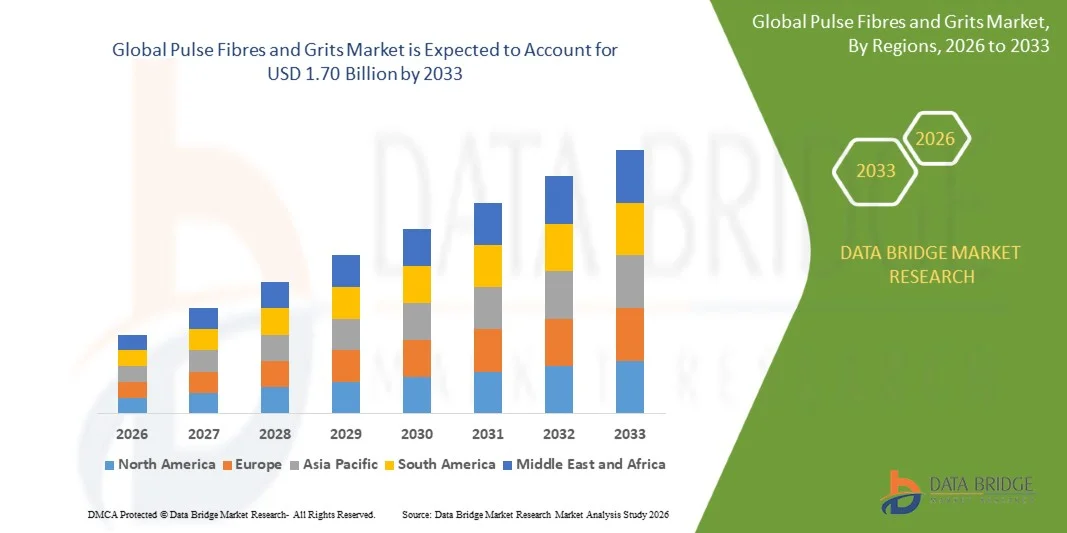
As per Data Bridge Market Research Analysis the Pulse Fibres and Grits Market was valued at USD 1.18 billion in 2025 and is projected to reach USD 1.70 billion by 2033, growing at a CAGR of 4.70% from 2026 to 2033. The market is experiencing steady growth driven by increasing consumer demand for plant-based and protein-rich food ingredients, growing awareness regarding digestive health and nutritional benefits, and expanding utilization of pulse-derived ingredients across bakery, snacks, ready-to-eat meals, and functional food applications.
The rising preference for clean-label, gluten-free, and sustainable food products is encouraging food manufacturers to incorporate pulse fibres and grits into product formulations to enhance nutritional value and improve texture. In addition, increasing adoption of pulses as an alternative protein source, supported by growing vegan and flexitarian populations worldwide, is accelerating market expansion. Advancements in pulse processing technologies and growing investments in value-added pulse ingredients are further strengthening market growth, while the food industry's focus on healthier formulations continues to create opportunities for pulse fibres and grits across both developed and emerging markets.
Key Market Trends & Insights
- North America dominated the pulse fibres and grits market with the largest revenue share of 38.45% in 2025, supported by rising demand for high-protein plant-based food ingredients and increasing adoption of gluten-free and clean-label dietary products.
- Asia-Pacific is expected to be the fastest-growing region, recording a CAGR of from 2026 to 2033. Growth is driven by rising population, increasing disposable incomes, expanding packaged food consumption, and strong traditional reliance on pulses such as peas, chickpeas, and lentils in daily diets.
- The Peas segment held the largest market revenue share of approximately 38.5% in 2025 driven by high availability, cost-effectiveness, and strong utilization in protein-rich food formulations, plant-based meat alternatives, and bakery applications. Pea-derived fibres and grits are widely preferred due to their neutral taste profile, high protein content, and strong functional properties in food processing systems.
- The Chickpeas segment is projected to register the fastest growth at a CAGR of 5.6% from 2026 to 2033, driven by increasing demand for high-protein, gluten-free ingredients and rising adoption in snack foods, hummus-based products, and functional food formulations. Expanding use of chickpea-based ingredients in plant-based diets and clean-label product development is accelerating segment expansion.
- The Food and Beverages segment held the largest market revenue share of approximately 72.4% in 2025 driven by strong demand for plant-based proteins, increasing consumer preference for fiber-enriched diets, and rising incorporation of pulse ingredients in bakery, snacks, cereals, and ready-to-eat products. Food manufacturers are increasingly leveraging pulse fibres and grits to enhance nutritional profiles and improve product texture and functionality.
- The Feed segment is projected to register the fastest growth at a CAGR of 5.1% from 2026 to 2033, driven by rising demand for sustainable and cost-effective animal nutrition solutions. Growing use of pulse-based ingredients in livestock and aquaculture feed formulations is supporting improved digestibility, protein enrichment, and overall feed efficiency, contributing to steady segment expansion.
Market Size & Forecast
- Global Market Value (2025): USD 1.18 Billion
- Expected Market Value (2033): USD 1.70 Billion
- Forecast CAGR (2026–2033): 4.70%
- Leading Region in 2025: North America
- Fastest Growing Region: Asia-Pacific
Report Scope and Pulse Fibres and Grits Market Segmentation
|
Attributes |
Pulse Fibres and Grits Key Market Insights |
|
Segments Covered |
|
|
Countries Covered |
North America
Europe
Asia-Pacific
Middle East and Africa
South America
|
|
Key Market Players |
• ADM (U.S.) |
|
Market Opportunities |
• Expansion Of Plant-Based Protein And Functional Food Applications • Growing Demand For Clean-Label And Gluten-Free Food Ingredients |
|
Value Added Data Infosets |
In addition to the insights on market scenarios such as market value, growth rate, segmentation, geographical coverage, and major players, the market reports curated by the Data Bridge Market Research also include in-depth expert analysis, pricing analysis, brand share analysis, consumer survey, demography analysis, supply chain analysis, value chain analysis, raw material/consumables overview, vendor selection criteria, PESTLE Analysis, Porter Analysis, and regulatory framework. |
What is the Key Trend in the Pulse Fibres and Grits Market?
Trend: Rising Adoption Of Plant-Based Functional Ingredients In Food Processing
Increasing consumer preference for nutritious, sustainable, and clean-label food products is driving demand for pulse fibres and grits across food and beverage applications. Traditional refined grain ingredients are increasingly being replaced with pulse-based alternatives due to their higher protein, dietary fiber, and micronutrient content, supporting healthier product formulations while meeting growing demand for plant-based nutrition.
Food manufacturers are incorporating pulse fibres and grits, For instance pea fibre, lentil grits, and chickpea ingredients, into bakery products, snacks, pasta, cereals, and meat alternatives to improve nutritional profiles and functional performance. In addition, growing consumer interest in gluten-free diets and digestive health is accelerating the use of pulse-derived ingredients as natural texture enhancers and fiber fortification agents.
The rapid expansion of plant-based food categories and alternative protein products is further strengthening market demand. According to industry estimates, global plant-based food sales surpassed USD 45 billion in 2024, creating significant opportunities for pulse ingredient suppliers. In addition, major food manufacturers introduced several pulse-enriched product lines during 2025, reporting protein content improvements of 15–25% compared to conventional grain-based formulations.
Pulse Fibres and Grits Market Dynamics
Key Market Driver: Growing Demand For High-Protein And Clean-Label Food Ingredients
Consumers worldwide are increasingly seeking healthier food options that provide higher nutritional value without artificial additives or synthetic ingredients. Rising awareness regarding obesity, digestive disorders, cardiovascular health, and protein deficiency is encouraging food manufacturers to develop products enriched with natural plant-based ingredients.
Pulse fibres and grits provide an attractive solution due to their high dietary fiber content, protein concentration, low glycemic index, and compatibility with clean-label formulations. Food producers across bakery, snacks, ready meals, and meat substitutes are increasingly utilizing pulse-derived ingredients to enhance nutritional content while maintaining product quality and taste. For instance, pulse ingredients are now widely incorporated into plant-based burgers, protein snacks, and fortified bakery products to improve nutritional claims.
Similarly, government initiatives promoting pulse consumption are supporting market growth. The Food and Agriculture Organization (FAO) continues to highlight pulses as sustainable nutrient-dense crops, while several countries have expanded pulse production programs to improve food security. Global pulse production exceeded 100 million metric tons in 2024, ensuring a stable supply base for ingredient manufacturers.
Key Restraint/Challenge: Supply Chain Volatility And Processing Complexity
Despite strong demand growth, pulse fibres and grits manufacturers face challenges associated with fluctuating raw material availability and complex processing requirements. Agricultural production of pulses remains vulnerable to adverse weather conditions, droughts, pest infestations, and regional trade disruptions, affecting pricing stability and ingredient supply.
In addition, achieving consistent functional properties such as texture, particle size, flavor neutrality, and moisture absorption requires advanced processing technologies and significant quality control investments. Certain pulse ingredients may also present flavor challenges, including earthy or beany notes, requiring additional formulation adjustments by food manufacturers.
Commercial processing studies indicate that pulse ingredient extraction and fractionation can increase production costs by 15–20% compared to conventional cereal ingredients. These factors may limit adoption among small food manufacturers and cost-sensitive markets while creating challenges for large-scale commercialization.
Key Market Opportunity: Expansion Of Alternative Protein And Functional Nutrition Applications
Modern consumers increasingly demand protein-rich, sustainable, and health-oriented food products, creating substantial opportunities for pulse fibres and grits manufacturers. Growing adoption of vegetarian, vegan, and flexitarian diets is accelerating demand for plant-based ingredients capable of delivering both nutritional and functional benefits.
Food companies are increasingly utilizing pulse fibres and grits, For instance in meat alternatives, dairy substitutes, protein bars, sports nutrition products, and functional beverages, to improve protein content and nutritional value while supporting clean-label product positioning. In the animal nutrition sector, pulse-based ingredients are also gaining traction as sustainable alternatives to traditional feed ingredients.
In addition, advancements in dry fractionation, protein isolation, and ingredient processing technologies are improving product functionality and expanding applications across food and beverage industries. Product launches across North America and Europe during 2025 demonstrated pulse-enriched formulations achieving fiber content increases of 20–30% while maintaining desirable texture and sensory characteristics, creating significant growth opportunities for manufacturers across global markets.
How is the Pulse Fibres and Grits Market Segmented?
The market is segmented on the basis of model, type, functionality, offering, and end-use application.
- By Source
On the basis of source, the pulse fibres and grits market is segmented into Peas, Beans, Chickpeas, and Lentils. The Peas segment held the largest market revenue share of approximately 38.5% in 2025 driven by high availability, cost-effectiveness, and strong utilization in protein-rich food formulations, plant-based meat alternatives, and bakery applications. Pea-derived fibres and grits are widely preferred due to their neutral taste profile, high protein content, and strong functional properties in food processing systems.
The Chickpeas segment is projected to register the fastest growth at a CAGR of 5.6% from 2026 to 2033, driven by increasing demand for high-protein, gluten-free ingredients and rising adoption in snack foods, hummus-based products, and functional food formulations. Expanding use of chickpea-based ingredients in plant-based diets and clean-label product development is accelerating segment expansion.
- By Application
On the basis of application, the pulse fibres and grits market is segmented into Food and Beverages, and Feed. The Food and Beverages segment held the largest market revenue share of approximately 72.4% in 2025 driven by strong demand for plant-based proteins, increasing consumer preference for fiber-enriched diets, and rising incorporation of pulse ingredients in bakery, snacks, cereals, and ready-to-eat products. Food manufacturers are increasingly leveraging pulse fibres and grits to enhance nutritional profiles and improve product texture and functionality.
The Feed segment is projected to register the fastest growth at a CAGR of 5.1% from 2026 to 2033, driven by rising demand for sustainable and cost-effective animal nutrition solutions. Growing use of pulse-based ingredients in livestock and aquaculture feed formulations is supporting improved digestibility, protein enrichment, and overall feed efficiency, contributing to steady segment expansion.
Which Region Holds the Largest Share of the Pulse Fibres and Grits Market?
North America Pulse Fibres and Grits Market Insight
North America dominated the pulse fibres and grits market with the largest revenue share of 38.45% in 2025, supported by rising demand for high-protein plant-based food ingredients and increasing adoption of gluten-free and clean-label dietary products. Consumers in the region are highly inclined toward functional nutrition, fiber-rich diets, and sustainable food sourcing, which is driving strong consumption of pulse-based ingredients across processed food and bakery applications. This growth is further supported by advanced food processing infrastructure, high awareness of health and wellness trends, and the expanding vegan and vegetarian population, establishing pulse fibres and grits as key ingredients in both retail and industrial food manufacturing.
U.S. Pulse Fibres and Grits Market Insight
The U.S. pulse fibres and grits market captured the largest revenue share in 2025 within North America, driven by rapid expansion of plant-based food alternatives and strong demand for high-protein snack formulations. Consumers are increasingly shifting toward chickpea-based, lentil-based, and pea-based ingredients due to rising concerns over obesity, diabetes, and digestive health. The growing penetration of clean-label and non-GMO food products, combined with strong retail distribution networks and foodservice innovation, is further supporting market expansion.
Europe Pulse Fibres and Grits Market Insight
The Europe pulse fibres and grits market is expected to witness the fastest growth rate from 2026 to 2033, primarily driven by stringent food labeling regulations and increasing consumer preference for sustainable and plant-based diets. Rising demand for allergen-free and gluten-free food ingredients is encouraging food manufacturers to incorporate pulse-derived fibres in bakery, confectionery, and processed foods. Countries such as Germany, France, and the U.K. are witnessing strong adoption due to growing vegan populations and increasing awareness of gut health benefits.
U.K. Pulse Fibres and Grits Market Insight
The U.K. pulse fibres and grits market is expected to witness strong growth from 2026 to 2033, driven by rising demand for plant-based nutrition and increasing consumption of high-fiber functional foods. Consumers are actively shifting toward sustainable protein alternatives, supported by government-backed healthy eating initiatives and expanding retail availability of pulse-based products. The growth of vegan product launches and food innovation in supermarkets is further strengthening market penetration.
Germany Pulse Fibres and Grits Market Insight
The Germany pulse fibres and grits market is expected to witness steady growth from 2026 to 2033, fueled by increasing demand for organic and sustainable food ingredients. German consumers show strong preference for natural, minimally processed foods, which is accelerating adoption of pulse-based fibres in bread, pasta, and breakfast cereals. The country’s strong food processing industry and emphasis on environmental sustainability are further supporting market expansion.
Asia-Pacific Pulse Fibres and Grits Market Insight
The Asia-Pacific pulse fibres and grits market is expected to witness the fastest growth rate from 2026 to 2033, supported by rising population, increasing disposable incomes, and traditional dietary reliance on pulses in countries such as India and China. Growing urbanization and expansion of packaged food consumption are boosting demand for pulse-based processed ingredients. In addition, government initiatives promoting protein-rich diets and food security are strengthening regional market growth.
Japan Pulse Fibres and Grits Market Insight
The Japan pulse fibres and grits market is expected to witness steady growth from 2026 to 2033 due to rising health awareness and increasing demand for functional and low-fat food products. The aging population is driving higher consumption of fiber-rich diets to support digestive health. In addition, integration of pulse-based ingredients in convenience foods and health-oriented snacks is contributing to gradual market expansion.
China Pulse Fibres and Grits Market Insight
The China pulse fibres and grits market accounted for the largest market revenue share in Asia-Pacific in 2025, attributed to rapid urbanization, expanding middle-class population, and increasing demand for nutritious processed foods. Strong domestic production of peas, chickpeas, and lentils is supporting large-scale ingredient availability. Rising health consciousness and government focus on food nutrition security are further driving adoption of pulse-based fibres in packaged food applications.
Which are the Top Companies in Pulse Fibres and Grits Market?
The Pulse Fibres and Grits industry is primarily led by well-established companies, including:
• ADM (U.S.)
• Ingredion Incorporated (U.S.)
• AGT Food and Ingredients (Canada)
• ANCHOR INGREDIENTS (U.S.)
• Agspring, LLC (U.S.)
• The Scoular Company (U.S.)
• SunOpta (Canada)
• EHL Limited (U.K.)
• Avena Foods, Limited (Canada)
• Batory Foods (U.S.)
• Diefenbaker Spice & Pulse (Canada)
• Great Western Malting (U.S.)
• BEAN GROWERS AUSTRALIA LIMITED (Australia)
• Blue Ribbon (U.S.)
• Alsiano (Denmark)
• GPA Capital Foods Pvt. Ltd. (India)
• Limagrain (France)
• Bühler Group (Switzerland)
• Parakh Group (India)
• Ganesh Grains Limited (India)
What are Latest Developments in Pulse Fibres and Grits Market?
- In September 2021, Ingredion Incorporated launched a product innovation initiative, introducing the “Prista” line of ultra-performance pulse ingredients including pea flour and faba-bean protein concentrates, designed to enhance taste, texture, and functional performance in pulse fibre and grits applications, thereby strengthening clean-label product development and expanding plant-based food formulation capabilities across the global processed food industry
- In June 2022, Bühler AG entered a strategic partnership with endeco GmbH, focusing on the development of advanced processing technologies for the pulse fibre and grits value chain, aimed at reducing CO₂ emissions and improving processing efficiency, which is expected to enhance sustainability performance and strengthen the adoption of high-quality pulse-based ingredients in food manufacturing systems

- Interactive Data Analysis Dashboard
- Company Analysis Dashboard for high growth potential opportunities
- Research Analyst Access for customization & queries
- Competitor Analysis with Interactive dashboard
- Latest News, Updates & Trend analysis
- Harness the Power of Benchmark Analysis for Comprehensive Competitor Tracking
Global Pulse Fibres And Grits Market, Supply Chain Analysis and Ecosystem Framework
To support market growth and help clients navigate the impact of geopolitical shifts, DBMR has integrated in-depth supply chain analysis into its Global Pulse Fibres And Grits Market research reports. This addition empowers clients to respond effectively to global changes affecting their industries. The supply chain analysis section includes detailed insights such as Global Pulse Fibres And Grits Market consumption and production by country, price trend analysis, the impact of tariffs and geopolitical developments, and import and export trends by country and HSN code. It also highlights major suppliers with data on production capacity and company profiles, as well as key importers and exporters. In addition to research, DBMR offers specialized supply chain consulting services backed by over a decade of experience, providing solutions like supplier discovery, supplier risk assessment, price trend analysis, impact evaluation of inflation and trade route changes, and comprehensive market trend analysis.
Data collection and base year analysis are done using data collection modules with large sample sizes. The stage includes obtaining market information or related data through various sources and strategies. It includes examining and planning all the data acquired from the past in advance. It likewise envelops the examination of information inconsistencies seen across different information sources. The market data is analysed and estimated using market statistical and coherent models. Also, market share analysis and key trend analysis are the major success factors in the market report. To know more, please request an analyst call or drop down your inquiry.
The key research methodology used by DBMR research team is data triangulation which involves data mining, analysis of the impact of data variables on the market and primary (industry expert) validation. Data models include Vendor Positioning Grid, Market Time Line Analysis, Market Overview and Guide, Company Positioning Grid, Patent Analysis, Pricing Analysis, Company Market Share Analysis, Standards of Measurement, Global versus Regional and Vendor Share Analysis. To know more about the research methodology, drop in an inquiry to speak to our industry experts.
Data Bridge Market Research is a leader in advanced formative research. We take pride in servicing our existing and new customers with data and analysis that match and suits their goal. The report can be customized to include price trend analysis of target brands understanding the market for additional countries (ask for the list of countries), clinical trial results data, literature review, refurbished market and product base analysis. Market analysis of target competitors can be analyzed from technology-based analysis to market portfolio strategies. We can add as many competitors that you require data about in the format and data style you are looking for. Our team of analysts can also provide you data in crude raw excel files pivot tables (Fact book) or can assist you in creating presentations from the data sets available in the report.













