


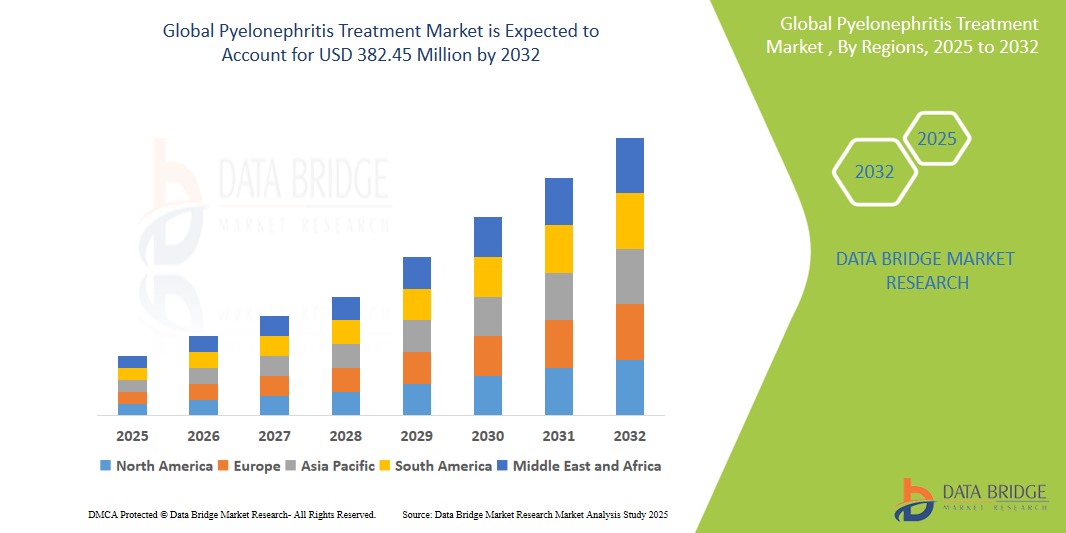
Pyelonephritis Treatment Market Size
- The Global Pyelonephritis Treatment Market size was valued at USD 273.87 million in 2024 and is expected to reach USD 382.45 million by 2032, at a CAGR of 4.3% during the forecast period
- The market growth is primarily driven by the rising prevalence of urinary tract infections (UTIs), increasing awareness about early diagnosis and treatment of kidney infections, and advancements in antibiotic therapies
- Additionally, the growing burden of antimicrobial resistance is prompting healthcare providers to adopt newer and more effective treatment regimens, contributing to the market’s expansion. These factors, combined with improved access to healthcare in emerging markets and increased government focus on infection control, are expected to fuel sustained demand for pyelonephritis treatment globally
Pyelonephritis Treatment Market Analysis
- Pyelonephritis, a severe bacterial infection of the kidneys, is increasingly recognized as a critical urological condition requiring timely and effective treatment through antibiotics or surgical interventions in complicated cases. The growing prevalence of urinary tract infections (UTIs), antibiotic-resistant pathogens, and recurrent kidney infections in both hospital and community settings is driving demand for targeted treatment solutions
- The rising global burden of healthcare-associated infections (HAIs), along with increasing awareness about early diagnosis and prompt antibiotic treatment, is significantly fueling market growth. The demand is further supported by a growing elderly population and patients with comorbidities such as diabetes, which increases susceptibility to kidney infections
- North America dominates the pyelonephritis treatment market, accounting for the largest revenue share of 38.7% in 2024, attributed to high healthcare spending, robust antibiotic stewardship programs, and advanced diagnostic infrastructure. The U.S. leads the regional market due to a high incidence of complicated UTIs and proactive public health initiatives aimed at managing antimicrobial resistance
- Asia-Pacific is projected to be the fastest-growing region in the pyelonephritis treatment market during the forecast period, driven by increasing access to healthcare services, growing awareness of UTI complications, and rising investments in infectious disease management across countries like India, China, and Southeast Asia
- The medication segment expect to dominate the treatment landscape, accounting for approximately 78.4% of the global pyelonephritis treatment market in 2024, with antibiotics such as Plazomicin, Levofloxacin, and Meropenem-Vaborbactam holding a significant share due to their efficacy against multidrug-resistant pathogens and their widespread use as first-line treatments in acute cases.
Report Scope and Pyelonephritis Treatment Market Segmentation
|
Attributes |
Pyelonephritis Treatment Key Market Insights |
|
Segments Covered |
|
|
Countries Covered |
North America
Europe
Asia-Pacific
Middle East and Africa
South America
|
|
Key Market Players |
|
|
Market Opportunities |
|
|
Value Added Data Infosets |
In addition to the insights on market scenarios such as market value, growth rate, segmentation, geographical coverage, and major players, the market reports curated by the Data Bridge Market Research also include in-depth expert analysis, pricing analysis, brand share analysis, consumer survey, demography analysis, supply chain analysis, value chain analysis, raw material/consumables overview, vendor selection criteria, PESTLE Analysis, Porter Analysis, and regulatory framework. |
Pyelonephritis Treatment Market Trends
“Advancements in Antibiotic Development and Diagnostic Precision”
- A significant trend shaping the global pyelonephritis treatment market is the growing focus on the development of novel antibiotics and rapid diagnostic tools to combat the increasing incidence of drug-resistant urinary tract infections (UTIs), including complicated pyelonephritis cases. These innovations are enhancing both treatment efficacy and clinical outcomes
- For Instance, Plazomicin, a next-generation aminoglycoside, has gained traction due to its potency against multidrug-resistant Enterobacteriaceae. Similarly, the Meropenem-Vaborbactam combination is being increasingly utilized for treating pyelonephritis caused by carbapenem-resistant organisms
- Parallel to drug development, molecular diagnostics and point-of-care testing are streamlining the identification of bacterial pathogens and resistance genes, allowing for faster, targeted therapy and reduced overuse of broad-spectrum antibiotics. Technologies like PCR-based urine testing and rapid susceptibility assays are becoming more common in hospital and specialty clinic settings
- This trend toward precision treatment is reinforcing the shift from empirical therapy to pathogen-specific regimens, improving antibiotic stewardship and reducing treatment failure rates. Pharmaceutical and diagnostics companies are investing in collaborative R&D efforts to create integrated solutions that combine diagnostics and tailored therapeutics
- With rising awareness among clinicians about antibiotic resistance and an increasing demand for faster treatment response in acute cases, this convergence of advanced drug therapies and diagnostic tools is expected to redefine the management of both acute and chronic pyelonephritis over the coming years
Pyelonephritis Treatment Market Dynamics
Driver
“Rising Incidence of Urinary Tract Infections and Growing Resistance Patterns”
- The increasing prevalence of UTIs, particularly among females, elderly populations, and catheterized patients, is a key factor driving the demand for effective pyelonephritis treatments globally. Pyelonephritis, a severe kidney infection resulting from untreated UTIs, has seen rising diagnosis rates in both community and hospital settings
- For Instance-According to clinical data, Escherichia coli remains the leading causative pathogen; however, its growing resistance to fluoroquinolones and beta-lactam antibiotics has made treatment increasingly challenging, particularly in acute and recurrent cases
- This has led to the adoption of broad-spectrum antibiotics and newer combination drugs that are effective against resistant strains. Governments and health authorities in several countries are also implementing national surveillance and antimicrobial resistance (AMR) containment programs, further boosting demand for high-efficacy treatment options
- Additionally, improved healthcare access, especially in developing regions, and the increased availability of advanced antibiotics in hospital pharmacies and online platforms, are expanding treatment coverage for pyelonephritis
Restraint/Challenge
“Antibiotic Resistance and Side Effects Limiting Long-Term Use”
- A major challenge confronting the pyelonephritis treatment market is the rapid emergence of antimicrobial resistance (AMR) among uropathogens. Overuse and misuse of antibiotics, particularly in outpatient settings, have led to reduced efficacy of commonly prescribed drugs like ciprofloxacin and trimethoprim-sulfamethoxazole
- This resistance complicates treatment protocols, resulting in longer hospital stays, increased healthcare costs, and a higher risk of complications or relapse. For instance, extended-spectrum beta-lactamase (ESBL)-producing E. coli strains are increasingly found in both community and nosocomial infections, limiting the utility of first-line therapies
- Moreover, certain antibiotics used in treating pyelonephritis, including aminoglycosides and carbapenems, are associated with nephrotoxicity and ototoxicity, which can pose significant risks for patients with comorbidities or renal impairment
- The lack of rapid, affordable diagnostic tools in primary care settings also contributes to the overuse of broad-spectrum agents. Addressing these concerns will require accelerated drug discovery, improved antibiotic stewardship programs, and greater investment in education around proper usage and resistance mitigation
- While pharmaceutical innovation is ongoing, the market still faces regulatory and clinical challenges in bringing novel, safe, and resistance-proof antibiotics to patients at scale
Pyelonephritis Treatment Market Scope
The market is segmented on the basis of disease type, drug class, route of administration, distribution channel, and end user.
• By Disease Type
On the basis of disease type, the pyelonephritis treatment market is segmented into acute pyelonephritis and chronic pyelonephritis. The acute pyelonephritis segment dominates the largest market revenue share of 67.5% in 2025, driven by its higher prevalence and the urgent need for short-term antibiotic treatment. Acute pyelonephritis is commonly caused by bacterial infections ascending from the lower urinary tract and requires immediate intervention, contributing to the high demand for effective antimicrobial therapies
The chronic pyelonephritis segment is anticipated to witness the fastest growth rate of 6.9% from 2025 to 2032, fueled by rising awareness and improved diagnostic rates. Chronic pyelonephritis often develops due to repeated or inadequately treated infections and is more prevalent among individuals with underlying structural or functional urinary tract abnormalities. Increasing healthcare access and advances in imaging techniques are aiding earlier detection and treatment, thereby contributing to market expansion
• By Drug Class
On the basis of drug class, the market is segmented into beta-lactam antibiotics, quinolones, aminoglycosides, cephalosporins, and others. The quinolones segment held the largest market revenue share in 2025, attributed to their broad-spectrum activity, oral bioavailability, and ability to reach therapeutic levels in renal tissues. Fluoroquinolones like ciprofloxacin and levofloxacin are often prescribed as first-line treatments for uncomplicated and complicated cases
The cephalosporins segment is expected to witness the fastest CAGR from 2025 to 2032, driven by their growing use in pediatric cases and patients with fluoroquinolone resistance. Third-generation cephalosporins, such as ceftriaxone, offer strong efficacy with fewer side effects, making them a preferred choice for hospital-based care and intravenous administration
• By Route of Administration
On the basis of route of administration, the pyelonephritis treatment market is segmented into oral, injectable, and others. The oral segment held the largest market revenue share in 2025, owing to the increasing preference for outpatient management of mild-to-moderate cases and the convenience of self-administration. Oral antibiotics such as trimethoprim-sulfamethoxazole and ciprofloxacin enable cost-effective treatment and improved patient compliance
The injectable segment is expected to witness the fastest CAGR from 2025 to 2032, driven by its critical role in treating severe and hospital-admitted cases. Intravenous antibiotics are often required in complicated infections, particularly among elderly patients, pregnant women, and individuals with comorbid conditions. Hospital protocols and rising hospitalization rates due to drug-resistant infections are further boosting the demand for injectable options
• By Distribution Channel
On the basis of distribution channel, the market is segmented into hospital pharmacies, retail pharmacies, online pharmacies, and others. The hospital pharmacies segment accounted for the largest revenue share in 2025, supported by the high volume of prescriptions for inpatient care, especially for complicated and acute pyelonephritis cases. The centralized distribution of injectable drugs and immediate access to treatment further bolster this segment
The online pharmacies segment is projected to grow at the fastest CAGR from 2025 to 2032, driven by the expanding digital health ecosystem, improved logistics, and increasing preference for contactless medicine delivery. The convenience of home delivery, discounts, and online consultations contributes to rising demand among patients managing uncomplicated or recurrent infections
• By End User
On the basis of end user, the pyelonephritis treatment market is segmented into hospitals, homecare, specialty clinics, and others. The hospitals segment dominated the market share in 2025, driven by the high number of admissions for acute or complicated pyelonephritis requiring IV antibiotics and continuous monitoring. Hospitals serve as the primary point of care for severe infections, thus accounting for a large share of drug administration and treatment services
The homecare segment is expected to witness the fastest CAGR from 2025 to 2032, driven by the trend of outpatient antibiotic therapy (OPAT), where stable patients receive treatment at home under medical supervision. The shift towards reducing hospital stays, combined with the development of portable infusion devices and growing home nursing services, is accelerating the adoption of home-based treatment models
Pyelonephritis Treatment Market Regional Analysis
- North America dominates the pyelonephritis treatment market with the largest revenue share of 38.7% in 2024, driven by well-established healthcare infrastructure, high prevalence of urinary tract infections, and widespread awareness about early diagnosis and treatment
- Patients and healthcare providers in the region prioritize timely and effective treatment protocols, supported by advanced diagnostic facilities and easy access to a wide range of antibiotics and therapeutics
- This dominance is further supported by favorable reimbursement policies, high healthcare expenditure, and ongoing research into antibiotic resistance and novel therapies, positioning North America as a leading market for pyelonephritis treatment in both inpatient and outpatient settings
U.S. Pyelonephritis Treatment Market Insight
The U.S. pyelonephritis treatment market captured the largest revenue share of 79% within North America in 2025, driven by advanced healthcare infrastructure and high patient awareness regarding urinary tract infections and kidney-related complications. The availability of a wide range of antibiotics, growing prevalence of complicated urinary infections, and increasing hospitalizations for pyelonephritis are key factors boosting market growth. Furthermore, ongoing research into antibiotic resistance and development of new therapeutic regimens contribute to market expansion. The increasing focus on outpatient care and early diagnosis supported by sophisticated diagnostic tools also supports market growth
Europe Pyelonephritis Treatment Market Insight
The European pyelonephritis treatment market is projected to grow at a steady CAGR over the forecast period, fueled by rising incidences of urinary tract infections and supportive government healthcare initiatives. Increasing urbanization and improved healthcare access across countries such as Germany, France, and the U.K. are promoting early detection and treatment of pyelonephritis. Moreover, the presence of strong healthcare systems and growing patient awareness regarding kidney health drive the adoption of effective treatment protocols in both residential and hospital settings
U.K. Pyelonephritis Treatment Market Insight
The U.K. pyelonephritis treatment market is expected to expand at a significant CAGR due to rising incidences of urinary tract infections and growing geriatric population susceptible to kidney infections. Increasing awareness campaigns and enhanced healthcare infrastructure facilitate early diagnosis and effective treatment. Additionally, rising demand for outpatient antibiotic therapies and personalized treatment plans is expected to drive the market. The country’s investment in healthcare innovation and electronic health records further supports improved patient management
Germany Pyelonephritis Treatment Market Insight
Germany’s pyelonephritis treatment market is anticipated to witness considerable growth, backed by advanced diagnostic facilities and increased focus on combating antibiotic resistance. The government’s efforts to improve renal health and prevent infection-related complications are supporting the market. Germany’s aging population, combined with high healthcare expenditure and strong pharmaceutical presence, promotes adoption of innovative treatment options and new drug formulations targeting pyelonephritis
Asia-Pacific Pyelonephritis Treatment Market Insight
The Asia-Pacific pyelonephritis treatment market is expected to grow at the fastest CAGR of 8.9% in 2025, driven by rising healthcare awareness, improving medical infrastructure, and increasing incidence of urinary tract infections across countries like China, India, and Japan. Government initiatives to expand healthcare access, alongside rapid urbanization and growing middle-class population, contribute to increasing demand for effective pyelonephritis treatment. Moreover, the availability of generic antibiotics at affordable prices and expanding hospital networks further stimulate market growth
Japan Pyelonephritis Treatment Market Insight
Japan’s pyelonephritis treatment market is gaining traction due to its aging population, high prevalence of chronic diseases, and advanced healthcare services. The growing demand for early detection and effective management of kidney infections is driving market growth. Integration of advanced diagnostic technologies and personalized medicine approaches, along with government support for elderly care, strengthens the market outlook. The emphasis on outpatient care and home-based therapies also enhances treatment accessibility.
China Pyelonephritis Treatment Market Insight
China accounted for the largest revenue share in the Asia-Pacific pyelonephritis treatment market in 2025, attributed to its large population base, rising prevalence of urinary tract infections, and expanding healthcare infrastructure. The government’s focus on improving kidney health and infection control, coupled with increased investments in pharmaceuticals and diagnostics, is propelling market growth. The increasing awareness among patients and healthcare providers about early intervention and antibiotic stewardship also supports the adoption of effective pyelonephritis therapies.
Pyelonephritis Treatment Market Share
The Pyelonephritis Treatment industry is primarily led by well-established companies, including:
- Melinta Therapeutics, Inc. (U.S.)
- Cipla Inc. (India)
- Johnson & Johnson Services, Inc. (U.S.)
- Allecra Therapeutics (Germany)
- Entasis Therapeutics (U.S.)
- Pfizer Inc. (U.S.)
- Allergan (Ireland)
- Paratek Pharmaceuticals Inc. (U.S.)
- Spero Therapeutics (U.S.)
- MerLion Pharmaceuticals GmbH (Germany)
- Merck & Co., Inc. (U.S.)
- VenatoRx Pharmaceuticals, Inc. (U.S.)
- Venus Remedies Limited (India)
- Nabriva Therapeutics plc (Ireland)
- Shionogi Inc. (Japan)
- Bayer AG (Germany)
- Takeda Pharmaceutical Company Limited (Japan)
- F. Hoffmann-La Roche Ltd (Switzerland)
- Astellas Pharma Inc. (Japan)
- Sanofi (France)
- Daiichi Sankyo Company, Limited (Japan)

- Interactive Data Analysis Dashboard
- Company Analysis Dashboard for high growth potential opportunities
- Research Analyst Access for customization & queries
- Competitor Analysis with Interactive dashboard
- Latest News, Updates & Trend analysis
- Harness the Power of Benchmark Analysis for Comprehensive Competitor Tracking
Data collection and base year analysis are done using data collection modules with large sample sizes. The stage includes obtaining market information or related data through various sources and strategies. It includes examining and planning all the data acquired from the past in advance. It likewise envelops the examination of information inconsistencies seen across different information sources. The market data is analysed and estimated using market statistical and coherent models. Also, market share analysis and key trend analysis are the major success factors in the market report. To know more, please request an analyst call or drop down your inquiry.
The key research methodology used by DBMR research team is data triangulation which involves data mining, analysis of the impact of data variables on the market and primary (industry expert) validation. Data models include Vendor Positioning Grid, Market Time Line Analysis, Market Overview and Guide, Company Positioning Grid, Patent Analysis, Pricing Analysis, Company Market Share Analysis, Standards of Measurement, Global versus Regional and Vendor Share Analysis. To know more about the research methodology, drop in an inquiry to speak to our industry experts.
Data Bridge Market Research is a leader in advanced formative research. We take pride in servicing our existing and new customers with data and analysis that match and suits their goal. The report can be customized to include price trend analysis of target brands understanding the market for additional countries (ask for the list of countries), clinical trial results data, literature review, refurbished market and product base analysis. Market analysis of target competitors can be analyzed from technology-based analysis to market portfolio strategies. We can add as many competitors that you require data about in the format and data style you are looking for. Our team of analysts can also provide you data in crude raw excel files pivot tables (Fact book) or can assist you in creating presentations from the data sets available in the report.












