What is the Pyrethrins Market Size and Growth Rate?
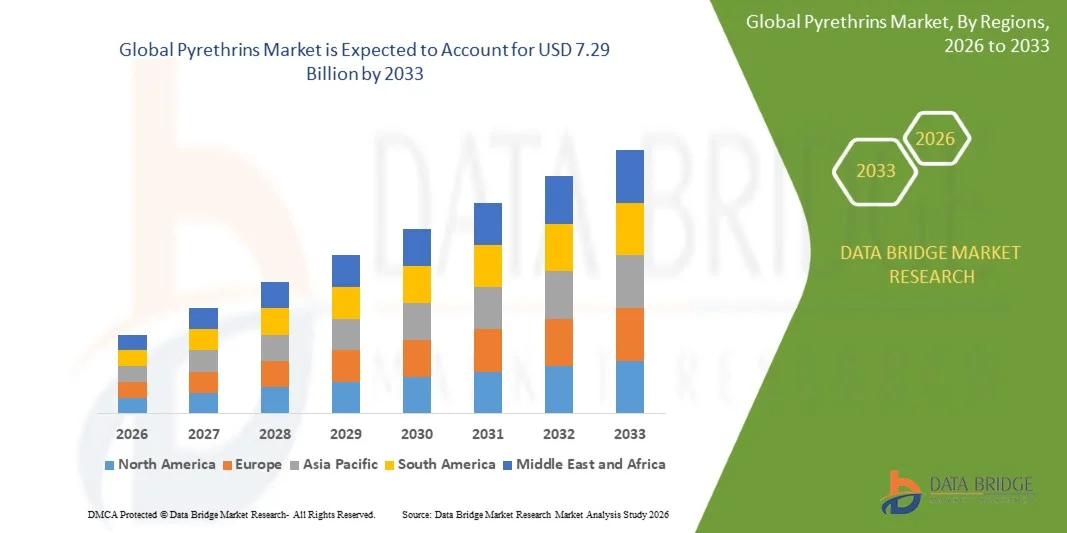
- As per Data Bridge Market Research analysis the pyrethrins market was valued at USD 4.31 billion in 2025 and is projected to reach USD 7.29 billion by 2033, growing at a CAGR of 6.80% from 2026 to 2033.
- The market is experiencing steady growth driven by increasing demand for natural and plant-based insecticides, growing concerns over the environmental and health impacts of synthetic pesticides, and rising adoption of pyrethrins in agricultural, household, and public health applications.
- Increasing emphasis on sustainable pest management, coupled with stringent regulations on chemical pesticides and growing demand for residue-free crop protection solutions, is encouraging farmers, pest control providers, and consumers to adopt pyrethrin-based products.
Market Size & Forecast
- Market Value (2025): USD 4.31 Billion
- Expected Market Value (2033): USD 7.29 Billion
- Forecast CAGR (2026–2033): 6.80%
- Leading Region in 2025: North America
- Fastest Growing Region: Asia-Pacific
What are the Major Takeaways of the Pyrethrins Market?
- North America dominated the pyrethrins market with the largest revenue share in 2025, supported by increasing demand for effective pest-control solutions across agriculture, household, commercial, and public health applications.
- Asia-Pacific pyrethrins market is expected to witness the fastest growth rate from 2026 to 2033, supported by expanding agricultural production, increasing pest-management requirements, and rising awareness of sustainable crop-protection solutions in countries such as China, India, and Japan.
- The pyrethrin 0.2 segment held the largest market revenue share in 2025, driven by its widespread use in household insecticides, agricultural pest control, and commercial pest management applications. Pyrethrin 0.2 is preferred for standard pest-control requirements due to its effective insecticidal activity, formulation flexibility, and suitability across diverse applications.
- The pyrethrin 0.5 segment is projected to register the fastest growth at a CAGR from 2026 to 2033, driven by increasing demand for higher-concentration formulations in agricultural, commercial, industrial, and public health applications. Rising adoption of concentrated pest-control solutions and expanding disease-control programs are supporting segment expansion.
- The agriculture segment held the largest market revenue share in 2025, driven by increasing demand for effective crop protection and growing adoption of botanical insecticides in sustainable farming practices. Pyrethrins are widely used for controlling a broad range of agricultural pests while supporting integrated pest management approaches.
- The public health applications segment is projected to register the fastest growth at a CAGR from 2026 to 2033, driven by increasing mosquito-control requirements and rising efforts to manage vector-borne diseases. Growing investments in vector-control programs and demand for effective insecticide solutions are accelerating segment expansion.
Report Scope and Pyrethrins Market Segmentation
|
Attributes |
Pyrethrins Key Market Insights |
|
Segments Covered |
|
|
Countries Covered |
North America
Europe
Asia-Pacific
Middle East and Africa
South America
|
|
Key Market Players |
|
|
Market Opportunities |
|
|
Value Added Data Infosets |
In addition to the insights on market scenarios such as market value, growth rate, segmentation, geographical coverage, and major players, the market reports curated by the Data Bridge Market Research also include import export analysis, production capacity overview, production consumption analysis, price trend analysis, climate change scenario, supply chain analysis, value chain analysis, raw material/consumables overview, vendor selection criteria, PESTLE Analysis, Porter Analysis, and regulatory framework. |
What is the Key Trend in the Pyrethrins Market?
- Increasing demand for natural and botanical pest-control solutions is driving the adoption of pyrethrins in organic agriculture, household pest control, and public health applications as consumers and producers seek alternatives to conventional synthetic pesticides.
- For instance, the U.S. Department of Agriculture (USDA) recognizes pyrethrum as an allowed natural botanical extract for organic production, supporting its use as a natural crop-protection input under specified organic standards.
- Pyrethrins are increasingly being used across agricultural and non-agricultural applications, including crop protection, household pest control, pet products, and mosquito-control products, reflecting their broad insecticidal activity.
- For instance, the U.S. Environmental Protection Agency (EPA) identifies pyrethrins as insecticides used against a wide range of pests in agricultural and non-agricultural settings, including residential pet products and other pest-control applications.
- As demand for sustainable and plant-derived pest-control products continues to increase, manufacturers are expected to expand pyrethrin-based formulations for organic farming, household applications, and integrated pest management, supporting continued market development.
What are the Key Drivers of the Pyrethrins Market?
- Growing organic farming and increasing restrictions on conventional synthetic pesticides are accelerating demand for naturally derived crop-protection products, with pyrethrins offering an established botanical insecticide option for pest management.
- For instance, USDA organic standards state that nonsynthetic substances are generally allowed in organic crop production unless specifically prohibited, while synthetic substances must be specifically permitted, creating opportunities for compliant botanical pest-control solutions such as pyrethrum.
- Rising global demand for vector-control solutions is also supporting insecticide consumption, particularly as mosquito-borne diseases continue to create substantial public health challenges worldwide.
- For instance, the World Health Organization reported that vector-borne diseases account for more than 17% of infectious diseases and cause more than 700,000 deaths annually, highlighting the continuing need for effective mosquito and other vector-control measures.
- With expanding organic agriculture, growing demand for botanical pest-control products, and continued public health requirements for insect management, pyrethrins are expected to maintain strong demand across agricultural, residential, and vector-control applications.
Which Factors are Challenging the Growth of the Pyrethrins Market?
- Environmental and non-target organism risks associated with pyrethrins can increase regulatory scrutiny and restrict certain application methods, particularly where products may enter aquatic environments or affect beneficial insects.
- For instance, the U.S. Environmental Protection Agency (EPA) is currently conducting registration review of pyrethrins, with the process addressing potential human health and ecological risks and considering risk-mitigation measures for certain applications.
- Pyrethrins are highly toxic to honey bees and highly to very highly toxic to fish and several aquatic organisms, creating challenges for application practices, spray management, and environmental compliance.
- For instance, EPA's proposed risk-mitigation measures for pyrethrins have included additional personal protective equipment requirements and restrictions on certain indoor dusters, aerosol sprays, misters, foggers, and liquid spray applications.
- Increasing regulatory requirements, environmental-risk assessments, and restrictions on certain applications can raise compliance costs and limit product deployment in sensitive environments, potentially slowing market expansion despite the growing preference for natural insecticides.
How is the Pyrethrins Market Segmented?
The market is segmented on the basis of product, application, and pest type.
- By Product
On the basis of product, the pyrethrins market is segmented into pyrethrin 0.2 and pyrethrin 0.5. The pyrethrin 0.2 segment held the largest market revenue share in 2025, driven by its widespread use in household insecticides, agricultural pest control, and commercial pest management applications. Pyrethrin 0.2 is preferred for standard pest-control requirements due to its effective insecticidal activity, formulation flexibility, and suitability across diverse applications.
The pyrethrin 0.5 segment is projected to register the fastest growth at a CAGR from 2026 to 2033, driven by increasing demand for higher-concentration formulations in agricultural, commercial, industrial, and public health applications. Rising adoption of concentrated pest-control solutions and expanding disease-control programs are supporting segment expansion.
- By Application
On the basis of application, the pyrethrins market is segmented into pharmaceutical, agriculture, veterinary, animal health, timber protection, household, commercial and industrial, public health applications, and disease control. The agriculture segment held the largest market revenue share in 2025, driven by increasing demand for effective crop protection and growing adoption of botanical insecticides in sustainable farming practices. Pyrethrins are widely used for controlling a broad range of agricultural pests while supporting integrated pest management approaches.
The public health applications segment is projected to register the fastest growth at a CAGR from 2026 to 2033, driven by increasing mosquito-control requirements and rising efforts to manage vector-borne diseases. Growing investments in vector-control programs and demand for effective insecticide solutions are accelerating segment expansion.
- By Pest Type
On the basis of pest type, the pyrethrins market is segmented into lepidoptera, coleoptera, mites, diptera, sucking pest, and other pest types. The diptera segment held the largest market revenue share in 2025, driven by extensive use of pyrethrins for controlling mosquitoes, flies, and other flying insects across household, agricultural, commercial, and public health applications. The growing need for effective vector and nuisance pest control is supporting segment dominance.
The sucking pest segment is projected to register the fastest growth at a CAGR from 2026 to 2033, driven by increasing crop losses associated with aphids, whiteflies, and other sap-feeding insects. Rising adoption of botanical insecticides and integrated pest management practices is expected to accelerate demand for pyrethrin-based solutions targeting sucking pests.
Which Region Holds the Largest Share of the Pyrethrins Market?
- North America dominated the pyrethrins market with the largest revenue share in 2025, supported by increasing demand for effective pest-control solutions across agriculture, household, commercial, and public health applications.
- The region’s well-established agricultural sector, growing preference for botanical insecticides, and stringent regulations governing pesticide use are encouraging the adoption of pyrethrin-based products. Increasing awareness of sustainable pest management and the need for effective mosquito and nuisance pest control are further supporting market growth.
U.S. Pyrethrins Market Insight
U.S. pyrethrins market captured the largest revenue share in 2025 within North America, fueled by extensive agricultural applications and strong demand for household and commercial insect-control products. The country’s emphasis on sustainable pest management and increasing adoption of naturally derived insecticides are supporting market expansion. Moreover, continued public health efforts to control mosquitoes and other disease vectors, along with established pesticide regulatory frameworks, are contributing to the growing use of pyrethrin-based solutions.
Europe Pyrethrins Market Insight
Europe pyrethrins market is expected to witness the fastest growth rate from 2026 to 2033, primarily driven by increasing demand for sustainable crop-protection solutions and stringent regulations concerning conventional chemical pesticides. The region’s growing organic farming sector and rising consumer preference for environmentally conscious pest-control products are fostering the adoption of botanical insecticides. Increasing emphasis on integrated pest management and residue reduction across agricultural applications is further supporting regional growth.
U.K. Pyrethrins Market Insight
U.K. pyrethrins market is expected to witness the fastest growth rate from 2026 to 2033, driven by increasing demand for sustainable pest-control solutions and growing adoption of organic and environmentally conscious agricultural practices. The rising use of botanical insecticides in household and agricultural applications is supporting market expansion. In addition, increasing awareness of pesticide impacts on ecosystems and the growing preference for naturally derived pest-management products are expected to stimulate demand.
Germany Pyrethrins Market Insight
Germany pyrethrins market is expected to witness the fastest growth rate from 2026 to 2033, fueled by increasing emphasis on sustainable agriculture, environmental protection, and reduced reliance on conventional synthetic pesticides. Germany’s advanced agricultural infrastructure and strong focus on integrated pest management are encouraging the use of botanical insecticides. The growing organic farming sector and demand for environmentally responsible crop-protection solutions are also contributing to the adoption of pyrethrin-based products.
Asia-Pacific Pyrethrins Market Insight
The Asia-Pacific pyrethrins market is expected to witness the fastest growth rate from 2026 to 2033, supported by expanding agricultural production, increasing pest-management requirements, and rising awareness of sustainable crop-protection solutions in countries such as China, India, and Japan. The region’s large agricultural base and growing food production are creating substantial demand for effective insecticides. Furthermore, increasing public health initiatives for mosquito and vector control are expanding the application of pyrethrins across the region.
Japan Pyrethrins Market Insight
Japan pyrethrins market is expected to witness the fastest growth rate from 2026 to 2033 due to increasing demand for efficient pest-control solutions across agricultural, household, and public health applications. The country’s advanced agricultural practices and strong emphasis on food safety are supporting the adoption of effective and controlled insecticide formulations. Moreover, growing requirements for mosquito and nuisance pest management in residential and commercial environments are contributing to market growth.
China Pyrethrins Market Insight
China pyrethrins market accounted for the largest market revenue share in Asia Pacific in 2025, attributed to the country’s extensive agricultural production, expanding food-processing sector, and increasing demand for crop-protection solutions. The growing need to manage agricultural pests and improve crop productivity is supporting insecticide consumption across the country. In addition, increasing adoption of sustainable agricultural practices and rising awareness of botanical pest-control alternatives are creating further opportunities for pyrethrin-based products.
Which are the Top Companies in Pyrethrins Market?
The pyrethrins industry is primarily led by well-established companies, including:
- Botanical Resources Australia Pty Ltd (Australia)
- McLaughlin Gormley King Company (U.S.)
- Sumitomo Chemical Co., Ltd. (Japan)
- KAPI Limited (Kenya)
- Pestech Australia Pty Ltd (Australia)
- Scintex Australia (Australia)
- Zhejiang Rayfull Chemicals Co., Ltd. (China)
- W. Neudorff GmbH KG (Germany)
- Beaphar (U.K.)
- Merck KGaA (Germany)
- Bayer AG (Germany)
- Valent BioSciences LLC (U.S.)
- AgroPy Ltd. (Rwanda)
- Horizon SOPYRWA (Rwanda)
- Red River Specialties LLC (U.S.)
What are Latest Developments in Pyrethrins Market?
- In August 2026, Sumitomo Chemical Co., Ltd. announced an acquisition of Pyragro, a subsidiary of COPYR, to expand its natural pyrethrum-based plant protection business. The acquisition provides access to registered natural pyrethrum-based products across Italy and several EMEA markets, strengthening Sumitomo Chemical’s sustainable crop-protection portfolio and supporting future growth in natural-origin pest-control solutions.
- In May 2024, BASF launched the SUWEIDA natural pyrethrin pesticide aerosol in China for household pest control. The product uses naturally derived pyrethrin and features a fixed-dose spray design to improve application accuracy, reduce waste, and support effective control of mosquitoes, flies, and cockroaches. The launch strengthens demand for convenient, naturally derived pyrethrin-based household insecticides.

- Interactive Data Analysis Dashboard
- Company Analysis Dashboard for high growth potential opportunities
- Research Analyst Access for customization & queries
- Competitor Analysis with Interactive dashboard
- Latest News, Updates & Trend analysis
- Harness the Power of Benchmark Analysis for Comprehensive Competitor Tracking
Data collection and base year analysis are done using data collection modules with large sample sizes. The stage includes obtaining market information or related data through various sources and strategies. It includes examining and planning all the data acquired from the past in advance. It likewise envelops the examination of information inconsistencies seen across different information sources. The market data is analysed and estimated using market statistical and coherent models. Also, market share analysis and key trend analysis are the major success factors in the market report. To know more, please request an analyst call or drop down your inquiry.
The key research methodology used by DBMR research team is data triangulation which involves data mining, analysis of the impact of data variables on the market and primary (industry expert) validation. Data models include Vendor Positioning Grid, Market Time Line Analysis, Market Overview and Guide, Company Positioning Grid, Patent Analysis, Pricing Analysis, Company Market Share Analysis, Standards of Measurement, Global versus Regional and Vendor Share Analysis. To know more about the research methodology, drop in an inquiry to speak to our industry experts.
Data Bridge Market Research is a leader in advanced formative research. We take pride in servicing our existing and new customers with data and analysis that match and suits their goal. The report can be customized to include price trend analysis of target brands understanding the market for additional countries (ask for the list of countries), clinical trial results data, literature review, refurbished market and product base analysis. Market analysis of target competitors can be analyzed from technology-based analysis to market portfolio strategies. We can add as many competitors that you require data about in the format and data style you are looking for. Our team of analysts can also provide you data in crude raw excel files pivot tables (Fact book) or can assist you in creating presentations from the data sets available in the report.