


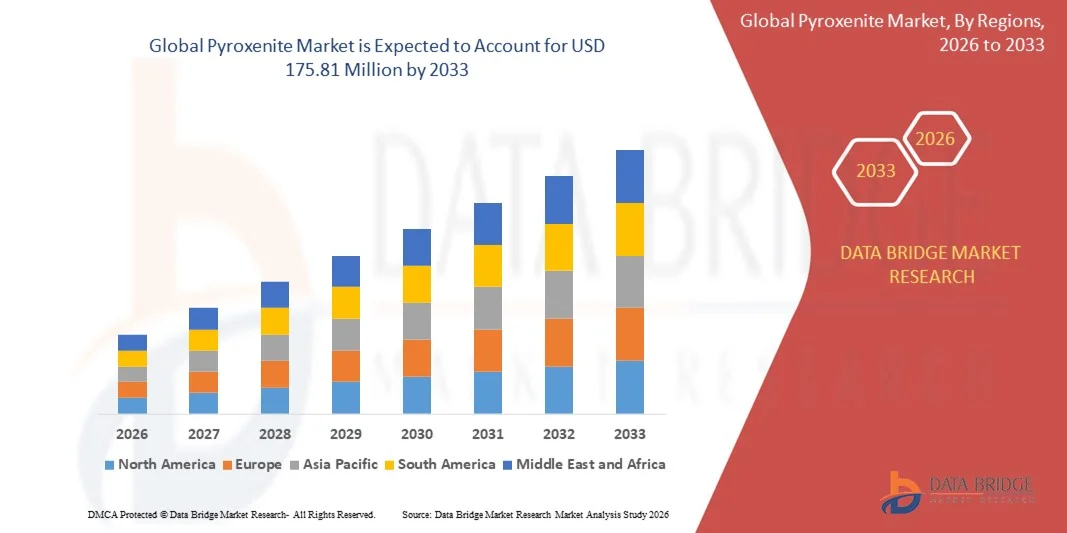
What is the Global Pyroxenite Market Size and Growth Rate?
- The global pyroxenite market size was valued at USD 134.02 million in 2025 and is expected to reach USD 175.81 million by 2033, at a CAGR of3.45% during the forecast period
- Rise in the demand for pyroxenite and dunite is the vital factor escalating the market growth, also growing demand for olivine as it offers numerous advantages over dolomite in slag conditions, including higher magnesium oxide content, decreased slag volume, low coke and energy consumption and considerably lower carbon dioxide emission, rise in the research & development activities, rapid industrialization and increase in the advancements in production technology and research are the major factors among others driving the pyroxenite market
What are the Major Takeaways of Pyroxenite Market?
- Rise in the demand from emerging economies and rise in the modernization in the production techniques will further create new opportunities for the pyroxenite market
- However, magnesium rich rocks are acting as a substitute which acts as the major factor among others acting as a restraint, and will further challenge the growth of pyroxenite market
- North America dominated the pyroxenite market with a 42.05% revenue share in 2025, supported by strong demand from iron & steel manufacturing, construction aggregates, and industrial refractory applications across the U.S. and Canada
- Asia-Pacific is projected to register the fastest CAGR of 7.1% from 2026 to 2033, fueled by rapid expansion in steel manufacturing, large-scale construction activities, and growing consumption of mineral aggregates across China, India, Japan, South Korea, and Southeast Asia
- The Iron and Steel Making segment dominated the market with a 54.7% share in 2025, driven by rising replacement of dolomite with pyroxenite as a high-MgO flux, improved desulphurization efficiency, reduced slag generation, and enhanced blast furnace performance
Report Scope and Pyroxenite Market Segmentation
|
Attributes |
Pyroxenite Key Market Insights |
|
Segments Covered |
|
|
Countries Covered |
North America
Europe
Asia-Pacific
Middle East and Africa
South America
|
|
Key Market Players |
|
|
Market Opportunities |
|
|
Value Added Data Infosets |
In addition to the insights on market scenarios such as market value, growth rate, segmentation, geographical coverage, and major players, the market reports curated by the Data Bridge Market Research also include in-depth expert analysis, pricing analysis, brand share analysis, consumer survey, demography analysis, supply chain analysis, value chain analysis, raw material/consumables overview, vendor selection criteria, PESTLE Analysis, Porter Analysis, and regulatory framework. |
What is the Key Trend in the Pyroxenite Market?
Rising Shift Toward High-Grade, Low-Impurity, and Metallurgy-Optimized Pyroxenites
- The pyroxenite market is experiencing strong adoption of high-purity, magnesium-rich, and low-silica pyroxenite grades, primarily driven by rising use in blast furnace operations, steel desulphurization, and chromite ore processing
- Manufacturers are increasingly developing processed, size-optimized, and high-density pyroxenite products to replace traditional fluxes such as dolomite and limestone in steelmaking. These enhanced variants improve furnace efficiency, reduce slag volume, and enhance hot metal quality
- Growing focus on cost-efficient, energy-saving, and eco-friendly metallurgical additives is boosting adoption across iron & steel plants, ferroalloy producers, and refractory manufacturers
- For instance, leading producers across India, South Africa, and Brazil have expanded production of blast-furnace-grade pyroxenite, offering consistent MgO levels and strict impurity control for predictable furnace performance
- Rising demand for high-MgO fluxes, reduced coke consumption, and enhanced desulphurization efficiency is accelerating the shift toward pyroxenite as a strategic metallurgical raw material
- As steel industries push toward higher operational efficiency and sustainability, pyroxenite will remain a vital substitute mineral, supporting cleaner steel production globally
What are the Key Drivers of Pyroxenite Market?
- Rising demand from the iron and steel sector, where pyroxenite is increasingly preferred as a fluxing agent due to its high MgO content, cost advantage, and ability to reduce consumption of traditional materials such as dolomite
- For instance, during 2024–2025, steel manufacturers in India, China, and South Africa increased pyroxenite usage to improve hot metal desulphurization, enhance slag properties, and optimize blast furnace operations
- Growing adoption in chromite processing, refractory production, construction aggregates, and metallurgical applications is strengthening market penetration across Asia-Pacific, Europe, and the U.S
- Advancements in mining technology, beneficiation methods, and impurity-control techniques have enhanced product consistency, further increasing industrial acceptance
- Rising demand for high-strength steel, ferroalloys, and cleaner metallurgical practices is boosting consumption of magnesium-rich flux materials
- Supported by investments in mining expansion, infrastructure growth, and steel capacity additions, the Pyroxenite market is expected to witness steady long-term growth
Which Factor is Challenging the Growth of the Pyroxenite Market?
- High logistics costs, variable ore quality, and significant processing requirements pose challenges for small-scale steelmakers and restrict adoption in cost-sensitive markets
- For instance, during 2024–2025, fluctuations in mining equipment prices, stricter environmental approvals, and higher operational expenses increased production costs for several global suppliers
- Inconsistent mineral composition, impurities such as silica or alumina, and the need for advanced beneficiation increase technical complexity and require specialized quality-control systems
- Limited awareness in emerging regions about pyroxenite’s metallurgical advantages—especially its replacement potential for dolomite—slows adoption across smaller steel plants
- Competition from traditional flux materials, availability of low-cost regional substitutes, and restrictive mining regulations create pricing pressure and affect supply stability
- To address these concerns, companies are investing in ore grading systems, sustainable mining practices, and cost-optimized processing methods to improve global adoption of pyroxenite
How is the Pyroxenite Market Segmented?
The market is segmented on the basis of application and grade.
- By Application
On the basis of application, the Pyroxenite market is segmented into Iron and Steel Making, Countertops/Kitchen, Building Stone/Dimension Stone, Aggregate, and Others. The Iron and Steel Making segment dominated the market with a 54.7% share in 2025, driven by rising replacement of dolomite with pyroxenite as a high-MgO flux, improved desulphurization efficiency, reduced slag generation, and enhanced blast furnace performance. Steel producers in India, China, and South Africa increasingly prefer pyroxenite due to its cost advantage, consistent mineralogy, and ability to support high-quality hot metal production. Growing steel capacity additions and demand for energy-efficient smelting further strengthen this dominance.
The Countertops/Kitchen segment is expected to grow at the fastest CAGR from 2026 to 2033, supported by rising consumption of decorative natural stones, demand for durable interior materials, and increasing use of pyroxenite for premium home surfaces. Expanding construction activity, lifestyle upgrades, and rising architectural applications contribute to long-term growth.
- By Grade
On the basis of grade, the Pyroxenite market is segmented into Grade-I and Grade-II. The Grade-I segment dominated the market with a 63.2% share in 2025, primarily due to its higher purity, superior MgO concentration, low silica content, and strong suitability for metallurgical applications, especially in iron and steel fluxing. Grade-I pyroxenite enables better slag formation, efficient sulphur removal, and consistent furnace output, making it the preferred choice for large integrated steel plants. Increasing demand for high-performance metallurgical minerals and strict quality requirements in steel production continue to support segment leadership.
The Grade-II segment is projected to grow at the fastest CAGR from 2026 to 2033, driven by expanding use in construction aggregates, building stones, landscaping materials, and secondary industrial applications. Its cost-effectiveness and broader availability make Grade-II pyroxenite suitable for infrastructure, real estate development, and volume-driven markets, positioning it for strong future adoption.
Which Region Holds the Largest Share of the Pyroxenite Market?
- North America dominated the pyroxenite market with a 42.05% revenue share in 2025, supported by strong demand from iron & steel manufacturing, construction aggregates, and industrial refractory applications across the U.S. and Canada
- The region benefits from mature steel production facilities, growing adoption of high-Mg flux materials, and increasing use of Pyroxenite as a replacement for dolomite in blast furnace operations. Rising construction activities and infrastructure modernization further strengthen the market
- Additionally, leading mining and mineral processing companies are investing in improved beneficiation processes, high-purity Pyroxenite grades, and sustainable extraction techniques. Strong regulatory frameworks, advanced mining technology, and well-established supply chains reinforce North America's dominant position in the global market
U.S. Pyroxenite Market Insight
The U.S. is the largest contributor, driven by high steel output, advanced metallurgical R&D, and expanding use of Pyroxenite in fluxing and slag control applications. Strong infrastructure spending, increasing adoption of Pyroxenite aggregates, and rising demand from countertops and dimension stone industries support robust market growth.
Canada Pyroxenite Market Insight
Canada contributes significantly due to growing mining activities, rising use of Pyroxenite in steel and alloy production, and increasing demand for high-strength construction materials. Government-backed investments in industrial minerals and sustainable resource development further accelerate adoption.
Asia-Pacific Pyroxenite Market
Asia-Pacific is projected to register the fastest CAGR of 7.1% from 2026 to 2033, fueled by rapid expansion in steel manufacturing, large-scale construction activities, and growing consumption of mineral aggregates across China, India, Japan, South Korea, and Southeast Asia. The region’s high-volume steel production, urbanization, and infrastructure megaprojects significantly increase the use of Pyroxenite in metallurgical and construction applications. Growth in industrialization, mining investments, and increasing preference for alternative flux materials further boost demand. Rising production of high-grade steel, alloy products, and engineered stone continues to expand the market for high-Mg Pyroxenite across Asia-Pacific.
China Pyroxenite Market Insight
China is the largest contributor to the region, supported by massive steel manufacturing capacity, large mining operations, and government-driven infrastructure expansion. Strong adoption of Pyroxenite in blast furnaces and construction aggregates fuels consistent market growth.
Japan Pyroxenite Market Insight
Japan shows steady growth due to premium steel manufacturing, high-quality construction standards, and demand for advanced flux materials. Rising use in specialty steels, industrial stone applications, and sustainable building materials enhances market expansion.
India Pyroxenite Market Insight
India is emerging as a key growth hub driven by expanding steel plants, large construction activities, and increasing demand for Pyroxenite as a cost-effective flux alternative. Government initiatives promoting mineral resource development support widespread adoption.
Which are the Top Companies in Pyroxenite Market?
The pyroxenite industry is primarily led by well-established companies, including:
- Tata Steel Ltd. (India)
- Anglo American plc (U.K.)
- Glencore Plc (U.K.)
- Rio Tinto Ltd. (U.K.)
- Kinross Gold Corporation (Canada)
- Bharat Mines and Minerals (India)
- Aegis Logistics Ltd (India)
- Foskor (Pty) Ltd (South Africa)
- Orex Mining Company DMCC (U.A.E.)
- Bharat Mining Company (India)
- Bushveld Minerals (South Africa)
- Foskor Ltd (South Africa)
- Imerys S.A. (France)
- Martin Marietta Materials Inc. (U.S.)
- Mineracao Candonga (Brazil)
- Omya International AG (Switzerland)
- PJSC MMC Norilsk Nickel (Russia)
- SCR Sibelco NV (Belgium)
- TVI Pacific Inc. (Canada)
- Vulcan Materials Co. (U.S.)

- Interactive Data Analysis Dashboard
- Company Analysis Dashboard for high growth potential opportunities
- Research Analyst Access for customization & queries
- Competitor Analysis with Interactive dashboard
- Latest News, Updates & Trend analysis
- Harness the Power of Benchmark Analysis for Comprehensive Competitor Tracking
Global Pyroxenite Market, Supply Chain Analysis and Ecosystem Framework
To support market growth and help clients navigate the impact of geopolitical shifts, DBMR has integrated in-depth supply chain analysis into its Global Pyroxenite Market research reports. This addition empowers clients to respond effectively to global changes affecting their industries. The supply chain analysis section includes detailed insights such as Global Pyroxenite Market consumption and production by country, price trend analysis, the impact of tariffs and geopolitical developments, and import and export trends by country and HSN code. It also highlights major suppliers with data on production capacity and company profiles, as well as key importers and exporters. In addition to research, DBMR offers specialized supply chain consulting services backed by over a decade of experience, providing solutions like supplier discovery, supplier risk assessment, price trend analysis, impact evaluation of inflation and trade route changes, and comprehensive market trend analysis.
Data collection and base year analysis are done using data collection modules with large sample sizes. The stage includes obtaining market information or related data through various sources and strategies. It includes examining and planning all the data acquired from the past in advance. It likewise envelops the examination of information inconsistencies seen across different information sources. The market data is analysed and estimated using market statistical and coherent models. Also, market share analysis and key trend analysis are the major success factors in the market report. To know more, please request an analyst call or drop down your inquiry.
The key research methodology used by DBMR research team is data triangulation which involves data mining, analysis of the impact of data variables on the market and primary (industry expert) validation. Data models include Vendor Positioning Grid, Market Time Line Analysis, Market Overview and Guide, Company Positioning Grid, Patent Analysis, Pricing Analysis, Company Market Share Analysis, Standards of Measurement, Global versus Regional and Vendor Share Analysis. To know more about the research methodology, drop in an inquiry to speak to our industry experts.
Data Bridge Market Research is a leader in advanced formative research. We take pride in servicing our existing and new customers with data and analysis that match and suits their goal. The report can be customized to include price trend analysis of target brands understanding the market for additional countries (ask for the list of countries), clinical trial results data, literature review, refurbished market and product base analysis. Market analysis of target competitors can be analyzed from technology-based analysis to market portfolio strategies. We can add as many competitors that you require data about in the format and data style you are looking for. Our team of analysts can also provide you data in crude raw excel files pivot tables (Fact book) or can assist you in creating presentations from the data sets available in the report.













