


What is the Quality Management Systems (QMS) for Pharmaceuticals Market Size and Overview?
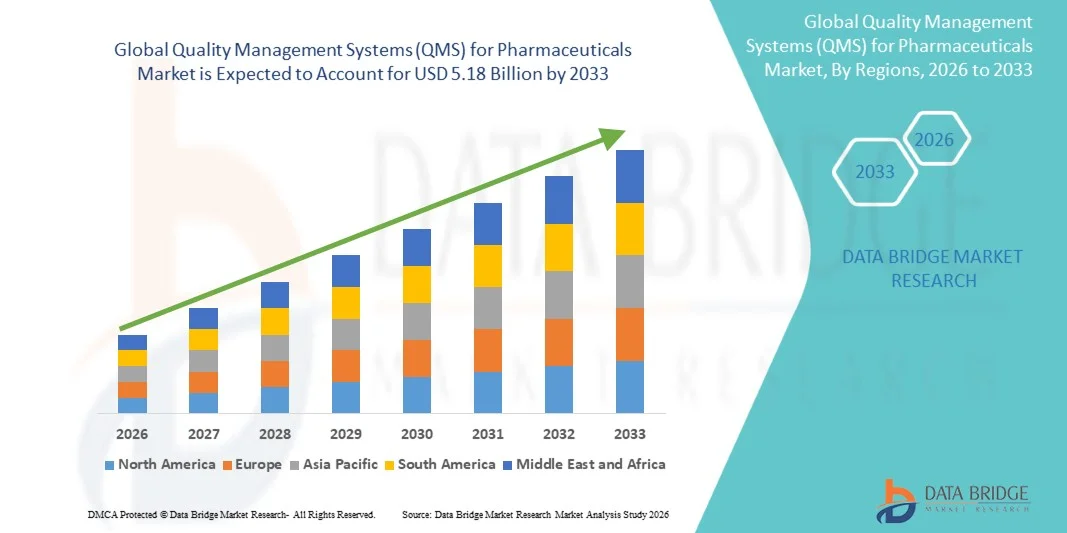
As per Data Bridge Market Research Analysis the quality management systems (QMS) for pharmaceuticals market was valued at USD 2.49 billion in 2025 and is projected to reach USD 5.18 billion by 2033, growing at a CAGR of 9.60% during the forecast period.
Quality management systems (QMS) for pharmaceuticals are digital platforms designed to help pharmaceutical and biotechnology companies manage quality processes throughout the product lifecycle, ensuring compliance with stringent regulatory requirements such as FDA, EMA, and ISO standards. The market is experiencing significant growth driven by increasing regulatory requirements, the growing complexity of drug development and manufacturing operations, the need for streamlined compliance processes, and rising demand for digital transformation in the pharmaceutical industry. Companies are adopting QMS solutions to improve efficiency, minimize errors, and ensure compliance with global standards while accelerating time-to-market. The shift from paper-based quality management to cloud-native, analytics-enabled systems exemplifies this evolution.
Market Size & Forecast
- Global Market Value (2025): USD 2.49 Billion
- Expected Market Value (2033): USD 5.18 Billion
- Forecast CAGR (2026–2033): 9.60%
- Leading Region in 2025: North America
- Fastest Growing Region: Asia-Pacific
Key Market Trends & Insights
- North America dominated the QMS for pharmaceuticals market with the largest revenue share of 42.78% in 2025, supported by stringent regulatory requirements, increasing adoption of digital quality management solutions, and the presence of major pharmaceutical and biotechnology companies.
- Asia-Pacific is expected to witness the fastest growth during the forecast period, driven by rapid expansion of pharmaceutical manufacturing, increasing regulatory harmonization, and rising digital GxP compliance awareness in countries such as India, China, and South Korea.
- The software segment dominated the component category in 2025, driven by the increasing adoption of cloud-based and ai-enabled qms platforms that automate document reviews, streamline workflows, and reduce administrative burden.
- The cloud-based deployment segment is expected to register the fastest growth due to its scalability, lower implementation costs, remote accessibility, and reduced validation complexity compared to on-premises solutions.
- Capa management remains the fastest-growing application segment due to increasing focus on proactive quality improvement, regulatory compliance, and the integration of automation and real-time monitoring.
- Large enterprises accounted for the largest market share because of their extensive quality management requirements across global operations and higher it spending on digital transformation initiatives.
- Pharmaceutical companies represent the largest end-user segment owing to increasing digital transformation, regulatory compliance requirements, and the need to manage complex quality processes across global operations.
Report Scope and Quality Management Systems (QMS) for Pharmaceuticals Market Segmentation
|
Attributes |
Quality Management Systems (QMS) for Pharmaceuticals Key Market Insights |
|
Segments Covered |
|
|
Countries Covered |
North America
Europe
Asia-Pacific
Middle East and Africa
South America
|
|
Key Market Players |
|
|
Market Opportunities |
|
|
Value Added Data Infosets |
In addition to the insights on market scenarios such as market value, growth rate, segmentation, geographical coverage, and major players, the market reports curated by the Data Bridge Market Research also include in-depth expert analysis, patient epidemiology, pipeline analysis, pricing analysis, and regulatory framework. |
What is the Key Trend in the Quality Management Systems (QMS) for Pharmaceuticals Market?
Trend: AI and Machine Learning Integration
The integration of artificial intelligence and machine learning is a defining trend reshaping the pharmaceutical QMS market. AI-powered QMS solutions are enabling predictive quality analytics, automated gap analysis, and intelligent compliance monitoring. Qualio announced the general availability of Compliance Intelligence, an AI-powered solution that scans entire QMS and connected data sources, maps evidence to regulatory requirements, and identifies gaps in minutes rather than weeks. Companies implementing AI-powered quality systems report productivity increases of over 35% while improving investigation effectiveness by 30% to 40%. AI-enabled QMS platforms are also cutting documentation time by 40% to 60% and improving triage speed by 15% to 30%.
Quality Management Systems (QMS) for Pharmaceuticals Market Dynamics
Key Market Driver: Stringent Regulatory Requirements
Heightened regulatory pressure from global agencies such as the FDA, EMA, and WHO is a primary driver of the pharmaceutical QMS market. The growing complexity of global regulatory requirements and the increasing need for pharmaceutical companies to meet stringent quality and safety standards are driving demand for robust QMS solutions. QMS platforms ensure traceability, consistency, and electronic compliance with all requirements, minimizing the risk of fines, recalls, or development delays. Regulatory compliance under the process segment is expected to register the fastest growth rate during the forecast period, as organizations seek to automate compliance monitoring and reporting.
For instance, global biopharmaceutical company medac implemented Veeva QMS, QualityDocs, and Training to improve FDA compliance and standardize quality globally. By consolidating disparate paper-based and hybrid processes into a unified digital system, medac reduced change control approval time by three weeks and automatically linked CAPAs to training tasks, creating a clear and auditable compliance trail.
Key Restraint/Challenge: High Deployment Costs and Integration Complexity
High costs of deploying pharmaceutical quality management systems restrain the growth of this market. Implementing QMS solutions requires significant capital expenditure for software, infrastructure modifications, and training, which can be prohibitive for small and mid-sized organizations. Additionally, the complexity of integrating QMS with existing enterprise systems and legacy infrastructure can lead to disruptions and require extensive customization. The total cost of ownership includes software licensing, implementation services, validation, training, and ongoing maintenance, which can be substantial for organizations with limited IT budgets.
For example, a major biopharmaceutical company expanding into 50 global markets faced inconsistent quality processes across regions, with some sites still relying on paper-based or hybrid systems. The company chose to implement Veeva QMS as a unified platform but encountered significant challenges in coordinating cross-regional system integration and process standardization, highlighting the considerable time and resource investment required for global implementation.
Key Market Opportunity: Integration of AI and Machine Learning
The integration of AI and machine learning in QMS presents significant growth opportunities. AI-powered predictive analytics enable early deviation detection, automated gap analysis, and intelligent compliance monitoring. Companies implementing AI-powered quality systems report significant productivity improvements and investigation effectiveness. As organizations seek predictive insights for batch failures, audit findings, and CAPA resolution timelines, AI-enabled QMS adoption is accelerating. Emerging markets, particularly in Asia-Pacific, offer significant growth opportunities for pharmaceutical QMS providers, driven by rapid expansion of pharmaceutical manufacturing capacities and rising digitization efforts.
For instance, in October 2025, Qualio launched Compliance Intelligence, an AI-powered solution that scans the entire QMS and connected data sources, mapping evidence to regulatory requirements and identifying gaps in minutes rather than weeks. MasterControl's AI-driven eQMS solution delivers 90% faster investigations and 50% improved training cycle times. McKinsey estimates that AI could unlock USD 100 billion in value for the life sciences industry through predictive quality and automated compliance.
How is the Quality Management Systems (QMS) for Pharmaceuticals Market Segmented?
The Quality Management Systems (QMS) for Pharmaceuticals market is segmented on the basis of component, deployment mode, application, enterprise size and end user.
- By Component
On the basis of component, the market is segmented into software and services. The software segment held the largest market share in 2025, driven by the increasing adoption of cloud-based, AI-enabled QMS platforms that automate document reviews, streamline workflows, and reduce administrative burden. Pharmaceutical companies are increasingly investing in integrated QMS software solutions that provide end-to-end quality management capabilities across the product lifecycle. The services segment is also witnessing significant growth, driven by the need for implementation, integration, training, and support services.
- By Deployment Mode
On the basis of deployment mode, the market is segmented into cloud-based and on-premises. The cloud-based segment is gaining significant traction, driven by the shift toward scalable, cost-effective SaaS solutions that reduce validation complexity, enable remote compliance management, and provide audit readiness. Cloud-based QMS platforms offer real-time data visibility, automatic updates, and seamless integration with other enterprise systems. The cloud-based segment is expected to register the fastest growth during the forecast period, as pharmaceutical companies increasingly adopt cloud-native solutions for their flexibility and scalability.
- By Application
On the basis of application, the market is segmented into document management, CAPA management, audit management, risk management, regulatory compliance, and others. CAPA management is the fastest-growing application segment, fueled by the rising focus on proactively identifying and fixing quality issues to meet regulatory standards. CAPA solutions help pharmaceutical companies systematically investigate root causes, implement corrective actions, and prevent the recurrence of deviations or nonconformities. Document management and regulatory compliance are also significant application segments, driven by the need for centralized document control and audit readiness.
- By Enterprise Size
On the basis of enterprise size, the market is segmented into large enterprises and small & medium enterprises. Large enterprises currently dominate the market, as these organizations have extensive quality management needs across global operations and significant IT budgets for QMS implementation. Large pharmaceutical companies require robust QMS platforms to manage complex quality processes across multiple manufacturing sites, clinical trials, and regulatory submissions. However, small and medium enterprises are increasingly adopting cloud-based, scalable QMS solutions that reduce validation complexity and enable remote compliance management.
- By End User
On the basis of end user, the market is segmented into pharmaceutical companies, biotechnology companies, contract research organizations, and contract development & manufacturing organizations. Pharmaceutical companies are the largest end users, as these organizations are at the forefront of digital transformation and require robust QMS platforms to manage complex quality processes across global operations. Biotechnology companies are also significant end users, particularly as the biologics and biosimilars sectors continue to expand. CROs and CDMOs are increasingly adopting QMS platforms to meet regulatory transparency requirements and ensure quality consistency across their client engagements.
Which Region Holds the Largest Share of the Quality Management Systems (QMS) for Pharmaceuticals Market?
North America QMS for Pharmaceuticals Market Insight
North America dominated the QMS for pharmaceuticals market with the largest revenue share of 42.78% in 2025. The region's dominance is supported by stringent regulatory requirements from agencies such as the FDA, strong pharmaceutical manufacturing capabilities, and early adoption of digital quality management solutions. The U.S. dominates the global life sciences quality management software market, valued at USD 1.33 billion in 2024 and reaching USD 1.50 billion in 2025. The region benefits from the increasing adoption of digital quality systems across regulated manufacturing, research, and compliance operations.
Europe QMS for Pharmaceuticals Market Insight
Europe represents a significant market for pharmaceutical QMS, supported by strong pharmaceutical research, advanced healthcare infrastructure, and stringent regulatory frameworks. The region has high adoption driven by EU GMP regulations, digital transformation mandates, and rising biologics manufacturing output. Countries such as Germany, the United Kingdom, France, and Italy are major contributors to the European market, with well-established pharmaceutical industries and regulatory compliance requirements. The European Medicines Agency's rigorous oversight and emphasis on data integrity are driving demand for advanced QMS solutions across the region.
Asia-Pacific QMS for Pharmaceuticals Market Insight
Asia-Pacific is expected to witness the fastest growth during the forecast period, with a CAGR of 14.78%. The region's growth is driven by rapid expansion of pharmaceutical manufacturing capacities, increasing number of clinical trials outsourced to the region, greater regulatory alignment with global standards, and rising digitization efforts. India, China, and South Korea are emerging as key markets, driven by pharmaceutical expansion and rising digital GxP compliance awareness. The rise in digitization efforts, combined with investments in advanced IT infrastructure and automation for compliance, is fueling widespread adoption of integrated QMS platforms.
Middle East & Africa QMS for Pharmaceuticals Market Insight
The Middle East and Africa region represents an emerging market for pharmaceutical QMS, with demand primarily concentrated in the Gulf Cooperation Council countries and South Africa. Governments across the region are increasing investments in healthcare infrastructure and regulatory frameworks to align with global standards. However, relatively low adoption of digital quality systems and limited IT infrastructure continue to restrain market growth in certain parts of the region.
South America QMS for Pharmaceuticals Market Insight
South America represents an emerging market for pharmaceutical QMS, with growing demand influenced by increasing pharmaceutical manufacturing activities, rising regulatory compliance requirements, and expanding healthcare investments. Brazil dominates the South American market, driven by the country's large economy, growing pharmaceutical sector, and increasing government focus on regulatory alignment with global standards. However, market growth is currently constrained by limited IT infrastructure and economic volatility compared to more developed regions.
Which are the Top Companies in Quality Management Systems (QMS) for Pharmaceuticals Market?
The quality management systems (QMS) for pharmaceuticals industry is primarily led by well-established companies, including:
- Veeva Systems Inc. (U.S.)
- MasterControl Solutions, Inc. (U.S.)
- Honeywell International Inc. (U.S.)
- IQVIA Holdings Inc. (U.S.)
- Dassault Systèmes SE (France)
- SAP SE (Germany)
- Qualio, Inc. (U.S.)
- Greenlight Guru (U.S.)
- MetricStream (U.S.)
- AssurX (U.S.)
- Pilgrim Quality Solutions (U.S.)
- ETQ, LLC (U.S.)
- ZenQMS (U.S.)
- Dot Compliance (Israel)
- QbDVision (U.S.)
- Caliber (India)
- Oracle Corporation (U.S.)
- Hexagon AB (Sweden)
What are Latest Developments in Quality Management Systems (QMS) for Pharmaceuticals Market?
- In October 2025, Qualio announced the general availability of Compliance Intelligence, an AI-powered solution advancing its life sciences GRC platform. The platform unifies regulatory compliance, quality management, and product lifecycle into one auditable system. The AI-powered gap analysis scans the entire QMS and connected data sources, maps evidence to regulatory requirements, and identifies gaps in minutes, not weeks.
- In January 2025, Veeva Systems and Zifo announced a product partnership to help biopharmaceutical companies modernize quality control operations. The integration will reduce the burden of master lab data configuration, lowering costs and speeding Veeva LIMS implementation.
- In January 2025, Honeywell introduced the TrackWise Life Sciences Platform, a purpose-built solution designed to revolutionize integrated manufacturing and quality management. The platform leverages digital transformation and advanced automation to help life sciences organizations streamline quality processes and ensure compliance.
- In September 2025, MasterControl launched a cutting-edge AI-driven upgrade to its cloud-based pharmaceutical QMS platform. The upgrade enhances quality investigation effectiveness and improves productivity through intelligent quality process automation.
- In October 2025, Recur Software announced the acquisition of Cognidox, a lean, browser-based eQMS for life sciences, medical devices, and high-tech product developers. The acquisition aims to invest in AI and growth within the pharmaceutical QMS space.

- Interactive Data Analysis Dashboard
- Company Analysis Dashboard for high growth potential opportunities
- Research Analyst Access for customization & queries
- Competitor Analysis with Interactive dashboard
- Latest News, Updates & Trend analysis
- Harness the Power of Benchmark Analysis for Comprehensive Competitor Tracking
Data collection and base year analysis are done using data collection modules with large sample sizes. The stage includes obtaining market information or related data through various sources and strategies. It includes examining and planning all the data acquired from the past in advance. It likewise envelops the examination of information inconsistencies seen across different information sources. The market data is analysed and estimated using market statistical and coherent models. Also, market share analysis and key trend analysis are the major success factors in the market report. To know more, please request an analyst call or drop down your inquiry.
The key research methodology used by DBMR research team is data triangulation which involves data mining, analysis of the impact of data variables on the market and primary (industry expert) validation. Data models include Vendor Positioning Grid, Market Time Line Analysis, Market Overview and Guide, Company Positioning Grid, Patent Analysis, Pricing Analysis, Company Market Share Analysis, Standards of Measurement, Global versus Regional and Vendor Share Analysis. To know more about the research methodology, drop in an inquiry to speak to our industry experts.
Data Bridge Market Research is a leader in advanced formative research. We take pride in servicing our existing and new customers with data and analysis that match and suits their goal. The report can be customized to include price trend analysis of target brands understanding the market for additional countries (ask for the list of countries), clinical trial results data, literature review, refurbished market and product base analysis. Market analysis of target competitors can be analyzed from technology-based analysis to market portfolio strategies. We can add as many competitors that you require data about in the format and data style you are looking for. Our team of analysts can also provide you data in crude raw excel files pivot tables (Fact book) or can assist you in creating presentations from the data sets available in the report.













