


What is the Quantitative Absorptiometer Market Size and Overview?
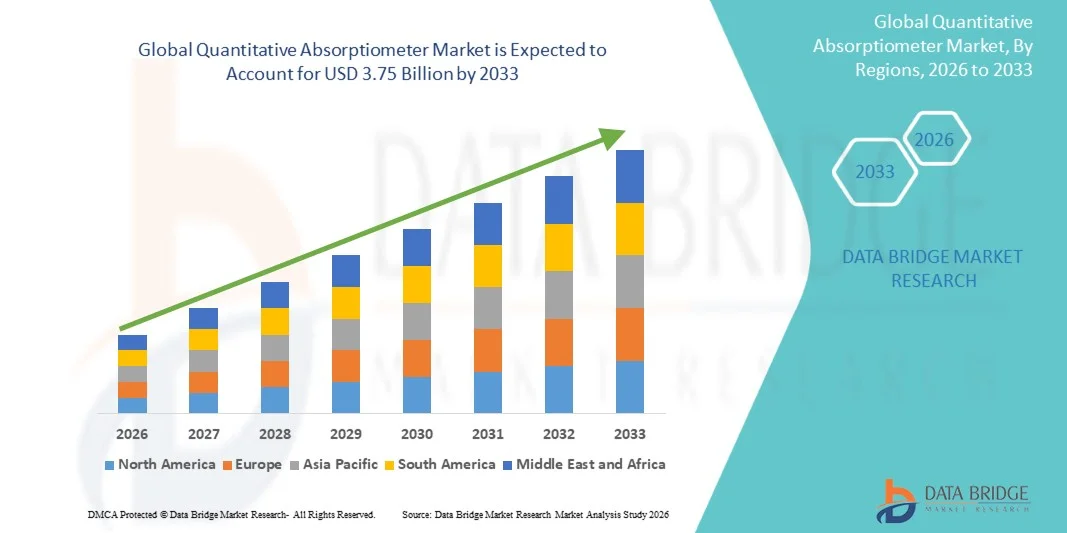
As per Data Bridge Market Research Analysis the Quantitative Absorptiometer Market was valued at USD 2.66 billion in 2025 and is projected to reach USD 3.75 billion by 2033, growing at a CAGR of 4.40% from 2026 to 2033. The market is experiencing consistent growth driven by rising demand for advanced bone health assessment technologies, increasing prevalence of osteoporosis and metabolic bone disorders, and growing adoption of quantitative absorptiometry systems for accurate and early diagnosis. The expanding geriatric population, increasing awareness regarding fracture prevention, and advancements in diagnostic imaging technologies are encouraging healthcare providers, research institutions, and diagnostic centers to adopt quantitative absorptiometer solutions.
The increasing burden of osteoporosis globally, combined with the growing focus on preventive healthcare and early disease detection, is compelling hospitals, specialty clinics, and diagnostic facilities to integrate advanced bone mineral density measurement technologies. Quantitative absorptiometry systems are replacing conventional assessment methods in many markets by offering precise, non-invasive, and repeatable measurements for evaluating bone density and treatment effectiveness. In addition, continuous innovations in dual-energy X-ray absorptiometry (DXA), peripheral quantitative computed tomography (pQCT), and advanced imaging analytics are improving diagnostic accuracy, supporting personalized treatment approaches, and accelerating adoption across developed and emerging healthcare markets.
Key Market Trends & Insights
- North America dominated the Quantitative Absorptiometer Market with the largest revenue share of 36.18% in 2025, supported by advanced diagnostic infrastructure, high adoption of bone health assessment technologies, increasing prevalence of osteoporosis, and strong healthcare expenditure. The region benefits from widespread availability of advanced imaging and diagnostic centers, growing geriatric population, and increasing screening initiatives for bone mineral density disorders. Rising awareness regarding early osteoporosis detection and increasing adoption of quantitative absorptiometry systems in hospitals and specialty clinics continue to strengthen North America’s leadership position.
- The Osteoporosis and Osteopenia Diagnosis segment dominated the market with a 46.8% share in 2025, owing to the increasing prevalence of bone-related disorders, rising geriatric population, and growing demand for early detection of bone mineral density loss.
- Asia-Pacific is expected to be the fastest-growing region at a CAGR of 7.6% from 2026 to 2033, fueled by rising healthcare expenditure, increasing aging population, growing awareness of bone health management, expanding diagnostic infrastructure, and improving access to advanced imaging technologies across China, India, and Japan. Government healthcare initiatives and increasing investments in specialty clinics are further supporting regional market growth.
- The Body Composition Measurement segment is projected to be the fastest-growing application category, registering a CAGR of 8.1% from 2026 to 2033, driven by increasing demand for accurate body composition analysis in obesity management, sports medicine, metabolic disorder monitoring, and personalized healthcare programs. Growing adoption of quantitative measurement technologies beyond traditional bone density assessment is creating new market opportunities.
- Hospitals and Specialty Clinics dominated the end-use segment with a 64.35% revenue share in 2025, supported by high patient volumes, availability of specialized diagnostic services, and increasing integration of quantitative absorptiometry systems into clinical workflows. These facilities are increasingly adopting advanced diagnostic equipment to support osteoporosis screening, chronic disease management, and comprehensive patient care.
- Diagnostic and Imaging Centers are expected to witness significant growth with a CAGR of 7.9% from 2026 to 2033, driven by increasing demand for specialized diagnostic services, rising preventive healthcare adoption, and growing outsourcing of imaging procedures from hospitals. Expansion of standalone diagnostic facilities in emerging economies is further contributing to segment growth.
- The Cystic Fibrosis Diagnosis segment accounted for a 12.46% revenue share in 2025, supported by the clinical importance of monitoring bone health complications associated with cystic fibrosis patients. Quantitative absorptiometry systems are increasingly used for assessing bone mineral density changes and supporting long-term disease management strategies.
- The Rheumatoid Arthritis Diagnosis segment is expected to grow steadily during the forecast period, driven by increasing prevalence of inflammatory disorders, rising awareness of associated bone health risks, and growing use of advanced diagnostic tools for evaluating disease-related bone deterioration.
Market Size & Forecast
- Global Market Value (2025): USD 2.66 Billion
- Expected Market Value (2033): USD 3.75 Billion
- Forecast CAGR (2026–2033): 4.40%
- Leading Region in 2025: North America
- Fastest Growing Region: Asia-Pacific
Report Scope and Quantitative Absorptiometer Market Segmentation
|
Attributes |
Quantitative Absorptiometer Key Market Insights |
|
Segments Covered |
|
|
Countries Covered |
North America · U.S. · Canada · Mexico Europe · Germany · France · U.K. · Netherlands · Switzerland · Belgium · Russia · Italy · Spain · Turkey · Rest of Europe Asia-Pacific · China · Japan · India · South Korea · Singapore · Malaysia · Australia · Thailand · Indonesia · Philippines · Rest of Asia-Pacific Middle East and Africa · Saudi Arabia · U.A.E. · South Africa · Egypt · Israel · Rest of Middle East and Africa South America · Brazil · Argentina · Rest of South America |
|
Key Market Players |
• Hologic Inc. (U.S.) |
|
Market Opportunities |
· Growing Demand for Early Osteoporosis Detection and Bone Health Assessment · Technological Advancements in Quantitative Imaging Systems · Expansion of Diagnostic Infrastructure in Emerging Markets |
|
Value Added Data Infosets |
In addition to the insights on market scenarios such as market value, growth rate, segmentation, geographical coverage, and major players, the market reports curated by the Data Bridge Market Research also include in-depth expert analysis, geographically represented company-wise production and capacity, network layouts of distributors and partners, detailed and updated price trend analysis and deficit analysis of supply chain and demand. |
What is the Key Trend in the Quantitative Absorptiometer Market?
Trend: Increasing Adoption of Quantitative Absorptiometry for Bone Health Assessment and Preventive Diagnostics
Healthcare providers are increasingly adopting quantitative absorptiometry technologies to improve early detection, monitoring, and management of bone-related disorders such as osteoporosis and osteopenia. The rising global burden of osteoporosis, particularly among aging populations, is driving demand for accurate bone mineral density (BMD) measurement solutions across hospitals, specialty clinics, and diagnostic centers. Advanced quantitative absorptiometry systems are being increasingly integrated with digital healthcare platforms to enable faster analysis, longitudinal patient monitoring, and improved fracture risk assessment.
The growing focus on preventive healthcare and early diagnosis is further supporting adoption, as organizations such as the International Osteoporosis Foundation (IOF) highlight the importance of timely screening and bone health monitoring to reduce osteoporosis-related fractures. In addition, expanding applications in body composition analysis, cystic fibrosis-related bone assessment, and chronic disease management are creating new growth opportunities for quantitative absorptiometer manufacturers.
Quantitative Absorptiometer Market Dynamics
Key Market Driver: Rising Prevalence of Osteoporosis and Increasing Demand for Early Bone Health Screening
The increasing prevalence of osteoporosis, osteopenia, and age-related bone disorders is a major factor driving the growth of the Quantitative Absorptiometer Market. Aging populations, increasing life expectancy, sedentary lifestyles, and nutritional deficiencies are contributing to a higher incidence of bone density disorders worldwide. Quantitative absorptiometry systems are becoming essential diagnostic tools for measuring bone mineral density and assessing fracture risk, particularly among postmenopausal women and elderly populations.
Healthcare systems across North America, Europe, and Asia-Pacific are investing in advanced diagnostic infrastructure to improve early detection and disease management. For instance, countries with aging populations such as Japan and several European nations are increasing screening programs and expanding access to bone health diagnostics. In addition, hospitals and specialty clinics are adopting advanced absorptiometry technologies to support preventive care strategies and improve long-term patient outcomes.
Key Restraint/Challenge: High Cost of Advanced Quantitative Absorptiometry Systems and Limited Access in Emerging Markets
A significant challenge in the Quantitative Absorptiometer Market is the high acquisition and maintenance cost associated with advanced diagnostic systems. Modern quantitative absorptiometry equipment requires substantial investment in installation, calibration, software upgrades, and technical support, which can limit adoption among smaller hospitals, diagnostic facilities, and healthcare providers in developing regions.
In addition, limited awareness regarding osteoporosis screening, uneven healthcare infrastructure, and restricted reimbursement coverage in certain emerging economies continue to affect market penetration. Although demand for affordable diagnostic solutions is increasing, cost sensitivity remains a key barrier, particularly in low- and middle-income countries where access to specialized imaging technologies is still developing.
Key Market Opportunity: Integration of AI, Digital Health Platforms, and Advanced Diagnostic Analytics
The integration of artificial intelligence (AI), cloud-based healthcare platforms, and advanced data analytics represents a significant opportunity for the Quantitative Absorptiometer market. AI-enabled diagnostic solutions can improve image interpretation, automate bone density analysis, enhance risk prediction, and support personalized treatment planning. The increasing adoption of digital health ecosystems is enabling remote monitoring and data-driven management of chronic bone conditions. For instance, healthcare providers are increasingly exploring AI-assisted diagnostic workflows to improve efficiency and reduce variability in clinical assessments. Furthermore, growing investments in healthcare digitization across regions such as North America, Europe, and Asia-Pacific are creating opportunities for manufacturers to develop connected quantitative absorptiometry systems with enhanced clinical capabilities.
The expansion of diagnostic centers, rising preventive healthcare initiatives, and increasing focus on early disease detection are expected to further accelerate the adoption of quantitative absorptiometry technologies globally.
Quantitative Absorptiometer Market Scope
The Quantitative Absorptiometer market is segmented on the basis of application and end use.
• By Application
On the basis of application, the Quantitative Absorptiometer Market is segmented into Osteoporosis and Osteopenia Diagnosis, Cystic Fibrosis Diagnosis, Body Composition Measurement, and Rheumatoid Arthritis Diagnosis. The Osteoporosis and Osteopenia Diagnosis segment dominated the market with a 46.8% share in 2025, owing to the increasing prevalence of bone-related disorders, rising geriatric population, and growing demand for early detection of bone mineral density loss. Quantitative absorptiometry systems are widely used for assessing bone health, monitoring osteoporosis progression, and evaluating fracture risk among high-risk populations. Increasing awareness regarding preventive healthcare, early diagnosis, and management of skeletal disorders is supporting segment growth. The rising incidence of osteoporosis among aging populations, particularly postmenopausal women, is further increasing demand for advanced bone density measurement technologies. Additionally, government initiatives focused on osteoporosis screening programs, expanding diagnostic infrastructure, and improved access to bone health assessment services are strengthening adoption across hospitals and diagnostic centers.
The Body Composition Measurement segment is expected to witness the fastest growth with a CAGR of 7.6% from 2026 to 2033, driven by increasing demand for advanced health monitoring, obesity management solutions, and personalized healthcare approaches. Quantitative absorptiometry systems are increasingly being adopted for accurate assessment of fat mass, lean tissue mass, and overall body composition in clinical and research settings. Growing concerns related to obesity, metabolic disorders, and lifestyle-related diseases are encouraging healthcare providers to utilize advanced body composition analysis technologies. Additionally, rising adoption among sports medicine centers, nutrition clinics, and wellness facilities is expanding application opportunities. Technological advancements in imaging accuracy, faster scanning capabilities, and integration with digital health platforms are further supporting market expansion. The increasing focus on preventive healthcare and personalized treatment strategies is expected to accelerate the growth of this segment during the forecast period.
• By End Use
On the basis of end use, the Quantitative Absorptiometer Market is segmented into Hospitals and Specialty Clinics, Diagnostic and Imaging Centers, and Others. The Hospitals and Specialty Clinics segment dominated the market with a 51.9% share in 2025, supported by the widespread adoption of quantitative absorptiometry systems for diagnosis, monitoring, and management of chronic bone and metabolic disorders. Hospitals and specialty clinics remain major end users due to the availability of advanced diagnostic infrastructure, skilled healthcare professionals, and increasing patient visits for osteoporosis, arthritis, and other related conditions. Growing demand for accurate diagnostic procedures, increasing healthcare expenditure, and expansion of specialty departments such as orthopedics and rheumatology are contributing to segment dominance. Furthermore, hospitals are increasingly investing in advanced imaging technologies to improve clinical decision-making and enhance patient outcomes. The increasing number of diagnostic procedures and rising focus on early disease detection are further supporting the strong adoption of quantitative absorptiometer systems in hospital settings.
The Diagnostic and Imaging Centers segment is expected to register the fastest growth with a CAGR of 8.1% from 2026 to 2033, driven by increasing outsourcing of diagnostic services, rising demand for specialized imaging facilities, and growing preference for accurate and non-invasive assessment methods. Diagnostic centers are expanding their service portfolios by adopting advanced bone density and body composition measurement technologies to cater to increasing patient demand. The growth of private diagnostic networks, improved healthcare accessibility, and increasing awareness regarding preventive screening programs are accelerating segment expansion. Additionally, technological advancements in quantitative absorptiometry devices, improved workflow efficiency, and faster diagnostic capabilities are encouraging adoption among imaging providers. The increasing trend toward early diagnosis and routine health monitoring is expected to create significant growth opportunities for diagnostic and imaging centers during the forecast period.
Which Region Holds the Largest Share of the Quantitative Absorptiometer Market?
North America dominated the Quantitative Absorptiometer Market with the largest revenue share of 36.18% in 2025, supported by advanced diagnostic infrastructure, high adoption of bone health assessment technologies, increasing prevalence of osteoporosis, and strong healthcare expenditure. The region benefits from widespread availability of advanced imaging and diagnostic centers, growing geriatric population, and increasing screening initiatives for bone mineral density disorders. The U.S. and Canada are witnessing increasing adoption of quantitative absorptiometry systems across hospitals, specialty clinics, and diagnostic centers due to rising awareness regarding early osteoporosis detection and fracture risk assessment. In addition, favorable reimbursement frameworks, strong presence of healthcare technology companies, and continuous advancements in diagnostic imaging technologies continue to strengthen North America’s leadership position in the global market.
U.S. Quantitative Absorptiometer Market Insight
The U.S. Quantitative Absorptiometer market is experiencing significant growth due to rising osteoporosis prevalence, increasing demand for early bone health screening, and expanding adoption of advanced diagnostic technologies. The country’s well-established healthcare infrastructure, high healthcare spending, and strong presence of hospitals and specialty imaging centers are driving demand for quantitative absorptiometry systems. Increasing focus on preventive healthcare, aging population management, and early diagnosis of bone-related disorders is encouraging healthcare providers to integrate advanced bone density measurement technologies. Furthermore, growing investments in medical imaging innovation and digital healthcare solutions are supporting market expansion across clinical and diagnostic applications.
Europe Quantitative Absorptiometer Market Insight
The Europe Quantitative Absorptiometer market remains a major contributor to global revenue, driven by strong healthcare systems, increasing awareness of osteoporosis management, and rising demand for advanced diagnostic solutions. The region is witnessing growing adoption of quantitative absorptiometry technologies due to the increasing burden of age-related bone disorders and government-supported screening initiatives. Countries across Europe are focusing on improving early diagnosis and preventive care strategies, particularly among elderly populations. Expanding specialty clinics, advanced diagnostic facilities, and increasing investments in healthcare modernization are further enhancing the adoption of quantitative absorptiometry systems throughout Europe.
U.K. Quantitative Absorptiometer Market Insight
The U.K. Quantitative Absorptiometer market is experiencing steady growth, supported by increasing osteoporosis screening programs, rising healthcare investments, and growing demand for advanced diagnostic technologies. The country’s focus on preventive healthcare and early disease detection is driving adoption of bone mineral density assessment systems across hospitals and diagnostic centers. Increasing awareness among healthcare professionals regarding fracture prevention and long-term bone health management is further supporting market growth. In addition, improvements in diagnostic infrastructure and expansion of specialty healthcare services are contributing to wider adoption of quantitative absorptiometry technologies.
Germany Quantitative Absorptiometer Market Insight
The Germany Quantitative Absorptiometer market is expanding steadily due to its advanced healthcare infrastructure, strong medical technology sector, and increasing focus on preventive diagnostics. Hospitals and specialty clinics are increasingly adopting advanced bone assessment technologies to support osteoporosis diagnosis and patient monitoring. Germany’s aging population, high healthcare expenditure, and emphasis on precision diagnostics are driving demand for quantitative absorptiometry systems. Continuous advancements in medical imaging technologies, research activities, and healthcare innovation initiatives are further contributing to market growth in the country.
Asia-Pacific Quantitative Absorptiometer Market Insight
The Asia-Pacific Quantitative Absorptiometer market is expected to witness the fastest growth, registering a CAGR of 7.6% from 2026 to 2033, fueled by rising healthcare expenditure, increasing aging population, growing awareness of bone health management, expanding diagnostic infrastructure, and improving access to advanced imaging technologies across China, India, and Japan. The region is benefiting from increasing investments in healthcare facilities, expansion of specialty clinics, and government initiatives aimed at improving chronic disease diagnosis and management. Rising osteoporosis prevalence, increasing adoption of preventive screening programs, and growing demand for advanced diagnostic equipment are accelerating market expansion across emerging economies.
Japan Quantitative Absorptiometer Market Insight
The Japan Quantitative Absorptiometer market is witnessing consistent growth due to the country’s rapidly aging population, advanced healthcare system, and increasing focus on osteoporosis prevention. Healthcare providers are increasingly adopting quantitative absorptiometry systems for early detection and monitoring of bone density disorders among elderly patients. Japan’s strong medical technology ecosystem, emphasis on preventive healthcare, and government-supported initiatives for healthy aging are supporting market development. Furthermore, increasing investments in advanced diagnostic imaging technologies are contributing to the expansion of quantitative absorptiometry adoption.
China Quantitative Absorptiometer Market Insight
The China Quantitative Absorptiometer market is growing rapidly, driven by increasing healthcare expenditure, rising aging population, expanding hospital infrastructure, and growing awareness regarding osteoporosis diagnosis and prevention. Government initiatives focused on improving healthcare accessibility and strengthening diagnostic capabilities are supporting the adoption of advanced bone health assessment technologies. The expansion of specialty clinics, increasing investment in medical imaging infrastructure, and rising demand for preventive healthcare solutions are creating significant growth opportunities. China’s growing focus on improving chronic disease management and enhancing access to advanced diagnostic technologies is positioning the country as one of the fastest-growing markets for Quantitative Absorptiometer globally.
Which are the Top Companies in Quantitative Absorptiometer Market?
The Quantitative Absorptiometer industry is primarily led by well-established companies, including:
- Hologic Inc. (U.S.)
- GE HealthCare Technologies Inc. (U.S.)
- Fujifilm Holdings Corporation (Japan)
- D.E. Hokanson Inc. (U.S.)
- Lunar Corporation (U.S.)
- Medilink International (U.K.)
- Norland Medical Systems (U.S.)
- Swissray International Inc. (Switzerland)
- OSTEOSYS Corp. (South Korea)
- BeamMed Ltd. (Israel)
- Eurotec Systems S.r.l. (Italy)
- Diagnostic Medical Systems (France)
- Scanflex Healthcare AB (Sweden)
- CompuMed Inc. (U.S.)
- Lone Oak Medical Technologies (U.S.)
- Lifecare Biomedical Ltd. (India)
- Medonica Co., Ltd. (South Korea)
- Esaote S.p.A. (Italy)
- Canon Medical Systems Corporation (Japan)
- Siemens Healthineers AG (Germany)
- Koninklijke Philips N.V. (Netherlands)
- Shimadzu Corporation (Japan)
- Mindways Software Inc. (U.S.)
- Xingaoyi Medical Equipment Co., Ltd. (China)
- Carestream Health Inc. (U.S.)
- Samsung Medison Co., Ltd. (South Korea)
- Hitachi Healthcare (Japan)
- Medtronic plc (Ireland)
- Toshiba Medical Systems Corporation (Japan)
- Hologic Asia-Pacific Pvt. Ltd. (Singapore)
What are Latest Developments in Quantitative Absorptiometer Market?
- In July 2022, researchers from the University of Tokyo and collaborating institutions published the development of an artificial intelligence-based approach for estimating bone mineral density (BMD) from standard X-ray images using quantitative computed tomography (QCT)-based learning. The study introduced a deep learning framework designed to improve opportunistic osteoporosis screening by estimating BMD without requiring dedicated DXA scanning equipment. This development highlights the growing integration of AI and advanced analytics into bone health assessment technologies to improve early detection capabilities
- In May 2023, researchers published a comparative analysis evaluating quantitative ultrasound (QUS) against dual-energy X-ray absorptiometry (DXA) for bone health assessment using UK Biobank cohort data. The study investigated the role of portable quantitative ultrasound technologies as a potential screening approach for osteoporosis and osteopenia, supporting continued innovation toward accessible and cost-effective bone density measurement solutions
- In May 2023, researchers from King George’s Medical University published a validation study on quantitative ultrasonography for osteoporosis diagnosis compared with dual-energy X-ray absorptiometry (DEXA). The research evaluated the effectiveness of quantitative ultrasound as a potential alternative screening method, reflecting increasing industry and academic focus on developing affordable and radiation-free bone assessment technologies
- In November 2023, researchers published the development of a quantitative ultrasound sonometer approach for rapid prediction of osteoporosis-related bone mineral loss. The study demonstrated the potential of quantitative ultrasound technology to support faster bone health evaluation and highlighted advancements in non-invasive diagnostic methods aimed at improving osteoporosis screening accessibility
- In April 2023, researchers published a systematic review on quantitative ultrasound technology for bone health assessment in elderly populations. The review analyzed the role of quantitative ultrasound as a non-invasive approach for evaluating bone quality and supporting osteoporosis management, reinforcing the growing interest in alternative diagnostic technologies beyond conventional imaging methods
- In July 2023, researchers introduced an AI-based bone mineral density estimation method using plain X-ray images and machine learning techniques. The approach aimed to enable low-cost and widely accessible osteoporosis screening by leveraging commonly available imaging data, supporting the broader trend toward AI-enabled quantitative diagnostic solutions in bone health management
- In May 2023, the OsteoLaus Study published findings demonstrating that heel quantitative ultrasound (QUS) could predict fracture risk independently of traditional bone density measures such as BMD and FRAX. The study supported the potential role of quantitative ultrasound as a complementary screening tool in osteoporosis management and fracture risk assessment
- In February 2024, FUJIFILM India announced the installation of its advanced FDX Visionary-DR Dual-Energy X-ray Absorptiometry (DEXA) system at a healthcare facility in Delhi, India. The system incorporates advanced imaging capabilities, including 3D-DXA technology, designed to generate detailed bone models from routine bone mineral density images and improve diagnostic accuracy for bone-related diseases. This installation reflects the increasing adoption of advanced quantitative absorptiometry technologies in emerging healthcare markets

- Interactive Data Analysis Dashboard
- Company Analysis Dashboard for high growth potential opportunities
- Research Analyst Access for customization & queries
- Competitor Analysis with Interactive dashboard
- Latest News, Updates & Trend analysis
- Harness the Power of Benchmark Analysis for Comprehensive Competitor Tracking
Data collection and base year analysis are done using data collection modules with large sample sizes. The stage includes obtaining market information or related data through various sources and strategies. It includes examining and planning all the data acquired from the past in advance. It likewise envelops the examination of information inconsistencies seen across different information sources. The market data is analysed and estimated using market statistical and coherent models. Also, market share analysis and key trend analysis are the major success factors in the market report. To know more, please request an analyst call or drop down your inquiry.
The key research methodology used by DBMR research team is data triangulation which involves data mining, analysis of the impact of data variables on the market and primary (industry expert) validation. Data models include Vendor Positioning Grid, Market Time Line Analysis, Market Overview and Guide, Company Positioning Grid, Patent Analysis, Pricing Analysis, Company Market Share Analysis, Standards of Measurement, Global versus Regional and Vendor Share Analysis. To know more about the research methodology, drop in an inquiry to speak to our industry experts.
Data Bridge Market Research is a leader in advanced formative research. We take pride in servicing our existing and new customers with data and analysis that match and suits their goal. The report can be customized to include price trend analysis of target brands understanding the market for additional countries (ask for the list of countries), clinical trial results data, literature review, refurbished market and product base analysis. Market analysis of target competitors can be analyzed from technology-based analysis to market portfolio strategies. We can add as many competitors that you require data about in the format and data style you are looking for. Our team of analysts can also provide you data in crude raw excel files pivot tables (Fact book) or can assist you in creating presentations from the data sets available in the report.













