


Global Quantum Cascade Lasers Market
Market Size in USD Million
CAGR :
% 
 USD
389.25 Million
USD
520.54 Million
2025
2033
USD
389.25 Million
USD
520.54 Million
2025
2033
 Forecast Period Forecast Period |
2026 –2033 |
 Market Size (Base Year) Market Size (Base Year) |
USD 389.25 Million |
 Market Size (Forecast Year) Market Size (Forecast Year) |
USD 520.54 Million |
 CAGR CAGR |
% |
| Major Markets Players |
|
Quantum Cascade Lasers Market Size
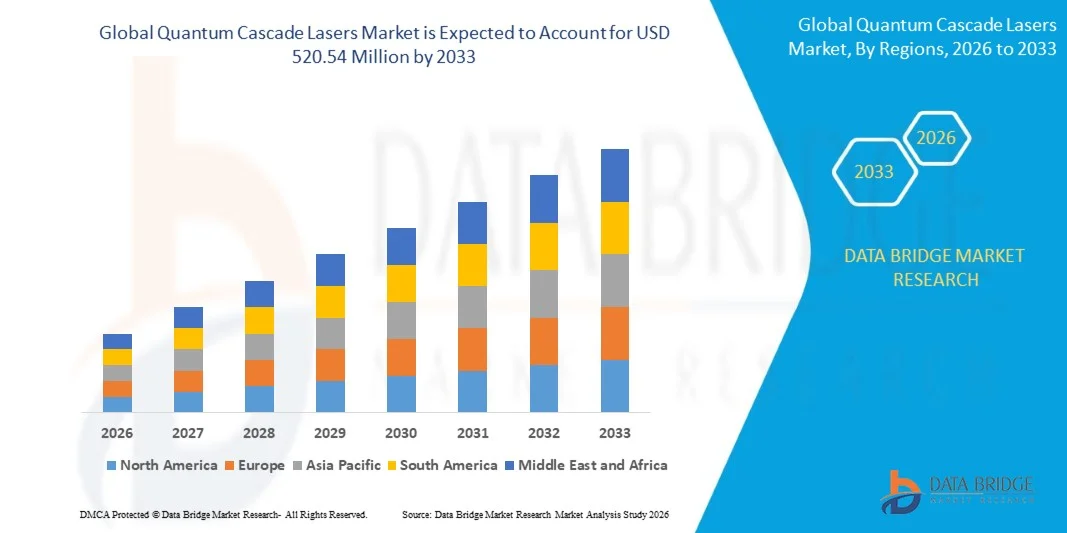
- The global quantum cascade lasers market size was valued at USD 389.25 million in 2025 and is expected to reach USD 520.54 million by 2033, at a CAGR of 3.70% during the forecast period
- The market growth is largely fueled by increasing adoption of advanced infrared sensing and spectroscopy technologies across industrial, environmental, and defense applications, where high-precision gas detection and molecular analysis are becoming critical operational requirements
- Furthermore, rising demand for compact, energy-efficient, and highly selective laser sources in applications such as process monitoring, emissions control, and security screening is accelerating the deployment of quantum cascade lasers across multiple end-use industries, thereby significantly boosting market expansion
Quantum Cascade Lasers Market Analysis
- Quantum cascade lasers are semiconductor-based light sources operating in the mid-infrared to terahertz range, enabling highly precise molecular identification and gas sensing capabilities for scientific, industrial, and defense applications
- The escalating demand for quantum cascade lasers is primarily driven by growing utilization in gas sensing, environmental monitoring, medical diagnostics, and defense systems, supported by their high tunability, spectral accuracy, and ability to operate in challenging detection environments
- North America dominated the quantum cascade lasers market with a share of 43.5% in 2025, due to strong adoption in advanced spectroscopy, defense sensing, and industrial gas analysis applications
- Asia-Pacific is expected to be the fastest growing region in the quantum cascade lasers market during the forecast period due to rapid industrialization, expanding semiconductor manufacturing, and increasing adoption of advanced sensing technologies in China, Japan, and India
- Continuous wave mode segment dominated the market with a market share of 58.9% in 2025, due to its stable output characteristics and strong suitability for spectroscopy, chemical sensing, and industrial process monitoring. Continuous emission enables precise measurement applications where signal consistency is critical. Its adoption is further supported by integration into laboratory-grade instruments and fixed monitoring systems
Report Scope and Quantum Cascade Lasers Market Segmentation
|
Attributes |
Quantum Cascade Lasers Key Market Insights |
|
Segments Covered |
|
|
Countries Covered |
North America
Europe
Asia-Pacific
Middle East and Africa
South America
|
|
Key Market Players |
|
|
Market Opportunities |
|
|
Value Added Data Infosets |
In addition to the insights on market scenarios such as market value, growth rate, segmentation, geographical coverage, and major players, the market reports curated by the Data Bridge Market Research also include in-depth expert analysis, geographically represented company-wise production and capacity, network layouts of distributors and partners, detailed and updated price trend analysis and deficit analysis of supply chain and demand. |
Quantum Cascade Lasers Market Trends
“Growing Use of Mid-Infrared Sensing in Industrial Monitoring”
- A significant trend in the quantum cascade lasers market is the growing integration of mid-infrared laser technology into industrial monitoring systems for real-time gas detection, process control, and emission tracking. This shift is being driven by the need for highly selective and sensitive detection of molecular signatures across complex industrial environments
- For instance, DRS Daylight Solutions provides quantum cascade laser-based systems widely used in defense-grade chemical detection and industrial sensing applications. Such solutions enhance detection accuracy and enable continuous monitoring in safety-critical environments
- The adoption of quantum cascade lasers in environmental monitoring is expanding as industries focus on reducing emissions and ensuring compliance with regulatory standards. These lasers enable precise identification of gases such as methane, carbon dioxide, and nitrogen oxides across industrial sites
- Healthcare and medical diagnostics are increasingly incorporating mid-infrared spectroscopy systems powered by quantum cascade lasers for non-invasive analysis. This supports advancements in breath analysis and biomedical research requiring high spectral resolution
- The growing use of quantum cascade lasers in security and defense applications is strengthening demand for advanced infrared sensing technologies. These systems are used for threat detection, surveillance, and identification of chemical agents in mission-critical operations
- The market is witnessing increased deployment of compact and tunable laser systems that improve portability and field usability. This trend is reinforcing the role of quantum cascade lasers in enabling advanced sensing across industrial, scientific, and defense domains
Quantum Cascade Lasers Market Dynamics
Driver
“Rising Demand for Precise Gas Detection Applications”
- The rising demand for precise gas detection across industrial safety, environmental monitoring, and defense applications is a key driver of the quantum cascade lasers market. These lasers provide high spectral selectivity and sensitivity, enabling accurate identification of trace gases in complex environments
- For instance, Picarro Inc. utilizes laser-based spectroscopy systems for high-precision greenhouse gas measurement and atmospheric monitoring. Such applications demonstrate how quantum cascade laser technology supports critical environmental research and emission tracking
- The increasing need for real-time industrial process monitoring is accelerating the adoption of quantum cascade lasers in manufacturing and energy sectors. These systems help improve operational efficiency by enabling continuous detection of gas leaks and chemical compositions
- Stricter environmental regulations across regions are pushing industries to adopt advanced gas sensing technologies for compliance and reporting. Quantum cascade lasers play a key role in meeting these requirements through reliable and accurate detection capabilities
- The growing emphasis on precision measurement in scientific research continues to reinforce this driver. Quantum cascade lasers are increasingly used in laboratories for spectroscopy applications requiring high accuracy and stability
Restraint/Challenge
“High Production Cost and Technical Complexity”
- The quantum cascade lasers market faces significant challenges due to the high production costs and complex fabrication processes involved in developing mid-infrared semiconductor laser systems. These devices require advanced epitaxial growth techniques and precision engineering, increasing manufacturing difficulty
- For instance, Alpes Lasers S.A. specializes in tunable quantum cascade laser systems that require highly controlled fabrication environments to achieve wavelength accuracy and stability. Such precision requirements significantly increase production time and cost
- The use of specialized materials and multi-layer semiconductor structures adds to the complexity of device manufacturing. This limits large-scale production efficiency and increases dependency on advanced fabrication facilities
- Stringent performance requirements for wavelength stability, power output, and thermal management further raise development challenges. These factors make it difficult to standardize production across different application needs
- The market continues to face pressure from the need to balance high-performance laser output with cost-effective manufacturing processes. This challenge affects widespread commercialization and adoption across price-sensitive applications
Quantum Cascade Lasers Market Scope
The market is segmented on the basis of fabrication technology, operation mode, packaging type, and end user.
• By Fabrication Technology
On the basis of fabrication technology, the quantum cascade lasers market is segmented into Fabry–Perot, Distributed Feedback (DFB), and Tunable External Cavities. The Fabry–Perot segment dominated the largest market revenue share in 2025, driven by its simpler structure, lower production cost, and widespread adoption in mid-infrared sensing and spectroscopy applications. Its ease of integration into industrial and research systems supports consistent demand across analytical instrumentation and environmental monitoring. Manufacturers prefer Fabry–Perot designs due to established fabrication processes and reliable output performance across standard operating conditions. The segment continues to lead due to broad applicability in cost-sensitive deployments.
The Distributed Feedback (DFB) segment is anticipated to witness the fastest growth rate from 2026 to 2033, driven by increasing demand for wavelength-selective and high-precision laser output. DFB structures enable narrow linewidth emission, making them suitable for advanced gas sensing, defense targeting systems, and high-resolution spectroscopy. Rising deployment in compact and high-accuracy analytical devices further strengthens adoption. Growth is supported by expanding requirements for stable tunable sources in industrial and scientific applications.
• By Operation Mode
On the basis of operation mode, the quantum cascade lasers market is segmented into continuous wave mode and pulsed mode. The continuous wave mode segment held the largest market revenue share of 58.9% in 2025, driven by its stable output characteristics and strong suitability for spectroscopy, chemical sensing, and industrial process monitoring. Continuous emission enables precise measurement applications where signal consistency is critical. Its adoption is further supported by integration into laboratory-grade instruments and fixed monitoring systems. The segment maintains dominance due to reliability in long-duration operational environments.
The pulsed mode segment is expected to witness the fastest growth rate from 2026 to 2033, driven by increasing usage in LiDAR systems, defense imaging, and time-resolved spectroscopy. Pulsed operation allows higher peak power output, enabling long-range detection and enhanced sensitivity in complex environments. Demand is increasing for compact, high-performance sensing systems in security and aerospace applications. Expansion is supported by advancements in fast-switching laser architectures and rising adoption in dynamic measurement technologies.
• By Packaging Type
On the basis of packaging type, the quantum cascade lasers market is segmented into C-Mount package, HHL and VHL package, and TO3 package. The C-Mount segment dominated the largest market revenue share in 2025, driven by its widespread use in laboratory systems, research applications, and mid-power laser installations. Its standardized design ensures easy thermal management and integration into existing optical setups. The packaging offers cost efficiency and flexibility for prototyping and industrial deployment. Strong adoption is supported by its compatibility with a wide range of mid-infrared applications.
The HHL and VHL package segment is anticipated to witness the fastest growth rate from 2026 to 2033, driven by increasing demand for compact, high-power, and thermally efficient laser modules. These packages support improved heat dissipation and higher operational stability, making them suitable for defense and industrial sensing systems. Miniaturization trends in photonics devices further support adoption. Growth is reinforced by expanding use in portable and field-deployable laser systems.
• By End User
On the basis of end user, the quantum cascade lasers market is segmented into industrial, healthcare, telecommunication, military and defense, and others. The industrial segment held the largest market revenue share in 2025, driven by extensive use in process control, gas analysis, and environmental monitoring applications. Industries rely on quantum cascade lasers for accurate detection of chemical compositions and emission control systems. Strong adoption is supported by regulatory requirements for industrial safety and emission tracking. The segment continues to lead due to broad integration across manufacturing and energy sectors.
The military and defense segment is expected to witness the fastest growth rate from 2026 to 2033, driven by rising adoption in infrared countermeasures, target detection, and advanced surveillance systems. Quantum cascade lasers provide high precision and tunability, making them suitable for mission-critical defense applications. Increasing investment in modern defense technologies accelerates deployment across airborne and ground-based platforms. Growth is reinforced by expanding demand for secure and high-resolution sensing systems.
Quantum Cascade Lasers Market Regional Analysis
- North America dominated the quantum cascade lasers market with the largest revenue share of 43.5% in 2025, driven by strong adoption in advanced spectroscopy, defense sensing, and industrial gas analysis applications
- The region benefits from high investments in photonics research, well-established semiconductor infrastructure, and strong integration of quantum cascade lasers in military and aerospace systems
- This widespread adoption is further supported by the presence of leading technology providers, strong R&D funding, and increasing demand for high-precision sensing solutions across industrial and scientific sectors
U.S. Quantum Cascade Lasers Market Insight
The U.S. quantum cascade lasers market captured the largest revenue share in North America in 2025, supported by extensive defense modernization programs and growing use in environmental monitoring and industrial process control. Demand is increasing for advanced infrared sensing systems used in chemical detection and homeland security applications. The strong presence of photonics companies and national research laboratories further accelerates innovation and commercialization. Rising adoption across aerospace, healthcare diagnostics, and telecommunications also contributes to sustained market expansion.
Europe Quantum Cascade Lasers Market Insight
The Europe quantum cascade lasers market is projected to grow at a steady CAGR throughout the forecast period, driven by increasing demand for emission monitoring, industrial safety compliance, and advanced medical diagnostics. Strict environmental regulations across the region are encouraging the use of high-precision gas sensing technologies. Expanding research initiatives in photonics and strong support for industrial automation further enhance market adoption. Growth is also supported by increasing integration of laser-based sensing systems in manufacturing and scientific instrumentation.
U.K. Quantum Cascade Lasers Market Insight
The U.K. quantum cascade lasers market is anticipated to expand at a notable CAGR during the forecast period, driven by rising investment in defense technologies, healthcare diagnostics, and environmental monitoring systems. Increasing focus on homeland security and gas detection applications is supporting demand for infrared laser-based sensing solutions. The country’s strong research ecosystem and collaborations between universities and technology firms further enhance innovation. Growing adoption in industrial process monitoring and scientific research continues to strengthen market penetration.
Germany Quantum Cascade Lasers Market Insight
The Germany quantum cascade lasers market is expected to grow at a considerable CAGR during the forecast period, supported by strong industrial automation, environmental compliance requirements, and advanced manufacturing capabilities. Germany’s focus on precision engineering and emission control systems is driving adoption in industrial gas sensing and process monitoring. The presence of leading automotive and chemical industries further strengthens demand for accurate analytical technologies. Increasing integration of photonics-based systems in industrial and research applications supports sustained growth.
Asia-Pacific Quantum Cascade Lasers Market Insight
The Asia-Pacific quantum cascade lasers market is poised to grow at the fastest CAGR from 2026 to 2033, driven by rapid industrialization, expanding semiconductor manufacturing, and increasing adoption of advanced sensing technologies in China, Japan, and India. Rising investments in environmental monitoring, healthcare diagnostics, and defense modernization are accelerating regional demand. The region is also emerging as a key manufacturing hub for photonics components, improving affordability and accessibility. Expanding research activities in laser-based technologies further support strong market expansion.
Japan Quantum Cascade Lasers Market Insight
The Japan quantum cascade lasers market is gaining momentum due to strong technological advancement, high adoption of precision instrumentation, and increasing demand for environmental and industrial monitoring solutions. The country’s focus on miniaturized and high-accuracy sensing systems supports integration across healthcare and semiconductor industries. Growing investments in photonics research and strong collaboration between academia and industry further strengthen development. Rising use in gas analysis and scientific instrumentation continues to support steady market growth.
China Quantum Cascade Lasers Market Insight
The China quantum cascade lasers market accounted for the largest revenue share in Asia-Pacific in 2025, driven by rapid industrial expansion, strong semiconductor ecosystem, and increasing adoption of advanced sensing technologies. Government initiatives supporting smart manufacturing and environmental monitoring are accelerating deployment across multiple industries. Strong domestic production capabilities and cost-effective manufacturing further enhance accessibility. Expanding applications in defense, healthcare, and industrial process control continue to drive robust market growth.
Quantum Cascade Lasers Market Share
The quantum cascade lasers industry is primarily led by well-established companies, including:
- Block Engineering, LLC. (U.S.)
- Wavelength Electronics, Inc. (U.S.)
- Hamamatsu Photonics K.K. (Japan)
- Thorlabs, Inc. (U.S.)
- Alpes Lasers S.A. (Switzerland)
- mirSense (France)
- AdTech Optics (U.S.)
- Pranalytica Inc. (U.S.)
- AKELA Laser Corporation (U.S.)
- Emerson Electric Co. (U.S.)
- DRS Daylight Solutions (U.S.)
- Picarro Inc. (U.S.)
- Aerodyne Research Inc. (U.S.)
- Power Technology Inc. (U.S.)
- Boston Electronic Corporation (U.S.)
- MG Optical (U.S.)
- Sacher Lasertechnik (Germany)
- LongWave Photonics (U.S.)
- nanoplus Nanosystems and Technologies GmbH (Germany)
- Eluxi Ltd. (U.K.)
Latest Developments in Global Quantum Cascade Lasers Market
- In March 2024, France strengthened its national quantum strategy review by the French quantum ecosystem alongside the launch of PROQCIMA, targeting development of two universal quantum computer prototypes by 2030. This initiative is expected to indirectly boost demand for quantum cascade lasers through expanded focus on quantum sensing, quantum cryptography, and quantum communication applications, where high-precision infrared sources are increasingly required for advanced system architectures
- In October 2023, Nano Plus Nanosystems and Technologies GmbH introduced new single-mode continuous-wave quantum cascade lasers (CW-QCLs) targeting far-infrared applications in the 6 µm to 11 µm range. This development enhances market growth by enabling ultra-sensitive spectroscopy and custom sensing applications, strengthening adoption in tunable diode laser absorption spectroscopy and expanding high-precision analytical capabilities across research and industrial sectors
- In July 2023, Hamamatsu Photonics expanded its mid-infrared laser portfolio by advancing high-power quantum cascade laser modules designed for gas sensing and environmental monitoring. This development supports broader market penetration by improving detection accuracy and reliability in industrial emissions monitoring and chemical analysis, increasing demand across environmental compliance and safety applications
- In April 2023, Alpes Lasers S.A. enhanced its distributed feedback quantum cascade laser offerings with improved wavelength stability and narrow linewidth performance. This advancement contributes to market growth by strengthening applications in high-resolution spectroscopy and defense-grade infrared sensing systems, where precision and spectral purity are critical
- In January 2023, Thorlabs Inc. expanded its infrared laser component portfolio by integrating advanced quantum cascade laser modules for laboratory and industrial use. This development supports increased adoption in research instrumentation and analytical chemistry applications, driven by demand for compact and reliable mid-infrared sources for real-time molecular detection and process monitoring
SKU-
Get online access to the report on the World's First Market Intelligence Cloud

- Interactive Data Analysis Dashboard
- Company Analysis Dashboard for high growth potential opportunities
- Research Analyst Access for customization & queries
- Competitor Analysis with Interactive dashboard
- Latest News, Updates & Trend analysis
- Harness the Power of Benchmark Analysis for Comprehensive Competitor Tracking
Global Quantum Cascade Lasers Market, Supply Chain Analysis and Ecosystem Framework
To support market growth and help clients navigate the impact of geopolitical shifts, DBMR has integrated in-depth supply chain analysis into its Global Quantum Cascade Lasers Market research reports. This addition empowers clients to respond effectively to global changes affecting their industries. The supply chain analysis section includes detailed insights such as Global Quantum Cascade Lasers Market consumption and production by country, price trend analysis, the impact of tariffs and geopolitical developments, and import and export trends by country and HSN code. It also highlights major suppliers with data on production capacity and company profiles, as well as key importers and exporters. In addition to research, DBMR offers specialized supply chain consulting services backed by over a decade of experience, providing solutions like supplier discovery, supplier risk assessment, price trend analysis, impact evaluation of inflation and trade route changes, and comprehensive market trend analysis.
Research Methodology
Data collection and base year analysis are done using data collection modules with large sample sizes. The stage includes obtaining market information or related data through various sources and strategies. It includes examining and planning all the data acquired from the past in advance. It likewise envelops the examination of information inconsistencies seen across different information sources. The market data is analysed and estimated using market statistical and coherent models. Also, market share analysis and key trend analysis are the major success factors in the market report. To know more, please request an analyst call or drop down your inquiry.
The key research methodology used by DBMR research team is data triangulation which involves data mining, analysis of the impact of data variables on the market and primary (industry expert) validation. Data models include Vendor Positioning Grid, Market Time Line Analysis, Market Overview and Guide, Company Positioning Grid, Patent Analysis, Pricing Analysis, Company Market Share Analysis, Standards of Measurement, Global versus Regional and Vendor Share Analysis. To know more about the research methodology, drop in an inquiry to speak to our industry experts.
Customization Available
Data Bridge Market Research is a leader in advanced formative research. We take pride in servicing our existing and new customers with data and analysis that match and suits their goal. The report can be customized to include price trend analysis of target brands understanding the market for additional countries (ask for the list of countries), clinical trial results data, literature review, refurbished market and product base analysis. Market analysis of target competitors can be analyzed from technology-based analysis to market portfolio strategies. We can add as many competitors that you require data about in the format and data style you are looking for. Our team of analysts can also provide you data in crude raw excel files pivot tables (Fact book) or can assist you in creating presentations from the data sets available in the report.












