


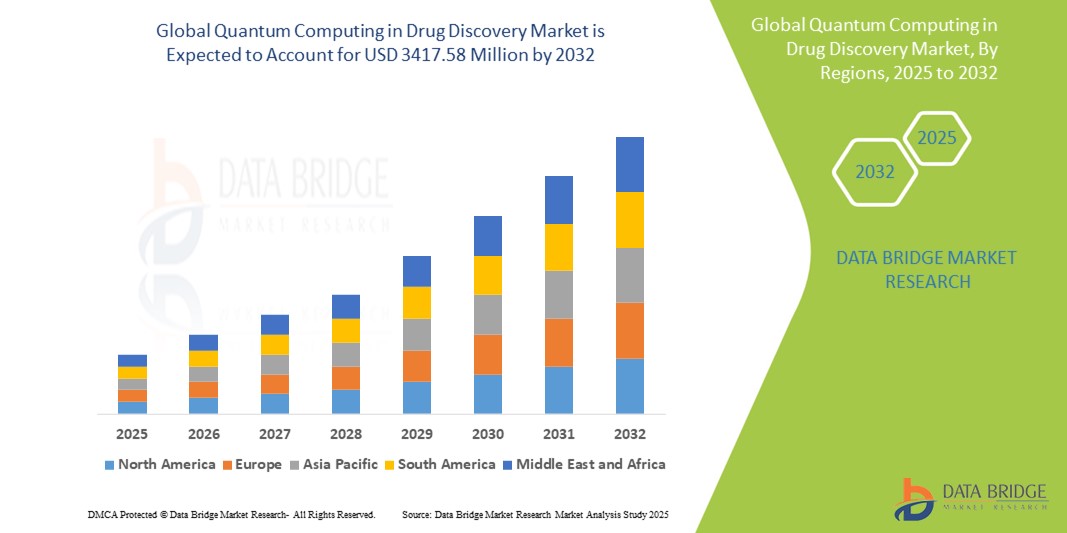
Quantum Computing in Drug Discovery Market Size
- The global quantum computing in drug discovery market size was valued at USD 416.39 million in 2024 and is expected to reach USD 3417.58 million by 2032, at a CAGR of 30.10% during the forecast period
- This growth is driven by factors such as the rising demand for faster drug development, increasing R&D in pharmaceuticals, and the growing adoption of advanced computing technologies in life sciences
Quantum Computing in Drug Discovery Market Analysis
- The quantum computing in drug discovery market is gaining traction as pharmaceutical companies explore advanced technologies to speed up molecule simulation and drug design
- Growing investments in quantum computing infrastructure are enabling faster integration of these tools into drug discovery pipelines
- North America is expected to dominate the quantum computing in drug discovery market due to strong technological infrastructure, presence of major quantum computing firms, and significant investments in pharmaceutical innovation and research collaborations
- Asia-Pacific is expected to be the fastest growing region in the quantum computing in drug discovery market during the forecast period due to rising government funding for quantum initiatives, growing adoption of advanced drug discovery tools, and increasing collaboration between tech start-ups and life science companies
- The lead optimization segment is expected to dominate the quantum computing in drug discovery market with the largest share of 65.5% in 2025 due to its critical role in refining potential drug candidates for efficacy, safety, and pharmacokinetics. Quantum computing enhances the accuracy of molecular simulations, allowing researchers to predict how small changes affect drug performance. This reduces trial-and-error cycles and accelerates the development pipeline. The precision offered by quantum tools significantly lowers development costs, making this stage a major focus for investment and innovation
Report Scope and Quantum Computing in Drug Discovery Market Segmentation
|
Attributes |
Quantum Computing in Drug Discovery Key Market Insights |
|
Segments Covered |
|
|
Countries Covered |
North America
Europe
Asia-Pacific
Middle East and Africa
South America
|
|
Key Market Players |
|
|
Market Opportunities |
|
|
Value Added Data Infosets |
In addition to the insights on market scenarios such as market value, growth rate, segmentation, geographical coverage, and major players, the market reports curated by the Data Bridge Market Research also include depth expert analysis, patient epidemiology, pipeline analysis, pricing analysis, and regulatory framework |
Quantum Computing in Drug Discovery Market Trends
“Rising Collaboration Between Tech Firms and Pharmaceutical Companies”
- Collaborations between technology companies and pharmaceutical firms are accelerating the use of quantum computing in drug discovery, aiming to solve complex molecular challenges more efficiently
- These partnerships combine the computational strength of tech firms with the biological and chemical expertise of pharmaceutical companies for advanced drug modeling
- For instance, Roche partnered with Cambridge Quantum to explore how quantum algorithms can optimize molecular structures, enhancing drug screening precision
- Boehringer Ingelheim’s collaboration with Google, where they are researching quantum computing’s role in simulating molecular dynamics for better drug efficacy predictions
- These collaborations support the early integration of quantum solutions in drug development pipelines, fostering innovation and proving the commercial value of quantum technologies in life sciences
Quantum Computing in Drug Discovery Market Dynamics
Driver
“Rising Complexity of Drug Molecules and Need for Faster Discovery”
- The increasing complexity of drug molecules is a key driver pushing the adoption of quantum computing in drug discovery, as traditional systems struggle to simulate intricate molecular interactions effectively
- Quantum computing allows for parallel processing of massive datasets, enabling faster and more accurate modeling of molecular behavior, including binding affinities and energy states
- This technology significantly reduces the trial-and-error phase in drug development, which can otherwise be time-consuming and costly for pharmaceutical companies
- For instance, simulating a protein-ligand interaction on a classical supercomputer can take weeks, while quantum algorithms can produce similar outcomes in hours, greatly accelerating the R&D process
- Companies such as Amgen and Roche are exploring quantum approaches to improve drug candidate selection, aiming to streamline workflows and bring treatments to market more efficiently
Opportunity
“Integration of Quantum AI in Early Drug Screening”
- An emerging opportunity in the market is the integration of quantum artificial intelligence for early-phase drug screening, combining the speed of quantum computing with AI’s data analysis capabilities
- This synergy helps rapidly evaluate large chemical and genomic datasets, predicting molecular behavior and identifying promising drug candidates much earlier in the R&D process
- Quantum AI tools are being developed to assess compound efficacy and toxicity, improving decision-making and reducing costly failures in clinical trials
For instance,
- Canadian startup Xanadu is working with biotech firms to apply photonic quantum computing in analyzing drug-such as molecules faster and more precisely
- Quantum-enhanced machine learning models being used to detect complex patterns in biological data, paving the way for more effective, personalized medicine strategies
Restraint/Challenge
“High Cost and Technical Limitations of Quantum Hardware”
- A major challenge in adopting quantum computing for drug discovery is the high cost and technical complexity of the hardware needed to operate quantum systems effectively
- These machines require extreme conditions such as ultra-low temperatures and vibration isolation, making setup and maintenance prohibitively expensive for many pharmaceutical companies
- Most quantum computers are still in the noisy intermediate-scale quantum phase, meaning they frequently produce errors and lack the stability required for reliable, large-scale drug simulations
For instance,
- Building and maintaining quantum systems from companies such as D-Wave or Rigetti demands multimillion-dollar investments and highly controlled environments
- Shortage of professionals skilled in quantum programming, which limits practical integration in pharmaceutical workflows despite some accessibility through cloud platforms from IBM and Amazon
Quantum Computing in Drug Discovery Market Scope
The market is segmented on the basis of offering, therapeutic area, and end user.
|
Segmentation |
Sub-Segmentation |
|
By Offering |
|
|
By Therapeutic Area |
|
|
By End User |
|
In 2025, the lead optimization is projected to dominate the market with a largest share in offering segment
The lead optimization segment is expected to dominate the quantum computing in drug discovery market with the largest share of 65.5% in 2025 due to its critical role in refining potential drug candidates for efficacy, safety, and pharmacokinetics. Quantum computing enhances the accuracy of molecular simulations, allowing researchers to predict how small changes affect drug performance. This reduces trial-and-error cycles and accelerates the development pipeline. The precision offered by quantum tools significantly lowers development costs, making this stage a major focus for investment and innovation
The oncological is expected to account for the largest share during the forecast period in therapeutic area segment
In 2025, the oncological segment is expected to dominate the market with the largest market share of 65.5% due to its urgent demand for effective therapies and the complex biological nature of cancer. Quantum computing enables more precise modelling of cancer-related protein interactions and genomic mutations. This supports personalized drug development strategies tailored to individual patient profiles. The high global burden of cancer continues to drive adoption of advanced technologies in this therapeutic area
Quantum Computing in Drug Discovery Market Regional Analysis
“North America Holds the Largest Share in the Quantum Computing in Drug Discovery Market”
- North America is the dominating region in the quantum computing in drug discovery market, accounting for over 45.5% of the global market share
- The region’s dominance is driven by strong presence of leading tech firms, pharmaceutical giants, and academic institutions fostering innovation in quantum healthcare applications
- High investments in R&D and early adoption of emerging technologies are accelerating the integration of quantum computing into drug discovery workflows
- Companies such as IBM and Google are actively collaborating with pharma firms to develop quantum solutions for molecular simulation and lead optimization
- Supportive government initiatives and funding programs are boosting the commercial and scientific use of quantum computing across healthcare and life sciences sectors
“Asia-Pacific is Projected to Register the Highest CAGR in the Quantum Computing in Drug Discovery Market”
- Asia-Pacific is the fastest growing region in the quantum computing in drug discovery market
- The Asia-Pacific region is experiencing rapid growth in the quantum computing in drug discovery market
- Increasing investments in healthcare and technology, along with government support, are driving the adoption of quantum computing
- Key players in the Asia-Pacific region, including research institutions and technology companies, are making significant strides in quantum computing
- Collaborative efforts with pharmaceutical companies are accelerating drug discovery research
Quantum Computing in Drug Discovery Market Share
The market competitive landscape provides details by competitor. Details included are company overview, company financials, revenue generated, market potential, investment in research and development, new market initiatives, global presence, production sites and facilities, production capacities, company strengths and weaknesses, product launch, product width and breadth, application dominance. The above data points provided are only related to the companies' focus related to market.
The Major Market Leaders Operating in the Market Are:
- 1QB Information Technologies, Inc. (Canada)
- Alphabet Inc. (U.S.)
- Atos SE (France)
- D-Wave Systems Inc. (Canada)
- Fujitsu Limited (Japan)
- Honeywell International Inc. (U.S.)
- Intel Corporation (U.S.)
- Quantum Brilliance Pty Ltd. (Australia)

- Interactive Data Analysis Dashboard
- Company Analysis Dashboard for high growth potential opportunities
- Research Analyst Access for customization & queries
- Competitor Analysis with Interactive dashboard
- Latest News, Updates & Trend analysis
- Harness the Power of Benchmark Analysis for Comprehensive Competitor Tracking
Data collection and base year analysis are done using data collection modules with large sample sizes. The stage includes obtaining market information or related data through various sources and strategies. It includes examining and planning all the data acquired from the past in advance. It likewise envelops the examination of information inconsistencies seen across different information sources. The market data is analysed and estimated using market statistical and coherent models. Also, market share analysis and key trend analysis are the major success factors in the market report. To know more, please request an analyst call or drop down your inquiry.
The key research methodology used by DBMR research team is data triangulation which involves data mining, analysis of the impact of data variables on the market and primary (industry expert) validation. Data models include Vendor Positioning Grid, Market Time Line Analysis, Market Overview and Guide, Company Positioning Grid, Patent Analysis, Pricing Analysis, Company Market Share Analysis, Standards of Measurement, Global versus Regional and Vendor Share Analysis. To know more about the research methodology, drop in an inquiry to speak to our industry experts.
Data Bridge Market Research is a leader in advanced formative research. We take pride in servicing our existing and new customers with data and analysis that match and suits their goal. The report can be customized to include price trend analysis of target brands understanding the market for additional countries (ask for the list of countries), clinical trial results data, literature review, refurbished market and product base analysis. Market analysis of target competitors can be analyzed from technology-based analysis to market portfolio strategies. We can add as many competitors that you require data about in the format and data style you are looking for. Our team of analysts can also provide you data in crude raw excel files pivot tables (Fact book) or can assist you in creating presentations from the data sets available in the report.













