


What is the Quinoa Flour Market Size and Growth Rate?
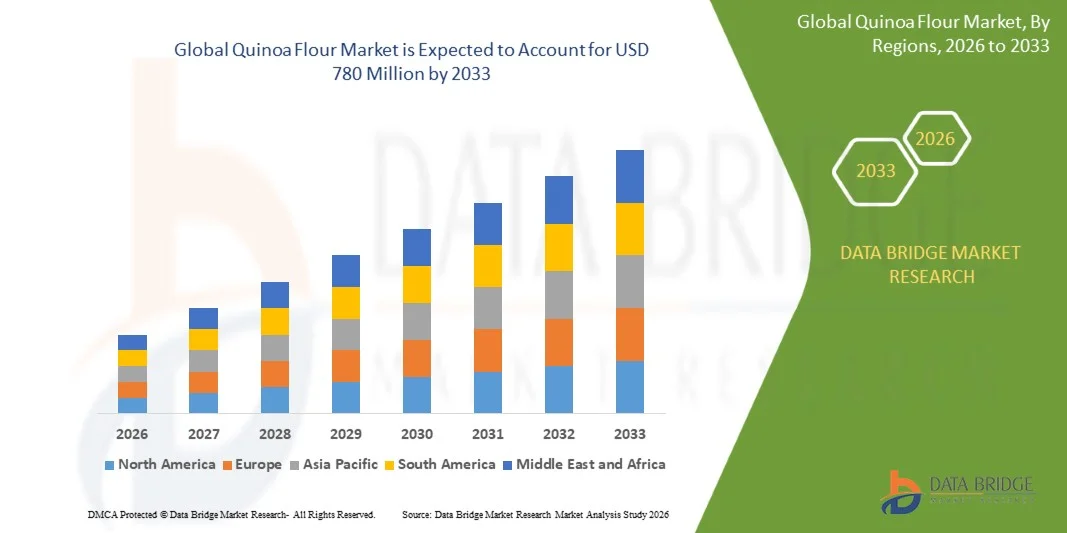
- As per Data Bridge Market Research analysis, the quinoa flour market was valued at USD 353 million in 2025 and is projected to reach USD 780 million by 2033, growing at a CAGR of 10.2% from 2026 to 2033.
- The market is experiencing strong growth driven by rising consumer awareness of gluten-free and nutrient-dense food alternatives, increasing prevalence of celiac disease and gluten intolerance, and expanding use of quinoa flour across bakery, snack, and pasta manufacturing.
- Growing adoption of plant-based, high-protein diets, coupled with increasing investment in quinoa cultivation and processing capacity across South America, North America, and parts of Asia, is supporting steady expansion in both developed and emerging economies.
Market Size & Forecast
- Global Market Value (2025): USD 353 Million
- Expected Market Value (2033): USD 780 Million
- Forecast CAGR (2026–2033): 10.2%
- Leading Region in 2025: North America
- Fastest Growing Region: Asia-Pacific
What are the Major Takeaways of the Quinoa Flour Market?
- North America dominated the global quinoa flour market with the largest revenue share of approximately 38% in 2025, supported by high consumer awareness of gluten-free diets, an established organic and health food retail base, and the presence of leading quinoa flour producers.
- Asia-Pacific is expected to be the fastest-growing region at a CAGR of 12.1% from 2026 to 2033, fueled by rising urbanization, increasing disposable incomes, and expanding health food retail across China, India, and Japan.
- The white quinoa flour segment led the market with a 54% share in 2025, owing to its mild flavor, wide culinary versatility, and broad availability compared with red and black quinoa varieties.
- Black quinoa flour is the fastest-growing type segment, projected to register a CAGR of 9.5%, reflecting rising consumer interest in antioxidant-rich, premium quinoa varieties.
- The bakery products segment dominated the application category with a 41% revenue share in 2025, led by rising demand for gluten-free breads, muffins, and baked snacks.
Report Scope and Quinoa Flour Market Segmentation
|
Attributes |
Quinoa Flour Key Market Insights |
|
Segments Covered |
|
|
Countries Covered |
North America
Europe
Asia-Pacific
Middle East and Africa
South America
|
|
Key Market Players |
|
|
Market Opportunities |
|
|
Value Added Data Infosets |
In addition to the insights on market scenarios such as market value, growth rate, segmentation, geographical coverage, and major players, the market reports curated by the Data Bridge Market Research also include in-depth expert analysis, geographically represented company-wise production and capacity, network layouts of distributors and partners, detailed and updated price trend analysis and deficit analysis of supply chain and demand. |
What is the Key Trend in the Quinoa Flour Market?
- Food manufacturers are increasingly incorporating quinoa flour into mainstream bakery, snack, and pasta products as demand grows for clean-label, plant-based, and gluten-free ingredients.
- For instance, in March 2024, The British Quinoa Company inaugurated a new processing facility in Shropshire, United Kingdom, integrating advanced sorting and cleaning technologies to meet growing demand for domestically sourced quinoa flour, with the initiative partly funded by UK government agricultural innovation grants.
- Rising product innovation and premiumization are prompting suppliers to expand organic, sprouted, and specialty-grade quinoa flour offerings tailored to functional and gluten-free food applications.
- For instance, Ardent Mills has invested in advanced milling technologies and developed Sustagrain Quinoa Flour, expanding its portfolio of nutrient-dense, functional quinoa-based ingredients for bakery and food manufacturing customers.
- Consolidation among leading suppliers is strengthening vertically integrated sourcing and processing capabilities across the value chain.
- For instance, in February 2023, Ardent Mills acquired Andean Naturals, a leading North American quinoa producer, expanding its quinoa flour production, sourcing, and distribution capabilities.
- As demand for gluten-free, high-protein, and plant-based ingredients continues to rise, quinoa flour adoption is expected to expand further across bakery, snack, infant nutrition, and dietary supplement applications globally.
What are the Key Drivers of the Quinoa Flour Market?
- Rising prevalence of celiac disease and gluten intolerance, combined with growing consumer preference for plant-based and high-protein diets, is driving strong demand for quinoa flour as a nutrient-dense wheat flour alternative.
- Growing adoption of quinoa flour across bakery, snack, and pasta manufacturing is expanding as food companies reformulate products to meet clean-label and functional nutrition demand.
- For instance, Andean Naturals expanded its quinoa sourcing network by partnering with regional farmers and cooperatives, strengthening supply chain reliability to meet rising downstream demand from food manufacturers.
- Increasing investment in quinoa cultivation, processing, and milling infrastructure across South America, North America, and parts of Asia is improving supply availability and quality consistency.
- Expanding e-commerce and specialty retail distribution is improving consumer access to organic and premium quinoa flour products, supporting adoption among health-conscious households worldwide.
Which Factors are Challenging the Growth of the Quinoa Flour Market?
- Quinoa cultivation remains concentrated in a limited number of growing regions, primarily Peru, Bolivia, and increasingly North America, making the supply chain vulnerable to climatic variability, crop yield fluctuations, and trade disruptions.
- These supply constraints contribute to raw material price volatility, which can affect manufacturer margins and downstream product pricing.
- Quinoa flour's naturally bitter, earthy flavor profile can limit its use as a full wheat flour replacement in certain baked goods, often requiring blending with other flours or additional processing such as toasting.
- High production and processing costs relative to conventional wheat flour continue to restrict adoption among price-sensitive consumers and small-scale food manufacturers, particularly in developing markets.
How is the Quinoa Flour Market Segmented?
The quinoa flour market is segmented on the basis of type, category, processing type, application, end user, and distribution channel.
- By Type
On the basis of type, the global quinoa flour market is segmented into white quinoa flour, red quinoa flour, black quinoa flour, and tri-color blend. The white quinoa flour segment dominated the market with a 54% share in 2025, owing to its mild flavor, fine texture, and wide versatility across bakery, snack, and household culinary applications.
The black quinoa flour segment is projected to register the fastest growth at a CAGR of 9.5% from 2026 to 2033, driven by rising consumer interest in antioxidant-rich, premium quinoa varieties and their growing use in specialty and functional food products.
- By Category
On the basis of category, the global quinoa flour market is segmented into organic and conventional. The conventional segment led the market with a 58% share in 2025, supported by its cost-effectiveness and widespread integration into mass-produced bakery and snack products.
The organic segment is expected to witness the fastest growth at a CAGR of 10.8% from 2026 to 2033, driven by rising consumer preference for chemical-free, sustainably sourced, and non-GMO food ingredients.
- By Processing Type
On the basis of processing type, the global quinoa flour market is segmented into whole grain quinoa flour, sprouted quinoa flour, and toasted/roasted quinoa flour. The whole grain quinoa flour segment dominated the market with a 62% share in 2025, owing to its higher fiber and nutrient retention compared with refined alternatives.
The sprouted quinoa flour segment is expected to witness the fastest growth at a CAGR of 11.2% from 2026 to 2033, driven by rising consumer demand for easily digestible, nutrient-enhanced functional flours.
- By Application
On the basis of application, the global quinoa flour market is segmented into bakery products, snacks & confectionery, pasta & noodles, infant & baby food, nutritional & dietary supplements, and others. The bakery products segment led the market with a 41% share in 2025, driven by rising demand for gluten-free breads, muffins, and baked snacks among health-conscious consumers.
The nutritional & dietary supplements segment is expected to witness the fastest growth at a CAGR of 10.9% from 2026 to 2033, driven by increasing use of quinoa flour as a functional, protein-rich ingredient in health, sports, and infant nutrition formulations.
- By End User
On the basis of end user, the global quinoa flour market is segmented into household/retail consumers, food service industry, and food & beverage manufacturers. The food & beverage manufacturers segment dominated the market with a 48% share in 2025, owing to large-scale procurement of quinoa flour for use in packaged bakery, snack, and functional food products.
The household/retail consumers segment is expected to witness the fastest growth at a CAGR of 9.6% from 2026 to 2033, driven by rising at-home gluten-free and health-conscious baking trends.
- By Distribution Channel
On the basis of distribution channel, the global quinoa flour market is segmented into supermarkets & hypermarkets, specialty & health food stores, online retail/e-commerce, and convenience stores. The supermarkets & hypermarkets segment dominated the market with a 39% share in 2025, supported by wide product availability and strong consumer footfall across established retail networks.
The online retail/e-commerce segment is expected to witness the fastest growth at a CAGR of 12.4% from 2026 to 2033, driven by rising consumer preference for convenient access to organic and specialty quinoa flour products through digital platforms.
Which Region Holds the Largest Share of the Quinoa Flour Market?
- North America dominated the quinoa flour market and accounted for the largest revenue share of approximately 38% in 2025, supported by high consumer awareness of celiac disease and gluten intolerance, a well-established organic and health food retail base, and the presence of leading quinoa flour producers and millers.
- The region also benefits from strong direct sourcing partnerships with South American quinoa growers, expanding domestic quinoa cultivation, and growing incorporation of quinoa flour into mainstream bakery and snack products. Rising consumer interest in plant-based, high-protein diets continues to strengthen North America's leadership position in the global market.
United States Quinoa Flour Market Insight
The United States quinoa flour market is experiencing steady growth, supported by high consumer awareness of gluten-free diets, strong demand from the organic and natural foods retail sector, and the presence of leading quinoa flour producers and millers. Rising incorporation of quinoa flour into bakery, snack, and infant nutrition products, along with expanding direct sourcing partnerships with South American growers, continues to support market growth.
Germany Quinoa Flour Market Insight
The Germany quinoa flour market is expanding steadily, driven by strong consumer demand for organic and gluten-free food products and the country's well-developed specialty and health food retail infrastructure. Growing adoption of quinoa flour among bakeries and food manufacturers seeking clean-label, plant-based ingredients continues to support market growth in the country.
Asia-Pacific Quinoa Flour Market Insight
The Asia-Pacific quinoa flour market is expected to witness rapid growth, driven by rising urbanization, increasing disposable incomes, and growing awareness of the health benefits of quinoa across China, India, and Japan. Expanding modern retail and e-commerce infrastructure, along with rising demand for gluten-free and high-protein foods among the region's growing middle class, is supporting market expansion.
China Quinoa Flour Market Insight
The China quinoa flour market is growing steadily, driven by rising health consciousness, expanding domestic quinoa cultivation, and increasing availability of quinoa flour through modern retail and e-commerce channels. Growing consumer interest in Western dietary trends and functional, protein-rich foods continues to support demand across the country.
India Quinoa Flour Market Insight
The India quinoa flour market is witnessing consistent growth, supported by rising consumer awareness of gluten-free and high-protein diets, expanding domestic quinoa cultivation, and growing presence of specialty and organic food brands. Increasing demand for quinoa flour in bakery and health food products among urban, health-conscious consumers continues to drive market growth in the country.
Which are the Top Companies in the Quinoa Flour Market?
The quinoa flour industry is primarily led by well-established companies, including:
- Ardent Mills, LLC (U.S.)
- Andean Naturals, Inc. (U.S.)
- The Quinoa Corporation (U.S.)
- Bob's Red Mill Natural Foods, Inc. (U.S.)
- King Arthur Baking Company, Inc. (U.S.)
- Andean Valley Corporation (Bolivia)
- Quinoa Foods Company (Bolivia)
- Irupana Andean Organic Food S.A. (Bolivia)
- GoGo Quinoa (Canada)
- Avena Foods Limited (Canada)
- The Hain Celestial Group, Inc. (U.S.)
- General Mills, Inc. (U.S.)
- Nutriwish (India)
- JIWA Healthy by Nature Pvt. Ltd. (India)
- Cerealto Siro Foods (Spain)
What are Latest Developments in the Quinoa Flour Market?
- In February 2023, Ardent Mills acquired Andean Naturals, a leading North American producer of quinoa, expanding its quinoa flour production, sourcing, and distribution capabilities and strengthening its position in the gluten-free ancient grains category.
- In March 2023, Andean Naturals expanded its quinoa sourcing network by partnering with regional farmers and cooperatives, aiming to secure a more reliable supply of high-quality quinoa amid rising downstream demand from food manufacturers.
- In March 2024, The British Quinoa Company inaugurated a new processing facility in Shropshire, United Kingdom, integrating advanced sorting and cleaning technologies to meet growing demand for domestically sourced quinoa flour, with the initiative partly funded by UK government agricultural innovation grants.
- Ardent Mills continued to invest in advanced milling technologies and expanded its Sustagrain Quinoa Flour line, broadening its portfolio of nutrient-dense, functional quinoa-based ingredients for bakery and food manufacturing customers.
- King Arthur Baking Company expanded its online educational platform and introduced new gluten-free flour blends incorporating quinoa flour, aiming to support home bakers adopting quinoa-based recipes.

- Interactive Data Analysis Dashboard
- Company Analysis Dashboard for high growth potential opportunities
- Research Analyst Access for customization & queries
- Competitor Analysis with Interactive dashboard
- Latest News, Updates & Trend analysis
- Harness the Power of Benchmark Analysis for Comprehensive Competitor Tracking
Global Quinoa Flour Market, Supply Chain Analysis and Ecosystem Framework
To support market growth and help clients navigate the impact of geopolitical shifts, DBMR has integrated in-depth supply chain analysis into its Global Quinoa Flour Market research reports. This addition empowers clients to respond effectively to global changes affecting their industries. The supply chain analysis section includes detailed insights such as Global Quinoa Flour Market consumption and production by country, price trend analysis, the impact of tariffs and geopolitical developments, and import and export trends by country and HSN code. It also highlights major suppliers with data on production capacity and company profiles, as well as key importers and exporters. In addition to research, DBMR offers specialized supply chain consulting services backed by over a decade of experience, providing solutions like supplier discovery, supplier risk assessment, price trend analysis, impact evaluation of inflation and trade route changes, and comprehensive market trend analysis.
Data collection and base year analysis are done using data collection modules with large sample sizes. The stage includes obtaining market information or related data through various sources and strategies. It includes examining and planning all the data acquired from the past in advance. It likewise envelops the examination of information inconsistencies seen across different information sources. The market data is analysed and estimated using market statistical and coherent models. Also, market share analysis and key trend analysis are the major success factors in the market report. To know more, please request an analyst call or drop down your inquiry.
The key research methodology used by DBMR research team is data triangulation which involves data mining, analysis of the impact of data variables on the market and primary (industry expert) validation. Data models include Vendor Positioning Grid, Market Time Line Analysis, Market Overview and Guide, Company Positioning Grid, Patent Analysis, Pricing Analysis, Company Market Share Analysis, Standards of Measurement, Global versus Regional and Vendor Share Analysis. To know more about the research methodology, drop in an inquiry to speak to our industry experts.
Data Bridge Market Research is a leader in advanced formative research. We take pride in servicing our existing and new customers with data and analysis that match and suits their goal. The report can be customized to include price trend analysis of target brands understanding the market for additional countries (ask for the list of countries), clinical trial results data, literature review, refurbished market and product base analysis. Market analysis of target competitors can be analyzed from technology-based analysis to market portfolio strategies. We can add as many competitors that you require data about in the format and data style you are looking for. Our team of analysts can also provide you data in crude raw excel files pivot tables (Fact book) or can assist you in creating presentations from the data sets available in the report.













