


Rabies Diagnostics Market Size
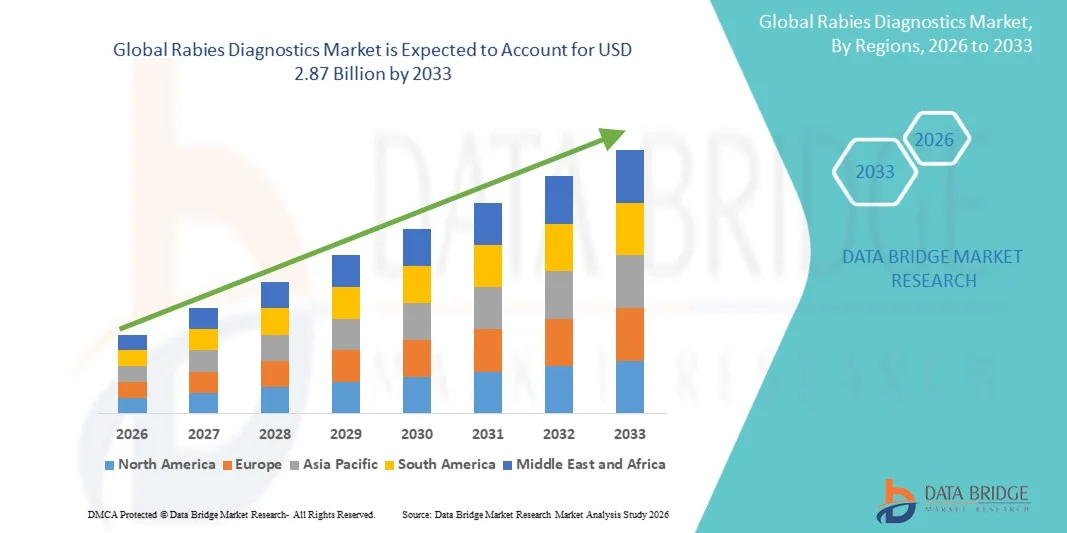
- The global rabies diagnostics market size was valued at USD 2.00 billion in 2025 and is expected to reach USD 2.87 billion by 2033, at a CAGR of 4.62% during the forecast period
- The market growth is largely fueled by the increasing prevalence of rabies infections and the growing need for accurate and early disease detection, leading to greater adoption of advanced rabies diagnostic technologies across hospitals, diagnostic laboratories, and veterinary clinics
- Furthermore, rising government initiatives for rabies surveillance and control programs, along with increasing awareness regarding zoonotic diseases and public health safety, is establishing rabies diagnostics as a critical component of infectious disease management. These converging factors are accelerating the uptake of Rabies Diagnostics solutions, thereby significantly boosting the industry's growth
Rabies Diagnostics Market Analysis
- Rabies diagnostics, encompassing advanced laboratory techniques for the detection of rabies virus infection in humans and animals, are becoming increasingly vital components of modern infectious disease surveillance and veterinary diagnostics due to their ability to enable rapid and accurate identification of rabies infections
- The escalating demand for rabies diagnostics is primarily fueled by the rising global burden of rabies cases, increasing awareness regarding zoonotic diseases, and the growing implementation of national rabies control and surveillance programs across both developed and emerging economies
- North America dominated the rabies diagnostics market with the largest revenue share of approximately 40.8% in 2025, supported by advanced healthcare and veterinary diagnostic infrastructure, strong public health surveillance systems, and the presence of leading diagnostic technology providers. The U.S. is experiencing substantial growth in rabies diagnostic testing across public health laboratories, veterinary clinics, and research institutions due to increasing surveillance initiatives and government-supported rabies prevention programs
- Asia-Pacific is expected to be the fastest-growing region in the rabies diagnostics market during the forecast period, registering a CAGR of approximately 9.4%, driven by increasing rabies incidence in several countries, expanding veterinary healthcare infrastructure, and growing government initiatives aimed at rabies elimination in countries such as India, China, and Southeast Asian nations
- The ELISA/Immunohistochemistry segment dominated the largest market revenue share of approximately 42.1% in 2025, driven by its widespread use in clinical laboratories and research institutions for detecting rabies virus antigens and antibodies
Report Scope and Rabies Diagnostics Market Segmentation
|
Attributes |
Rabies Diagnostics Key Market Insights |
|
Segments Covered |
|
|
Countries Covered |
North America
Europe
Asia-Pacific
Middle East and Africa
South America
|
|
Key Market Players |
• Thermo Fisher Scientific Inc. (U.S.) |
|
Market Opportunities |
|
|
Value Added Data Infosets |
In addition to the insights on market scenarios such as market value, growth rate, segmentation, geographical coverage, and major players, the market reports curated by the Data Bridge Market Research also include in-depth expert analysis, patient epidemiology, pipeline analysis, pricing analysis, and regulatory framework. |
Rabies Diagnostics Market Trends
“Increasing Adoption of Rapid and Molecular Diagnostic Technologies”
- A significant and accelerating trend in the global Rabies Diagnostics market is the growing adoption of advanced molecular and rapid diagnostic technologies that enable faster and more accurate detection of rabies infections in both humans and animals. These technologies are increasingly being implemented in clinical laboratories, veterinary hospitals, and public health institutions to improve disease surveillance and early diagnosis
- For instance, diagnostic assays developed by Thermo Fisher Scientific and Bio-Rad Laboratories provide advanced PCR-based solutions that allow laboratories to detect rabies virus genetic material with high sensitivity and accuracy
- Molecular diagnostic techniques such as reverse transcription polymerase chain reaction (RT-PCR) and real-time PCR are becoming widely adopted because they provide rapid and reliable results compared to traditional diagnostic methods. These technologies enable healthcare professionals and veterinary experts to identify infections quickly, which is critical for initiating timely treatment and controlling disease spread
- In addition, the development of portable diagnostic kits and point-of-care testing solutions is transforming rabies surveillance in remote and resource-limited regions. These diagnostic tools enable field veterinarians and public health workers to conduct testing outside centralized laboratories, improving response times during suspected outbreaks
- The integration of advanced diagnostic technologies with global disease surveillance programs is also strengthening rabies monitoring efforts. Public health organizations are increasingly utilizing modern diagnostic platforms to improve reporting accuracy and track infection trends across different regions
- As governments and international health organizations intensify efforts to eliminate rabies globally, the demand for rapid, accurate, and scalable diagnostic solutions is expected to continue increasing across healthcare and veterinary sectors
Rabies Diagnostics Market Dynamics
Driver
“Rising Prevalence of Rabies and Growing Focus on Disease Surveillance”
- The increasing incidence of rabies infections in several developing and emerging countries, combined with rising global awareness regarding zoonotic diseases, is a major driver supporting the growth of the rabies diagnostics market. Early detection of rabies infection is essential for timely post-exposure prophylaxis and effective disease management
- For instance, global health initiatives led by organizations such as World Health Organization and World Organisation for Animal Health promote large-scale rabies surveillance programs and diagnostic testing to support the global goal of eliminating dog-mediated rabies deaths
- Increasing government initiatives to strengthen veterinary healthcare infrastructure and disease monitoring programs are encouraging the adoption of advanced diagnostic technologies across veterinary clinics and public health laboratories
- Furthermore, the growing collaboration between international health organizations, research institutions, and veterinary services is improving access to rabies diagnostic tools and laboratory infrastructure in high-risk regions
- Rising public awareness regarding animal-borne diseases and increasing vaccination programs for pets and livestock are also contributing to the demand for reliable diagnostic solutions for early infection detection
- In addition, expanding investments in healthcare infrastructure and infectious disease research are supporting the development and adoption of advanced rabies diagnostic technologies worldwide
Restraint/Challenge
“Limited Diagnostic Infrastructure in Developing Regions”
- Limited access to advanced laboratory infrastructure and diagnostic technologies in several developing and rural regions remains a key challenge restricting the widespread adoption of rabies diagnostic tools. Many regions with high rabies prevalence lack adequate testing facilities and trained laboratory personnel
- For instance, reports from the World Health Organization indicate that several countries in Africa and parts of Asia face significant challenges in establishing reliable rabies surveillance and diagnostic systems due to limited healthcare resources
- In many rural areas, the lack of modern laboratory equipment and transportation challenges for biological samples can delay diagnostic confirmation, which may hinder timely treatment and disease containment
- In addition, the cost associated with advanced molecular diagnostic equipment and reagents can limit adoption in resource-constrained healthcare systems and veterinary laboratories
- Insufficient awareness about rabies diagnosis and limited training among healthcare workers and veterinary professionals can also impact the accurate detection and reporting of rabies cases
- Addressing these challenges will require increased government investment in diagnostic infrastructure, expanded training programs for healthcare professionals, and improved accessibility to affordable rabies diagnostic technologies globally
Rabies Diagnostics Market Scope
The Rabies Diagnostics market is segmented on the basis of diagnostic method, technology, and end user.
• By Diagnostic Method
On the basis of diagnostic method, the Rabies Diagnostics market is segmented into Fluorescent Antibody Test, Immunohistochemical Test, Amplification Methods, Histologic Examination, and Serology Tests. The Fluorescent Antibody Test segment dominated the largest market revenue share of approximately 38.7% in 2025, driven by its recognition as the gold standard method for rabies detection. This technique is widely used in laboratories for the direct detection of rabies virus antigens in brain tissue samples with high specificity and sensitivity. Public health laboratories and veterinary diagnostic centers frequently rely on this test due to its reliability and rapid turnaround time. The increasing incidence of rabies infections in animals and humans, particularly in developing regions, has significantly boosted demand for accurate diagnostic tools. Government health agencies and disease surveillance programs also recommend fluorescent antibody testing as a primary diagnostic method for rabies confirmation. Advancements in fluorescence microscopy and diagnostic reagents have further improved test accuracy and laboratory efficiency. In addition, the availability of standardized testing protocols and trained laboratory professionals supports the continued adoption of this method globally. North America and Europe dominate the segment due to well-established diagnostic infrastructure and strict disease monitoring systems. Increasing awareness regarding zoonotic diseases and improved veterinary healthcare systems further contribute to segment growth. The widespread acceptance of fluorescent antibody testing in both research and clinical diagnostics ensures its continued market leadership.
The Amplification Methods segment is expected to witness the fastest CAGR of 11.6% from 2026 to 2033, fueled by the increasing adoption of molecular diagnostic technologies such as polymerase chain reaction (PCR). Amplification-based techniques enable highly sensitive detection of rabies virus genetic material even in small sample quantities. These methods are particularly useful for early-stage detection and confirmatory diagnosis in complex clinical cases. Advances in molecular biology technologies and the availability of automated PCR platforms have significantly improved diagnostic speed and reliability. Hospitals, research laboratories, and diagnostic centers are increasingly incorporating amplification-based testing into routine rabies diagnosis protocols. The rising demand for rapid and accurate molecular diagnostics in infectious disease surveillance further supports segment growth. In addition, the growing focus on preventing zoonotic disease outbreaks and improving public health preparedness is encouraging the adoption of advanced diagnostic tools. Increasing investments in molecular diagnostic infrastructure across emerging economies are also accelerating adoption. Furthermore, technological improvements in nucleic acid amplification techniques and portable diagnostic platforms are expanding the use of molecular diagnostics in field and point-of-care settings.
• By Technology
On the basis of technology, the Rabies Diagnostics market is segmented into ELISA/Immunohistochemistry, Chromatography Techniques, PCR, and Others. The ELISA/Immunohistochemistry segment dominated the largest market revenue share of approximately 42.1% in 2025, driven by its widespread use in clinical laboratories and research institutions for detecting rabies virus antigens and antibodies. ELISA-based diagnostic tests are highly reliable and allow large numbers of samples to be processed simultaneously, making them suitable for mass screening and epidemiological studies. Immunohistochemistry techniques are also commonly used to visualize rabies virus antigens in infected tissue samples. Hospitals and veterinary diagnostic laboratories frequently adopt these technologies due to their accuracy and cost-effectiveness. Growing demand for immunoassay-based diagnostic kits in infectious disease detection further supports segment growth. Technological advancements in enzyme-linked immunoassays have improved sensitivity, reproducibility, and testing efficiency. Government health agencies and disease monitoring organizations also utilize ELISA-based assays for large-scale rabies surveillance programs. The increasing focus on zoonotic disease control and expanding veterinary diagnostic infrastructure worldwide further contribute to the segment’s dominance. In addition, improved laboratory automation and digital analysis systems enhance the efficiency of ELISA and immunohistochemistry techniques.
The PCR segment is expected to witness the fastest CAGR of 12.4% from 2026 to 2033, driven by the growing demand for advanced molecular diagnostic technologies capable of detecting rabies virus with high sensitivity and specificity. PCR-based testing enables rapid amplification and detection of viral genetic material, allowing accurate diagnosis even in early stages of infection. Research laboratories and advanced diagnostic centers increasingly rely on PCR platforms for confirmatory rabies testing and epidemiological studies. Technological advancements in real-time PCR and automated molecular diagnostic systems have improved testing speed and reliability. Increasing investments in molecular diagnostic infrastructure and laboratory modernization further support segment growth. The rising global focus on improving infectious disease detection and pandemic preparedness is also accelerating adoption. In addition, the growing availability of portable PCR devices and point-of-care molecular diagnostic tools is expanding the use of PCR-based rabies diagnostics in remote and resource-limited settings.
• By End User
On the basis of end user, the Rabies Diagnostics market is segmented into Hospitals, Diagnostic Centers, Cancer Palliative Care Clinics, and Pharmacies. The Hospitals segment dominated the largest market revenue share of approximately 45.3% in 2025, due to the high number of suspected rabies cases diagnosed and treated in hospital settings. Hospitals are equipped with advanced laboratory infrastructure, trained healthcare professionals, and specialized diagnostic facilities required for accurate disease detection. Patients presenting with symptoms of rabies infection are typically referred to hospitals for confirmatory testing and immediate medical intervention. The increasing prevalence of rabies infections, particularly in regions with high animal bite incidents, has significantly increased diagnostic demand in hospital laboratories. Hospitals also play a crucial role in disease surveillance, reporting, and patient management in collaboration with public health authorities. The availability of advanced diagnostic equipment and integrated healthcare systems supports efficient testing and treatment workflows. In addition, hospitals often participate in research and clinical trials focused on improving rabies detection and prevention strategies. Rising healthcare investments and expanding hospital infrastructure globally further support the segment’s market leadership.
The Diagnostic Centers segment is expected to witness the fastest CAGR of 10.8% from 2026 to 2033, driven by the increasing demand for specialized diagnostic services and laboratory testing. Independent diagnostic laboratories and imaging centers are expanding their infectious disease testing capabilities, including rabies diagnostics. These facilities offer efficient testing services, shorter waiting times, and advanced diagnostic technologies, making them an attractive option for patients and healthcare providers. Increasing awareness regarding early disease detection and improved access to laboratory testing services are contributing to higher patient volumes in diagnostic centers. Technological advancements in molecular diagnostics and immunoassays further enhance the testing capabilities of these facilities. The expansion of private healthcare services and laboratory networks across emerging economies is also driving segment growth. In addition, partnerships between hospitals, public health agencies, and private diagnostic laboratories are strengthening disease surveillance and diagnostic capacity worldwide.
Rabies Diagnostics Market Regional Analysis
- North America dominated the rabies diagnostics market with the largest revenue share of approximately 40.8% in 2025, supported by advanced healthcare and veterinary diagnostic infrastructure, strong public health surveillance systems, and the presence of leading diagnostic technology providers. The region has well-established laboratory networks, government-supported disease monitoring programs, and strong collaboration between healthcare institutions and veterinary authorities, which significantly strengthens rabies detection and surveillance efforts. In addition, increasing investments in infectious disease diagnostics and growing adoption of molecular diagnostic technologies across public health laboratories further support regional market growth
- Public health authorities and veterinary institutions across the region are increasingly emphasizing early rabies detection and surveillance programs to reduce disease transmission and support prevention strategies. For instance, organizations such as the Centers for Disease Control and Prevention and the World Health Organization actively support rabies surveillance, laboratory testing initiatives, and vaccination campaigns aimed at controlling rabies infections in both humans and animals
- Furthermore, the rising focus on zoonotic disease monitoring and growing collaboration between public health agencies and research institutions are strengthening the adoption of advanced rabies diagnostic technologies across hospitals, veterinary clinics, and specialized diagnostic laboratories. The increasing availability of molecular diagnostic tools, improved laboratory infrastructure, and rising awareness regarding early disease detection are also contributing to the expansion of the rabies diagnostics market in North America
U.S. Rabies Diagnostics Market Insight
The U.S. rabies diagnostics market captured the largest revenue share of approximately 81% in 2025 within North America, primarily driven by strong public health infrastructure, extensive disease monitoring programs, and widespread availability of advanced diagnostic laboratories. The country has a highly developed healthcare and veterinary diagnostic ecosystem that supports rapid detection and reporting of rabies cases. Increasing investments in infectious disease research, the presence of leading biotechnology and diagnostic companies, and the growing use of molecular diagnostic technologies such as PCR-based assays are further strengthening market growth. Additionally, ongoing government initiatives focused on rabies elimination and animal vaccination programs continue to support the expansion of rabies diagnostic testing across veterinary clinics, research laboratories, and public health institutions.
Europe Rabies Diagnostics Market Insight
The Europe rabies diagnostics market is projected to expand at a substantial CAGR throughout the forecast period, supported by strong public health policies, advanced veterinary healthcare systems, and increasing awareness regarding zoonotic diseases. Many European countries maintain rigorous rabies surveillance programs and mandatory animal vaccination policies, which contribute to the demand for reliable diagnostic technologies. In addition, rising investments in laboratory infrastructure and infectious disease monitoring programs are strengthening diagnostic capabilities across the region. Collaborative initiatives among research institutions, veterinary organizations, and public health agencies are also promoting the development and adoption of advanced rabies diagnostic solutions across hospitals, veterinary laboratories, and research centers.
U.K. Rabies Diagnostics Market Insight
The U.K. rabies diagnostics market is anticipated to grow at a noteworthy CAGR during the forecast period, driven by strong public health monitoring systems and the country’s focus on maintaining rabies-free status through strict surveillance and import control policies. Government authorities and veterinary agencies closely monitor potential rabies risks associated with wildlife and international animal travel. In addition, the country’s advanced healthcare infrastructure and well-established research institutions support the adoption of modern diagnostic technologies for infectious disease detection. Continuous research activities in virology and zoonotic disease surveillance further contribute to the expansion of rabies diagnostic capabilities across the U.K.
Germany Rabies Diagnostics Market Insight
The Germany rabies diagnostics market is expected to expand at a considerable CAGR during the forecast period, supported by the country’s strong biomedical research ecosystem, well-developed veterinary healthcare infrastructure, and increasing investments in infectious disease diagnostics. Germany hosts several leading research institutes and biotechnology companies actively engaged in developing advanced diagnostic tools for viral infections. In addition, the country’s strict animal health regulations and strong disease monitoring systems contribute to the continued demand for accurate rabies diagnostic testing across veterinary clinics, public health laboratories, and academic research institutions.
Asia-Pacific Rabies Diagnostics Market Insight
The Asia-Pacific rabies diagnostics market is poised to grow at the fastest CAGR of approximately 9.4% during the forecast period, driven by increasing rabies incidence in several countries, expanding veterinary healthcare infrastructure, and growing government initiatives aimed at rabies elimination. Rapid population growth, rising awareness regarding zoonotic diseases, and increasing investment in healthcare and veterinary services are significantly strengthening diagnostic capabilities across the region. Governments and international health organizations are also launching large-scale vaccination and disease surveillance programs to reduce rabies-related mortality. As a result, the demand for advanced diagnostic technologies across hospitals, veterinary clinics, and research laboratories is expected to increase significantly in Asia-Pacific.
Japan Rabies Diagnostics Market Insight
The Japan rabies diagnostics market is gaining momentum due to the country’s strong healthcare infrastructure, advanced research capabilities, and strict animal disease control policies. Although rabies cases remain extremely rare in Japan, continuous monitoring and surveillance programs are maintained to prevent potential outbreaks. The country’s highly developed biomedical research sector supports the development and use of sophisticated diagnostic technologies for infectious disease detection. In addition, government policies emphasizing disease prevention, laboratory testing, and international animal quarantine regulations contribute to sustained demand for rabies diagnostic solutions in Japan.
China Rabies Diagnostics Market Insight
The China rabies diagnostics market accounted for the largest market revenue share in Asia-Pacific in 2025, attributed to the country’s large population, increasing prevalence of rabies in certain rural areas, and expanding veterinary healthcare infrastructure. China has been actively strengthening rabies surveillance and vaccination programs to reduce infection rates and improve public health safety. Growing government investment in healthcare infrastructure, the expansion of diagnostic laboratories, and the increasing adoption of molecular diagnostic technologies are further supporting market growth. In addition, collaborations between public health institutions, research organizations, and veterinary agencies are improving access to rabies diagnostic testing across both urban and rural regions of the country.
Rabies Diagnostics Market Share
The Rabies Diagnostics industry is primarily led by well-established companies, including:
• Thermo Fisher Scientific Inc. (U.S.)
• Merck KGaA (Germany)
• Bio-Rad Laboratories, Inc. (U.S.)
• BD (U.S.)
• Abbott (U.S.)
• Agilent Technologies, Inc. (U.S.)
• QIAGEN N.V. (Netherlands)
• Roche Diagnostics (Switzerland)
• Siemens Healthineers AG (Germany)
• Danaher Corporation (U.S.)
• Zoetis Inc. (U.S.)
• IDEXX Laboratories, Inc. (U.S.)
• Mindray Bio-Medical Electronics Co., Ltd. (China)
• GenScript Biotech Corporation (China)
• Fujifilm Holdings Corporation (Japan)
• Shimadzu Corporation (Japan)
• Hologic, Inc. (U.S.)
• PerkinElmer Inc. (U.S.)
• Charles River Laboratories (U.S.)
• Lonza Group AG (Switzerland)
Latest Developments in Global Rabies Diagnostics Market
- In May 2022, Bio‑Rad Laboratories announced the launch of the CFX Duet Real-Time PCR System, a molecular diagnostic platform designed to support highly sensitive nucleic-acid detection assays, including those used for rabies virus identification. The system incorporates enhanced thermal performance, gradient functionality, and improved optical detection capabilities, enabling laboratories to develop more reliable quantitative PCR-based rabies diagnostic tests and strengthen infectious disease surveillance programs
- In March 2023, IDEXX Laboratories introduced a rapid rabies diagnostic test designed to deliver results in approximately 30 minutes for veterinary and clinical laboratory settings. The test was developed to accelerate rabies detection and improve decision-making in animal health diagnostics, particularly in veterinary clinics and surveillance programs focused on zoonotic disease control
- In February 2024, BioStone Animal Health launched the AsurDx Rabies Antibody Test Kit, an ELISA-based diagnostic assay that detects rabies virus-specific antibodies in mammalian serum samples. The kit provides rapid and cost-effective evaluation of immunity levels in animals and helps determine whether additional vaccination is required to maintain protective immunity against rabies infection
- In June 2024, Zoetis expanded its rabies diagnostic portfolio through the acquisition of a molecular diagnostics company, strengthening its capabilities in advanced veterinary disease detection technologies. The acquisition was aimed at improving rabies and zoonotic disease testing accuracy and expanding diagnostic service capabilities in veterinary laboratories worldwide
- In January 2025, Thermo Fisher Scientific partnered with a global health organization to deploy rabies diagnostic solutions in underserved regions, supporting large-scale rabies surveillance and control programs. The initiative focused on improving access to accurate diagnostic testing in regions with limited laboratory infrastructure and strengthening global efforts toward rabies elimination

- Interactive Data Analysis Dashboard
- Company Analysis Dashboard for high growth potential opportunities
- Research Analyst Access for customization & queries
- Competitor Analysis with Interactive dashboard
- Latest News, Updates & Trend analysis
- Harness the Power of Benchmark Analysis for Comprehensive Competitor Tracking
Data collection and base year analysis are done using data collection modules with large sample sizes. The stage includes obtaining market information or related data through various sources and strategies. It includes examining and planning all the data acquired from the past in advance. It likewise envelops the examination of information inconsistencies seen across different information sources. The market data is analysed and estimated using market statistical and coherent models. Also, market share analysis and key trend analysis are the major success factors in the market report. To know more, please request an analyst call or drop down your inquiry.
The key research methodology used by DBMR research team is data triangulation which involves data mining, analysis of the impact of data variables on the market and primary (industry expert) validation. Data models include Vendor Positioning Grid, Market Time Line Analysis, Market Overview and Guide, Company Positioning Grid, Patent Analysis, Pricing Analysis, Company Market Share Analysis, Standards of Measurement, Global versus Regional and Vendor Share Analysis. To know more about the research methodology, drop in an inquiry to speak to our industry experts.
Data Bridge Market Research is a leader in advanced formative research. We take pride in servicing our existing and new customers with data and analysis that match and suits their goal. The report can be customized to include price trend analysis of target brands understanding the market for additional countries (ask for the list of countries), clinical trial results data, literature review, refurbished market and product base analysis. Market analysis of target competitors can be analyzed from technology-based analysis to market portfolio strategies. We can add as many competitors that you require data about in the format and data style you are looking for. Our team of analysts can also provide you data in crude raw excel files pivot tables (Fact book) or can assist you in creating presentations from the data sets available in the report.













