


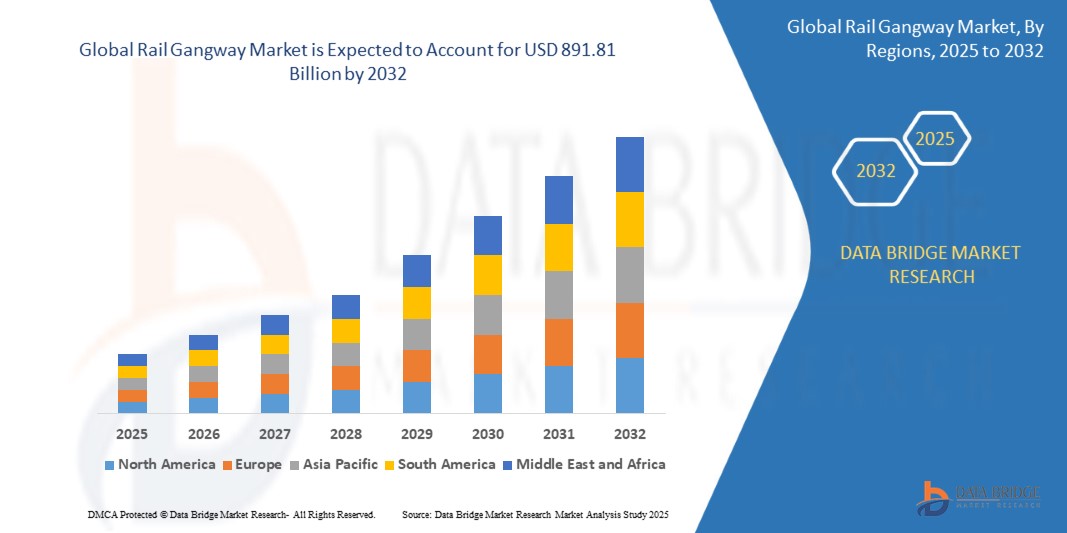
What is the Global Rail Gangway Market Size and Growth Rate?
- The global rail gangway market size was valued at USD 589.99 billion in 2024 and is expected to reach USD 891.81 billion by 2032, at a CAGR of 5.30% during the forecast period
- Rise in the rapid expansion of the metro network is a crucial factor accelerating the market growth, also increase in the passenger transportation through railways and growing urbanization across the globe are the major factors among others boosting the rail gangways market
- Moreover, rise in the research and development activities in the market will further create new opportunities for rail gangways market in the forecast period mentioned above
What are the Major Takeaways of Rail Gangway Market?
- Various data center companies have invested highly in hyper-scale data centers, which will be expected to generate lucrative market growth opportunities. Last year, Equinix announced plans to construct around 32 hyper-scale data centers in a few major markets in Europe
- With a total capacity of around 600 megawatts and above USD 6.9 billion in investment, the company goals to gain a better position in the rising landscape of hyper-scale data centers. Such growth in the region's data centers will increase the demand for the region's HCI market
- North America dominated the rail gangway market with the largest revenue share of 33.64% in 2024, driven by substantial investments in passenger rail infrastructure and the refurbishment of aging rail fleets
- Asia-Pacific rail gangway market is anticipated to register the fastest CAGR of 11.47% from 2025 to 2032, owing to increasing rail electrification, urban transit growth, and rapid infrastructure development
- The single piece gangway segment dominated the rail gangway market with the largest revenue share of 57.4% in 2024, primarily due to its structural integrity, reduced maintenance, and enhanced safety in high-speed applicationss
Report Scope and Rail Gangway Market Segmentation
|
Attributes |
Rail Gangway Key Market Insights |
|
Segments Covered |
|
|
Countries Covered |
North America
Europe
Asia-Pacific
Middle East and Africa
South America
|
|
Key Market Players |
|
|
Market Opportunities |
|
|
Value Added Data Infosets |
In addition to the insights on market scenarios such as market value, growth rate, segmentation, geographical coverage, and major players, the market reports curated by the Data Bridge Market Research also include in-depth expert analysis, pricing analysis, brand share analysis, consumer survey, demography analysis, supply chain analysis, value chain analysis, raw material/consumables overview, vendor selection criteria, PESTLE Analysis, Porter Analysis, and regulatory framework. |
What is the Key Trend in the Rail Gangway Market?
“Modular Design and Lightweight Materials for Improved Performance”
- A notable trend shaping the global rail gangway market is the shift toward modular gangway systems constructed from lightweight yet durable materials such as aluminum alloys and composite polymers. This design innovation improves performance, enhances fuel efficiency, and simplifies maintenance across rail systems
- For instance, HÜBNER GmbH & Co. KG introduced a modular gangway system that allows faster installation and easier replacement of damaged components, reducing downtime and improving operational efficiency
- These modular gangways are designed for customizability and retrofitting, allowing rail operators to upgrade older fleets with modern features such as noise insulation, weather resistance, and improved passenger safety
- Lightweight materials reduce overall train weight, contributing to lower energy consumption and enabling compliance with sustainability regulations in regions such as Europe and North America
- Companies such as Dellner Couplers AB and ATG Autotechnik GmbH are actively developing next-gen gangway systems that align with smart train standards and sustainability goals
- This trend is expected to redefine product development in the rail gangway market, as rail operators seek modular, efficient, and environmentally friendly solutions for enhanced passenger experience
What are the Key Drivers of Rail Gangway Market?
- Rising investments in urban rail transit and intercity rail infrastructure, particularly in Asia-Pacific and Europe, are key drivers accelerating rail gangway market growth. Expanding metro networks and refurbishment of older rolling stock necessitate modern gangway systems that enhance safety and connectivity
- For instance, in February 2023, CAF secured a contract to supply new metro trains in Naples, Italy, each equipped with state-of-the-art gangway systems to enhance passenger flow and safety
- The increasing focus on passenger comfort, accessibility, and safety is compelling manufacturers to design gangways that ensure seamless inter-car movement, minimize vibrations, and offer fire resistance
- Rail operators are demanding customized gangway systems that are compatible with varying train configurations, thereby driving demand across commuter, high-speed, and light rail applications
- Moreover, the need for energy-efficient solutions and sustainable materials is pushing innovation in the design and construction of gangways, aligning with global environmental regulations and operator requirements
- Together, these factors create a favorable environment for sustained market growth, particularly in fast-growing regions and technologically evolving rail systems
Which Factor is challenging the Growth of the Rail Gangway Market?
- One of the major challenges facing the rail gangway market is the high cost and complexity associated with the development, customization, and integration of gangway systems in railcars. The need for tailor-made gangways based on train specifications, climate conditions, and safety norms increases design and production expenses
- For instance, specialized gangways for high-speed rail or articulated metro trains require intensive engineering and rigorous testing, leading to longer lead times and higher operational costs for OEMs and transit authorities
- The limited standardization across global rail networks further complicates production, as manufacturers must develop gangway models that meet diverse regulations and structural designs
- In addition, in developing regions with tight transportation budgets, the upfront cost of advanced gangway systems can deter adoption, with preference given to low-cost or legacy solutions that lack modern safety and comfort features
- Companies must also contend with technical challenges, such as ensuring air-tight sealing, noise reduction, and durability under varying environmental conditions
- To overcome these obstacles, manufacturers need to invest in cost-effective modular solutions, universal design standards, and scalable manufacturing processes to improve affordability and drive wider market acceptance
How is the Rail Gangway Market Segmented?
The market is segmented on the basis of product type, material type, and train type.
• By Product Type
On the basis of product type, the rail gangway market is segmented into Single Piece Gangway and Two Piece Gangway. The Single Piece Gangway segment dominated the rail gangway market with the largest revenue share of 57.4% in 2024, primarily due to its structural integrity, reduced maintenance, and enhanced safety in high-speed applications. These gangways are commonly preferred in modern railcars for their sealed construction, offering superior protection against weather and external elements.
The Two Piece Gangway segment is expected to witness the fastest growth rate from 2025 to 2032, driven by increasing deployment in commuter and metro trains where modularity and cost-efficiency are key considerations. Their flexible design allows for easy installation and maintenance, making them attractive to operators seeking scalable and replaceable components.
• By Material Type
On the basis of material type, the rail gangway market is segmented into Steel, Aluminium, Alloys, and Composites. The Steel segment held the largest revenue share of 41.6% in 2024, attributed to its strength, durability, and long lifecycle under demanding rail conditions. Steel-based gangways are widely used in long-distance and freight trains where mechanical robustness is critical.
The Composites segment is anticipated to register the fastest CAGR during 2025–2032, driven by rising demand for lightweight materials that enhance energy efficiency and reduce overall train weight. Composites offer superior corrosion resistance and design flexibility, which is encouraging their adoption in advanced and high-speed rail applications.
• By Train Type
On the basis of train type, the rail gangway market is segmented into Passenger Train, Metro/Subway Train, High-Speed Train, and Special Train. The Passenger Train segment accounted for the largest market share of 36.9% in 2024, supported by the high global volume of intercity and regional passenger services using gangway systems to enable movement between carriages while ensuring safety and comfort.
The High-Speed Train segment is projected to witness the fastest growth rate from 2025 to 2032, spurred by increasing investments in bullet train projects and dedicated corridors globally. The demand for advanced gangway systems in high-speed trains focuses on aerodynamic performance, lightweight construction, and noise insulation, making it a key area of innovation and investment.
Which Region Holds the Largest Share of the Rail Gangway Market?
- North America dominated the rail gangway market with the largest revenue share of 33.64% in 2024, driven by substantial investments in passenger rail infrastructure and the refurbishment of aging rail fleets
- The region’s strong presence of OEMs and Tier 1 suppliers, combined with government-led railway modernization programs, continues to fuel demand for durable and safe gangway systems
- In addition, the increased adoption of high-speed trains and a focus on enhanced passenger safety and comfort have made rail gangways a critical component in the modernization of train carriages across North America
U.S. Rail Gangway Market Insight
The U.S. rail gangway market dominated North America’s revenue share in 2024, primarily due to the expansion of intercity rail networks and commuter transit systems. The emphasis on passenger mobility, coupled with rising investments in smart rail infrastructure, has led to higher adoption of single-piece and two-piece gangways in both regional and metro trains. Furthermore, initiatives such as Amtrak’s fleet modernization and transit developments in cities such as New York, Chicago, and San Francisco are driving steady demand for advanced gangway systems.
Europe Rail Gangway Market Insight
The Europe rail gangway market is projected to grow at a significant CAGR during the forecast period, bolstered by the EU’s investments in trans-European rail corridors and sustainability goals. Strong rail networks in countries such as Germany, France, and Italy—combined with increasing demand for energy-efficient and safer train designs—are accelerating gangway integration across passenger fleets. The focus on reducing carbon emissions and enhancing public transit has led to high adoption of composite material gangways in both existing and new rolling stock.
U.K. Rail Gangway Market Insight
The U.K. rail gangway market is poised for notable growth, supported by ongoing rail infrastructure upgrades under projects such as HS2 and Crossrail. Demand is particularly strong in metro and suburban train systems, where two-piece gangways offer flexible connectivity and enhanced passenger movement between coaches. As part of its strategy to decarbonize transport and modernize fleets, the U.K. is increasingly integrating gangways that comply with advanced safety and accessibility standards.
Germany Rail Gangway Market Insight
The Germany rail gangway market is expected to grow steadily, driven by the country's leadership in railway engineering and innovation. With Deutsche Bahn’s ongoing fleet renewals and investments in high-speed rail expansion, the demand for lightweight, durable, and crashworthy gangways is rising. German manufacturers are focusing on aluminum and composite gangways that meet both safety norms and sustainability requirements, strengthening the country’s role in shaping EU rail technologies.
Which Region is the Fastest Growing Region in the Rail Gangway Market?
Asia-Pacific rail gangway market is anticipated to register the fastest CAGR of 11.47% from 2025 to 2032, owing to increasing rail electrification, urban transit growth, and rapid infrastructure development. Countries such as China, Japan, and India are heavily investing in metro and high-speed rail systems, leading to significant demand for efficient and reliable gangway solutions. The presence of large-scale OEMs and government initiatives promoting mass transit solutions are making Asia-Pacific a key region for both production and consumption of rail gangways.
Japan Rail Gangway Market Insight
The Japan rail gangway market is expanding rapidly due to the country’s advanced railway technologies and focus on commuter safety and convenience. With Shinkansen and urban rail lines continuously evolving, demand for high-performance gangways that ensure passenger stability at high speeds is rising. In addition, the growing senior population is prompting a push for gangway designs that offer better accessibility and comfort, particularly in metro and suburban trains.
China Rail Gangway Market Insight
The China rail gangway market held the largest share in Asia-Pacific in 2024, backed by massive investments in metro rail, intercity high-speed trains, and urban transit systems. Local manufacturers are innovating rapidly, offering cost-effective gangways with improved safety, modularity, and compatibility with evolving train designs. The push for smart urbanization and green mobility, coupled with a robust domestic supply chain, continues to make China a key growth engine in the global rail gangway industry.
Which are the Top Companies in Rail Gangway Market?
The rail gangway industry is primarily led by well-established companies, including:
- HÜBNER GmbH & Co. KG (Germany)
- Narita Mfg., Ltd (U.S.)
- Airflow Equipments PVT. Limited (India)
- Dellner Couplers AB (Switzerland)
- Schliess- und Sicherungssysteme GmbH (Germany)
- HUTCHINSON (U.S.)
- ATG Autotechnik GmbH (Germany)
- Bellow & Bus (Pty) Ltd (China)
What are the Recent Developments in Global Rail Gangway Market?
- In October 2024, HÜBNER Group unveiled the world’s first AutoCouple System for automated gangway coupling, aimed at improving flexibility, efficiency, and safety in passenger train operations. The system, introduced at InnoTrans 2024, significantly reduces operational time, cost, and energy, while enabling both retrofits and new vehicle integrations. This innovation marks a transformative leap in automated rail coupling technology
- In September 2024, HÜBNER’s AutoCouple system, set to launch in Canada by 2025, was introduced to optimize coupling time in Toronto Subway operations. It reduces gangway coupling time from 30 minutes to just 5 minutes, enhancing fleet adaptability, cost savings, and operational ease. This development sets a new benchmark for rail efficiency in North American urban transit
- In November 2020, Hitachi ABB Power Grids signed a five-year agreement with Dubai Electricity and Water Authority (DEWA) to deliver integrated energy solutions. The deal includes the supply, installation, testing, and commissioning of 15 new substations and upgrades to 18 existing ones using its MicroSCADA system for improved control, measurement, and supervision. This strategic move strengthens Dubai’s power infrastructure and digital resilience

- Interactive Data Analysis Dashboard
- Company Analysis Dashboard for high growth potential opportunities
- Research Analyst Access for customization & queries
- Competitor Analysis with Interactive dashboard
- Latest News, Updates & Trend analysis
- Harness the Power of Benchmark Analysis for Comprehensive Competitor Tracking
Data collection and base year analysis are done using data collection modules with large sample sizes. The stage includes obtaining market information or related data through various sources and strategies. It includes examining and planning all the data acquired from the past in advance. It likewise envelops the examination of information inconsistencies seen across different information sources. The market data is analysed and estimated using market statistical and coherent models. Also, market share analysis and key trend analysis are the major success factors in the market report. To know more, please request an analyst call or drop down your inquiry.
The key research methodology used by DBMR research team is data triangulation which involves data mining, analysis of the impact of data variables on the market and primary (industry expert) validation. Data models include Vendor Positioning Grid, Market Time Line Analysis, Market Overview and Guide, Company Positioning Grid, Patent Analysis, Pricing Analysis, Company Market Share Analysis, Standards of Measurement, Global versus Regional and Vendor Share Analysis. To know more about the research methodology, drop in an inquiry to speak to our industry experts.
Data Bridge Market Research is a leader in advanced formative research. We take pride in servicing our existing and new customers with data and analysis that match and suits their goal. The report can be customized to include price trend analysis of target brands understanding the market for additional countries (ask for the list of countries), clinical trial results data, literature review, refurbished market and product base analysis. Market analysis of target competitors can be analyzed from technology-based analysis to market portfolio strategies. We can add as many competitors that you require data about in the format and data style you are looking for. Our team of analysts can also provide you data in crude raw excel files pivot tables (Fact book) or can assist you in creating presentations from the data sets available in the report.













