What is the Railway Fishplates Market Size and Growth Rate?
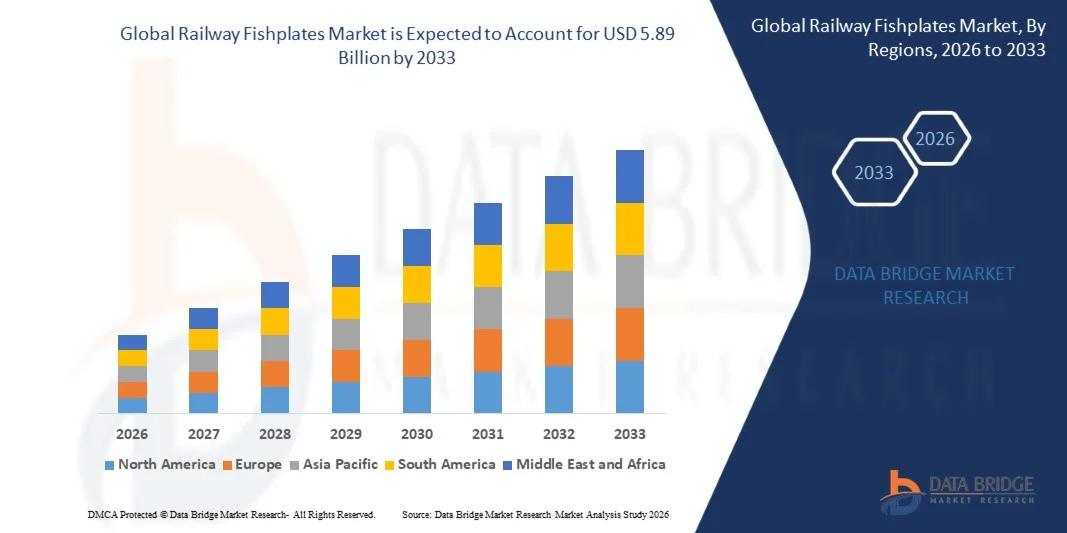
- As per Data Bridge Market Research analysis, the railway fishplates market was valued at USD 4.64 billion in 2025 and is projected to reach USD 5.89 billion by 2033, growing at a CAGR of 3.03% from 2026 to 2033.
- The market is experiencing consistent growth driven by rising railway infrastructure investments, increasing demand for durable and reliable track components, and expanding railway modernization and maintenance activities across passenger, freight, and high-speed rail networks.
- The increasing expansion of railway networks globally, combined with government investments in high-speed rail, urban transit, and railway infrastructure modernization, is compelling railway operators and infrastructure developers to adopt reliable fishplates for secure rail joining and track stability. Conventional steel fishplates remain widely used, while advancements in high-strength and corrosion-resistant materials are supporting longer service life, improved safety, and reduced railway maintenance requirements.
Market Size & Forecast
- Global Market Value (2025): USD 4.64 Billion
- Expected Market Value (2033): USD 5.89 Billion
- Forecast CAGR (2026–2033): 3.03%
- Leading Region in 2025: North America
- Fastest Growing Region: Asia Pacific
What are the Major Takeaways of the Railway Fishplates Market?
- North America dominated the railway fishplates market with the largest revenue share of 36.5% in 2025, supported by established railway infrastructure, extensive freight rail networks, and ongoing track maintenance and replacement activities.
- Asia-Pacific is expected to be the fastest-growing region at a CAGR of 4.2% from 2026 to 2033, fueled by rapid railway network expansion, high-speed rail investments, urban transit development, and infrastructure modernization across China, India, and Japan.
- The common rail joint segment led the market with a 45% share in 2025, driven by its widespread use for connecting rails of the same section and its established application across conventional railway networks.
- Insulated rail joint are the fastest-growing rail joint type, projected to register a CAGR of 4.0%, reflecting the surge in deployment of railway signaling and track-circuit systems that require electrical isolation between adjoining rail sections.
- The carbon steel segment dominated the material type category with a 60% revenue share in 2025, led by its high strength, durability, cost-effectiveness, and extensive use in conventional railway track applications
- Heavy rail accounted for 55% of the market share in 2025, preferred by extensive utilization across freight railways, mainline passenger networks, and high-load railway corridors.
- The high-speed rail segment is the fastest-growing application category, with a CAGR of 4.5%, driven by increasing investments in high-speed railway networks and modernization of existing passenger rail infrastructure.
Report Scope and Railway Fishplates Market Segmentation
|
Attributes |
Railway Fishplates Key Market Insights |
|
Segments Covered |
|
|
Countries Covered |
North America
Europe
Asia-Pacific
Middle East and Africa
South America
|
|
Key Market Players |
|
|
Market Opportunities |
|
|
Value Added Data Infosets |
In addition to the market insights such as market value, growth rate, market segments, geographical coverage, market players, and market scenario, the market report curated by the Data Bridge Market Research team includes in-depth expert analysis, import/export analysis, pricing analysis, production consumption analysis, and pestle analysis. |
What is the Key Trend in the Railway Fishplates Market?
- Railway operators are increasingly adopting advanced fishplate designs and stronger rail-joint systems to improve track stability, accommodate heavier axle loads, and extend the service life of railway infrastructure while reducing maintenance requirements.
- For instance, in January 2025, Exel Composites achieved certification for its glass-fibre composite fishplate rail joints under the updated European Standard EN 16843 after mechanical and electrical testing in Finland, highlighting the growing adoption of composite fishplates for reliable and electrically insulated rail connections
- The development of combination, insulated, and joggled fishplates is enabling railway infrastructure operators to address different rail profiles, signaling requirements, and specialized track configurations.
- Digital monitoring and predictive maintenance technologies are increasingly being integrated with rail-joint management to identify bolt preload loss, joint deterioration, and potential failures before they affect railway operations.
- For instance, in August 2026, International Railway Journal reported research showing that Rayleigh-wave technology can detect and characterize fatigue cracks in fishplates, addressing defects caused by repeated dynamic loading and increasing axle loads that can be difficult to identify through conventional visual inspection
- As railway networks increasingly prioritize higher axle loads, faster train operations, stronger rail connections, and predictive maintenance, manufacturers are expected to focus on high-performance fishplates and digitally supported rail-joint monitoring solutions, reinforcing advanced joint technology as a key direction in the railway fishplates market.
What are the Key Drivers of the Railway Fishplates Market?
- The rapid expansion and modernization of railway infrastructure worldwide is significantly increasing demand for fishplates and other rail-joint components required for track renewal, replacement, and maintenance activities.
- For instance, in January 2026, the Ministry of Railways reported that Indian Railways had completed track renewal across 6,851 km during 2024–25, with more than 7,500 km underway in 2025–26 and another 7,900 km planned over the following two years, demonstrating sustained demand for rail-track components used in renewal and maintenance activities.
- Rising investments in high-speed rail, freight corridors, metro systems, and railway electrification are encouraging infrastructure developers to deploy reliable rail-joint components capable of maintaining track alignment and structural integrity under demanding operating conditions.
- Growing emphasis on railway safety, track reliability, and preventive maintenance is further supporting demand for fishplates as operators replace damaged joints and upgrade conventional rail connections to improve service performance.
- For instance, in March 2026, the Ministry of Railways reported that approximately 54,600 km of railway track had been renewed between 2014 and February 2026, while modern track structures using heavier 60-kg rails, improved fastening systems, and mechanized maintenance technologies were being adopted to improve track reliability and safety
- With governments and railway operators continuing to invest in track renewal, network modernization, higher-speed operations, and infrastructure safety, demand for durable fishplates is expected to remain strong as rail networks expand and existing infrastructure undergoes systematic replacement and upgrading.
What Factors are Challenging the Growth of the Railway Fishplates Market?
- Railway fishplates require regular inspection, correct fastening, proper installation, and maintenance to prevent joint deterioration, increasing the operational and maintenance burden for railway infrastructure operators.
- For instance, in September 2025, Network Rail issued a safety bulletin after an ultrasonic inspection identified a track joint on the Cumbrian Coast line where all bolts and fishplates had detached from the rail, highlighting the maintenance, inspection, and replacement requirements associated with fishplate joints.
- Improper bolt preload, rail-joint deterioration, and repeated mechanical loading can cause joint instability, increased rail deflection, and cracking around bolt holes, creating safety concerns and increasing maintenance requirements.
- The need for specialized maintenance practices, skilled personnel, and periodic replacement can increase the lifecycle cost of fish-plated railway joints, particularly on heavily trafficked networks exposed to repeated loading and demanding operating conditions.
- For instance, in August 2026, International Railway Journal reported that research on 32 defective fishplates from North American freight railways identified fatigue cracking caused by repeated dynamic loading and increasing axle loads, while conventional inspection methods can struggle to detect cracks in inaccessible areas of fishplates.
- These maintenance and reliability requirements can increase operational expenditure and inspection complexity, encouraging railway operators to adopt stronger fishplate designs, improved fastening systems, and predictive monitoring technologies to reduce failures and minimize track-maintenance disruptions.
How is the Railway Fishplates Market Segmented?
The railway fishplates market is segmented on the basis of rail joint type, material type, rail type, and application.
- By Rail Joint Type
On the basis of rail joint type, the railway fishplates market is segmented into common rail joint, compromise rail joint, insulated rail joint, and joggled fish plate. The common rail joint segment dominated the market with 45% share in 2025, owing to its widespread use for connecting rails of the same section and its established application across conventional railway networks. These fishplates provide a simple and reliable method of maintaining rail continuity at joints. They are extensively used in freight, passenger, and conventional railway tracks where standardized rail profiles are installed. Their relatively simple design allows easier installation, inspection, and replacement during routine track maintenance. Railway maintenance contractors also benefit from the availability of standardized common fishplates across established rail systems. Continued track renewal and replacement of worn rail joints are supporting demand for this segment.
The insulated rail joint segment is projected to register the fastest growth at 4.5% CAGR during forecast period, driven by increasing deployment of railway signaling and track-circuit systems that require electrical isolation between adjoining rail sections. Insulated joints prevent electrical current from passing between designated track sections while maintaining mechanical continuity. They are particularly important for modern railway signaling, train detection, and electrified railway infrastructure. Expansion of high-speed, metro, and technologically advanced railway networks is increasing the requirement for reliable insulated rail connections. Improvements in insulated joint materials and manufacturing technologies are also enhancing durability under repeated train loading. Growing emphasis on railway safety and automated signaling is further supporting adoption. Increasing railway electrification and modernization activities are therefore expected to accelerate demand for insulated rail joints.
- By Material Type
On the basis of material type, the railway fishplates market is segmented into carbon steel, high manganese steel, stainless steel, and composite materials. The carbon steel segment dominated the market with 60% share in 2025, supported by its high strength, durability, cost-effectiveness, and extensive use in conventional railway track applications. Carbon steel fishplates can withstand substantial mechanical stresses generated by repeated train movements and axle loading. Their established manufacturing processes and broad availability make them suitable for large-scale railway maintenance programs. They are also compatible with widely used rail sections and conventional fastening systems. Railway operators prefer carbon steel for applications where mechanical strength and affordability are important considerations. The material's established supply chain further supports consistent availability across railway infrastructure markets.
The composite materials segment is projected to register the fastest growth at 5.0% CAGR during forecast period, driven by increasing demand for lightweight, corrosion-resistant, and electrically insulating rail-joint components. Composite fishplates can provide improved resistance to environmental degradation compared with conventional metallic components in certain applications. Their lightweight characteristics can simplify handling and installation during railway maintenance activities. Composite materials are also gaining attention for insulated rail joints and applications where electrical separation is required. Advances in glass-fiber and polymer-based composite technologies are improving mechanical performance and durability. Railway operators are increasingly seeking components that can reduce maintenance requirements and extend service life. Growing research, testing, and commercialization of composite rail-joint technologies are therefore expected to accelerate segment growth.
- By Rail Type
On the basis of rail type, the railway fishplates market is segmented into heavy rail and light rail. The heavy rail segment dominated the market with 55% share in 2025, owing to extensive utilization across freight railways, mainline passenger networks, and high-load railway corridors. Heavy rails experience substantial vertical and lateral forces, creating strong requirements for durable rail-joint components. Fishplates used with heavy rail must withstand repeated dynamic loading and maintain secure rail alignment. Expansion and modernization of freight railway networks are generating continued demand for heavy-duty track components. Heavy rail infrastructure is also widely deployed on major intercity and long-distance railway routes. Regular track inspection, maintenance, and renewal create recurring requirements for replacement fishplates.
The light rail segment is projected to register the fastest growth at 4.0% CAGR during forecast period, supported by increasing investments in urban transit, metro systems, tramways, and light-rail networks. Rapid urbanization is encouraging cities to expand rail-based transportation to reduce road congestion and improve public mobility. Light-rail infrastructure requires specialized track components capable of supporting frequent vehicle movements and intensive operating schedules. Expansion of modern tram and urban rail networks is creating additional demand for rail-joint components. Government investment in sustainable public transportation is further supporting light-rail development in emerging and developed markets. Modern light-rail projects also increasingly incorporate upgraded track materials and maintenance technologies. Continued urban transportation investment is therefore expected to strengthen demand for fishplates used in light-rail applications.
- By Application
On the basis of application, the railway fishplates market is segmented into freight rail, high-speed rail, passenger rail, and urban transit. The freight rail segment dominated the market with 40% share in 2025, driven by extensive freight railway networks and the high mechanical loads generated by heavy locomotives and cargo trains. Freight tracks experience substantial axle loads and repeated dynamic stresses, increasing the need for strong and reliable rail-joint connections. Fishplates are routinely required during track construction, maintenance, renewal, and replacement activities across freight corridors. Expansion of rail freight transportation is also encouraging investment in track capacity and infrastructure reliability. Growing efforts to shift cargo transportation from road to rail are supporting long-term development of freight railway networks. Increasing emphasis on safe and reliable heavy-haul operations further strengthens demand for durable fishplates.
The high-speed rail segment is projected to register the fastest growth at 4.5% CAGR during forecast period, supported by increasing investments in high-speed railway networks and modernization of existing passenger rail infrastructure. High-speed railway systems require highly reliable track components capable of maintaining precise alignment under frequent high-speed operations. Infrastructure development across Asia-Pacific, Europe, and other emerging high-speed rail markets is creating additional demand for advanced track components. Railway operators are also emphasizing improved track safety, durability, and maintenance efficiency as train operating speeds increase. Development of specialized rail-joint technologies is supporting the use of fishplates in applications where conventional components may require enhanced performance characteristics. Increasing government spending on high-speed rail corridors is further strengthening infrastructure procurement. Continued expansion of high-speed passenger networks is therefore expected to make this application one of the fastest-growing areas for railway fishplates.
Which Region Holds the Largest Share of the Railway Fishplates Market?
- North America dominated the railway fishplates market with the largest revenue share of 36.5% in 2025, supported by established railway infrastructure, extensive freight rail networks, and ongoing track maintenance and replacement activities.
- The region also benefits from established heavy-haul railway operations, aging track infrastructure requiring regular replacement, and strong emphasis on rail safety and network reliability. Ongoing investments in track renewal and infrastructure upgrades across the U.S. and Canada continue to generate demand for durable fishplates and other rail-joint components, strengthening North America's leadership position in the global market
U.S. Railway Fishplates Market Insight
The U.S. railway fishplates market is witnessing steady growth due to extensive freight rail infrastructure, ongoing track renewal programs, and increasing investment in railway safety and maintenance. The country's large heavy-haul rail network, along with continued replacement of aging track components, is driving demand for durable fishplates across freight and passenger applications. In addition, growing emphasis on track reliability, infrastructure modernization, and preventive maintenance is supporting the adoption of improved rail-joint components.
Asia-Pacific Railway Fishplates Market Insight
The Asia-Pacific railway fishplates market is expected to witness rapid growth, driven by expanding railway networks, high-speed rail development, and increasing investments in railway infrastructure across countries such as China, India, and Japan. Growing urbanization, expansion of metro and passenger rail systems, and rising freight transportation are supporting regional demand for reliable rail-joint components. In addition, increasing railway modernization, electrification, and adoption of advanced track-maintenance technologies are accelerating fishplate demand across the region.
Japan Railway Fishplates Market Insight
The Japan railway fishplates market is witnessing consistent growth due to continued investment in railway maintenance, high-speed rail infrastructure, and advanced track safety technologies. Railway operators are increasingly focusing on maintaining highly reliable rail infrastructure to support intensive passenger transportation and high-speed services. Moreover, increasing adoption of advanced inspection, maintenance, and rail-joint technologies, along with Japan's emphasis on railway safety and operational reliability, is further contributing to market growth.
China Railway Fishplates Market Insight
The China railway fishplates market is growing rapidly, driven by extensive railway network expansion, high-speed rail development, and rising investments in railway infrastructure modernization. Increasing construction of passenger and freight rail corridors is significantly boosting demand for rail-joint components across new and existing networks. In addition, government emphasis on railway connectivity, infrastructure upgrades, electrification, and high-speed transportation is supporting fishplate demand, positioning China as one of the fastest-growing markets for railway track components globally.
U.K. Railway Fishplates Market Insight
The U.K. railway fishplates market is experiencing steady growth, supported by continuous railway track renewal, infrastructure maintenance, and increasing investment in network reliability. Railway operators are focusing on replacing aging track components and improving rail-joint performance to maintain safe and efficient train operations. Furthermore, growing adoption of advanced inspection technologies, preventive maintenance practices, and improved rail-joint designs is supporting demand for reliable fishplates across the U.K. railway network.
Germany Railway Fishplates Market Insight
The Germany railway fishplates market is expanding steadily due to the country's extensive railway infrastructure, ongoing track modernization, and strong focus on railway safety and operational efficiency. Railway infrastructure operators are increasingly investing in track renewal and maintenance programs to improve network reliability and accommodate growing passenger and freight transportation requirements. Continuous advancements in rail-joint technology, infrastructure modernization, and preventive maintenance practices are further driving demand for high-performance fishplates in Germany.
Which are the Top Companies in Railway Fishplates Market?
The railway fishplates industry is primarily led by well-established companies, including:
- Anyang General International Corp. (China)
- Maanshan Kingrail Technology Co.,ltd (China)
- Kunshan Alex Railway Fastening Co., Ltd. (China)
- Anyang Railway Equipment CO.,Ltd (China)
- Shanghai Rongkun Industrial Equipment Co., Ltd. (China)
- Hanzi Industrial Shanghai Co., Ltd. (China)
- Techma Engineering Enterprise Private Limited (India)
- Holdwell Components Pvt. Ltd. (India)
- NIPHA India (India)
- Jai Dadi Group (India)
- voestalpine Railway Systems (Austria)
- Pandrol (U.K.)
- Vossloh AG (Germany)
- Schwihag AG (Switzerland)
- SIMIS (China)
- TH Rail (China)
- TY Rail (China)
- GNEE Railway Steel (China)
What are Latest Developments in Railway Fishplates Market?
- In March 2025, Network Rail issued Issue 13 of its Design and Construction of Track standard, introducing updated requirements for fishplated joints, including specifications for fishplated expansion joints, temporary rail joints, insulated joints, and the correct use of fishplates according to rail section. The updated standard also specifies requirements for lubrication, rail-end preparation, expansion gaps, and fishbolt tightening, reinforcing standardized installation and maintenance practices for railway fishplates.
- In December 2024, the Rail Industry Safety and Standards Board (RISSB) published AS 1085.2:2024, Railway Track Material Part 2: Fishplates, following approval in November 2024. The updated standard established requirements for the design, steel composition, dimensions, mechanical properties, tensile strength, tolerances, and compliance assessment of bar-type steel fishplates, supporting greater consistency and quality across railway track components.
- In February 2023, L.B. Foster announced the opening of a new Bonded Insulated Rail Joints facility in Juiz de Fora, Brazil, designed to manufacture and assemble insulated rail joints in an automated facility according to international standards. The facility was established to serve increasing demand from the Brazilian railway market and strengthened local production capabilities for insulated rail-joint components used in railway signaling and infrastructure.
- In June 2022, Cold Forge released its ClampLok product range for clamping fishplates to rail, introducing a patented clamping mechanism designed to provide controlled linear clamping force and prevent bolt bending. The product was available for Australian rail profiles using fishplates compliant with AS1085.2, and successful three-week track trials were reported by ARTC Hunter Valley, demonstrating development of improved fishplate fastening solutions.
- In July 2021, KFP Rail successfully trialled its patented fishplate solution at a local mine in South Africa to address uneven rail-head thickness and reduce the risk of underground derailments. The technology was developed to accommodate replacement rails with different wear characteristics, demonstrating the development of specialized fishplate solutions for challenging mining and heavy-haul railway environments.
- Interactive Data Analysis Dashboard
- Company Analysis Dashboard for high growth potential opportunities
- Research Analyst Access for customization & queries
- Competitor Analysis with Interactive dashboard
- Latest News, Updates & Trend analysis
- Harness the Power of Benchmark Analysis for Comprehensive Competitor Tracking
Data collection and base year analysis are done using data collection modules with large sample sizes. The stage includes obtaining market information or related data through various sources and strategies. It includes examining and planning all the data acquired from the past in advance. It likewise envelops the examination of information inconsistencies seen across different information sources. The market data is analysed and estimated using market statistical and coherent models. Also, market share analysis and key trend analysis are the major success factors in the market report. To know more, please request an analyst call or drop down your inquiry.
The key research methodology used by DBMR research team is data triangulation which involves data mining, analysis of the impact of data variables on the market and primary (industry expert) validation. Data models include Vendor Positioning Grid, Market Time Line Analysis, Market Overview and Guide, Company Positioning Grid, Patent Analysis, Pricing Analysis, Company Market Share Analysis, Standards of Measurement, Global versus Regional and Vendor Share Analysis. To know more about the research methodology, drop in an inquiry to speak to our industry experts.
Data Bridge Market Research is a leader in advanced formative research. We take pride in servicing our existing and new customers with data and analysis that match and suits their goal. The report can be customized to include price trend analysis of target brands understanding the market for additional countries (ask for the list of countries), clinical trial results data, literature review, refurbished market and product base analysis. Market analysis of target competitors can be analyzed from technology-based analysis to market portfolio strategies. We can add as many competitors that you require data about in the format and data style you are looking for. Our team of analysts can also provide you data in crude raw excel files pivot tables (Fact book) or can assist you in creating presentations from the data sets available in the report.