


Railways Telematics Market Size
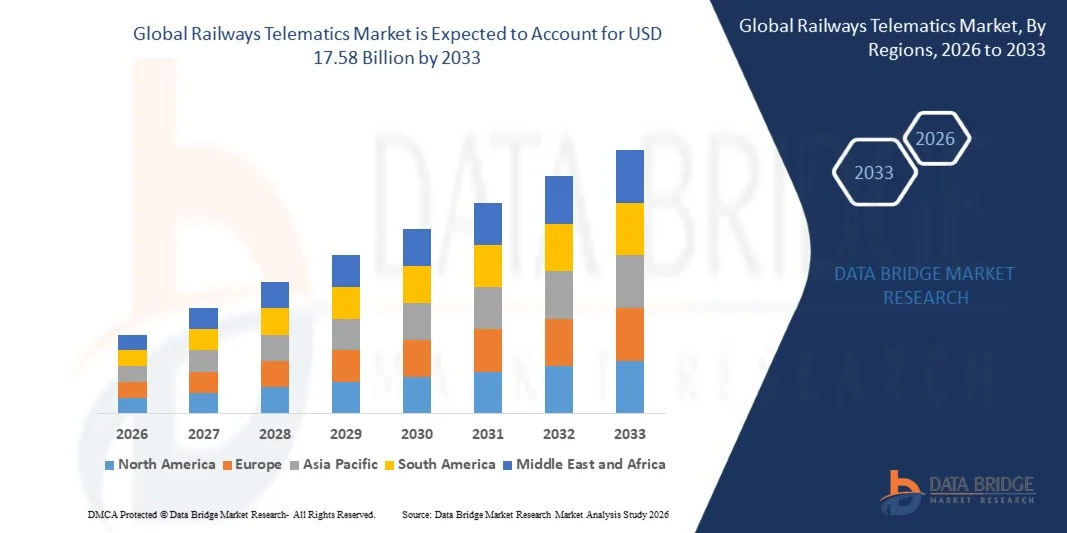
- The global railways telematics market size was valued at USD 9.5 billion in 2025 and is expected to reach USD 17.58 billion by 2033, at a CAGR of 8.00% during the forecast period
- The market growth is largely fuelled by the increasing adoption of advanced monitoring systems, real-time data analytics, and IoT-enabled telematics solutions across railway networks to enhance operational efficiency and passenger safety
- Rising investments in smart rail infrastructure and the modernization of existing railway systems are encouraging the deployment of telematics technologies for fleet management, predictive maintenance, and remote diagnostics
Railways Telematics Market Analysis
- The market is experiencing steady growth due to the increasing integration of digital technologies such as IoT, AI, and cloud computing within railway operations, enabling real-time tracking, condition monitoring, and improved decision-making capabilities for railway operators
- In addition, the expansion of high-speed rail projects and the rising focus on enhancing railway safety, reliability, and efficiency are encouraging transportation authorities and rail operators to invest in advanced telematics systems for better infrastructure and fleet management
- North America dominated the railways telematics market with the largest revenue share in 2025, driven by the strong adoption of advanced railway monitoring technologies and increasing investments in modern rail infrastructure
- Asia-Pacific region is expected to witness the highest growth rate in the global railways telematics market, driven by rapid railway infrastructure development, growing urbanization, and increasing deployment of smart rail technologies across countries such as China, India, and Japan
- The fleet management segment held the largest market revenue share in 2025 driven by the increasing need for real-time monitoring of locomotives and rail assets. Fleet management solutions help railway operators track train locations, monitor performance, optimize routes, and improve overall operational efficiency across freight and passenger rail networks
Report Scope and Railways Telematics Market Segmentation
|
Attributes |
Railways Telematics Key Market Insights |
|
Segments Covered |
|
|
Countries Covered |
North America
Europe
Asia-Pacific
Middle East and Africa
South America
|
|
Key Market Players |
|
|
Market Opportunities |
|
|
Value Added Data Infosets |
In addition to the market insights such as market value, growth rate, market segments, geographical coverage, market players, and market scenario, the market report curated by the Data Bridge Market Research team includes in-depth expert analysis, import/export analysis, pricing analysis, production consumption analysis, and pestle analysis. |
Railways Telematics Market Trends
Increasing Adoption of IoT and Real-Time Monitoring in Rail Operations
- The growing integration of Internet of Things (IoT) technologies and real-time monitoring systems is significantly shaping the railways telematics market, as railway operators increasingly prioritize operational efficiency, safety, and asset optimization. Telematics solutions enable real-time tracking of locomotives, freight wagons, and rail infrastructure, helping operators monitor performance, detect anomalies, and reduce operational disruptions. This trend is strengthening the adoption of advanced telematics platforms across freight and passenger rail networks worldwide
- Increasing demand for efficient rail transport and improved fleet management has accelerated the deployment of telematics systems in railway operations. Railway authorities and logistics providers are actively investing in digital solutions that enable predictive maintenance, route optimization, and enhanced asset utilization. These capabilities allow rail operators to reduce downtime, improve scheduling accuracy, and enhance overall service reliability
- Digitalization trends are influencing purchasing decisions, with rail operators emphasizing integrated telematics platforms that combine GPS tracking, remote diagnostics, and data analytics. These technologies support better decision-making by providing actionable insights into train performance, fuel consumption, and maintenance requirements. As a result, railway companies are increasingly collaborating with technology providers to implement advanced telematics infrastructure
- For instance, in 2024, several railway operators in Europe and Asia expanded the use of telematics-based monitoring systems across freight and passenger trains. These systems enabled real-time tracking of rolling stock and infrastructure components, improving operational visibility and reducing unexpected failures. The deployment also supported predictive maintenance strategies, helping operators optimize maintenance schedules and reduce operational costs
- While demand for railway telematics is growing, sustained market expansion depends on continuous technological innovation, interoperability with existing rail systems, and cost-effective deployment. Companies are focusing on enhancing data analytics capabilities, improving connectivity solutions, and developing scalable telematics platforms that can support modern railway networks
Railways Telematics Market Dynamics
Driver
Growing Demand for Efficient Fleet Management and Predictive Maintenance
- Rising demand for efficient fleet management and predictive maintenance solutions is a major driver for the railways telematics market. Telematics technologies enable railway operators to collect real-time data on train performance, fuel consumption, and component conditions, allowing them to detect potential issues before they lead to system failures. This capability significantly improves operational efficiency and reduces maintenance costs
- Expanding railway networks and increasing freight transportation are influencing market growth. Telematics systems help optimize train scheduling, route planning, and cargo tracking, enabling railway companies to enhance logistics performance and ensure timely delivery of goods. The growing importance of rail freight as a sustainable transportation option further supports the adoption of advanced telematics technologies
- Railway authorities and transportation agencies are actively promoting telematics adoption through digital transformation initiatives and smart rail projects. These efforts are supported by increasing investments in modern rail infrastructure and the need to improve safety and reliability in rail operations. Partnerships between railway operators and technology providers are also accelerating the development of innovative telematics solutions
- For instance, in 2023, several rail operators introduced telematics-based predictive maintenance systems to monitor locomotive performance and track component health in real time. These systems allowed operators to detect potential mechanical failures early, reduce maintenance downtime, and improve overall fleet reliability. The integration of advanced analytics also helped optimize maintenance planning and operational efficiency
- Although growing demand for operational efficiency supports market growth, wider adoption depends on infrastructure modernization, reliable connectivity, and investment in advanced telematics platforms. Continuous innovation in data analytics, connectivity technologies, and digital rail solutions will be essential to meet evolving industry requirements
Restraint/Challenge
High Implementation Costs and Integration Complexity
- The relatively high cost associated with implementing railway telematics systems remains a key challenge for market growth. Deployment requires substantial investments in hardware devices, connectivity infrastructure, and data management platforms. Smaller railway operators may face financial constraints when adopting comprehensive telematics solutions across large fleets and infrastructure networks
- Integration complexity also limits adoption, particularly in regions with legacy railway systems. Many rail networks operate with older infrastructure that may not be fully compatible with modern telematics technologies. Upgrading existing systems and ensuring interoperability with new digital platforms can require significant time and technical expertise
- Data management and cybersecurity concerns also impact the adoption of telematics solutions in the railway sector. As telematics systems collect and transmit large volumes of operational data, ensuring secure data storage and protection from cyber threats becomes a critical priority for railway operators. Companies must invest in advanced cybersecurity frameworks and secure communication networks to maintain system integrity
- For instance, in 2024, several railway operators reported challenges in integrating advanced telematics platforms with existing signaling and communication systems. These integration issues increased deployment timelines and implementation costs, particularly for operators managing extensive legacy infrastructure. In some cases, additional investments were required to upgrade connectivity networks and ensure system compatibility
- Addressing these challenges will require strategic investments in digital infrastructure, improved interoperability standards, and collaborative efforts between railway authorities, technology providers, and infrastructure developers. Strengthening cybersecurity measures and developing cost-efficient telematics solutions will also play a crucial role in supporting the long-term growth of the global railways telematics market.
Railways Telematics Market Scope
The market is segmented on the basis of solution, train type, components, railcar, and mode of operation.
- By Solution
On the basis of solution, the railways telematics market is segmented into fleet management, automatic stock control, shock detection, reefer wagon management, ETA, remote data access, collision detection and prevention, railcar tracking and tracing, and others. The fleet management segment held the largest market revenue share in 2025 driven by the increasing need for real-time monitoring of locomotives and rail assets. Fleet management solutions help railway operators track train locations, monitor performance, optimize routes, and improve overall operational efficiency across freight and passenger rail networks.
The railcar tracking and tracing segment is expected to witness the fastest growth rate from 2026 to 2033, driven by rising demand for improved cargo visibility and supply chain efficiency. These solutions enable operators and logistics providers to track railcar movement in real time, reduce delays, and enhance asset utilization, making them highly valuable for freight transportation.
- By Train Type
On the basis of train type, the railways telematics market is segmented into passenger train and freight train. The freight train segment accounted for the largest market revenue share in 2025 due to the growing demand for efficient cargo transportation and logistics monitoring. Telematics systems help freight operators monitor wagon conditions, optimize routes, and improve delivery timelines through real-time data insights.
The passenger train segment is expected to witness the fastest growth rate from 2026 to 2033 driven by increasing investments in smart rail infrastructure and digital passenger services. Telematics solutions are increasingly used to enhance safety monitoring, improve train scheduling, and provide better operational control for passenger rail networks.
- By Components
On the basis of components, the railways telematics market is segmented into TCU and sensor. The TCU segment held the largest market revenue share in 2025 driven by its critical role in collecting, processing, and transmitting data from trains to centralized monitoring systems. TCUs enable real-time communication between onboard systems and control centers, supporting efficient fleet management and predictive maintenance.
The sensor segment is expected to witness the fastest growth rate from 2026 to 2033 driven by the increasing deployment of advanced sensing technologies for monitoring train performance and railcar conditions. Sensors help detect temperature variations, vibration levels, and component wear, enabling early identification of potential faults and improving safety.
- By Railcar
On the basis of railcar, the railways telematics market is segmented into hoppers, tank cars, well cars, boxcars, refrigerated boxcars, and others. The tank cars segment accounted for the largest market revenue share in 2025 driven by the need for continuous monitoring of hazardous and liquid cargo transportation. Telematics systems help track tank car conditions and ensure safe transport of chemicals, fuels, and other liquid materials.
The refrigerated boxcars segment is expected to witness the fastest growth rate from 2026 to 2033 due to the increasing demand for temperature-controlled transportation of perishable goods. Telematics solutions help monitor temperature levels, track cargo location, and maintain product quality during transit.
- By Mode of Operation
On the basis of mode of operation, the railways telematics market is segmented into semi-autonomous and fully autonomous. The semi-autonomous segment held the largest market revenue share in 2025 driven by the widespread adoption of automated monitoring and control systems that assist train operators while maintaining human supervision. These systems help improve safety, optimize train performance, and support efficient railway operations.
The fully autonomous segment is expected to witness the fastest growth rate from 2026 to 2033 driven by advancements in artificial intelligence, automation technologies, and smart rail infrastructure. Fully autonomous systems enable trains to operate with minimal human intervention, improving operational efficiency and supporting the future development of intelligent railway networks.
Railways Telematics Market Regional Analysis
- North America dominated the railways telematics market with the largest revenue share in 2025, driven by the strong adoption of advanced railway monitoring technologies and increasing investments in modern rail infrastructure
- Railway operators in the region highly value the efficiency, safety enhancements, and real-time monitoring capabilities offered by telematics systems, which enable improved fleet management and predictive maintenance of locomotives and railcars
- This widespread adoption is further supported by well-developed rail networks, strong government support for digital rail initiatives, and the growing need for efficient freight transportation, establishing telematics solutions as an essential component of modern railway operations
U.S. Railways Telematics Market Insight
The U.S. railways telematics market captured the largest revenue share in 2025 within North America, fueled by the rapid digitalization of rail operations and increasing demand for advanced fleet management solutions. Railway operators are prioritizing technologies that provide real-time data on train location, asset performance, and maintenance requirements. The growing use of IoT-enabled sensors, predictive maintenance platforms, and cloud-based analytics systems is further strengthening telematics adoption. Moreover, the expansion of freight rail transportation and investments in smart rail infrastructure are significantly contributing to the growth of the railways telematics market in the U.S.
Europe Railways Telematics Market Insight
The Europe railways telematics market is expected to witness the fastest growth rate from 2026 to 2033, primarily driven by increasing investments in smart railway infrastructure and the strong emphasis on improving operational efficiency and rail safety. Governments and railway authorities across the region are implementing digital rail initiatives and advanced monitoring technologies to enhance network reliability. The growing adoption of predictive maintenance systems and real-time fleet tracking solutions is encouraging railway operators to invest in telematics platforms. The region is witnessing strong demand across both passenger and freight rail segments, supporting the expansion of telematics solutions.
U.K. Railways Telematics Market Insight
The U.K. railways telematics market is expected to witness the fastest growth rate from 2026 to 2033, driven by the country’s increasing focus on digital railway transformation and operational efficiency. Railway operators are adopting telematics technologies to enhance fleet monitoring, optimize maintenance schedules, and improve passenger service reliability. In addition, the modernization of rail infrastructure and the growing use of advanced data analytics tools are further encouraging the adoption of telematics systems across the U.K. rail network.
Germany Railways Telematics Market Insight
The Germany railways telematics market is expected to witness the fastest growth rate from 2026 to 2033, fueled by strong investments in railway modernization and the country’s focus on engineering innovation. Germany’s well-developed rail infrastructure and emphasis on operational efficiency are encouraging railway companies to implement telematics systems for asset tracking, predictive maintenance, and network optimization. The increasing integration of digital technologies and automation within rail transport is also contributing to the expansion of telematics solutions across the German railway sector.
Asia-Pacific Railways Telematics Market Insight
The Asia-Pacific railways telematics market is expected to witness the fastest growth rate from 2026 to 2033, driven by rapid urbanization, growing rail passenger traffic, and increasing investments in railway infrastructure across emerging economies. Governments in countries such as China, India, and Japan are actively promoting smart transportation initiatives and high-speed rail projects, encouraging the adoption of telematics technologies. Furthermore, the region’s expanding freight transportation sector and digital rail transformation initiatives are accelerating the demand for advanced telematics solutions.
Japan Railways Telematics Market Insight
The Japan railways telematics market is expected to witness the fastest growth rate from 2026 to 2033 due to the country’s advanced rail network and strong focus on safety and operational precision. Japanese railway operators are increasingly adopting telematics systems to monitor train performance, optimize maintenance processes, and ensure reliable passenger services. The integration of telematics with advanced automation technologies and IoT-based monitoring solutions is further driving market growth across Japan’s high-speed and urban rail networks.
China Railways Telematics Market Insight
The China railways telematics market accounted for the largest market revenue share in Asia-Pacific in 2025, attributed to the country’s extensive railway network and large-scale investments in rail infrastructure development. China continues to expand its high-speed rail systems and freight transportation networks, increasing the demand for real-time monitoring and asset management solutions. The strong government focus on smart transportation systems and digital rail technologies is also accelerating the adoption of telematics platforms across the country’s railway industry.
Railways Telematics Market Share
The Railways Telematics industry is primarily led by well-established companies, including:
- Robert Bosch GmbH (Germany)
- Siemens AG (Germany)
- Hitachi, Ltd. (Japan)
- Alstom SA (France)
- Atzlinger GmbH (Austria)
- Railnova (Belgium)
- Intermodal Telematics BV (Netherlands)
- SAVVY Telematic Systems AG (Germany)
- A1 Digital International GmbH (Austria)
- VTG Aktiengesellschaft (Germany)
- Savi Technology (U.S.)
- StarTrak GPS (U.S.)
- CalAmp Corp. (U.S.)
- Norfolk Southern Corporation (U.S.)
- Wabtec Corporation (U.S.)
- TrinityRail (U.S.)
- Cando Rail & Terminals Ltd. (Canada)
- ORBCOMM Inc. (U.S.)
Latest Developments in Global Railways Telematics Market
- In July, 2025 Wabtec Corporation announced the acquisition of Frauscher Sensor Technology Group for approximately EUR 675 million to strengthen its rail signaling and digital monitoring capabilities. The acquisition is expected to enhance Wabtec’s advanced sensor technology portfolio and expand its presence across European and Indian railway markets, supporting improved rail safety and operational efficiency in the global railways telematics industry
- In November, 2024 Siemens Mobility partnered with Bane NOR to activate the European Rail Traffic Management System (ERTMS) on Norway’s Gjøvik Line North. This development marks the country’s first implementation of the latest ERTMS standard, enabling advanced digital signaling and improved railway traffic management, which is expected to accelerate the adoption of intelligent telematics and automation technologies in modern rail networks
- In September, 2024 RailPulse introduced an open technology infrastructure platform designed to enable real-time railcar tracking and data visibility across North America’s freight rail fleet. The platform aims to standardize sensor integration and improve supply chain transparency, supporting greater efficiency in freight logistics and encouraging wider adoption of telematics-based asset monitoring solutions
- In July, 2024 CSX Corporation joined the RailPulse coalition to support the expansion of standardized railcar telematics sensors across major freight rail networks. This collaboration is expected to enhance data sharing and interoperability across Class I railroads, improving asset tracking capabilities and strengthening the overall digital transformation of the rail freight industry
- In October, 2023 Hitachi Rail introduced advanced digital rail monitoring and predictive maintenance solutions designed to enhance real-time train performance analysis and asset reliability. These innovations support railway operators in reducing operational disruptions and improving maintenance planning, driving greater adoption of telematics and IoT-based monitoring technologies in rail systems
- In May, 2022 Alstom launched new smart rail telematics and condition monitoring solutions aimed at improving train safety, asset tracking, and operational efficiency. The initiative focuses on integrating advanced sensors and digital analytics into rail infrastructure, supporting the global transition toward connected and intelligent railway networks

- Interactive Data Analysis Dashboard
- Company Analysis Dashboard for high growth potential opportunities
- Research Analyst Access for customization & queries
- Competitor Analysis with Interactive dashboard
- Latest News, Updates & Trend analysis
- Harness the Power of Benchmark Analysis for Comprehensive Competitor Tracking
Data collection and base year analysis are done using data collection modules with large sample sizes. The stage includes obtaining market information or related data through various sources and strategies. It includes examining and planning all the data acquired from the past in advance. It likewise envelops the examination of information inconsistencies seen across different information sources. The market data is analysed and estimated using market statistical and coherent models. Also, market share analysis and key trend analysis are the major success factors in the market report. To know more, please request an analyst call or drop down your inquiry.
The key research methodology used by DBMR research team is data triangulation which involves data mining, analysis of the impact of data variables on the market and primary (industry expert) validation. Data models include Vendor Positioning Grid, Market Time Line Analysis, Market Overview and Guide, Company Positioning Grid, Patent Analysis, Pricing Analysis, Company Market Share Analysis, Standards of Measurement, Global versus Regional and Vendor Share Analysis. To know more about the research methodology, drop in an inquiry to speak to our industry experts.
Data Bridge Market Research is a leader in advanced formative research. We take pride in servicing our existing and new customers with data and analysis that match and suits their goal. The report can be customized to include price trend analysis of target brands understanding the market for additional countries (ask for the list of countries), clinical trial results data, literature review, refurbished market and product base analysis. Market analysis of target competitors can be analyzed from technology-based analysis to market portfolio strategies. We can add as many competitors that you require data about in the format and data style you are looking for. Our team of analysts can also provide you data in crude raw excel files pivot tables (Fact book) or can assist you in creating presentations from the data sets available in the report.













