


Range Extended Electric Vehicle Market Size and Growth Rate
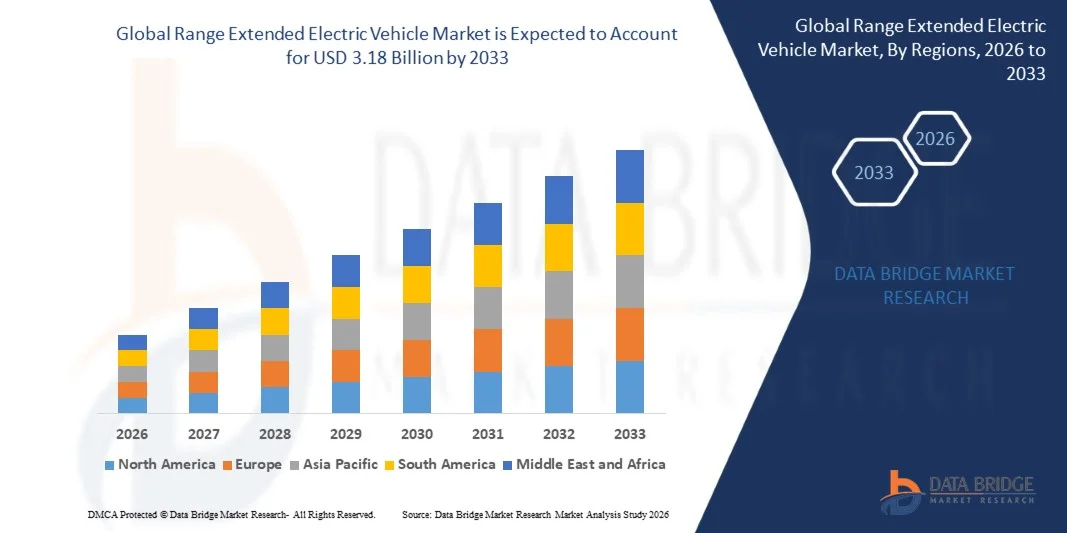
- As per Data Bridge Market Research Analysis the global range extended electric vehicle market size was valued at USD 1.41 billion in 2025 and is expected to reach USD 3.18 billion by 2033, at a CAGR of 10.65% during the forecast period
- The market growth is largely fueled by the increasing global shift toward vehicle electrification and stringent emission regulations aimed at reducing carbon footprints, encouraging automakers and consumers to adopt low-emission mobility solutions such as range extended electric vehicles
- Furthermore, rising concerns regarding range anxiety, limited charging infrastructure in certain regions, and the need for long-distance travel flexibility are positioning range extended electric vehicles as a practical transitional solution between conventional internal combustion vehicles and fully battery electric vehicles, thereby significantly accelerating market expansion
Market Size and Forecast:
- Global Market Value (2025): USD 1.41 billion
- Expected Market Value (2033): USD 3.18 billion
- Forecast CAGR (2026–2033): 10.65%
Range Extended Electric Vehicle Market Analysis
- Range extended electric vehicles, which combine electric propulsion systems with an auxiliary internal combustion engine that acts as a generator, are becoming increasingly important in the automotive industry as they provide enhanced driving range while maintaining lower emissions compared to traditional vehicles
- The growing demand for these vehicles is primarily driven by advancements in battery technology, supportive government incentives for electrified vehicles, expanding EV charging infrastructure, and increasing consumer preference for sustainable transportation options without compromising driving convenience
- North America dominated the range extended electric vehicle market with a share of 44.20% in 2025, due to increasing demand for low-emission mobility solutions and strong investment in hybrid-electric vehicle technologies
- Asia-Pacific is expected to be the fastest growing region in the range extended electric vehicle market during the forecast period due to rapid urbanization, rising disposable incomes, and strong government initiatives promoting electric mobility in countries such as China, Japan, and India
- Passenger cars segment dominated the market with a market share of 68.9% in 2025, due to rising consumer demand for long-range electric mobility without full dependence on charging infrastructure. Buyers prefer REEV passenger cars as they eliminate range anxiety while maintaining lower emissions compared to conventional internal combustion vehicles
Report Scope and Range Extended Electric Vehicle Market Segmentation
|
Attributes |
Range Extended Electric Vehicle Key Market Insights |
|
Segments Covered |
|
|
Countries Covered |
North America
Europe
Asia-Pacific
Middle East and Africa
South America
|
|
Key Market Players |
|
|
Market Opportunities |
|
|
Value Added Data Infosets |
In addition to the market insights such as market value, growth rate, market segments, geographical coverage, market players, and market scenario, the market report curated by the Data Bridge Market Research team includes in-depth expert analysis, import/export analysis, pricing analysis, production consumption analysis, and pestle analysis. |
Range Extended Electric Vehicle Market Trends
“Increasing Integration of Advanced Battery and Range-Extender Technologies”
- A significant trend in the range extended electric vehicle market is the increasing integration of advanced battery systems with efficient internal combustion or generator-based range extenders to improve driving distance and operational flexibility. This integration enhances vehicle reliability and reduces range anxiety, positioning range extended electric vehicles as a transitional solution between conventional hybrids and fully battery electric vehicles
- For instance, BMW introduced the i3 with Range Extender configuration, combining a lithium-ion battery with a compact gasoline generator to extend driving range beyond pure electric capability. This configuration enabled improved consumer confidence and supported wider adoption in urban markets with limited charging infrastructure
- Automakers are focusing on optimizing energy management systems that seamlessly switch between electric propulsion and auxiliary power generation to ensure smooth performance. This technological refinement is strengthening overall vehicle efficiency and enabling better fuel economy compared to traditional combustion vehicles
- The development of lightweight materials and compact generator units is contributing to improved vehicle dynamics and reduced energy consumption. These advancements are enhancing the practicality of range extended electric vehicles for both passenger and commercial transportation segments
- Manufacturers are also integrating smart connectivity and real-time battery monitoring systems to maximize energy utilization and predictive maintenance. This digital integration supports enhanced driving performance and reduces operational uncertainties for users
- The market is witnessing broader acceptance in regions where charging infrastructure expansion is still progressing, as extended range capability offers a practical alternative to fully electric models. This growing technological integration is reinforcing the role of range extended electric vehicles in the global electrification landscape and supporting gradual transition toward low-emission mobility
Range Extended Electric Vehicle Market Dynamics
Driver
“Stringent Emission Regulations and Global Electrification Targets”
- The implementation of strict emission standards and decarbonization goals across major automotive markets is driving the demand for range extended electric vehicles that offer reduced tailpipe emissions and improved fuel efficiency. Governments are encouraging automakers to introduce low-emission alternatives to meet regulatory thresholds and carbon neutrality commitments
- For instance, European Commission has established stringent fleet-wide CO₂ emission targets under its Green Deal framework, compelling manufacturers to accelerate electrified vehicle production. Such regulatory measures are stimulating investments in range extended electric vehicle technologies to balance compliance with consumer usability
- National electrification roadmaps across regions such as China and Europe are reinforcing the adoption of vehicles capable of operating primarily in electric mode while retaining extended range functionality. These initiatives are strengthening market confidence and supporting infrastructure expansion alongside vehicle deployment
- Urban low-emission zones and pollution control mandates are increasing consumer preference for electrified vehicles that can operate in zero-emission mode within city limits. Range extended electric vehicles align with these policies by enabling electric-only urban driving while providing flexibility for long-distance travel
- Automotive manufacturers are strategically expanding their electrified portfolios to comply with tightening environmental regulations while addressing consumer range concerns. This sustained regulatory pressure and policy support are collectively positioning range extended electric vehicles as viable contributors to global emission reduction objectives
Restraint/Challenge
“High Production Costs and Complex Powertrain Integration”
- The range extended electric vehicle market faces challenges associated with high production costs resulting from the integration of dual propulsion systems, advanced battery packs, and auxiliary generators within a single vehicle architecture. This complexity increases material requirements and elevates overall manufacturing expenditure
- For instance, General Motors developed the Chevrolet Volt with a sophisticated extended-range electric drivetrain that required intricate calibration between electric motors and internal combustion components. Such integration demanded advanced engineering and testing processes, contributing to higher production costs compared to conventional vehicles
- The need for precise synchronization between battery systems, power electronics, and range extenders increases design complexity and development timelines. Manufacturers must invest significantly in research and validation to ensure seamless operational performance and safety compliance
- Packaging constraints and additional weight from dual systems can affect vehicle efficiency and limit scalability across multiple models. This engineering challenge requires continuous optimization to maintain competitive performance standards
- The requirement for specialized components and advanced energy management software further intensifies cost pressures across the supply chain. These combined technical and financial challenges restrict rapid market expansion and compel manufacturers to balance affordability with technological sophistication in range extended electric vehicle development
Range Extended Electric Vehicle Market Scope
The market is segmented on the basis of vehicle type, component, propulsion type, battery type, and end-user.
• By Vehicle Type
On the basis of vehicle type, the Range Extended Electric Vehicle (REEV) market is segmented into passenger cars, commercial vehicles, and others. The passenger cars segment dominated the market with the largest revenue share of 68.9% in 2025, driven by rising consumer demand for long-range electric mobility without full dependence on charging infrastructure. Buyers prefer REEV passenger cars as they eliminate range anxiety while maintaining lower emissions compared to conventional internal combustion vehicles. Automakers are increasingly introducing range-extended models in the passenger segment to cater to urban commuters and long-distance travelers seeking flexibility. Supportive government incentives for low-emission personal vehicles and expanding charging networks further strengthen the segment’s leadership.
The commercial vehicles segment is anticipated to witness the fastest growth rate from 2026 to 2033, fueled by increasing electrification of delivery vans and light-duty fleets. Logistics companies are adopting REEV technology to ensure uninterrupted operations while meeting sustainability targets and emission regulations. Range extenders provide operational reliability for last-mile and intercity transport where charging downtime can impact productivity. Growing e-commerce activity and fleet electrification initiatives are accelerating adoption in this segment.
• By Component
On the basis of component, the market is segmented into battery, electric motor, generator, power electronics, and others. The battery segment dominated the market with the largest revenue share in 2025, as it represents the core energy storage system determining vehicle range and performance. Continuous advancements in battery density, lifecycle, and thermal management have enhanced overall vehicle efficiency and consumer confidence. Manufacturers are investing heavily in battery optimization to balance cost, weight, and driving range in REEV platforms. The central role of batteries in overall vehicle cost structure further reinforces their dominant market contribution.
The power electronics segment is projected to register the fastest growth rate from 2026 to 2033, driven by increasing focus on energy efficiency and intelligent energy management systems. Advanced inverters and control units enhance coordination between the electric motor and range extender, improving overall system performance. As REEV architectures become more sophisticated, demand for high-efficiency converters and integrated control modules is rising significantly.
• By Propulsion Type
On the basis of propulsion type, the market is segmented into series, parallel, and series-parallel. The series propulsion segment dominated the market with the largest revenue share in 2025, primarily due to its simplified drivetrain configuration and optimized electric driving experience. In this architecture, the internal combustion engine functions solely as a generator, enabling smoother operation and lower mechanical complexity. Consumers favor series systems for their enhanced fuel efficiency and seamless electric propulsion without direct engine-to-wheel connection. Automakers also benefit from easier integration with existing electric vehicle platforms.
The series-parallel segment is expected to witness the fastest growth rate from 2026 to 2033, as it offers greater operational flexibility by combining benefits of both series and parallel systems. This configuration allows direct engine assistance during high-load conditions, improving overall performance and fuel economy. Growing demand for versatile propulsion systems capable of adapting to diverse driving conditions is accelerating its adoption.
• By Battery Type
On the basis of battery type, the market is segmented into lithium-ion, nickel-metal hydride, and others. The lithium-ion segment dominated the market with the largest revenue share in 2025, attributed to its high energy density, lightweight structure, and longer lifecycle. Lithium-ion batteries enable extended electric-only driving range, making them highly suitable for REEV applications. Continuous cost reductions and technological advancements in lithium-ion chemistry have strengthened their widespread adoption across automotive manufacturers. Their compatibility with fast-charging systems and improved safety standards further support market dominance.
The nickel-metal hydride segment is anticipated to witness steady growth from 2026 to 2033, supported by its proven reliability and cost-effectiveness in hybrid configurations. While offering lower energy density than lithium-ion, it remains a viable option in specific vehicle models where durability and established supply chains are prioritized.
• By End-User
On the basis of end-user, the market is segmented into private, commercial, and government & fleet. The private segment dominated the market with the largest revenue share in 2025, driven by rising environmental awareness and consumer preference for vehicles that combine electric mobility with extended range assurance. Individuals increasingly opt for REEVs to reduce fuel dependency while maintaining long-distance travel capability. Government subsidies and tax incentives for low-emission personal vehicles further stimulate demand in this segment.
The government & fleet segment is projected to witness the fastest growth rate from 2026 to 2033, fueled by public sector electrification programs and corporate sustainability commitments. Municipal authorities and corporate fleets are adopting REEVs to balance emission reduction goals with operational flexibility. The ability to operate in electric mode within city limits while retaining extended range for intercity travel makes REEVs highly suitable for structured fleet deployment.
Range Extended Electric Vehicle Market Regional Analysis
- North America dominated the range extended electric vehicle market with the largest revenue share of 44.20% in 2025, driven by increasing demand for low-emission mobility solutions and strong investment in hybrid-electric vehicle technologies
- Consumers in the region prioritize extended driving range, fuel efficiency, and reduced carbon emissions, making range extended electric vehicles a practical solution for long-distance travel across the U.S. and Canada
- This widespread adoption is further supported by favorable federal tax incentives, expanding EV charging infrastructure, established automotive manufacturers, and growing awareness regarding sustainable transportation, positioning North America as a key revenue contributor
U.S. Range Extended Electric Vehicle Market Insight
The U.S. range extended electric vehicle market captured the largest revenue share within North America in 2025, fueled by rapid electrification initiatives and strong consumer demand for vehicles that minimize range anxiety. Buyers increasingly prefer extended-range technology to ensure flexibility for interstate travel while benefiting from electric-only urban driving. Government emission standards, tax credits, and infrastructure funding programs further stimulate market expansion. Continuous innovation by domestic automakers and investment in battery technology are strengthening the country’s leadership position.
Europe Range Extended Electric Vehicle Market Insight
The Europe range extended electric vehicle market is projected to expand at a substantial CAGR throughout the forecast period, primarily driven by stringent emission regulations and ambitious carbon neutrality targets. Increasing fuel prices and regulatory pressure on internal combustion vehicles are accelerating the shift toward electrified propulsion systems. Consumers value the balance between electric efficiency and extended travel capability offered by REEVs. Growth is supported by strong automotive manufacturing hubs and policy-driven incentives across major economies.
U.K. Range Extended Electric Vehicle Market Insight
The U.K. range extended electric vehicle market is anticipated to grow at a noteworthy CAGR during the forecast period, driven by the country’s transition toward cleaner mobility and phased restrictions on conventional fuel vehicles. Rising consumer awareness regarding environmental sustainability and increasing investment in EV infrastructure are encouraging adoption. Fleet operators and private buyers are exploring REEV technology to ensure operational continuity while reducing emissions. Government support schemes and corporate sustainability commitments continue to support market growth.
Germany Range Extended Electric Vehicle Market Insight
The Germany range extended electric vehicle market is expected to expand at a considerable CAGR during the forecast period, fueled by strong automotive innovation capabilities and increasing focus on advanced propulsion systems. Germany’s emphasis on engineering excellence and sustainable mobility solutions supports the development of efficient range extender platforms. Incentives for electric mobility and investment in research and development are driving domestic production and adoption. Integration of advanced battery systems and hybrid architectures further enhances market prospects.
Asia-Pacific Range Extended Electric Vehicle Market Insight
The Asia-Pacific range extended electric vehicle market is poised to grow at the fastest CAGR during the forecast period of 2026 to 2033, driven by rapid urbanization, rising disposable incomes, and strong government initiatives promoting electric mobility in countries such as China, Japan, and India. Expanding charging infrastructure and large-scale automotive production capacity support regional growth. Increasing consumer preference for cost-efficient and flexible electric vehicles further accelerates adoption. The region’s expanding middle class and supportive regulatory frameworks position Asia-Pacific as the fastest-growing market.
Japan Range Extended Electric Vehicle Market Insight
The Japan range extended electric vehicle market is gaining momentum due to technological advancement and strong hybrid vehicle adoption culture. Consumers in Japan prioritize energy efficiency and reliability, encouraging demand for vehicles that combine electric propulsion with extended range capability. The presence of established automotive manufacturers investing in advanced battery and generator technologies strengthens domestic market expansion. Urban density and fuel efficiency concerns further contribute to sustained growth.
China Range Extended Electric Vehicle Market Insight
The China range extended electric vehicle market accounted for the largest revenue share in Asia Pacific in 2025, attributed to rapid urbanization, strong policy incentives, and large-scale EV manufacturing capabilities. Government subsidies, new energy vehicle mandates, and expansion of smart mobility initiatives significantly accelerate adoption. Domestic manufacturers are actively investing in range extender technologies to address consumer concerns related to charging access in remote areas. Growing middle-class demand and aggressive electrification targets continue to propel the market forward.
Top Companies in Range Extended Electric Vehicle Market
The range extended electric vehicle industry is primarily led by well-established companies, including:
- Li Auto Inc. (China)
- BYD Company Ltd. (China)
- Geely Holding Group (China)
- Stellantis (Netherlands)
- Ford Motor Company (U.S.)
- Hyundai Motor Group (South Korea)
- Dongfeng Motor Corporation (China)
- Great Wall Motor (China)
- Chery Automobile (China)
- Guangzhou Automobile Group (China)
- Changan Automobile (China)
- SAIC Motor (China)
- Volkswagen Group (Germany)
- BMW Group (Germany)
Latest Developments in Global Range Extended Electric Vehicle Market
- In January 2026, SAIC-Volkswagen filed production details for the Volkswagen ID. ERA 9X extended-range SUV in China, marking a strategic expansion of Volkswagen’s electrified portfolio in the world’s largest EV market. The model’s planned high pure-electric range combined with a dedicated range-extending engine strengthens the credibility of EREV technology in the premium SUV segment. This development reinforces growing OEM confidence in range-extended platforms as a transitional solution between hybrid and fully battery electric vehicles, potentially accelerating mainstream acceptance
- In December 2025, IM Motors officially launched the IM LS9 with a combined driving range exceeding 1,500 km. The introduction of such ultra-long-range capability significantly reduces consumer range anxiety and positions EREVs as viable alternatives to conventional internal combustion SUVs. This launch intensifies competition in China’s premium electrified SUV category and highlights increasing consumer demand for long-distance electric mobility solutions
- In November 2025, XPeng introduced its Kunpeng Super Electric System supporting extended-range configurations across future models. By enabling combined ranges of over 1,400 km, the technology enhances drivetrain flexibility and energy efficiency. This advancement strengthens XPeng’s competitive positioning in the smart EV segment while demonstrating how proprietary range-extension systems can differentiate brands in an increasingly crowded market
- In October 2025, Leapmotor partnered with ZF Friedrichshafen AG to integrate advanced eRE+ range-extender technology into its upcoming D-series SUV lineup. The collaboration improves system efficiency, drivetrain performance, and scalability for future EREV platforms. This partnership signals deeper supplier involvement in next-generation electrified architectures and supports broader commercialization of advanced range-extender modules globally
- In September 2025, Harbinger Motors collaborated with THOR Industries to introduce the range-extended Entegra Coach Embark electric recreational vehicle. By integrating a gasoline range extender into an electric RV platform, the initiative expands EREV technology beyond passenger cars into specialty vehicle segments. This diversification broadens the application scope of range-extended systems and opens new revenue streams within commercial and recreational mobility markets

- Interactive Data Analysis Dashboard
- Company Analysis Dashboard for high growth potential opportunities
- Research Analyst Access for customization & queries
- Competitor Analysis with Interactive dashboard
- Latest News, Updates & Trend analysis
- Harness the Power of Benchmark Analysis for Comprehensive Competitor Tracking
Data collection and base year analysis are done using data collection modules with large sample sizes. The stage includes obtaining market information or related data through various sources and strategies. It includes examining and planning all the data acquired from the past in advance. It likewise envelops the examination of information inconsistencies seen across different information sources. The market data is analysed and estimated using market statistical and coherent models. Also, market share analysis and key trend analysis are the major success factors in the market report. To know more, please request an analyst call or drop down your inquiry.
The key research methodology used by DBMR research team is data triangulation which involves data mining, analysis of the impact of data variables on the market and primary (industry expert) validation. Data models include Vendor Positioning Grid, Market Time Line Analysis, Market Overview and Guide, Company Positioning Grid, Patent Analysis, Pricing Analysis, Company Market Share Analysis, Standards of Measurement, Global versus Regional and Vendor Share Analysis. To know more about the research methodology, drop in an inquiry to speak to our industry experts.
Data Bridge Market Research is a leader in advanced formative research. We take pride in servicing our existing and new customers with data and analysis that match and suits their goal. The report can be customized to include price trend analysis of target brands understanding the market for additional countries (ask for the list of countries), clinical trial results data, literature review, refurbished market and product base analysis. Market analysis of target competitors can be analyzed from technology-based analysis to market portfolio strategies. We can add as many competitors that you require data about in the format and data style you are looking for. Our team of analysts can also provide you data in crude raw excel files pivot tables (Fact book) or can assist you in creating presentations from the data sets available in the report.













