


Rare Gas Market Overview
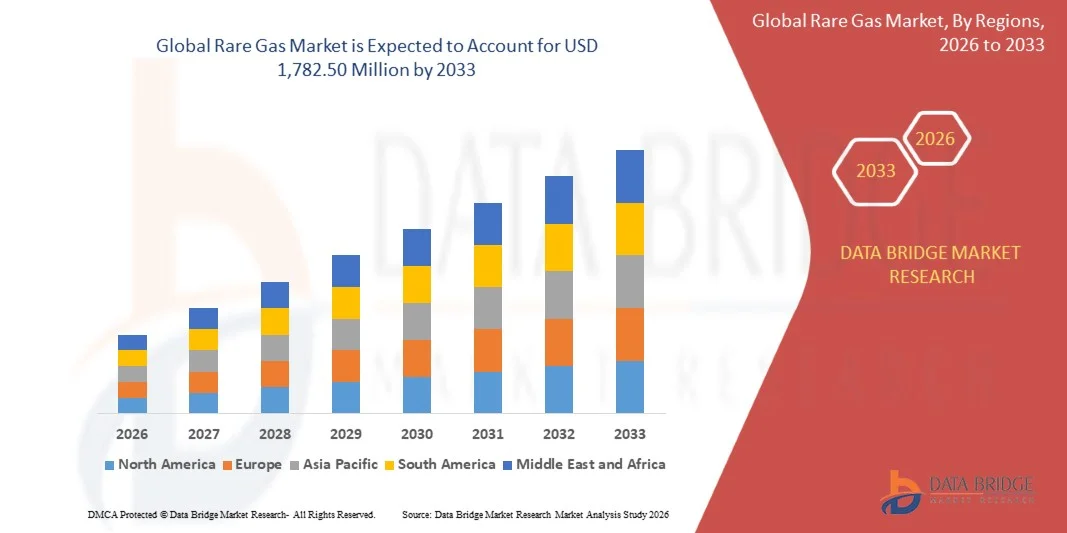
The Rare Gas Market was valued at USD 941.89 million in 2025 and is projected to reach USD 1,782.50 million by 2033, growing at a CAGR of 8.30% from 2026 to 2033. The market is witnessing steady expansion driven by increasing demand across electronics, healthcare, lighting, and manufacturing industries, where rare gases are widely used in specialized applications such as semiconductor production, laser technologies, and cryogenics.
The growing adoption of advanced electronics and semiconductor devices, coupled with rising investments in medical imaging and diagnostic systems, is significantly boosting the consumption of rare gases globally. In addition, the expansion of industrial applications such as welding, metal fabrication, and aerospace technologies is further supporting market growth, as rare gases provide high stability, efficiency, and precision in critical processes.
Key Market Trends & Insights
- Asia-Pacific dominated the rare gas market with the largest revenue share of approximately 40.6% in 2025, supported by the strong presence of semiconductor manufacturing hubs, expanding electronics production, and rising demand from display panel and chip fabrication industries. Countries such as China, Japan, South Korea, and India are major contributors, driven by rapid industrialization and increasing investments in advanced manufacturing technologies.
- North America is expected to witness steady and significant growth from 2026 to 2033, supported by strong demand from semiconductor fabrication, healthcare imaging, aerospace applications, and industrial manufacturing. The region benefits from advanced technological infrastructure, high adoption of specialty gases in research and defense applications, and the presence of key end-use industries such as electronics and automotive.
- The Neon segment held the largest market revenue share of approximately 52.4% in 2025 driven by its extensive use in semiconductor lithography, signage, and high-intensity discharge lighting applications. Neon’s dominance is supported by its critical role in excimer lasers used in advanced chip manufacturing processes and its relatively higher availability from air separation units compared to other rare gases.
- The Xenon segment is projected to register the fastest growth at a CAGR of 9.6% from 2026 to 2033, driven by increasing demand in medical imaging, satellite propulsion systems, and high-performance lighting systems. Rising adoption of xenon in ion propulsion for spacecraft and its expanding use in anesthesia and diagnostic imaging applications is accelerating segment expansion.
- The Semiconductors segment held the largest market revenue share of approximately 34.7% in 2025 driven by rapid expansion of electronics manufacturing and growing demand for ultra-pure gases in chip fabrication processes. Rare gases such as neon, krypton, and xenon are critical in lithography and plasma etching applications, supporting high-precision semiconductor production.
- The Satellites segment is projected to register the fastest growth at a CAGR of 10.9% from 2026 to 2033, driven by increasing deployment of commercial satellites, deep space exploration missions, and rising adoption of xenon-based electric propulsion systems. Expanding investments in space infrastructure and satellite communication networks is further accelerating segment growth.
- The Cylinders & Liquid Containers segment held the largest market revenue share of approximately 46.2% in 2025 driven by its widespread use in industrial, medical, and laboratory applications requiring flexible and portable gas supply solutions. This mode is preferred for smaller-scale consumption and distributed industrial usage across manufacturing and healthcare sectors.
- The Tonnage Distribution segment is projected to register the fastest growth at a CAGR of 8.7% from 2026 to 2033, driven by increasing demand from large-scale semiconductor fabrication plants and integrated industrial facilities. Growing preference for continuous and high-volume gas supply systems is accelerating adoption of tonnage delivery infrastructure.
- The Electronics segment held the largest market revenue share of approximately 41.3% in 2025 driven by strong demand from semiconductor manufacturing, display technologies, and advanced lighting applications. Rising penetration of consumer electronics and ongoing miniaturization of semiconductor components are further supporting segment dominance.
- The Health Care segment is projected to register the fastest growth at a CAGR of 9.4% from 2026 to 2033, driven by increasing use of xenon in anesthesia, diagnostic imaging, and advanced medical research applications. Expanding healthcare infrastructure and rising adoption of precision medical technologies are further accelerating segment growth.
Market Size & Forecast
- Global Market Value (2025): USD 941.89 Million
- Expected Market Value (2033): USD 1,782.50 Million
- Forecast CAGR (2026–2033): 8.30%
- Leading Region in 2025: North America
- Fastest Growing Region: Asia-Pacific
Report Scope and Rare Gas Market Segmentation
|
Attributes |
Rare Gas Key Market Insights |
|
Segments Covered |
· By Type: Neon, Krypton, and Xenon · By Functions: Illumination, Insulation, Scanning, Anaesthesia, Semiconductors, and Satellites · By Transportation: Cylinders & Liquid Containers, Tonnage Distribution, Bulk and Micro Bulk Delivery · By End Use: Manufacturing & Construction, Electronics, Automotive and Transportation Equipment, and Health Care |
|
Countries Covered |
North America · U.S. · Canada · Mexico Europe · Germany · France · U.K. · Netherlands · Switzerland · Belgium · Russia · Italy · Spain · Turkey · Rest of Europe Asia-Pacific · China · Japan · India · South Korea · Singapore · Malaysia · Australia · Thailand · Indonesia · Philippines · Rest of Asia-Pacific Middle East and Africa · Saudi Arabia · U.A.E. · South Africa · Egypt · Israel · Rest of Middle East and Africa South America · Brazil · Argentina · Rest of South America |
|
Key Market Players |
• Air Products Inc. (U.S.) |
|
Market Opportunities |
• Expansion Of Semiconductor Manufacturing And Electronics Industry. |
|
Value Added Data Infosets |
In addition to the insights on market scenarios such as market value, growth rate, segmentation, geographical coverage, and major players, the market reports curated by the Data Bridge Market Research also include import export analysis, production capacity overview, production consumption analysis, price trend analysis, climate change scenario, supply chain analysis, value chain analysis, raw material/consumables overview, vendor selection criteria, PESTLE Analysis, Porter Analysis, and regulatory framework. |
Rare Gas Market Trends
Trend: Growing Demand For Rare Gases In Semiconductor Manufacturing And Advanced Industrial Applications
Increasing demand for high-purity rare gases across semiconductor fabrication, electronics manufacturing, and specialized industrial processes is significantly strengthening market growth. Conventional industrial gases are insufficient for advanced lithography, etching, and deposition processes, which require ultra-high purity and stable performance gases such as neon, xenon, krypton, argon, and helium, encouraging industries to adopt rare gases for precision-driven manufacturing.
In semiconductor production, manufacturers are increasingly utilizing neon and argon in lithography and plasma etching processes to achieve higher accuracy and yield in advanced chip architectures, particularly for sub-5nm and AI-driven processors. In healthcare applications, xenon and helium are being used in medical imaging systems such as MRI cooling and anesthesia applications, improving diagnostic precision and patient safety while reducing operational risks.
The rapid expansion of electronics manufacturing in Asia-Pacific is also increasing demand for rare gases in display technologies, fiber optics, and laser systems, where ultra-clean processing environments are essential. In addition, aerospace and defense industries continue to rely on helium for rocket propulsion systems and pressurization applications, such as NASA and SpaceX launch operations, due to its inert properties and extreme temperature stability. Growing industrial validation through semiconductor facility expansions in 2025 across Taiwan and South Korea is showing increased rare gas consumption of nearly 12–18% year-on-year driven by advanced chip production scaling and AI hardware demand.
Rare Gas Market Dynamics
Key Market Driver: Rising Semiconductor Production And Expanding Electronics Manufacturing
Industries worldwide are experiencing strong demand for advanced computing, AI chips, and high-performance electronics, leading to increased reliance on ultra-high purity rare gases in manufacturing processes. Rare gases play a critical role in photolithography, plasma etching, and insulation processes, where precision and contamination-free environments are essential for next-generation semiconductor fabrication.
Semiconductor manufacturers in regions such as Taiwan, South Korea, and the U.S. are increasingly utilizing neon, argon, and helium in wafer fabrication plants to support rising demand for AI processors and 5G-enabled devices. For instance in advanced chip fabrication, neon-based excimer lasers are widely used in deep ultraviolet lithography systems to achieve high-resolution patterning for sub-7nm chip nodes, improving processing efficiency and yield rates.
Similarly, display panel manufacturers and fiber optic producers are expanding rare gas usage to enhance product quality and production stability in high-precision environments. Real-world supply chain data from 2025 indicates that global helium demand has risen by approximately 6–9% annually, largely driven by semiconductor cooling systems and MRI applications in developed healthcare markets.
Key Restraint/Challenge: Supply Constraints And High Production Costs
Rare gases are typically obtained as by-products of natural gas processing and air separation units, making their supply highly dependent on energy-intensive extraction and purification processes. Limited availability of helium reserves and geopolitical concentration of production facilities create significant supply chain vulnerabilities, leading to price volatility and periodic shortages.
In addition, high purification costs and complex cryogenic separation technologies increase overall production expenses, making rare gases expensive for end-use industries such as healthcare and electronics manufacturing. Transportation and storage challenges, especially for helium due to its low boiling point and leakage risks, further add to logistical complexity and cost burdens for global suppliers.
Market observations in 2025 indicate that helium prices have experienced fluctuations of nearly 10–15% in key industrial regions due to supply disruptions and maintenance shutdowns in major production facilities, highlighting the sensitivity of the market to production and distribution constraints.
Key Market Opportunity: Expansion In Space, Healthcare, And Advanced Technology Applications
Modern space exploration, healthcare imaging, and advanced electronics industries are increasingly relying on rare gases for high-performance and precision-driven applications. Growing investments in satellite launches, deep-space exploration, and reusable rocket systems are expanding demand for helium and xenon due to their stability and non-reactive properties in extreme environments.
Space agencies and private aerospace companies are increasingly utilizing helium in rocket pressurization systems and xenon in ion propulsion technologies, improving thrust efficiency and long-duration mission capability. In healthcare, xenon-based anesthesia systems and helium-based MRI cooling technologies are enhancing diagnostic accuracy and patient safety in advanced medical infrastructure.
In addition, rising adoption of rare gases in quantum computing research, fiber optics, and high-end semiconductor fabrication is creating strong future growth potential across Asia-Pacific, Europe, and North America. Industry developments in 2025 indicate increasing investment in rare gas recycling and recovery technologies in semiconductor fabs, with efficiency recovery improvements of nearly 8–12% in gas utilization systems under pilot implementations in advanced manufacturing facilities.
Rare Gas Market Scope
The market is segmented on the basis of model, type, functionality, offering, and end-use application.
- By Type
On the basis of type, the rare gas market is segmented into Neon, Krypton, and Xenon. The Neon segment held the largest market revenue share of approximately 52.4% in 2025 driven by its extensive use in semiconductor lithography, signage, and high-intensity discharge lighting applications. Neon’s dominance is supported by its critical role in excimer lasers used in advanced chip manufacturing processes and its relatively higher availability from air separation units compared to other rare gases.
The Xenon segment is projected to register the fastest growth at a CAGR of 9.6% from 2026 to 2033, driven by increasing demand in medical imaging, satellite propulsion systems, and high-performance lighting systems. Rising adoption of xenon in ion propulsion for spacecraft and its expanding use in anesthesia and diagnostic imaging applications is accelerating segment expansion.
- By Functions
On the basis of functions, the rare gas market is segmented into Illumination, Insulation, Scanning, Anaesthesia, Semiconductors, and Satellites. The Semiconductors segment held the largest market revenue share of approximately 34.7% in 2025 driven by rapid expansion of electronics manufacturing and growing demand for ultra-pure gases in chip fabrication processes. Rare gases such as neon, krypton, and xenon are critical in lithography and plasma etching applications, supporting high-precision semiconductor production.
The Satellites segment is projected to register the fastest growth at a CAGR of 10.9% from 2026 to 2033, driven by increasing deployment of commercial satellites, deep space exploration missions, and rising adoption of xenon-based electric propulsion systems. Expanding investments in space infrastructure and satellite communication networks is further accelerating segment growth.
- By Transportation
On the basis of transportation, the rare gas market is segmented into Cylinders & Liquid Containers, Tonnage Distribution, Bulk and Micro Bulk Delivery. The Cylinders & Liquid Containers segment held the largest market revenue share of approximately 46.2% in 2025 driven by its widespread use in industrial, medical, and laboratory applications requiring flexible and portable gas supply solutions. This mode is preferred for smaller-scale consumption and distributed industrial usage across manufacturing and healthcare sectors.
The Tonnage Distribution segment is projected to register the fastest growth at a CAGR of 8.7% from 2026 to 2033, driven by increasing demand from large-scale semiconductor fabrication plants and integrated industrial facilities. Growing preference for continuous and high-volume gas supply systems is accelerating adoption of tonnage delivery infrastructure.
- By End Use
On the basis of end use, the rare gas market is segmented into Manufacturing & Construction, Electronics, Automotive and Transportation Equipment, and Health Care. The Electronics segment held the largest market revenue share of approximately 41.3% in 2025 driven by strong demand from semiconductor manufacturing, display technologies, and advanced lighting applications. Rising penetration of consumer electronics and ongoing miniaturization of semiconductor components are further supporting segment dominance.
The Health Care segment is projected to register the fastest growth at a CAGR of 9.4% from 2026 to 2033, driven by increasing use of xenon in anesthesia, diagnostic imaging, and advanced medical research applications. Expanding healthcare infrastructure and rising adoption of precision medical technologies are further accelerating segment growth.
Rare Gas Market Regional Analysis
Asia-Pacific Rare Gas Market Insight
Asia-Pacific dominated the rare gas market with the largest revenue share of approximately 40.6% in 2025, supported by the strong presence of semiconductor manufacturing hubs, expanding electronics production, and rising demand from display panel and chip fabrication industries. Countries such as China, Japan, South Korea, and India are major contributors, driven by rapid industrialization and increasing investments in advanced manufacturing technologies. The region benefits from large-scale air separation units, cost-effective production capabilities, and strong export-oriented industrial ecosystems, which significantly strengthen rare gas consumption across electronics and industrial applications.
China Rare Gas Market Insight
The China rare gas market captured the largest revenue share in Asia-Pacific in 2025, driven by its dominant semiconductor fabrication base, strong electronics manufacturing ecosystem, and rapid expansion of display panel production. The country’s growing investments in semiconductor self-sufficiency, coupled with rising demand from electric vehicles, photovoltaics, and high-tech manufacturing, are further accelerating consumption of neon, krypton, and xenon. In addition, the expansion of air separation plants and strong domestic production capabilities are supporting supply chain stability and market growth.
Japan Rare Gas Market Insight
The Japan rare gas market is expected to witness steady and significant growth from 2026 to 2033, driven by its advanced semiconductor industry, precision electronics manufacturing, and high demand for ultra-pure gases in lithography applications. Japan’s strong focus on technological innovation and high-value manufacturing processes supports extensive use of rare gases in semiconductors, medical imaging, and specialized lighting systems. The integration of rare gases in research-driven industries and next-generation electronic components is further strengthening market expansion.
North America Rare Gas Market Insight
North America is expected to witness steady and significant growth from 2026 to 2033, supported by strong demand from semiconductor fabrication, healthcare imaging, aerospace applications, and industrial manufacturing. The region benefits from advanced technological infrastructure, high adoption of specialty gases in research and defense applications, and the presence of key end-use industries such as electronics and automotive. Increasing investments in semiconductor fabrication plants in the U.S. are further strengthening demand for ultra-high purity rare gases across critical applications.
U.S. Rare Gas Market Insight
The U.S. rare gas market is expected to witness steady and significant growth from 2026 to 2033, driven by strong semiconductor manufacturing expansion, rising adoption of xenon in medical imaging and anesthesia, and growing aerospace and defense applications. Increasing investments in domestic chip production facilities and advanced research in space propulsion systems are significantly boosting demand for neon, krypton, and xenon. The country’s strong innovation ecosystem and presence of leading technology manufacturers further support market growth.
Europe Rare Gas Market Insight
Europe accounted for approximately 22.1% of the Rare Gas Market revenue share in 2025, supported by strong demand from automotive manufacturing, healthcare applications, and semiconductor research activities. The region’s focus on high-precision engineering, renewable energy technologies, and advanced medical systems is driving steady consumption of rare gases. In addition, stringent quality and environmental standards are encouraging the use of high-purity gases in industrial and scientific applications.
Germany Rare Gas Market Insight
The Germany rare gas market is expected to witness the fastest growth rate within Europe from 2026 to 2033, driven by its strong automotive manufacturing base, advanced industrial engineering sector, and increasing adoption of semiconductor technologies. Germany’s emphasis on innovation, energy-efficient production systems, and precision manufacturing is supporting rising demand for rare gases in electronics, healthcare imaging, and industrial insulation applications.
U.K. Rare Gas Market Insight
The U.K. rare gas market is expected to witness steady growth from 2026 to 2033, driven by increasing demand from healthcare, aerospace, and research institutions. The country’s strong focus on scientific research, coupled with expanding semiconductor and advanced manufacturing activities, is supporting the adoption of rare gases. Growing investments in clean energy technologies and high-tech industries are further contributing to market expansion.
Rare Gas Market Share
The Rare Gas industry is primarily led by well-established companies, including:
- Air Products Inc., (U.S)
- Linde Plc (Germany)
- Air Liquide (France)
- Ellenbarrie Industrial Gases (India)
- Praxair Technology, Inc., (U.S)
- TAIYO NIPPON SANSO CORPORATION, (Japan)
- AIMS INDUSTRIES PRIVATE LIMITED (India)
- scicalgas (U.S)
- SOL Group (Italy)
- Atlas Copco AB (Sweden)
- Zaburitz Pearl Energy Co., Ltd., (Myanmar)
- Rotarex (Luxembourg)
- Messer Group GmbH (Germany)
- Amico Group, (UAE)
- GCE Group (Sweden)
Latest Developments in Rare Gas Market
- In June 2024, Messer, a Germany-based industrial gas company, announced the opening of a new production center in Estella, Navarre, Spain. This development focuses on filling industrial, food, medical, and specialty gases into cylinders and bundles for regional distribution. The expansion is expected to enhance supply chain efficiency and strengthen Messer’s service capabilities in northern Spain, thereby improving regional market accessibility and supporting growing demand for high-purity gases across key end-use industries such as healthcare and manufacturing.

- Interactive Data Analysis Dashboard
- Company Analysis Dashboard for high growth potential opportunities
- Research Analyst Access for customization & queries
- Competitor Analysis with Interactive dashboard
- Latest News, Updates & Trend analysis
- Harness the Power of Benchmark Analysis for Comprehensive Competitor Tracking
Global Rare Gas Market, Supply Chain Analysis and Ecosystem Framework
To support market growth and help clients navigate the impact of geopolitical shifts, DBMR has integrated in-depth supply chain analysis into its Global Rare Gas Market research reports. This addition empowers clients to respond effectively to global changes affecting their industries. The supply chain analysis section includes detailed insights such as Global Rare Gas Market consumption and production by country, price trend analysis, the impact of tariffs and geopolitical developments, and import and export trends by country and HSN code. It also highlights major suppliers with data on production capacity and company profiles, as well as key importers and exporters. In addition to research, DBMR offers specialized supply chain consulting services backed by over a decade of experience, providing solutions like supplier discovery, supplier risk assessment, price trend analysis, impact evaluation of inflation and trade route changes, and comprehensive market trend analysis.
Data collection and base year analysis are done using data collection modules with large sample sizes. The stage includes obtaining market information or related data through various sources and strategies. It includes examining and planning all the data acquired from the past in advance. It likewise envelops the examination of information inconsistencies seen across different information sources. The market data is analysed and estimated using market statistical and coherent models. Also, market share analysis and key trend analysis are the major success factors in the market report. To know more, please request an analyst call or drop down your inquiry.
The key research methodology used by DBMR research team is data triangulation which involves data mining, analysis of the impact of data variables on the market and primary (industry expert) validation. Data models include Vendor Positioning Grid, Market Time Line Analysis, Market Overview and Guide, Company Positioning Grid, Patent Analysis, Pricing Analysis, Company Market Share Analysis, Standards of Measurement, Global versus Regional and Vendor Share Analysis. To know more about the research methodology, drop in an inquiry to speak to our industry experts.
Data Bridge Market Research is a leader in advanced formative research. We take pride in servicing our existing and new customers with data and analysis that match and suits their goal. The report can be customized to include price trend analysis of target brands understanding the market for additional countries (ask for the list of countries), clinical trial results data, literature review, refurbished market and product base analysis. Market analysis of target competitors can be analyzed from technology-based analysis to market portfolio strategies. We can add as many competitors that you require data about in the format and data style you are looking for. Our team of analysts can also provide you data in crude raw excel files pivot tables (Fact book) or can assist you in creating presentations from the data sets available in the report.













