


What is the Ready Meals Market Size and Growth Rate?
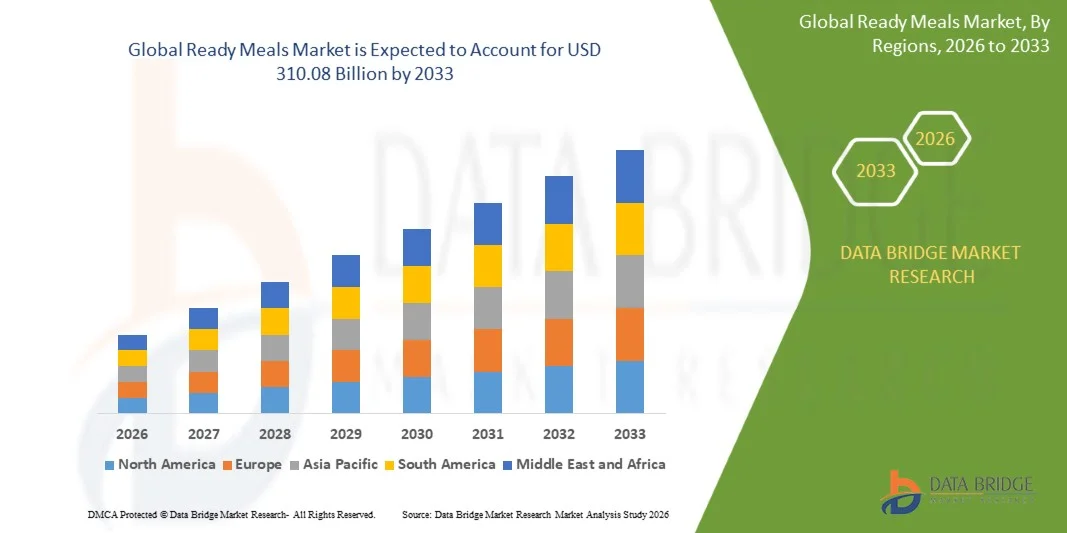
- As per Data Bridge Market Research analysis, the ready meals market was valued at USD 202.05 billion in 2025 and is projected to reach USD 310.08 billion by 2033, growing at a CAGR of 5.50% from 2026 to 2033.
- The market is experiencing consistent growth driven by busy lifestyles, increasing working populations, rapid urbanization, growing demand for convenient meal solutions, and expanding availability through supermarkets, convenience stores, and online retail channels. The increasing preference for frozen, chilled, and shelf-stable meals, along with innovations in healthier, plant-based, premium, and clean-label formulations, is further supporting market expansion.
- The growing number of time-constrained consumers globally, combined with rising disposable incomes and expanding organized retail and e-commerce grocery platforms, is encouraging households to adopt ready meals as convenient alternatives to traditional home cooking. Manufacturers are increasingly introducing nutritious, portion-controlled, plant-based, high-protein, and culturally diverse meal options, while improvements in packaging, preservation, and cold-chain infrastructure are enhancing product quality, shelf life, and accessibility across developed and emerging market
Market Size & Forecast
- Global Market Value (2025): USD 202.05 Billion
- Expected Market Value (2033): USD 310.08 Billion
- Forecast CAGR (2026–2033): 5.50%
What are the Major Takeaways of the Ready Meals Market?
- North America dominated the ready meals market with the largest revenue share of 34.10% in 2025, supported by strong demand for convenient meal solutions, established retail infrastructure, and high consumer adoption of frozen and prepared foods.
- Asia-Pacific is expected to be the fastest-growing region at a CAGR of 4.83% from 2026 to 2033, fueled by rapid urbanization, rising disposable incomes, smaller household sizes, expanding cold-chain infrastructure, and growing demand for convenient food options.
- The frozen ready meals segment led the market with a 52.93% share in 2025, driven by longer shelf life, convenience, broad product availability, and established frozen-food distribution infrastructure.
- Prepared salads are the fastest-growing type, projected to register a CAGR of 5.0%, reflecting the surge in demand for fresh, convenient, and healthier meal alternatives.
- The frozen & chilled segment dominated the product type category with a 78% revenue share in 2025, led by strong consumer preference for convenient meals that retain freshness, flavor, and nutritional characteristics.
- Non-vegetarian accounted for 60.02% of the market share in 2025, preferred by widespread consumption of meat, poultry, and seafood-based prepared meals.
- The vegan segment is the fastest-growing meal type category, with a CAGR of 5.5%, driven by increasing interest in plant-based diets, animal-welfare considerations, and environmentally conscious consumption.
Report Scope and Ready Meals Market Segmentation
|
Attributes |
Ready Meals Key Market Insights |
|
Segments Covered |
|
|
Countries Covered |
North America
Europe
Asia-Pacific
Middle East and Africa
South America
|
|
Key Market Players |
|
|
Market Opportunities |
|
|
Value Added Data Infosets |
In addition to the insights on market scenarios such as market value, growth rate, segmentation, geographical coverage, and major players, the market reports curated by the Data Bridge Market Research also include in-depth expert analysis, pricing analysis, brand share analysis, consumer survey, demography analysis, supply chain analysis, value chain analysis, raw material/consumables overview, vendor selection criteria, PESTLE Analysis, Porter Analysis, and regulatory framework. |
What is the Key Trend in the Ready Meals Market?
- Ready meals are increasingly shifting toward healthier, protein-rich, clean-label, and premium formulations, as consumers seek convenient foods that provide nutritional benefits without compromising taste, freshness, or preparation time.
- High-protein, high-fibre, vitamin-fortified, and plant-based formulations are gaining traction as manufacturers respond to growing health awareness and demand for functional nutrition in convenient meal formats.
- For instance, in February 2025, Waitrose expanded its PlantLiving range of plant-based ready meals after reporting a 38% increase in sales of its PlantLiving Indian Inspired Takeaway Feast and a 17% increase for its Vegetable Tikka Masala & Rice.
- Ready-meal manufacturers are increasingly combining restaurant-style flavors, regional cuisines, premium ingredients, and convenient cooking formats to attract consumers seeking elevated at-home dining experiences.
- For instance, in April 2026, Ingredion reported that more than half of global consumers choose ready meals for ease and speed, while more than half of ready-meal purchasers consume them at least once a week, highlighting the shift toward restaurant-inspired convenience meals.
- As consumers increasingly balance convenience with nutrition, taste, and food quality, manufacturers are expected to accelerate innovation in high-protein, plant-based, clean-label, and restaurant-inspired ready meals, strengthening premiumization across the global market.
What are the Key Drivers of the Ready Meals Market?
- The rapid growth of urbanization, dual-income households, longer working hours, and time-constrained lifestyles is significantly increasing demand for convenient ready meals that reduce preparation and cooking time.
- For instance, in July 2025, Kantar Worldpanel data reported that India's ready-to-cook category grew 58% in 2024, adding 18 million households, while the overall packaged-food market grew only 8%, demonstrating the strong consumer shift toward convenience-oriented food products.
- Food manufacturers and retailers are expanding ready-meal portfolios across frozen, chilled, shelf-stable, ready-to-heat, and ready-to-cook formats, enabling consumers to access convenient meal solutions across different price points and consumption occasions.
- For instance, in October 2025, Redseer estimated India's addressable Ready-to-Eat and Ready-to-Heat consumer base at 70–80 million, highlighting substantial demand potential driven by urbanization, rising incomes, convenience, and evolving food preferences.
- With consumers increasingly prioritizing speed, convenience, accessibility, and variety, ready meals will remain an important component of modern food consumption, while expanding online grocery and quick-commerce channels are further improving product availability and market penetration.
Which Factors are Challenging the Growth of the Ready Meals Market?
- Frozen and chilled ready meals require temperature-controlled storage, transportation, and last-mile delivery, creating substantial infrastructure and operating requirements compared with ambient shelf-stable products.
- For instance, in May 2025, the Warehousing Development and Regulatory Authority (WDRA) stated that India’s logistics costs were 14–18%, compared with an international benchmark of about 8%, highlighting the significant cost burden associated with food-product transportation and distribution. This is particularly relevant to chilled and frozen ready meals, which require controlled-temperature logistics.
- These cold-chain requirements can increase distribution costs and restrict market penetration in emerging economies and tier-2 and tier-3 markets, where refrigerated warehouses, transportation networks, and reliable power infrastructure remain uneven.
- For instance, in August 2025, reporting based on FSSAI survey findings highlighted that around 20% of prepared food in India did not meet prescribed quality standards, while food losses and quality deterioration across the supply chain remained significant concerns. Such quality deterioration increases waste and costs for prepared and ready-to-eat food businesses, particularly where temperature-controlled handling is required.
- The high cost of refrigeration, energy-intensive processing, specialized transportation, and cold-storage infrastructure continues to pressure ready-meal manufacturers and distributors, particularly for frozen and chilled products.
- These supply-chain constraints can increase product prices, create spoilage risks, and limit geographic expansion, slowing adoption in price-sensitive and infrastructure-constrained markets.
How is the Ready Meals Market Segmented?
The ready meals market is segmented on the basis of type, product, meal type, and distribution channel.
- By Type
On the basis of type, the ready meals market is segmented into chilled pizza, canned/preserved ready meals, chilled ready meals, dried ready meals, frozen pizza, frozen ready meals, and prepared salads. The frozen ready meals segment dominated the market with 52.93% share in 2025, owing to longer shelf life, convenience, broad product availability, and established frozen-food distribution infrastructure. These meals enable consumers to prepare complete dishes quickly while reducing food spoilage and waste. Improvements in freezing technologies and packaging are helping preserve taste, texture, and nutritional quality. Frozen ready meals are also widely available across supermarkets, hypermarkets, convenience stores, and online grocery platforms. The segment benefits from a broad range of products, including meat-based meals, vegetarian dishes, pasta, rice-based meals, and ethnic cuisines.
The prepared salads segment is projected to register the fastest growth at 5.0% CAGR from 2026 to 2033, driven by rising demand for fresh, convenient, and healthier meal alternatives. Prepared salads provide ready-to-eat solutions that require little or no preparation. Growing health consciousness is encouraging consumers to seek meals containing vegetables, plant-based ingredients, and nutrient-rich components. The segment is also benefiting from increasing demand for portion-controlled and minimally processed food products. Improved refrigerated packaging and freshness-preservation technologies are helping extend product shelf life. Retailers are expanding chilled fresh-food sections and online grocery offerings, improving accessibility.
- By Product
On the basis of product, the ready meals market is segmented into frozen & chilled, canned, and dried. The frozen & chilled segment dominated the market with 78% share in 2025, supported by strong consumer preference for convenient meals that retain freshness, flavor, and nutritional characteristics. Frozen and chilled products provide a broad variety of meal options for consumers seeking quick alternatives to traditional cooking. Their extensive availability through modern grocery retailers further strengthens market penetration. Improvements in cold-chain infrastructure are enabling manufacturers to expand distribution across domestic and international markets. Manufacturers are also introducing premium, healthier, plant-based, and culturally diverse products within these formats.
The dried segment is expected to witness the fastest growth at 5.5% CAGR from 2026 to 2033, driven by extended shelf life, lightweight packaging, convenient storage, and comparatively simple transportation requirements. Dried ready meals are particularly attractive to consumers seeking portable and easy-to-prepare food solutions. The category includes dehydrated noodles, pasta, rice-based meals, soups, and other meal preparations. Increasing demand among students, travelers, outdoor consumers, and busy urban populations is creating additional growth opportunities. Dried products also reduce dependence on temperature-controlled transportation compared with frozen and chilled alternatives. Manufacturers are increasingly developing products with improved flavors, healthier ingredients, and premium formulations.
- By Meal Type
On the basis of meal type, the ready meals market is segmented into vegetarian, non-vegetarian, and vegan. The non-vegetarian segment dominated the market with 60.02% share in 2025, supported by widespread consumption of meat, poultry, and seafood-based prepared meals. Ready meals containing animal-based proteins provide consumers with convenient and substantial meal solutions requiring minimal preparation. Manufacturers offer extensive varieties of chicken, beef, pork, seafood, and mixed-protein dishes across different cuisines. Strong consumer familiarity with meat-based foods and their broad retail availability further reinforce segment leadership. High-protein meal positioning is also encouraging manufacturers to expand meat-based ready-meal portfolios.
The vegan segment is projected to register the fastest growth at 5.5% CAGR from 2026 to 2033, driven by increasing interest in plant-based diets, animal-welfare considerations, and environmentally conscious consumption. Vegan ready meals provide convenient alternatives for consumers avoiding meat, dairy, eggs, and other animal-derived ingredients. Manufacturers are expanding portfolios with plant-based curries, pasta, rice dishes, burgers, and other internationally inspired meals. Improvements in plant-based proteins are enabling better taste, texture, and nutritional characteristics. Growing availability through supermarkets, specialty retailers, and online grocery platforms is improving consumer accessibility. Rising investment in plant-based food innovation is further supporting new product development.
- By Distribution Channel
On the basis of distribution channel, the ready meals market is segmented into supermarket & hypermarket, and online retail. The supermarket & hypermarket segment dominated the market with 42% share in 2025, owing to extensive retail networks, large product assortments, and established refrigerated and frozen-food infrastructure. These outlets allow consumers to compare different brands, meal formats, flavors, and price points in one location. Dedicated chilled and frozen sections improve product visibility and accessibility while supporting impulse purchases. Promotional offers, discounts, private-label products, and meal deals further encourage ready-meal purchases. Supermarkets and hypermarkets also provide established cold-storage facilities that are particularly important for frozen and chilled products.
The online retail segment is expected to register the fastest growth at 4.52% CAGR from 2026 to 2033, driven by increasing e-commerce adoption, digital grocery platforms, and demand for convenient home delivery. Online channels provide consumers with access to broader ready-meal assortments than many physical stores. Quick-commerce services are also improving access to chilled and frozen meals through rapid last-mile delivery. Digital platforms enable personalized recommendations, promotions, subscriptions, and targeted marketing to encourage repeat purchases. Improvements in insulated packaging and temperature-controlled delivery are further supporting online sales of temperature-sensitive products
Which Region Holds the Largest Share of the Ready Meals Market?
- North America dominated the ready meals market with the largest revenue share of 34.10% in 2025, supported by strong demand for convenient meal solutions, established retail infrastructure, and high consumer adoption of frozen and prepared foods.
- The region also benefits from strong penetration of supermarkets and hypermarkets, extensive cold-chain infrastructure, high disposable incomes, and growing demand for healthier and premium ready-meal options. Increasing adoption of online grocery shopping, quick-commerce delivery, plant-based meals, and convenient single-serve products continues to strengthen North America's leadership position in the global market.
U.S. Ready Meals Market Insight
The U.S. ready meals market is witnessing strong growth due to rising consumer demand for convenient, time-saving food solutions and the widespread adoption of frozen, chilled, and shelf-stable meal products. The country's mature food retail ecosystem, extensive supermarket and hypermarket network, and well-developed cold-chain infrastructure are supporting product availability across diverse consumer segments. In addition, growing demand for healthier, high-protein, plant-based, and clean-label ready meals is encouraging manufacturers to expand product portfolios and develop premium offerings.
Asia-Pacific Ready Meals Market Insight
The Asia-Pacific ready meals market is expected to witness rapid growth, driven by increasing urbanization, rising disposable incomes, expanding working populations, and changing consumer lifestyles across countries such as China, India, and Japan. Growing awareness regarding convenient food solutions, expanding modern retail infrastructure, and increasing availability of frozen, chilled, and shelf-stable meals are supporting regional market expansion. In addition, the rapid development of e-commerce, quick-commerce, and cold-chain distribution networks is accelerating ready-meal adoption across urban households.
Japan Ready Meals Market Insight
The Japan ready meals market is witnessing consistent growth due to rising demand for convenient, portion-controlled, and high-quality food products among urban consumers and an aging population. Convenience stores, supermarkets, and foodservice retailers are increasingly expanding ready-to-eat meals, bento products, prepared salads, and other convenient food options. Moreover, growing demand for nutritious meals, premium ingredients, and traditional Japanese as well as international cuisines is supporting product innovation and contributing to market growth.
China Ready Meals Market Insight
The China ready meals market is growing rapidly, driven by increasing urbanization, expanding middle-class populations, rising disposable incomes, and growing demand for convenient food solutions. Increasing adoption of frozen and chilled meals across supermarkets, convenience stores, and online grocery platforms is significantly boosting market demand. In addition, rapid expansion of e-commerce and food-delivery infrastructure, growing interest in healthier and premium meal options, and continuous product innovation are positioning China as one of the fastest-growing markets for ready meals globally.
U.K. Ready Meals Market Insight
The U.K. ready meals market is experiencing steady growth, supported by strong consumer preference for convenient meal solutions and extensive availability through supermarkets, convenience stores, and online grocery platforms. Increasing demand for healthier, vegetarian, vegan, premium, and international ready meals is encouraging manufacturers and retailers to diversify their product offerings. Furthermore, growing adoption of online grocery shopping, quick-commerce services, and innovative chilled and frozen meal formats is improving product accessibility and supporting continued market growth in the U.K.
Germany Ready Meals Market Insight
The Germany ready meals market is expanding steadily due to rising demand for convenient food products, increasing urban lifestyles, and strong consumer interest in high-quality and healthier prepared meals. Food manufacturers and retailers are increasingly offering frozen, chilled, vegetarian, vegan, and organic ready meals to address changing dietary preferences. Continuous expansion of supermarkets, discount retailers, and online grocery channels, along with growing demand for sustainable packaging and clean-label products, is further supporting market growth in Germany.
Which are the Top Companies in Ready Meals Market?
The ready meals industry is primarily led by well-established companies, including:
- Nestlé (Switzerland)
- Conagra Brands, Inc. (U.S.)
- General Mills Inc. (U.S.)
- Kraft Heinz (U.S.)
- Tyson Foods, Inc. (U.S.)
- Hormel Foods Corporation (U.S.)
- Nomad Foods (U.K.)
- Greencore Group plc (U.K.)
- Hilton Food Group plc (U.K.)
- Premier Foods plc (U.K.)
- McCain Foods Limited (Canada)
- Bell Food Group Ltd (Switzerland)
- FRoSTA AG (Germany)
- Ajinomoto Co., Inc. (Japan)
- NICHIREI CORPORATION (Japan)
- ITC LIMITED (India)
- Orkla ASA (Norway)
- MTR Foods Pvt Ltd. (India)
- BRF S.A. (Brazil)
- MBRF (Brazil)
What are Latest Developments in Ready Meals Market?
- In February 2025, HelloFresh launched its Factor Ready-to-Eat (RTE) meal service in Germany, introducing fresh, nutritious ready meals delivered directly to consumers. The launch marked an important expansion of Factor into Germany and was designed to address growing demand for convenient, high-quality meals that require minimal preparation.
- In July 2024, Mars Food & Nutrition launched its Ben’s Original ready-meal ranges in the U.K., U.S., and Canada, expanding into convenient ready-to-eat products. The launch included Ben’s Original Lunch Bowls and Favourites in the U.K. and Street Food products in the U.S. and Canada, with the ranges developed around consumers’ increasing demand for convenient and tasty meal solutions.
- In December 2023, Blue Apron announced the launch of its Prepared & Ready meal category, introducing more than 16 fresh, pre-made, single-serving meals that customers could order for delivery. The meals included options such as salmon with riced broccoli, turkey with brown rice, chicken with quinoa, and Korean-style kimchi rice, expanding Blue Apron beyond traditional meal kits into ready-to-eat offerings.
- In June 2022, Meatless Farm launched five new frozen and chilled plant-based ready meals through Morrisons and Ocado in the U.K., marking the company's entry into the ready-meal category. The range included Meatless Marinara, Korean BBQ-style chicken and rice, and Chilli Non Carne, responding to demand for convenient plant-based meal alternatives.
- In April 2021, Sunbasket transitioned its Fresh & Ready meals to individual single-serving portions, expanding its convenient ready-to-heat offering with more than 65 new recipes planned during the year. The pre-prepared meals were designed to require no preparation or cleanup and provided consumers with chef-created options across different dietary preferences and cuisines.

- Interactive Data Analysis Dashboard
- Company Analysis Dashboard for high growth potential opportunities
- Research Analyst Access for customization & queries
- Competitor Analysis with Interactive dashboard
- Latest News, Updates & Trend analysis
- Harness the Power of Benchmark Analysis for Comprehensive Competitor Tracking
Global Ready Meals Market, Supply Chain Analysis and Ecosystem Framework
To support market growth and help clients navigate the impact of geopolitical shifts, DBMR has integrated in-depth supply chain analysis into its Global Ready Meals Market research reports. This addition empowers clients to respond effectively to global changes affecting their industries. The supply chain analysis section includes detailed insights such as Global Ready Meals Market consumption and production by country, price trend analysis, the impact of tariffs and geopolitical developments, and import and export trends by country and HSN code. It also highlights major suppliers with data on production capacity and company profiles, as well as key importers and exporters. In addition to research, DBMR offers specialized supply chain consulting services backed by over a decade of experience, providing solutions like supplier discovery, supplier risk assessment, price trend analysis, impact evaluation of inflation and trade route changes, and comprehensive market trend analysis.
Data collection and base year analysis are done using data collection modules with large sample sizes. The stage includes obtaining market information or related data through various sources and strategies. It includes examining and planning all the data acquired from the past in advance. It likewise envelops the examination of information inconsistencies seen across different information sources. The market data is analysed and estimated using market statistical and coherent models. Also, market share analysis and key trend analysis are the major success factors in the market report. To know more, please request an analyst call or drop down your inquiry.
The key research methodology used by DBMR research team is data triangulation which involves data mining, analysis of the impact of data variables on the market and primary (industry expert) validation. Data models include Vendor Positioning Grid, Market Time Line Analysis, Market Overview and Guide, Company Positioning Grid, Patent Analysis, Pricing Analysis, Company Market Share Analysis, Standards of Measurement, Global versus Regional and Vendor Share Analysis. To know more about the research methodology, drop in an inquiry to speak to our industry experts.
Data Bridge Market Research is a leader in advanced formative research. We take pride in servicing our existing and new customers with data and analysis that match and suits their goal. The report can be customized to include price trend analysis of target brands understanding the market for additional countries (ask for the list of countries), clinical trial results data, literature review, refurbished market and product base analysis. Market analysis of target competitors can be analyzed from technology-based analysis to market portfolio strategies. We can add as many competitors that you require data about in the format and data style you are looking for. Our team of analysts can also provide you data in crude raw excel files pivot tables (Fact book) or can assist you in creating presentations from the data sets available in the report.













