


Reagent Grade Gases Market Size
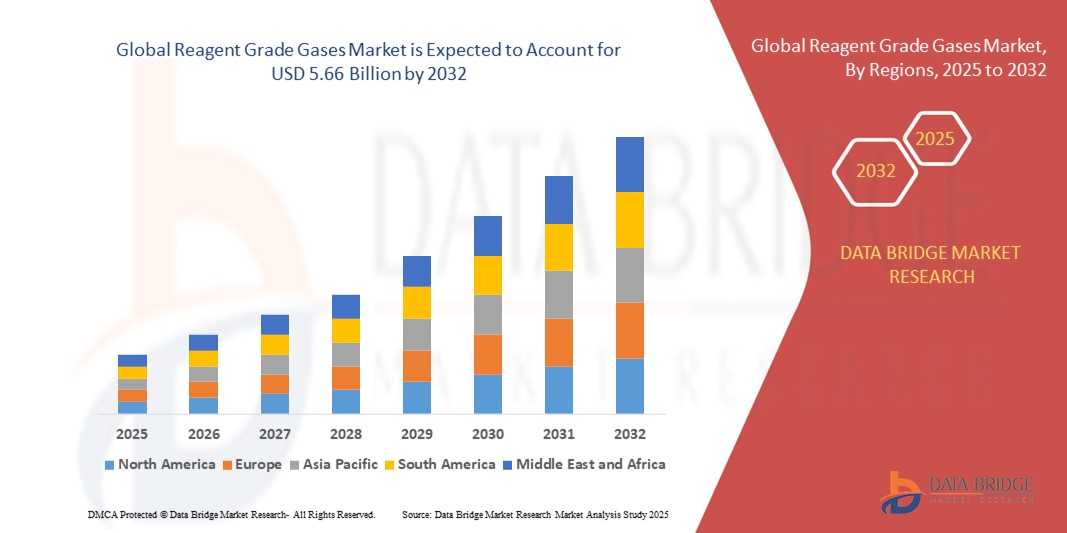
- The global reagent grade gases market size was valued at USD 3.69 billion in 2024 and is expected to reach USD 5.66 billion by 2032, at a CAGR of 5.50% during the forecast period
- The market growth is largely fuelled by the rising demand for high-purity gases in analytical laboratories, pharmaceutical research, and chemical testing applications.
- Increasing investments in life sciences research and the growing adoption of advanced analytical techniques are further contributing to market expansion
- Addition, technological advancements in gas purification processes and the growing emphasis on quality assurance across industries are boosting market growth
Reagent Grade Gases Market Analysis
- The reagent grade gases market is witnessing steady growth driven by the expanding pharmaceutical and biotechnology sectors, where high-purity gases are essential for various analytical and manufacturing processes
- Rising environmental testing activities and growing regulatory focus on product quality and safety standards are also accelerating the adoption of reagent grade gases across multiple industries
- Asia-Pacific dominated the reagent grade gases market with the largest revenue share of 42.3% in 2024, driven by rapid industrialization, growing pharmaceutical production, and the expanding semiconductor and electronics sectors in China, Japan, and India
- North America region is expected to witness the highest growth rate in the global reagent grade gases market, driven by robust technological innovation, strong demand from life sciences and chemical industries, and the presence of major specialty gas manufacturers ensuring a stable supply chain
- The Nitrogen (N2) segment held the largest market revenue share in 2024 due to its extensive use as a carrier and blanketing gas across analytical instruments and industrial processes. Its inert properties and cost-effectiveness make it a preferred choice for a wide range of laboratory and manufacturing applications
Report Scope and Reagent Grade Gases Market Segmentation
|
Attributes |
Reagent Grade Gases Key Market Insights |
|
Segments Covered |
|
|
Countries Covered |
North America
Europe
Asia-Pacific
Middle East and Africa
South America
|
|
Key Market Players |
|
|
Market Opportunities |
• Growing Adoption Of High-Purity Gases In Pharmaceutical Research |
|
Value Added Data Infosets |
In addition to the insights on market scenarios such as market value, growth rate, segmentation, geographical coverage, and major players, the market reports curated by the Data Bridge Market Research also include import export analysis, production capacity overview, production consumption analysis, price trend analysis, climate change scenario, supply chain analysis, value chain analysis, raw material/consumables overview, vendor selection criteria, PESTLE Analysis, Porter Analysis, and regulatory framework. |
Reagent Grade Gases Market Trends
Shift Toward Ultra-High Purity (UHP) & Digitalized Supply
• The accelerating move to ultra-high purity specifications (UHP/UHP-plus) is reshaping reagent gas portfolios, enabling lower background noise in GC/LC-MS, ICP-MS, and semiconductor process control. Labs benefit from improved sensitivity, fewer analytical reruns, and enhanced data reproducibility, directly translating into higher productivity and cost efficiency
• Demand for complex, certified specialty gas mixtures is rising as analytical methods become more standardized and tightly regulated across industries. Pre-blended, traceable mixtures eliminate the need for on-site manual preparation, reducing contamination risk, ensuring regulatory compliance, and minimizing human error in critical testing workflows
• Cylinder telemetry, RFID tagging, and IoT-based pressure/weight sensors are gaining traction for real-time monitoring of gas inventory and usage patterns. These technologies reduce the risk of stockouts, improve supply chain transparency, and enable automated reordering, ensuring uninterrupted laboratory operations and lower administrative overheads
• Sustainability initiatives are accelerating the adoption of returnable cylinders, high-capacity composite packages, and on-site purification solutions. By minimizing transport emissions, packaging waste, and hazardous material handling, suppliers align with global ESG goals while lowering total lifecycle costs for end-users
• For instance, in 2023, multiple semiconductor fabs in East Asia and the U.S. reported a surge in UHP nitrogen, argon, hydrogen, and ammonia demand for advanced microelectronics manufacturing. This prompted suppliers to expand purification capacity, deploy bulk delivery systems, and integrate on-site backup storage to maintain uninterrupted supply
• While UHP adoption and digital fleet management are rapidly gaining momentum, their success relies on continued innovation in purification processes, competitive pricing models, and localized production hubs. Vendors must also develop robust after-sales service networks to support distributed and high-volume end-users effectively
Reagent Grade Gases Market Dynamics
Driver
Expansion of Regulated Testing & Advanced Manufacturing
• Growth in regulated QC/QA testing across pharmaceuticals, biologics, food safety, and environmental monitoring is raising baseline purity requirements. Stricter method validation criteria and heightened audit scrutiny are driving consistent demand for certified carrier, calibration, and zero gases with comprehensive documentation
• The proliferation of semiconductor, solar, and battery manufacturing facilities requires ultra-clean process environments with stringent impurity controls. As wafer nodes shrink and advanced materials come into use, the need for UHP gases and complex specialty mixtures has surged to maintain product quality and yield
• Analytical instrument installed bases are expanding across CROs/CMOs, academic labs, and public-sector research networks. Higher instrument density per facility and rising utilization rates are increasing recurring gas consumption, particularly for helium, hydrogen, nitrogen, and multi-component calibration blends
• Public investments in air-quality networks, industrial emissions compliance, and climate monitoring have boosted the adoption of certified calibration standards. Continuous emissions monitoring systems (CEMS) rely heavily on traceable gas mixtures for sensor calibration, driving recurring procurement contracts and long-term supply agreements
• For instance, in 2022–2023, several pharma QC facilities and CRO expansions in North America and Europe standardized GC/LC-MS workflows requiring high-purity hydrogen and nitrogen generators. Certified calibration gas mixtures were integrated into these systems, reinforcing demand consistency across regional laboratory networks
• While regulatory initiatives and industrial capacity growth are strong market enablers, suppliers must prioritize consistent product quality, batch-to-batch reproducibility, and comprehensive technical support to sustain long-term adoption and customer loyalty
Restraint/Challenge
Helium Scarcity, Cost Volatility, and Logistics Complexity
• Periodic tightness in helium supply, coupled with price volatility, continues to challenge laboratories reliant on helium as a carrier gas for GC systems. Budgeting uncertainty and unplanned cost spikes often lead to workflow disruptions, delayed method validation, and increased adoption of hydrogen-based alternatives
• Achieving and certifying UHP-grade gas purity requires high-cost purification technologies, contamination-controlled filling stations, and extensive analytical verification. Smaller regional players face financial and technical barriers in meeting international pharmacopeial and ISO standards at globally competitive price points
• In many emerging markets, logistics for hazardous and high-purity gases remain complex due to non-standard cylinder valves, limited transport infrastructure, and import/export restrictions. Long lead times and fragmented service networks increase inventory costs and risk of supply chain interruptions for end-users
• Skill gaps in gas cylinder handling, regulator selection, and point-of-use purification lead to operational errors, analytical contamination, and instrument downtime. Training gaps combined with lack of SOP standardization result in higher rerun rates, wasted consumables, and additional maintenance expenses
• For instance, in 2023, supply interruptions and price spikes for helium prompted numerous analytical labs to transition toward on-site hydrogen generators. While reducing long-term dependence on helium, these upgrades involved significant capital investments and extensive method revalidation procedures
• While technology innovation in purification, on-site generation, and recycling continues, market stakeholders must prioritize resilient supply chains, standardized hardware ecosystems, and decentralized service models to mitigate risk and support sustainable long-term growth
Reagent Grade Gases Market Scope
The market is segmented on the basis of type, applications, and end user.
- By Type
On the basis of type, the reagent grade gases market is segmented into Nitrogen (N2), Oxygen (O2), Hydrogen (H2), Helium (He), Argon (Ar), Carbon Dioxide (CO2), Methane (CH4), Acetylene (C2H2), and Others. The Nitrogen (N2) segment held the largest market revenue share in 2024 due to its extensive use as a carrier and blanketing gas across analytical instruments and industrial processes. Its inert properties and cost-effectiveness make it a preferred choice for a wide range of laboratory and manufacturing applications.
The Helium (He) segment is expected to witness the fastest growth rate from 2025 to 2032, driven by its critical role as a carrier gas in gas chromatography (GC) and leak detection systems. Despite periodic supply constraints, the rising demand for high-purity analytical methods continues to fuel helium adoption in precision testing environments.
- By Applications
On the basis of applications, the market is segmented into Gas Chromatography (GC), Mass Spectrometry (MS), Atomic Absorption Spectroscopy (AAS), Atomic Emission Spectroscopy (AES), Chemical Synthesis, Welding and Cutting, Environmental Monitoring, and Others. The Gas Chromatography (GC) segment accounted for the largest revenue share in 2024 owing to its widespread use in pharmaceuticals, food safety, petrochemicals, and environmental analysis. The requirement for ultra-high purity gases in GC ensures accurate and reliable analytical results.
The Mass Spectrometry (MS) segment is expected to witness the fastest growth rate from 2025 to 2032, supported by expanding applications in proteomics, metabolomics, and drug development. High-purity gases enable enhanced sensitivity and precision in MS workflows, driving demand across academic and industrial research laboratories.
- By End User
On the basis of end user, the reagent grade gases market is segmented into Pharmaceuticals, Chemicals, Environmental Analysis, Food and Beverage, Electronics and Semiconductors, Healthcare, Academic and Research Institutions, and Others. The Pharmaceuticals segment dominated the market in 2024 due to the growing adoption of high-purity gases in drug discovery, quality control, and production-scale synthesis. Stringent regulatory standards further boost demand for certified gas mixtures in pharma applications.
The Electronics and Semiconductors segment is expected to witness the fastest growth rate from 2025 to 2032, fueled by rapid growth in semiconductor fabrication, solar cell manufacturing, and microelectronics testing. Ultra-high purity gases ensure defect-free processes and optimal performance in advanced electronic component production.
Reagent Grade Gases Market Regional Analysis
• Asia-Pacific dominated the reagent grade gases market with the largest revenue share of 42.3% in 2024, driven by rapid industrialization, growing pharmaceutical production, and the expanding semiconductor and electronics sectors in China, Japan, and India.
• The region benefits from strong government initiatives promoting environmental monitoring, healthcare R&D, and manufacturing modernization, all of which require high-purity gases for testing and production.
• Increasing investments in academic research, coupled with the availability of cost-effective local gas producers, further strengthen Asia-Pacific’s leadership position in the global reagent grade gases market.
China Reagent Grade Gases Market Insight
The China reagent grade gases market accounted for the largest revenue share in Asia-Pacific in 2024, fueled by the country’s rapid pharmaceutical manufacturing growth, extensive electronics production, and push for environmental compliance. Government-led programs for smart cities, industrial automation, and renewable energy have increased the adoption of ultra-high purity gases across laboratories, industries, and research institutions. The presence of strong domestic gas suppliers offering competitive pricing also supports long-term market expansion.
Japan Reagent Grade Gases Market Insight
The Japan reagent grade gases market is expected to witness the fastest growth rate from 2025 to 2032 growth due to its advanced semiconductor fabrication, life sciences research, and healthcare infrastructure. Rising demand for analytical instruments in drug discovery, environmental testing, and precision manufacturing processes continues to drive adoption of high-purity gases. Japan’s focus on technology innovation and industrial sustainability further strengthens its role as a key market within the region.
North America Reagent Grade Gases Market Insight
The North America reagent grade gases market is expected to witness the fastest growth rate from 2025 to 2032, supported by mature pharmaceutical R&D, stringent environmental monitoring regulations, and widespread use of advanced analytical techniques. The presence of leading specialty gas manufacturers and continuous innovation in life sciences and semiconductor manufacturing drive steady demand across the region.
U.S. Reagent Grade Gases Market Insight
The U.S. reagent grade gases market is expected to witness the fastest growth rate from 2025 to 2032, fueled by the growth of biotechnology research, pharmaceutical quality testing, and climate monitoring programs. Adoption of high-purity gases in drug development, academic institutions, and industrial emissions testing continues to rise, supported by strong investments in laboratory automation and analytical technologies.
Europe Reagent Grade Gases Market Insight
The Europe reagent grade gases market is expected to witness the fastest growth rate from 2025 to 2032, driven by stringent EU regulations for food safety, product quality, and emissions monitoring. Rising adoption of mass spectrometry, gas chromatography, and environmental testing solutions across academic, pharmaceutical, and chemical laboratories is accelerating demand for ultra-high purity gases across the region.
Germany Reagent Grade Gases Market Insight
The Germany reagent grade gases market is expected to witness the fastest growth rate from 2025 to 2032 due to its strong chemical manufacturing base, leadership in industrial automation, and environmental compliance programs. Demand for certified calibration and process gases is increasing across pharmaceuticals, automotive R&D, and energy sectors, supported by the country’s commitment to sustainability and technological innovation.
U.K. Reagent Grade Gases Market Insight
The U.K. reagent grade gases market is expected to witness the fastest growth rate from 2025 to 2032, driven by increasing investments in pharmaceutical research, academic institutions, and environmental monitoring programs. Rising adoption of gas chromatography and mass spectrometry in drug quality testing, climate analysis, and food safety applications continues to fuel demand for high-purity gases. In addition, the country’s strong focus on sustainability and green chemistry practices supports the development of advanced specialty gas solutions for both industrial and laboratory use.
Reagent Grade Gases Market Share
The Reagent Grade Gases industry is primarily led by well-established companies, including:
- Air Liquide (France)
- Linde Plc (U.K.)
- Air Products and Chemicals Inc. (U.S.)
- Taiyo Nippon Sanso Corporation (Japan)
- Messer Group (Germany)
- Airgas Inc (Subsidiary of Air Liquide) (U.S.)
- Gulf Cryo (UAE)
- Universal Industrial Gases Inc. (U.S.)
- Coregas Pvt Ltd (Australia)
- SOL Group (Italy)
Latest Developments in Global Reagent Grade Gases Market
- In March 2024, Sandia National Laboratories initiated simulation and laboratory experiments to evaluate the feasibility of using depleted oil and natural gas reservoirs for storing carbon-free hydrogen fuel. This development aims to repurpose existing underground infrastructure for large-scale hydrogen storage, supporting the transition to clean energy. If successful, it could significantly reduce storage costs, enable year-round hydrogen availability, and accelerate the adoption of hydrogen as a sustainable fuel, positively impacting the renewable energy and storage markets
- In September 2023, Air Liquide announced a strategic partnership with ADP Group to develop hydrogen infrastructure in airports. The collaboration focuses on building refueling and storage facilities to enable the use of hydrogen-powered aircraft and ground support equipment. This initiative is expected to advance decarbonization in the aviation sector, promote sustainable air transport, and create growth opportunities for hydrogen technology suppliers across global transportation markets

- Interactive Data Analysis Dashboard
- Company Analysis Dashboard for high growth potential opportunities
- Research Analyst Access for customization & queries
- Competitor Analysis with Interactive dashboard
- Latest News, Updates & Trend analysis
- Harness the Power of Benchmark Analysis for Comprehensive Competitor Tracking
Global Reagent Grade Gases Market, Supply Chain Analysis and Ecosystem Framework
To support market growth and help clients navigate the impact of geopolitical shifts, DBMR has integrated in-depth supply chain analysis into its Global Reagent Grade Gases Market research reports. This addition empowers clients to respond effectively to global changes affecting their industries. The supply chain analysis section includes detailed insights such as Global Reagent Grade Gases Market consumption and production by country, price trend analysis, the impact of tariffs and geopolitical developments, and import and export trends by country and HSN code. It also highlights major suppliers with data on production capacity and company profiles, as well as key importers and exporters. In addition to research, DBMR offers specialized supply chain consulting services backed by over a decade of experience, providing solutions like supplier discovery, supplier risk assessment, price trend analysis, impact evaluation of inflation and trade route changes, and comprehensive market trend analysis.
Data collection and base year analysis are done using data collection modules with large sample sizes. The stage includes obtaining market information or related data through various sources and strategies. It includes examining and planning all the data acquired from the past in advance. It likewise envelops the examination of information inconsistencies seen across different information sources. The market data is analysed and estimated using market statistical and coherent models. Also, market share analysis and key trend analysis are the major success factors in the market report. To know more, please request an analyst call or drop down your inquiry.
The key research methodology used by DBMR research team is data triangulation which involves data mining, analysis of the impact of data variables on the market and primary (industry expert) validation. Data models include Vendor Positioning Grid, Market Time Line Analysis, Market Overview and Guide, Company Positioning Grid, Patent Analysis, Pricing Analysis, Company Market Share Analysis, Standards of Measurement, Global versus Regional and Vendor Share Analysis. To know more about the research methodology, drop in an inquiry to speak to our industry experts.
Data Bridge Market Research is a leader in advanced formative research. We take pride in servicing our existing and new customers with data and analysis that match and suits their goal. The report can be customized to include price trend analysis of target brands understanding the market for additional countries (ask for the list of countries), clinical trial results data, literature review, refurbished market and product base analysis. Market analysis of target competitors can be analyzed from technology-based analysis to market portfolio strategies. We can add as many competitors that you require data about in the format and data style you are looking for. Our team of analysts can also provide you data in crude raw excel files pivot tables (Fact book) or can assist you in creating presentations from the data sets available in the report.













