


Real-time Locating System Market Size
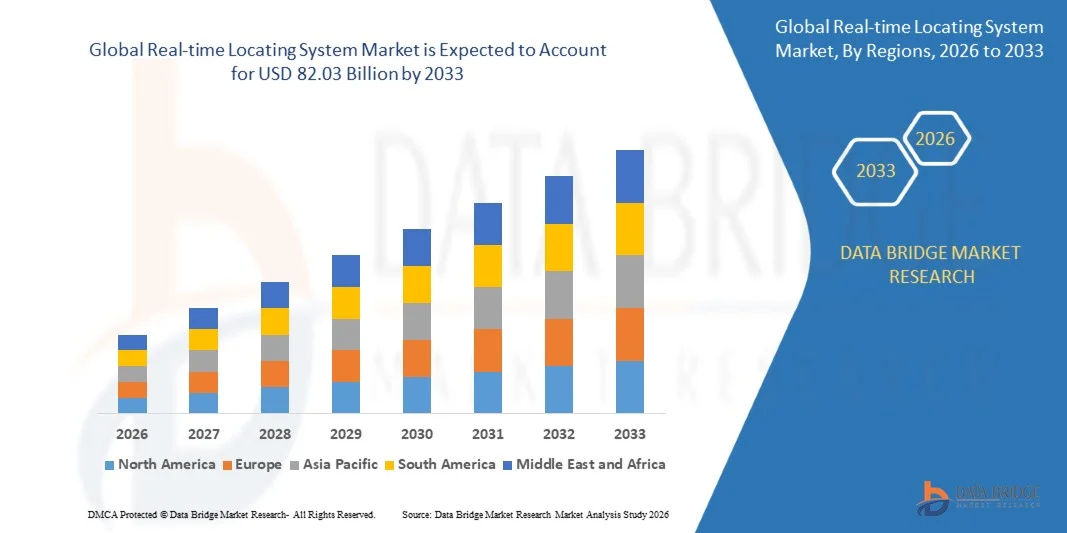
- The global real-time locating system market size was valued at USD 13.94 billion in 2025 and is expected to reach USD 82.03 billion by 2033, at a CAGR of 24.8% during the forecast period
- The market growth is largely fuelled by the increasing adoption of IoT-enabled tracking solutions across healthcare, manufacturing, and logistics sectors
- Rising demand for operational efficiency, asset visibility, and workforce safety is further accelerating the deployment of real-time locating systems across industries
Real-time Locating System Market Analysis
- The market is witnessing strong expansion due to the integration of advanced technologies such as RFID, Wi-Fi, UWB, and Bluetooth Low Energy for precise indoor positioning
- Growing digital transformation initiatives and the expansion of smart infrastructure across industries are significantly enhancing market adoption and scalability
- North America dominated the real-time locating system market with the largest revenue share in 2025, driven by strong adoption of advanced IoT infrastructure, automation technologies, and high investment in digital transformation across industries
- The Asia-Pacific region is expected to witness the highest growth rate in the global real-time locating system market, driven by accelerating urbanization, expansion of smart manufacturing ecosystems, and increasing adoption of IoT-based tracking systems across emerging economies
- The hardware segment held the largest market revenue share in 2025 driven by the widespread deployment of tags, sensors, and readers required for continuous location tracking. Hardware components form the backbone of RTLS infrastructure, enabling accurate data capture and real-time visibility across indoor and outdoor environments. These devices are widely used across industrial facilities, hospitals, and logistics centers to ensure uninterrupted tracking of assets and personnel. Increasing investments in smart infrastructure and IoT-enabled environments are further supporting hardware demand
Report Scope and Real-time Locating System Market Segmentation
|
Attributes |
Real-time Locating System Key Market Insights |
|
Segments Covered |
|
|
Countries Covered |
North America
Europe
Asia-Pacific
Middle East and Africa
South America
|
|
Key Market Players |
• CenTrak (U.S.) |
|
Market Opportunities |
• Expansion Of Smart Healthcare Infrastructure |
|
Value Added Data Infosets |
In addition to the market insights such as market value, growth rate, market segments, geographical coverage, market players, and market scenario, the market report curated by the Data Bridge Market Research team includes in-depth expert analysis, import/export analysis, pricing analysis, production consumption analysis, and pestle analysis. |
Real-time Locating System Market Trends
“Rising Adoption of IoT-Enabled Tracking and Smart Infrastructure”
• The increasing integration of IoT and wireless communication technologies is significantly shaping the global real-time locating system market, as organizations seek accurate, automated, and continuous visibility of assets and personnel. RTLS solutions are gaining traction due to their ability to enhance operational efficiency, reduce losses, and improve decision-making across industrial and commercial environments. This trend is strengthening adoption across healthcare, manufacturing, logistics, and retail sectors, encouraging vendors to develop more advanced and scalable tracking solutions
• Growing emphasis on operational efficiency and workflow optimization is accelerating the use of RTLS in hospitals, warehouses, and production facilities. Organizations are leveraging real-time data to track equipment, monitor patient movement, and optimize asset utilization. This is driving demand for hybrid positioning technologies combining RFID, Wi-Fi, BLE, and UWB to improve accuracy and coverage across complex environments
• Increasing focus on safety, compliance, and workforce monitoring is further supporting market expansion, particularly in high-risk industries such as mining, oil & gas, and manufacturing. RTLS solutions enable organizations to enhance worker safety, ensure regulatory compliance, and reduce emergency response times through real-time alerts and location tracking capabilities
• For instance, in 2024, Zebra Technologies in the U.S. and Stanley Healthcare expanded their RTLS solutions for hospitals and large enterprises, integrating advanced analytics and cloud-based dashboards to improve asset tracking and patient flow management. These deployments were introduced to reduce equipment loss and enhance operational visibility across healthcare facilities and industrial environments
• While demand for RTLS is increasing, market growth depends on system interoperability, infrastructure readiness, and cost-effective deployment models. Vendors are focusing on improving accuracy, battery life of tags, and integration with enterprise software systems to support large-scale adoption across industries
Real-time Locating System Market Dynamics
Driver
“Rising Demand for Asset Visibility and Operational Efficiency”
• Increasing need for real-time visibility of assets, inventory, and personnel is a major driver for the global RTLS market. Organizations are deploying tracking systems to reduce operational inefficiencies, minimize asset loss, and improve utilization rates across facilities
• Expanding applications in healthcare, logistics, manufacturing, and retail are accelerating adoption, as RTLS enables better workflow automation, inventory management, and equipment tracking. This is improving productivity while reducing manual errors and downtime
• Growing adoption of Industry 4.0 technologies and smart factory initiatives is further supporting market growth, with RTLS playing a key role in enabling connected operations and real-time decision-making across production environments
• For instance, in 2023, Honeywell in the U.S. and Ubisense in the U.K. reported increased deployment of RTLS solutions in industrial and warehouse environments to improve supply chain visibility and optimize asset utilization. These implementations supported faster retrieval times and improved operational accuracy across large-scale facilities
• Although demand is rising, widespread adoption depends on reducing deployment complexity, improving system scalability, and ensuring seamless integration with existing enterprise systems
Restraint/Challenge
“High Deployment Costs and Infrastructure Complexity”
• The relatively high cost of RTLS deployment remains a key challenge, limiting adoption among small and medium-sized enterprises. Expenses related to sensors, tags, network infrastructure, and software integration contribute to overall implementation costs
• Technical complexity in installation and system calibration also restricts adoption, as RTLS performance depends on environmental factors, signal interference, and infrastructure design. This requires skilled personnel and customized deployment strategies for different use cases
• Data privacy and security concerns further impact adoption, particularly in workforce tracking applications where continuous monitoring raises regulatory and ethical considerations. Organizations must ensure compliance with data protection regulations while deploying RTLS solutions
• For instance, in 2024, logistics operators in Southeast Asia reported slower adoption of RTLS solutions from providers such as Siemens and AiRISTA Flow due to high setup costs and integration challenges with legacy warehouse management systems. Limited technical expertise and infrastructure constraints further delayed large-scale deployment
• Overcoming these challenges will require cost-optimized hardware, simplified deployment models, and improved interoperability with enterprise platforms. Increased awareness, vendor support, and flexible pricing strategies will be critical for accelerating global RTLS market expansion
Real-time Locating System Market Scope
The market is segmented on the basis of component, architecture, application, and end-user.
• By Component
On the basis of component, the real-time locating system market is segmented into hardware and software. The hardware segment held the largest market revenue share in 2025 driven by the widespread deployment of tags, sensors, and readers required for continuous location tracking. Hardware components form the backbone of RTLS infrastructure, enabling accurate data capture and real-time visibility across indoor and outdoor environments. These devices are widely used across industrial facilities, hospitals, and logistics centers to ensure uninterrupted tracking of assets and personnel. Increasing investments in smart infrastructure and IoT-enabled environments are further supporting hardware demand.
The software segment is expected to witness the fastest growth rate from 2026 to 2033, driven by increasing demand for advanced analytics, cloud-based platforms, and AI-powered location intelligence. RTLS software solutions enable data visualization, predictive insights, and integration with enterprise systems, making them essential for optimizing operational efficiency and decision-making. Growing adoption of digital twins and real-time dashboards is further enhancing software utilization. In addition, rising demand for centralized monitoring systems is accelerating software deployment across multiple industries.
• By Architecture
On the basis of architecture, the real-time locating system market is segmented into Wi-Fi, RFID, Ultra-Wideband, Bluetooth, Ultrasound, ZigBee, and Others. The RFID segment held the largest market revenue share in 2025 driven by its cost-effectiveness, ease of deployment, and widespread use in asset tracking and inventory management applications. RFID-based RTLS solutions are widely adopted across industrial and logistics environments due to their reliability and scalability. These systems are particularly suitable for large-scale deployments where continuous monitoring is required.
The Ultra-Wideband segment is expected to witness the fastest growth rate from 2026 to 2033, driven by its high accuracy and low latency in real-time positioning applications. UWB technology is increasingly preferred in environments requiring precise location tracking, such as healthcare facilities, smart factories, and automated warehouses. Its ability to provide centimeter-level accuracy is significantly improving operational precision. In addition, rising demand for advanced automation and robotics integration is further supporting UWB adoption.
• By Application
On the basis of application, the real-time locating system market is segmented into asset tracking and management, supply chain management, staff locating and monitoring, and visualization and mapping. The asset tracking and management segment held the largest market revenue share in 2025 driven by the growing need to improve asset utilization, reduce losses, and enhance operational efficiency across industries. RTLS solutions in this segment enable real-time visibility of equipment, tools, and inventory. These systems are widely deployed in warehouses, hospitals, and manufacturing plants to minimize downtime. Increasing focus on operational transparency is further supporting segment growth.
The staff locating and monitoring segment is expected to witness the fastest growth rate from 2026 to 2033, driven by increasing focus on workforce safety, productivity tracking, and compliance requirements. Organizations are increasingly adopting RTLS solutions to monitor employee movement, improve emergency response, and optimize workforce allocation. These solutions are especially important in high-risk and large-scale industrial environments. Growing emphasis on workplace safety regulations is also accelerating adoption across sectors.
• By End-User
On the basis of end-user, the real-time locating system market is segmented into healthcare, retail, manufacturing, transport and logistics, defense, and sports and entertainment. The healthcare segment held the largest market revenue share in 2025 driven by the extensive use of RTLS for patient tracking, equipment management, and workflow optimization in hospitals. Healthcare providers are increasingly adopting RTLS solutions to improve operational efficiency and patient care quality. These systems help reduce equipment loss and improve emergency response times. Rising hospital digitization is further strengthening adoption in this segment.
The transport and logistics segment is expected to witness the fastest growth rate from 2026 to 2033, driven by rising demand for supply chain visibility, inventory optimization, and real-time shipment tracking. RTLS technologies are increasingly being deployed in warehouses, distribution centers, and fleet management systems to enhance transparency and reduce operational delays. These solutions help improve delivery accuracy and reduce logistics costs. Expanding global e-commerce activities are also significantly contributing to segment growth.
Real-time Locating System Market Regional Analysis
• North America dominated the real-time locating system market with the largest revenue share in 2025, driven by strong adoption of advanced IoT infrastructure, automation technologies, and high investment in digital transformation across industries
• Organizations in the region are increasingly prioritizing operational efficiency, asset visibility, and workforce safety, which is significantly boosting the deployment of RTLS solutions across healthcare, manufacturing, and logistics sectors
• The presence of leading technology providers, along with early adoption of Industry 4.0 and smart factory initiatives, is further supporting market expansion, making RTLS a critical component of enterprise digital ecosystems
U.S. Real-time Locating System Market Insight
The U.S. real-time locating system market captured the largest revenue share in 2025 within North America, driven by rapid adoption of IoT-enabled tracking solutions and increasing demand for real-time asset visibility. Enterprises are increasingly implementing RTLS to optimize supply chain operations, improve hospital workflow efficiency, and enhance warehouse management. Strong investment in smart infrastructure, cloud computing, and AI-based analytics is further accelerating market growth. In addition, integration of RTLS with enterprise platforms and automation systems is significantly supporting large-scale deployment across industries.
Europe Real-time Locating System Market Insight
The Europe real-time locating system market is expected to witness the fastest growth rate from 2026 to 2033, driven by strict regulatory frameworks related to workplace safety, asset tracking, and operational transparency. Growing adoption of smart manufacturing and Industry 4.0 initiatives is further fueling demand for RTLS solutions across industrial sectors. Increasing focus on energy-efficient and optimized operations is also encouraging organizations to deploy real-time tracking systems. Moreover, rising investments in healthcare digitalization and smart logistics infrastructure are supporting regional market expansion.
U.K. Real-time Locating System Market Insight
The U.K. real-time locating system market is expected to witness the fastest growth rate from 2026 to 2033, driven by rising demand for advanced security, asset tracking, and workforce monitoring solutions. Organizations are increasingly adopting RTLS technologies to enhance operational efficiency in hospitals, warehouses, and commercial facilities. The growing trend of digital transformation and smart building integration is further accelerating adoption. In addition, concerns related to productivity optimization and safety compliance are encouraging wider deployment across public and private sectors.
Germany Real-time Locating System Market Insight
The Germany real-time locating system market is expected to witness the fastest growth rate from 2026 to 2033, fueled by strong industrial automation, high engineering standards, and increasing adoption of smart factory solutions. RTLS technologies are widely used in manufacturing and logistics environments to improve precision, efficiency, and real-time monitoring. The country’s emphasis on technological innovation and data-driven operations is further supporting market growth. In addition, integration of RTLS with robotics and automated systems is becoming increasingly common across industrial applications.
Asia-Pacific Real-time Locating System Market Insight
The Asia-Pacific real-time locating system market is expected to witness the fastest growth rate from 2026 to 2033, driven by rapid urbanization, expanding industrial infrastructure, and increasing adoption of IoT-based technologies in countries such as China, Japan, and India. The region is experiencing strong demand for smart logistics, healthcare digitalization, and automated manufacturing systems. Government initiatives supporting smart cities and digital transformation are further boosting RTLS adoption. Moreover, the availability of cost-effective solutions and growing manufacturing capabilities are expanding market accessibility across the region.
Japan Real-time Locating System Market Insight
The Japan real-time locating system market is expected to witness the fastest growth rate from 2026 to 2033 due to strong technological advancement, aging population needs, and high demand for automation in healthcare and industrial sectors. RTLS solutions are increasingly being deployed in hospitals, eldercare facilities, and smart factories to improve efficiency and safety. The integration of RTLS with robotics, AI, and IoT systems is further driving adoption. In addition, Japan’s focus on precision and operational excellence is supporting continuous market expansion.
China Real-time Locating System Market Insight
The China real-time locating system market accounted for the largest market revenue share in Asia Pacific in 2025, attributed to rapid industrialization, strong e-commerce growth, and widespread adoption of smart manufacturing technologies. RTLS solutions are increasingly used in logistics centers, warehouses, and manufacturing plants to improve supply chain visibility and operational efficiency. Government initiatives promoting smart cities and digital infrastructure are further accelerating adoption. In addition, the presence of strong domestic manufacturers and cost-effective solutions is enhancing market penetration across multiple industries.
Real-time Locating System Market Share
The Real-time Locating System industry is primarily led by well-established companies, including:
• CenTrak (U.S.)
• DecaWave (Ireland)
• Lockheed Martin Corporation (U.S.)
• Ekahau (U.S.)
• Redpine Signals Inc. (U.S.)
• GENERAL ELECTRIC (U.S.)
• Sonitor Technologies (Norway)
• Stanley Black & Decker Inc. (U.S.)
• TeleTracking Technologies, Inc. (U.S.)
• Ubisense (U.K.)
• Arcweb (U.S.)
• Midmark Corporation (U.S.)
• Zebra Technologies Corp (U.S.)
• AeroScout (U.S.)
• Savi Technology (U.S.)
• Hewlett Packard Enterprise Development LP (U.S.)
• Impinj Inc. (U.S.)
• Airista Flow Inc. (U.S.)
• Cisco (U.S.)
• Juniper Networks, Inc. (U.S.)

- Interactive Data Analysis Dashboard
- Company Analysis Dashboard for high growth potential opportunities
- Research Analyst Access for customization & queries
- Competitor Analysis with Interactive dashboard
- Latest News, Updates & Trend analysis
- Harness the Power of Benchmark Analysis for Comprehensive Competitor Tracking
Data collection and base year analysis are done using data collection modules with large sample sizes. The stage includes obtaining market information or related data through various sources and strategies. It includes examining and planning all the data acquired from the past in advance. It likewise envelops the examination of information inconsistencies seen across different information sources. The market data is analysed and estimated using market statistical and coherent models. Also, market share analysis and key trend analysis are the major success factors in the market report. To know more, please request an analyst call or drop down your inquiry.
The key research methodology used by DBMR research team is data triangulation which involves data mining, analysis of the impact of data variables on the market and primary (industry expert) validation. Data models include Vendor Positioning Grid, Market Time Line Analysis, Market Overview and Guide, Company Positioning Grid, Patent Analysis, Pricing Analysis, Company Market Share Analysis, Standards of Measurement, Global versus Regional and Vendor Share Analysis. To know more about the research methodology, drop in an inquiry to speak to our industry experts.
Data Bridge Market Research is a leader in advanced formative research. We take pride in servicing our existing and new customers with data and analysis that match and suits their goal. The report can be customized to include price trend analysis of target brands understanding the market for additional countries (ask for the list of countries), clinical trial results data, literature review, refurbished market and product base analysis. Market analysis of target competitors can be analyzed from technology-based analysis to market portfolio strategies. We can add as many competitors that you require data about in the format and data style you are looking for. Our team of analysts can also provide you data in crude raw excel files pivot tables (Fact book) or can assist you in creating presentations from the data sets available in the report.













