


Reclaimed Rubber Market Overview
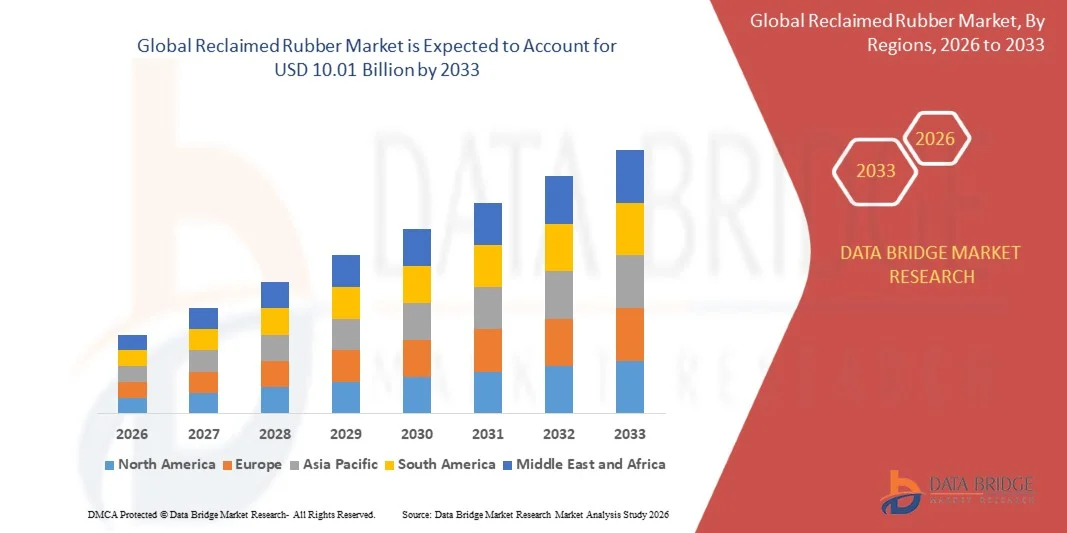
The Reclaimed Rubber Market was valued at USD 4.41 billion in 2025 and is projected to reach USD 10.01 billion by 2033, growing at a CAGR of 10.80% from 2026 to 2033. The market is experiencing steady growth driven by increasing demand for sustainable raw materials, rising adoption of circular economy practices, and growing utilization of reclaimed rubber across the tire, automotive, footwear, and industrial rubber products industries.
The increasing generation of end-of-life tires, combined with stringent environmental regulations on rubber waste disposal and rising pressure to reduce carbon emissions, is encouraging manufacturers to adopt reclaimed rubber as a cost-effective and eco-friendly alternative to virgin rubber. In addition, advancements in devulcanization and recycling technologies, along with growing demand for sustainable manufacturing solutions, are supporting the widespread use of reclaimed rubber to improve resource efficiency, reduce production costs, and enhance environmental performance across both developed and emerging markets.
Market Size & Forecast
- Global Market Value (2025): USD 4.41 Billion
- Expected Market Value (2033): USD 10.01 Billion
- Forecast CAGR (2026–2033): 10.80%
- Leading Region in 2025: North America
- Fastest Growing Region: Asia-Pacific
Key Market Trends & Insights
- North America dominated the Reclaimed Rubber Market with the largest revenue share of 34.92% in 2025, supported by stringent environmental regulations, a well-established tire recycling industry, increasing adoption of sustainable rubber materials, and strong demand from the automotive and industrial manufacturing sectors.
- The Tire segment dominated the market with a 38% share in 2025 owing to the extensive utilization of reclaimed rubber in passenger vehicle, commercial vehicle, and off-road tire manufacturing .
- Asia-Pacific is expected to be the fastest-growing regional market, registering a CAGR of 7.3% from 2026 to 2033, fueled by rapid industrialization, expanding automotive production, increasing tire manufacturing capacity, growing government support for circular economy initiatives, and rising investments in rubber recycling infrastructure across China, India, and Southeast Asia.
- The ethylene propylene diene monomer (EPDM) segment is projected to be the fastest-growing product category, registering a CAGR of 7.0% from 2026 to 2033, reflecting increasing demand for high-performance reclaimed rubber in automotive sealing systems, construction materials, and weather-resistant industrial applications.
Report Scope and Reclaimed Rubber Market Segmentation
|
Attributes |
Reclaimed Rubber Key Market Insights |
|
Segments Covered |
|
|
Countries Covered |
North America · U.S. · Canada · Mexico Europe · Germany · France · U.K. · Netherlands · Switzerland · Belgium · Russia · Italy · Spain · Turkey · Rest of Europe Asia-Pacific · China · Japan · India · South Korea · Singapore · Malaysia · Australia · Thailand · Indonesia · Philippines · Rest of Asia-Pacific Middle East and Africa · Saudi Arabia · U.A.E. · South Africa · Egypt · Israel · Rest of Middle East and Africa South America · Brazil · Argentina · Rest of South America |
|
Key Market Players |
|
|
Market Opportunities |
· Growing Adoption of Sustainable and Circular Economy Practices · Rising Demand from Tire Retreading and Automotive Industries · Advancements in Devulcanization and Rubber Recycling Technologies |
|
Value Added Data Infosets |
In addition to the insights on market scenarios such as market value, growth rate, segmentation, geographical coverage, and major players, the market reports curated by the Data Bridge Market Research also include in-depth expert analysis, geographically represented company-wise production and capacity, network layouts of distributors and partners, detailed and updated price trend analysis and deficit analysis of supply chain and demand. |
Reclaimed Rubber Market Trends
Trend: Rising Adoption of Circular Economy Practices and Sustainable Rubber Recycling
The growing global emphasis on sustainability and circular economy initiatives is significantly increasing the adoption of reclaimed rubber across automotive, construction, footwear, and industrial manufacturing industries. Manufacturers are increasingly incorporating reclaimed rubber into new products to reduce dependence on virgin natural and synthetic rubber while lowering production costs and carbon emissions. Government regulations promoting waste tire recycling and landfill reduction are further supporting market expansion. According to the World Business Council for SustainableDevelopment (WBCSD), approximately one billion end-of-life tires are generated globally each year, creating a substantial source of raw material for reclaimed rubber production. Technological advancements in devulcanization and rubber recycling processes are also improving the quality and performance of reclaimed rubber, enabling its use in higher-value applications.
Reclaimed Rubber Market Dynamics
Key Market Driver: Increasing Demand for Sustainable and Cost-Effective Rubber Materials
The growing demand for environmentally sustainable and economically viable raw materials is a major driver of the Reclaimed Rubber Market. Reclaimed rubber provides manufacturers with a cost-effective alternative to virgin rubber while maintaining acceptable mechanical properties for numerous industrial applications. It is widely utilized in tire manufacturing, belts, hoses, footwear, molded rubber goods, automotive components, and construction materials to reduce raw material costs and improve resource efficiency. Rising volatility in natural rubber prices, coupled with increasing environmental regulations governing tire disposal and industrial waste management, is encouraging manufacturers to increase the use of reclaimed rubber in production processes. Furthermore, expanding automotive production and growing investments in sustainable manufacturing are expected to continue driving market growth.
Key Restraint/Challenge: Performance Limitations and Quality Variability of Reclaimed Rubber
One of the primary challenges facing the Reclaimed Rubber Market is the variation in quality and performance characteristics compared with virgin rubber. Mechanical properties such as tensile strength, elasticity, abrasion resistance, and durability may vary depending on the quality of waste rubber feedstock and the reclamation process employed. These limitations restrict the use of reclaimed rubber in high-performance applications requiring stringent technical specifications, including premium tires and specialized industrial products. In addition, inconsistent supply of quality scrap rubber, fluctuations in waste tire collection rates, and the need for advanced processing technologies increase production complexity and operational costs for manufacturers.
Key Market Opportunity: Expanding Applications in Green Tires and Sustainable Automotive Manufacturing
The increasing focus on sustainable mobility and environmentally friendly manufacturing presents significant opportunities for the Reclaimed Rubber Market. Leading tire manufacturers and automotive component suppliers are expanding the use of reclaimed rubber to reduce carbon emissions, improve material circularity, and meet corporate sustainability targets. Advances in devulcanization technologies are producing reclaimed rubber with improved physical properties, enabling greater incorporation into high-performance tires and automotive rubber components. Moreover, rising investments in electric vehicle manufacturing, green infrastructure projects, and government-supported tire recycling initiatives across Asia-Pacific, Europe, and North America are expected to create substantial long-term growth opportunities for reclaimed rubber producers during the forecast period.
Reclaimed Rubber Market Scope
The Reclaimed Rubber Market is segmented on the basis of product, application, and end user.
- By Product
On the basis of product, the Reclaimed Rubber Market is segmented into Whole Tire Reclaim (WTR), Butyl Reclaim, Ethylene Propylene Diene Monomer (EPDM), Drab and Colored, and Others. The whole tire reclaim (WTR) segment dominated the market with a 44.76% share in 2025 due to the abundant availability of end-of-life tires and its cost-effective production process. WTR is widely utilized in tire manufacturing, molded rubber goods, mats, belts, hoses, and footwear because it provides a practical substitute for virgin rubber while reducing production costs. Manufacturers increasingly prefer WTR owing to its compatibility with natural and synthetic rubber compounds and its ability to improve sustainability in manufacturing. Growing regulatory pressure to recycle waste tires and minimize landfill disposal has further accelerated its adoption. Continuous advancements in devulcanization technologies have also improved product quality, enhancing its acceptance across automotive and industrial applications. The combination of environmental benefits, economic advantages, and a stable raw material supply continues to strengthen the dominance of this segment globally.
The Ethylene Propylene Diene Monomer (EPDM) segment is expected to witness the fastest growth at a CAGR of 7.0% from 2026 to 2033. Growth is driven by increasing demand for weather-resistant and high-performance reclaimed rubber materials in automotive, construction, and industrial applications. Reclaimed EPDM offers excellent resistance to ozone, UV radiation, heat, and harsh environmental conditions, making it highly suitable for roofing membranes, automotive seals, and insulation products. Increasing investments in sustainable construction materials and electric vehicle manufacturing are supporting demand for reclaimed EPDM. Technological improvements in EPDM recycling have significantly enhanced product performance and material consistency. Rising environmental regulations encouraging rubber recycling are also creating new growth opportunities. Furthermore, increasing adoption of circular economy practices across developed economies is expected to further accelerate the expansion of this segment.
- By Application
On the basis of application, the Reclaimed Rubber Market is segmented into Tire and Non-Tire. The Tire segment dominated the market with a 69.38% share in 2025 owing to the extensive utilization of reclaimed rubber in passenger vehicle, commercial vehicle, and off-road tire manufacturing. Tire manufacturers increasingly incorporate reclaimed rubber to reduce raw material costs while improving sustainability and minimizing dependence on virgin natural rubber. Growing production of replacement tires, expanding automotive fleets, and increasing emphasis on environmentally friendly manufacturing practices continue to support market demand. Reclaimed rubber also improves processability and reduces overall production costs without significantly affecting product performance in many tire applications. Government regulations promoting waste tire recycling have further strengthened segment growth. Continuous technological improvements in rubber reclaiming processes are enabling manufacturers to incorporate higher proportions of reclaimed material into modern tire compounds.
The Non-Tire segment is projected to register the fastest growth at a CAGR of 6.8% from 2026 to 2033. Growth is supported by increasing demand for reclaimed rubber in footwear, industrial mats, flooring, conveyor belts, hoses, molded rubber goods, adhesives, and construction products. Rising investments in sustainable infrastructure and eco-friendly consumer products are expanding application opportunities beyond traditional tire manufacturing. Manufacturers are increasingly utilizing reclaimed rubber to reduce manufacturing costs while achieving corporate sustainability targets. Technological advancements have improved the quality and consistency of reclaimed rubber, enabling its use in higher-value industrial applications. Growing environmental awareness among manufacturers and consumers is also accelerating product adoption. Increasing utilization across multiple industrial sectors is expected to sustain strong long-term growth for this segment.
- By End Users
On the basis of end users, the Reclaimed Rubber Market is segmented into automotive and aircraft, cycle tyre, retreading, belts and hoses, footwear, molded rubber goods, and others. The automotive and aircraft segment dominated the market with a 31.84% share in 2025 due to the extensive use of reclaimed rubber in tires, seals, gaskets, vibration dampers, floor mats, bushings, and various molded rubber components. Automotive manufacturers are increasingly incorporating reclaimed rubber to lower manufacturing costs while meeting sustainability objectives and reducing carbon emissions. Rising global vehicle production and increasing demand for replacement components continue to support market growth. The aviation industry is also utilizing reclaimed rubber in selected non-critical applications to improve resource efficiency. Government regulations promoting recycled materials in manufacturing further contribute to segment expansion. Continuous improvements in reclaimed rubber quality have increased its acceptance across automotive component manufacturing worldwide.
The Footwear segment is anticipated to witness the fastest growth at a CAGR of 6.9% from 2026 to 2033. Growth is driven by rising consumer demand for sustainable footwear and increasing adoption of recycled materials by leading footwear manufacturers. Reclaimed rubber is widely used in shoe soles, sandals, sports footwear, and industrial safety footwear due to its durability, flexibility, and cost-effectiveness. Growing environmental awareness among consumers and manufacturers is encouraging the replacement of virgin rubber with recycled alternatives. Increasing investments in sustainable product innovation and circular economy initiatives are further supporting market expansion. Technological advancements in rubber processing are improving product quality and performance, making reclaimed rubber suitable for premium footwear applications. The continued focus on reducing environmental impact across the footwear industry is expected to drive strong segment growth throughout the forecast period.
Reclaimed Rubber Market Regional Analysis
North America dominated the Reclaimed Rubber Market and accounted for the largest revenue share of 34.92% in 2025, supported by stringent environmental regulations, a well-established tire recycling industry, increasing adoption of sustainable rubber materials, and strong demand from the automotive and industrial manufacturing sectors. The region also benefits from growing investments in circular economy initiatives, rising utilization of recycled rubber in industrial applications, and increasing emphasis on reducing landfill waste through advanced tire recycling technologies.
U.S. Reclaimed Rubber Market Insight
The U.S. reclaimed rubber market is witnessing strong growth due to increasing adoption of sustainable manufacturing practices, rising demand for recycled rubber materials, and expanding tire recycling activities. The country's established automotive industry, growing use of reclaimed rubber in tire manufacturing, molded rubber goods, and industrial products, along with increasing investments in rubber recycling technologies, continues to drive market growth.
Europe Reclaimed Rubber Market Insight
The Europe reclaimed rubber market remains a major contributor to global revenue, driven by strict environmental regulations, ambitious circular economy policies, and increasing demand for sustainable raw materials across automotive, construction, and industrial sectors. Growing investments in tire recycling infrastructure and increasing use of reclaimed rubber in value-added applications continue to support market expansion throughout the region.
U.K. Reclaimed Rubber Market Insight
The U.K. reclaimed rubber market is experiencing steady growth, supported by rising adoption of recycled materials, increasing focus on sustainable manufacturing, and expanding tire recycling initiatives. Growing demand for reclaimed rubber in automotive components, footwear, and industrial rubber products, along with supportive environmental policies, is contributing to market growth.
Germany Reclaimed Rubber Market Insight
The Germany reclaimed rubber market is expanding steadily due to the country's strong automotive manufacturing base, advanced recycling infrastructure, and increasing focus on sustainable industrial production. Manufacturers are increasingly incorporating reclaimed rubber into tires, molded rubber goods, and engineering applications to reduce raw material costs and improve environmental performance. Continued innovation in rubber recycling technologies is further supporting market growth.
Asia-Pacific Reclaimed Rubber Market Insight
The Asia-Pacific reclaimed rubber market is expected to witness the fastest growth, registering a CAGR of 7.3% from 2026 to 2033, fueled by rapid industrialization, expanding automotive production, increasing tire manufacturing capacity, growing government support for circular economy initiatives, and rising investments in rubber recycling infrastructure across China, India, and Southeast Asia. Rising consumption of rubber products, increasing availability of end-of-life tires, and expanding industrial manufacturing activities are further supporting regional market expansion.
Japan Reclaimed Rubber Market Insight
The Japan reclaimed rubber market is witnessing consistent growth due to increasing emphasis on resource efficiency, sustainable manufacturing, and advanced recycling technologies. Growing demand from the automotive, industrial, and footwear sectors, coupled with the country's strong commitment to environmental sustainability, continues to support the adoption of reclaimed rubber across multiple applications.
China Reclaimed Rubber Market Insight
The China reclaimed rubber market is growing rapidly, driven by expanding tire manufacturing, increasing automotive production, and rising investments in rubber recycling infrastructure. Government initiatives promoting resource conservation, growing availability of waste tires, and increasing demand for cost-effective and sustainable rubber materials are significantly boosting market demand. In addition, the widespread use of reclaimed rubber in tire production, molded rubber products, footwear, and industrial applications is positioning China as one of the fastest-growing markets for reclaimed rubber globally.
Reclaimed Rubber Market Share
The Reclaimed Rubber industry is primarily led by well-established companies, including:
- GRP Ltd. (India)
- J. Allcock & Sons Ltd. (U.K.)
- Huxar Reclamation (India)
- Swani Rubber Industries (India)
- Rolex Reclaim Pvt. Ltd. (India)
- Star Polymers Inc. (U.S.)
- High Tech Reclaim Pvt. Ltd. (India)
- Minar Reclamation Private Limited (India)
- Fishfa Rubbers Ltd. (India)
- SRI Impex Pvt. Ltd. (India)
- Eldan Recycling A/S (Denmark)
- Genan Holding A/S (Denmark)
- Liberty Tire Recycling LLC (U.S.)
- Lehigh Technologies, Inc. (U.S.)
- Scandinavian Enviro Systems AB (Sweden)
- Radhe Group of Energy (India)
- Tyromer Inc. (Canada)
- ECO Green Equipment (U.S.)
- CRM Rubber Manufacturers (U.S.)
- Shred-Tech Corporation (Canada)
- West Coast Rubber Recycling, Inc. (U.S.)
- Rethink Tires (U.S.)
- Enrestec Inc. (Taiwan)
- Eversafe ExtreMe Polymer Co., Ltd. (Thailand)
- Klean Industries Inc. (Canada)
Latest Developments in Reclaimed Rubber Market
- In February 2021, Michelin, a global leader in sustainable mobility, announced its ambition to manufacture 100% sustainable tires by 2050, significantly increasing the use of recycled and bio-sourced materials, including reclaimed rubber derived from end-of-life tires. The initiative strengthened Michelin's circular economy strategy and accelerated investments in advanced rubber recycling technologies for future tire production
- In November 2021, Bridgestone Corporation and Michelin Group launched a joint industry initiative focused on increasing the utilization of recovered carbon black (rCB) and reclaimed materials from end-of-life tires. The collaboration aimed to improve circularity within the tire industry by developing common standards and expanding the use of recycled rubber materials in new tire manufacturing.
- In September 2023, Bridgestone Corporation and Michelin Group published a joint technical white paper presenting the results of their collaborative work on recovered carbon black and recycled tire materials. The publication proposed global recommendations to accelerate adoption of reclaimed materials in tire manufacturing and support the industry's transition toward a circular economy
- In April 2024, GRP Limited, one of the world's leading reclaimed rubber manufacturers, announced the expansion of its tire recycling and reclaimed rubber production capacity through investments in new recycling infrastructure and advanced pyrolysis facilities. The expansion was undertaken to meet growing global demand for sustainable rubber materials from automotive, tire, and industrial manufacturers while strengthening the company's circular economy capabilities
- In March 2025, leading reclaimed rubber producers, including GRP Limited, highlighted major advancements in chemical and microwave devulcanization technologies, enabling the production of higher-quality reclaimed rubber with improved tensile strength and greater suitability for premium automotive and industrial applications. These technology developments are supporting wider adoption of reclaimed rubber across global manufacturing industries

- Interactive Data Analysis Dashboard
- Company Analysis Dashboard for high growth potential opportunities
- Research Analyst Access for customization & queries
- Competitor Analysis with Interactive dashboard
- Latest News, Updates & Trend analysis
- Harness the Power of Benchmark Analysis for Comprehensive Competitor Tracking
Global Reclaimed Rubber Market, Supply Chain Analysis and Ecosystem Framework
To support market growth and help clients navigate the impact of geopolitical shifts, DBMR has integrated in-depth supply chain analysis into its Global Reclaimed Rubber Market research reports. This addition empowers clients to respond effectively to global changes affecting their industries. The supply chain analysis section includes detailed insights such as Global Reclaimed Rubber Market consumption and production by country, price trend analysis, the impact of tariffs and geopolitical developments, and import and export trends by country and HSN code. It also highlights major suppliers with data on production capacity and company profiles, as well as key importers and exporters. In addition to research, DBMR offers specialized supply chain consulting services backed by over a decade of experience, providing solutions like supplier discovery, supplier risk assessment, price trend analysis, impact evaluation of inflation and trade route changes, and comprehensive market trend analysis.
Data collection and base year analysis are done using data collection modules with large sample sizes. The stage includes obtaining market information or related data through various sources and strategies. It includes examining and planning all the data acquired from the past in advance. It likewise envelops the examination of information inconsistencies seen across different information sources. The market data is analysed and estimated using market statistical and coherent models. Also, market share analysis and key trend analysis are the major success factors in the market report. To know more, please request an analyst call or drop down your inquiry.
The key research methodology used by DBMR research team is data triangulation which involves data mining, analysis of the impact of data variables on the market and primary (industry expert) validation. Data models include Vendor Positioning Grid, Market Time Line Analysis, Market Overview and Guide, Company Positioning Grid, Patent Analysis, Pricing Analysis, Company Market Share Analysis, Standards of Measurement, Global versus Regional and Vendor Share Analysis. To know more about the research methodology, drop in an inquiry to speak to our industry experts.
Data Bridge Market Research is a leader in advanced formative research. We take pride in servicing our existing and new customers with data and analysis that match and suits their goal. The report can be customized to include price trend analysis of target brands understanding the market for additional countries (ask for the list of countries), clinical trial results data, literature review, refurbished market and product base analysis. Market analysis of target competitors can be analyzed from technology-based analysis to market portfolio strategies. We can add as many competitors that you require data about in the format and data style you are looking for. Our team of analysts can also provide you data in crude raw excel files pivot tables (Fact book) or can assist you in creating presentations from the data sets available in the report.













