


Recombinant Polyclonal Antibodies Market Size
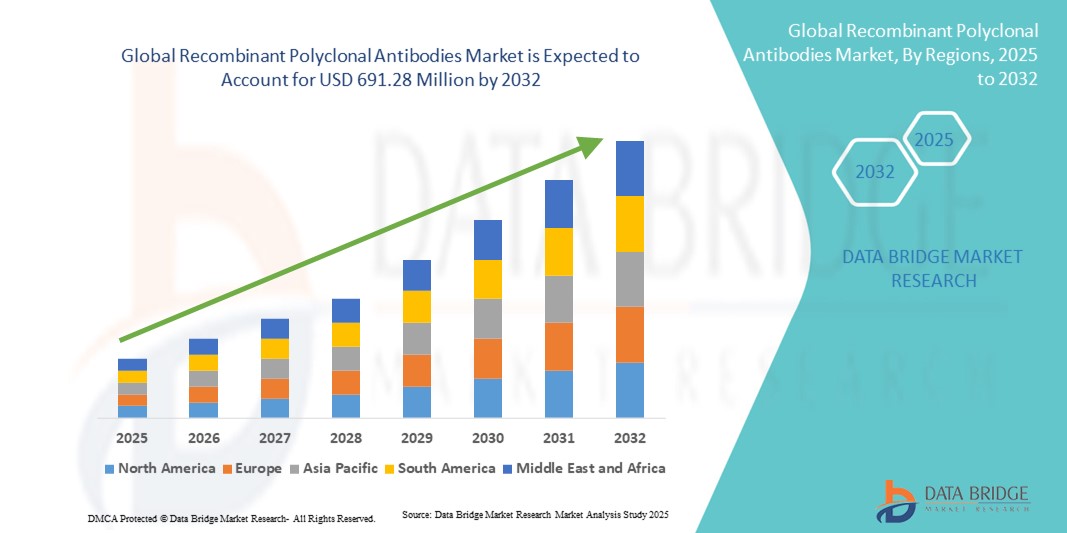
- The global recombinant polyclonal antibodies market size was valued at USD 381.88 million in 2024 and is expected to reach USD 691.28 million by 2032, at a CAGR of 7.70% during the forecast period
- The market growth is largely fueled by the increasing adoption of advanced biotechnology techniques and innovations in antibody engineering, leading to improved efficacy, specificity, and scalability of recombinant polyclonal antibodies
- Furthermore, rising demand for highly reliable and reproducible antibody-based solutions in therapeutic, diagnostic, and research applications is driving market expansion. These factors are accelerating the uptake of recombinant polyclonal antibodies, thereby significantly boosting the industry's growth
Recombinant Polyclonal Antibodies Market Analysis
- The global Recombinant Polyclonal Antibodies market is witnessing significant growth due to the rising demand for targeted therapeutics, advanced diagnostic solutions, and increasing prevalence of chronic and infectious diseases. Recombinant polyclonal antibodies are preferred over traditional polyclonal antibodies because of their higher specificity, reproducibility, and reduced batch-to-batch variability
- The escalating demand for recombinant polyclonal antibodies is primarily fueled by advancements in biotechnology, growing adoption in clinical research, diagnostics, and therapeutic applications, as well as increasing healthcare investments across both developed and emerging regions
- North America dominated the recombinant polyclonal antibodies market with the largest revenue share of 44.2% in 2024, driven by the presence of leading biopharmaceutical companies, advanced research infrastructure, favorable regulatory frameworks, and strong government support for innovative antibody development. The U.S. leads the regional market due to widespread adoption of recombinant polyclonal antibodies in hospitals, research institutions, and pharmaceutical companies, supported by robust funding for antibody-based research and therapeutic development
- Asia-Pacific is expected to be the fastest-growing region in the recombinant polyclonal antibodies market during the forecast period, driven by increasing healthcare investments, expanding biotechnology industries, growing number of research centers, and rising demand for advanced therapeutics in countries such as China, India, and Japan
- The cancer therapeutics segment dominated the recombinant polyclonal antibodies market, capturing the largest revenue share of 55.1% in 2024, due to the rising prevalence of cancer and the growing use of recombinant polyclonal antibodies in targeted therapies
Report Scope and Recombinant Polyclonal Antibodies Market Segmentation
|
Attributes |
Recombinant Polyclonal Antibodies Key Market Insights |
|
Segments Covered |
|
|
Countries Covered |
North America
Europe
Asia-Pacific
Middle East and Africa
South America
|
|
Key Market Players |
|
|
Market Opportunities |
|
|
Value Added Data Infosets |
In addition to the insights on market scenarios such as market value, growth rate, segmentation, geographical coverage, and major players, the market reports curated by the Data Bridge Market Research also include in-depth expert analysis, pricing analysis, brand share analysis, consumer survey, demography analysis, supply chain analysis, value chain analysis, raw material/consumables overview, vendor selection criteria, PESTLE Analysis, Porter Analysis, and regulatory framework. |
Recombinant Polyclonal Antibodies Market Trends
Rising Demand Driven by Therapeutic and Diagnostic Applications
- A significant and accelerating trend in the global recombinant polyclonal antibodies market is the increasing adoption of these antibodies across therapeutic and diagnostic applications. Recombinant polyclonal antibodies are being leveraged to provide high specificity and consistency in treating diseases such as cancer, infectious diseases, and chronic conditions
- For instance, several biopharmaceutical companies are developing recombinant polyclonal antibody-based therapies that target multiple epitopes, enhancing efficacy and reducing the likelihood of resistance in complex diseases. These innovations are helping expand treatment options in oncology and immunotherapy
- In diagnostics, recombinant polyclonal antibodies are increasingly used in high-throughput assay development, including applications in hepatitis, tuberculosis, HIV, and cancer diagnostics. Their reproducibility and ability to target multiple antigens improve the reliability of laboratory testing and research outcomes
- Biotechnology and research institutes are incorporating recombinant polyclonal antibodies into advanced research workflows, enabling better detection, quantification, and characterization of biomarkers. This supports drug discovery, vaccine development, and academic research initiatives
- The growing focus on personalized medicine and precision therapies further drives demand, as recombinant polyclonal antibodies allow for more tailored treatment strategies with improved efficacy and safety profiles
- Overall, the expanding use of recombinant polyclonal antibodies in both therapeutics and diagnostics is significantly contributing to the growth of the market, providing opportunities for companies to innovate and offer specialized solutions for clinical, research, and pharmaceutical applications
Recombinant Polyclonal Antibodies Market Dynamics
Driver
Growing Demand Due to Expanding Therapeutic and Diagnostic Applications
- The increasing prevalence of chronic diseases, infectious conditions, and cancer worldwide is driving the adoption of recombinant polyclonal antibodies in both therapeutic and diagnostic applications. Their ability to target multiple epitopes with high specificity makes them highly valuable in improving treatment efficacy and diagnostic accuracy
- For instance, in March 2023, Abgenex announced the launch of a new recombinant polyclonal antibody platform designed for oncology applications, enabling higher batch-to-batch consistency and enhanced target recognition. Such strategic innovations by key players are expected to further drive the market growth during the forecast period
- Recombinant polyclonal antibodies are increasingly incorporated into diagnostic assays for diseases such as HIV, tuberculosis, hepatitis, and cancer, providing reliable and reproducible results. Their use in clinical laboratories helps improve early detection rates and treatment outcomes
- Furthermore, the growing emphasis on precision medicine and personalized therapies is fueling demand, as recombinant polyclonal antibodies enable more targeted and patient-specific treatment approaches
- The research and biopharmaceutical sectors are also driving growth, leveraging these antibodies for drug discovery, vaccine development, and laboratory applications, which enhances overall market expansion
- Technological advancements, such as improved expression systems and scalable production techniques, are contributing to higher yield, better quality, and more affordable recombinant polyclonal antibodies, further encouraging adoption across various end-users
Restraint/Challenge
High Production Costs and Regulatory Complexities
- The relatively high cost of developing and manufacturing recombinant polyclonal antibodies poses a significant barrier for broader market penetration, particularly for smaller biotech companies or emerging markets
- Advanced production methods, purification processes, and validation requirements increase overall costs
- Regulatory complexities associated with approval of therapeutic and diagnostic antibodies, including stringent guidelines from agencies such as the FDA and EMA, can slow product commercialization and market expansion
- In addition, achieving consistent quality and reproducibility across different production batches remains a technical challenge, potentially affecting market confidence
- The need for specialized storage, handling, and cold chain logistics for recombinant polyclonal antibodies can increase operational costs for end-users, limiting adoption in regions with less developed infrastructure
- Addressing these challenges through innovation in cost-effective production, streamlined regulatory pathways, and robust quality control measures will be crucial for sustained market growth
- Collaboration between manufacturers, research institutions, and regulatory authorities can help reduce development timelines and costs, enabling wider adoption of recombinant polyclonal antibodies across therapeutic, diagnostic, and research applications
Recombinant Polyclonal Antibodies Market Scope
The market is segmented on the basis of product type, therapeutics, end users, and application.
- By Product Type
On the basis of product type, the recombinant polyclonal antibodies market is segmented into primary antibody and secondary antibody. The primary antibody segment dominated the market, accounting for the largest revenue share of 52.4% in 2024, owing to its widespread use across diagnostics, research, and therapeutic applications. Primary antibodies are essential for identifying specific antigens in immunoassays, ELISA, and immunohistochemistry, providing high specificity and reproducibility. The segment’s growth is supported by advancements in recombinant technology, which improves batch-to-batch consistency and reduces cross-reactivity. Pharmaceutical and clinical laboratories heavily rely on primary antibodies for accurate disease detection and biomarker studies. In addition, ongoing R&D in oncology and infectious disease diagnostics continues to drive adoption, making this segment highly stable and revenue-generating.
The secondary antibody segment is expected to witness the fastest CAGR of 19.3% from 2025 to 2032, driven by increasing demand for signal amplification in diagnostic assays and research applications. Secondary antibodies are engineered to enhance sensitivity while minimizing background noise, making them indispensable for advanced immunoassays. The segment benefits from growth in biotechnology companies, contract research organizations, and research institutes, where reliable secondary antibodies are critical for reproducible results. Moreover, the increasing complexity of multiplex assays and high-throughput screening techniques is fueling the adoption of secondary antibodies. The availability of labeled secondary antibodies for fluorescence, chemiluminescence, and other detection methods further strengthens this segment’s growth prospects.
- By Therapeutics
On the basis of therapeutics, the recombinant polyclonal antibodies market is segmented into cancer and chronic diseases. The cancer therapeutics segment dominated the market, capturing the largest revenue share of 55.1% in 2024, due to the rising prevalence of cancer and the growing use of recombinant polyclonal antibodies in targeted therapies. These antibodies improve specificity, reduce off-target effects, and enhance treatment outcomes in oncology applications. The segment is further strengthened by ongoing clinical trials, significant R&D investments, and the expansion of personalized medicine approaches. Cancer research institutes and hospitals increasingly prefer recombinant polyclonal antibodies for early detection, biomarker validation, and therapeutic monitoring, ensuring continuous demand.
The chronic diseases segment is anticipated to register the fastest CAGR of 17.8% during 2025–2032, driven by the rising incidence of autoimmune disorders, cardiovascular diseases, and diabetes. Recombinant polyclonal antibodies are increasingly used for disease monitoring, therapeutic interventions, and biomarker analysis in chronic disease management. The adoption is further encouraged by government initiatives promoting advanced diagnostics and the expansion of healthcare infrastructure in emerging markets. Continuous innovation in antibody engineering and the increasing need for reliable chronic disease diagnostics provide substantial growth opportunities for this segment.
- By End Users
On the basis of end users, the recombinant polyclonal antibodies market is segmented into hospitals, research institutes, biopharmaceutical companies, contract research institutes, and research laboratories. The hospitals segment dominated the market, holding a revenue share of 48.6% in 2024, due to the adoption of recombinant polyclonal antibodies in clinical diagnostics and therapeutic monitoring. Hospitals rely on these antibodies for detecting infectious and non-infectious diseases, improving patient management, and ensuring accurate treatment planning. The segment benefits from increasing hospital infrastructure, advanced laboratory facilities, and rising awareness of precision diagnostics. In addition, growing healthcare expenditure and the integration of modern diagnostic techniques further bolster demand in hospitals globally.
The biopharmaceutical companies segment is expected to witness the fastest CAGR of 20.4% from 2025 to 2032, driven by the rising demand for recombinant polyclonal antibodies in drug development, biologics production, and targeted therapy research. Pharmaceutical companies utilize these antibodies for preclinical testing, therapeutic antibody development, and biomarker validation. The growth of biopharmaceutical research in both developed and emerging regions, coupled with continuous innovation, supports rapid adoption. Expansion of contract manufacturing and research collaborations also contributes to the segment’s accelerated growth.
- By Application
On the basis of application, the recombinant polyclonal antibodies market is segmented into hepatitis diagnostics, tuberculosis diagnostics, cancer diagnostics, oncology diagnostics, HIV diagnostics, infectious disease diagnostics, and others. The oncology diagnostics segment dominated the market, capturing the largest revenue share of 53.2% in 2024, driven by increasing cancer prevalence and the need for precise early detection. Recombinant polyclonal antibodies are widely used in immunohistochemistry, ELISA, and multiplex assays for sensitive and accurate detection of cancer biomarkers. The segment benefits from rising government initiatives for cancer screening programs and increased investment in hospital and diagnostic lab infrastructure.
The infectious disease diagnostics segment is expected to register the fastest CAGR of 18.7% during 2025–2032, fueled by the growing incidence of infectious diseases and the need for rapid, reliable detection methods. Recombinant polyclonal antibodies provide consistent performance in detecting multiple epitopes of viral, bacterial, and fungal pathogens. Adoption is further driven by expanding clinical laboratories, hospitals, and research institutes focused on infectious disease monitoring. Technological innovations enabling faster, high-throughput diagnostics and government health programs in emerging markets also contribute to the segment’s rapid growth.
Recombinant Polyclonal Antibodies Market Regional Analysis
- North America dominated the recombinant polyclonal antibodies market with the largest revenue share of 44.2% in 2024
- Driven by the presence of leading biopharmaceutical companies, advanced research infrastructure, favorable regulatory frameworks, and strong government support for innovative antibody development
- The widespread adoption of recombinant polyclonal antibodies in hospitals, research institutions, and pharmaceutical companies, supported by robust funding for antibody-based research and therapeutic development
U.S. Recombinant Polyclonal Antibodies Market Insight
The U.S. recombinant polyclonal antibodies market captured the largest revenue share within North America in 2024, fueled by the increasing adoption of antibody-based diagnostics and therapeutics. Pharmaceutical and biotechnology companies are actively investing in recombinant antibody development, supported by favorable reimbursement policies and advanced laboratory infrastructure. The U.S. market is also driven by ongoing clinical trials, rising prevalence of chronic and infectious diseases, and a strong emphasis on precision medicine.
Europe Recombinant Polyclonal Antibodies Market Insight
The Europe recombinant polyclonal antibodies market is projected to expand at a substantial CAGR throughout the forecast period, primarily driven by increasing investment in biopharmaceutical research, government initiatives promoting innovative therapies, and growing adoption of recombinant antibody technologies in clinical diagnostics. The region is witnessing significant growth across hospitals, research laboratories, and pharmaceutical manufacturing facilities.
U.K. Recombinant Polyclonal Antibodies Market Insight
The U.K. recombinant polyclonal antibodies market is anticipated to grow at a noteworthy CAGR during the forecast period, driven by expanding clinical research activities, rising funding for biotechnology initiatives, and increasing demand for recombinant antibody-based therapeutics. In addition, collaborations between academic institutions and pharmaceutical companies are fostering market growth.
Germany Recombinant Polyclonal Antibodies Market Insight
The Germany recombinant polyclonal antibodies market is expected to expand at a considerable CAGR during the forecast period, fueled by advanced research infrastructure, government support for biotech innovation, and growing adoption of recombinant antibodies in diagnostics and therapeutic development. Germany’s strong pharmaceutical sector and emphasis on precision medicine significantly contribute to the market expansion.
Asia-Pacific Recombinant Polyclonal Antibodies Market Insight
The Asia-Pacific recombinant polyclonal antibodies market is poised to grow at the fastest CAGR during the forecast period, driven by increasing healthcare investments, expanding biotechnology industries, growing number of research centers, and rising demand for advanced therapeutics in countries such as China, India, and Japan. The region is witnessing rapid development in clinical research facilities, rising prevalence of chronic and infectious diseases, and government initiatives to promote local biopharmaceutical manufacturing.
Japan Recombinant Polyclonal Antibodies Market Insight
The Japan recombinant polyclonal antibodies market is gaining momentum due to advanced research infrastructure, a strong focus on innovative therapies, and increasing adoption of recombinant antibodies in hospitals and laboratories. Japan’s aging population and growing focus on precision medicine are also contributing to the rising demand for recombinant polyclonal antibodies.
China Recombinant Polyclonal Antibodies Market Insight
The China recombinant polyclonal antibodies market accounted for the largest market revenue share in Asia-Pacific in 2024, supported by expanding biotechnology industries, increasing healthcare investments, and rising demand for recombinant antibody-based therapeutics and diagnostics. The country’s emphasis on precision medicine, development of local biopharmaceutical manufacturing, and increasing clinical research activities are key factors driving market growth.
Recombinant Polyclonal Antibodies Market Share
The recombinant polyclonal antibodies industry is primarily led by well-established companies, including:
- Thermo Fisher Scientific Inc. (U.S.)
- Abgenex (India)
- Bio-Rad Laboratories, Inc. (U.S.)
- Absolute Antibody (U.K.)
- GenScript (U.S.)
- Creative BioLabs (U.S.)
- Bioventix plc (U.K.)
- Abcam plc (U.K.)
- Merck KGaA (Germany)
- Santa Cruz Biotechnology, Inc. (U.S.)
- Sino Biological Inc. (China)
- Proteintech Group, Inc. (U.S.)
- Rockland Immunochemicals, Inc. (U.S.)
- R&D Systems (part of Bio-Techne, U.S.)
- Agilent Technologies, Inc. (U.S.)
- Invitrogen (part of Thermo Fisher Scientific, U.S.)
- Enzo Life Sciences, Inc. (U.S.)
- PeproTech, Inc. (U.S., now part of Thermo Fisher)
- OriGene Technologies, Inc. (U.S.)
- Cell Signaling Technology, Inc. (U.S.)
- ImmunoPrecise Antibodies Ltd. (Canada)
- Synaptic Systems GmbH (Germany)
Latest Developments in Global Recombinant Polyclonal Antibodies Market
- In July 2023, researchers highlighted the potential of recombinant polyclonal antibodies in combating viral diseases such as hepatitis B. The study emphasizes the engineering of these antibodies as a promising approach to developing effective treatments for viral infections that lack successful therapeutic options
- In August 2024, GigaGen, a Grifols company, announced that its investigational new drug (IND) application for GIGA-2339, a recombinant human polyclonal antibody therapy for chronic hepatitis B virus (HBV) infection, was approved by the U.S. Food and Drug Administration (FDA). This approval paved the way for a Phase 1 clinical trial of GIGA-2339

- Interactive Data Analysis Dashboard
- Company Analysis Dashboard for high growth potential opportunities
- Research Analyst Access for customization & queries
- Competitor Analysis with Interactive dashboard
- Latest News, Updates & Trend analysis
- Harness the Power of Benchmark Analysis for Comprehensive Competitor Tracking
Data collection and base year analysis are done using data collection modules with large sample sizes. The stage includes obtaining market information or related data through various sources and strategies. It includes examining and planning all the data acquired from the past in advance. It likewise envelops the examination of information inconsistencies seen across different information sources. The market data is analysed and estimated using market statistical and coherent models. Also, market share analysis and key trend analysis are the major success factors in the market report. To know more, please request an analyst call or drop down your inquiry.
The key research methodology used by DBMR research team is data triangulation which involves data mining, analysis of the impact of data variables on the market and primary (industry expert) validation. Data models include Vendor Positioning Grid, Market Time Line Analysis, Market Overview and Guide, Company Positioning Grid, Patent Analysis, Pricing Analysis, Company Market Share Analysis, Standards of Measurement, Global versus Regional and Vendor Share Analysis. To know more about the research methodology, drop in an inquiry to speak to our industry experts.
Data Bridge Market Research is a leader in advanced formative research. We take pride in servicing our existing and new customers with data and analysis that match and suits their goal. The report can be customized to include price trend analysis of target brands understanding the market for additional countries (ask for the list of countries), clinical trial results data, literature review, refurbished market and product base analysis. Market analysis of target competitors can be analyzed from technology-based analysis to market portfolio strategies. We can add as many competitors that you require data about in the format and data style you are looking for. Our team of analysts can also provide you data in crude raw excel files pivot tables (Fact book) or can assist you in creating presentations from the data sets available in the report.













