


What is the Recombinant Technology Market Size and Growth Rate ?
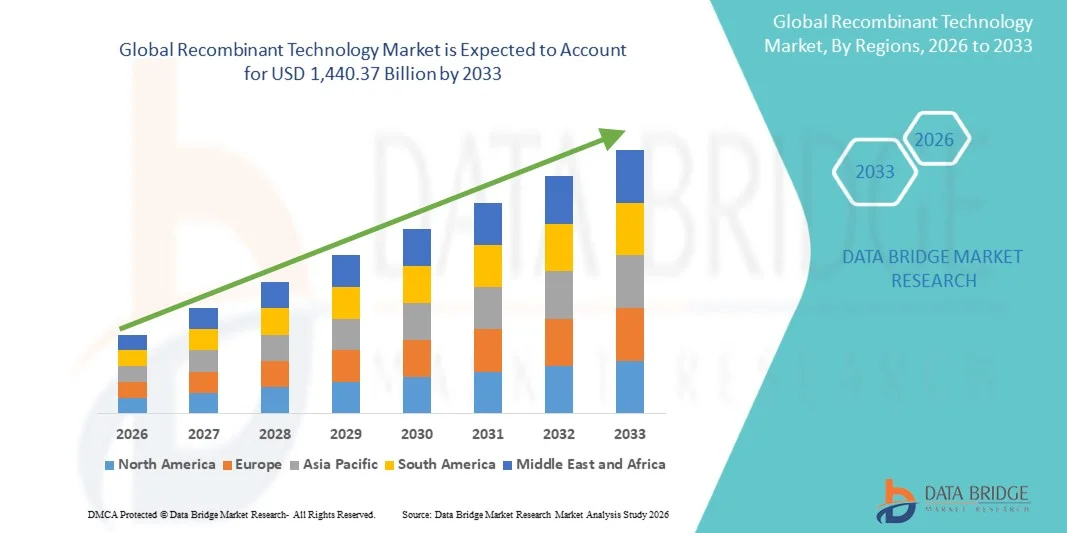
- As per Data Bridge Market Research Analysis the global recombinant technology market size was valued at USD 882.18 billion in 2025and is expected to reach USD 1,440.37 billion by 2033, at a CAGR of 6.32% during the forecast period
- The market growth is primarily driven by increasing demand for biologics and advanced therapeutic proteins, along with rapid advancements in genetic engineering, protein expression systems, and biopharmaceutical manufacturing capabilities across healthcare and research sectors
- Furthermore, rising prevalence of chronic and rare diseases, coupled with expanding applications in drug development, vaccine production, and industrial biotechnology, is strengthening the adoption of recombinant technology solutions, thereby significantly accelerating industry growth
Market Size & Forecast
- Global Market Value (2025): USD 882.18 billion
- Expected Market Value (2033): USD 1,440.37 billion
- Forecast CAGR (2026–2033): 6.32%
What are the Major Takeaways of Recombinant Technology Market ?
- Recombinant technology, which enables the production of genetically engineered proteins, enzymes, and biologically active molecules through recombinant DNA methods, is a critical pillar of modern biotechnology and biopharmaceutical manufacturing due to its precision, scalability, and wide-ranging applications across healthcare, agriculture, and environmental solutions
- The rising demand for recombinant technology is primarily driven by the growing development of biologics and biosimilars, increasing utilization in therapeutic protein and vaccine production, and expanding applications across food safety, agricultural improvement, and industrial biotechnology
- North America dominated the recombinant technology market with the largest revenue share of 39.6% in 2025, supported by advanced biotechnology infrastructure, strong R&D investment, and the presence of leading pharmaceutical and life sciences companies, particularly in the U.S., where recombinant-based drug development continues to expand rapidly
- Asia-Pacific is expected to be the fastest growing region in the recombinant technology market during the forecast period due to increasing investments in biotechnology research, expanding biomanufacturing capacity, and rising demand for cost-effective biologics in emerging economies
- Health and Disease application segment dominated the recombinant technology market with a market share of 48.3% in 2025, driven by extensive use in therapeutic protein production, vaccine development, and targeted treatment solutions for chronic and rare diseases
Report Scope and Recombinant Technology Market Segmentation
|
Attributes |
Recombinant Technology Key Market Insights |
|
Segments Covered |
|
|
Countries Covered |
North America
Europe
Asia-Pacific
Middle East and Africa
South America
|
|
Key Market Players |
|
|
Market Opportunities |
|
|
Value Added Data Infosets |
In addition to the insights on market scenarios such as market value, growth rate, segmentation, geographical coverage, and major players, the market reports curated by the Data Bridge Market Research also include in-depth expert analysis, patient epidemiology, pipeline analysis, pricing analysis, and regulatory framework |
What is the Key Trend in the Recombinant Technology Market ?
“Advancements in Precision Engineering and Expanding Biologic Applications”
- A significant and accelerating trend in the global recombinant technology market is the integration of advanced genetic engineering tools with high-efficiency expression platforms to improve yield, stability, and scalability of biologically active molecules across healthcare and industrial applications
- For instance, recombinant protein production systems such as CHO cell-based platforms and microbial expression systems are increasingly being optimized to enhance monoclonal antibody and vaccine manufacturing efficiency at commercial scale
- The adoption of next-generation gene editing and synthetic biology approaches is enabling more precise design of recombinant molecules, allowing improved therapeutic targeting and reduced development timelines in biopharmaceutical pipelines
- Furthermore, the convergence of recombinant technology with automation and bioprocessing digitalization is facilitating real-time monitoring and optimization of production workflows in large-scale biomanufacturing facilities
- The growing expansion of recombinant applications in agriculture and food industries, including engineered enzymes and improved crop traits, is broadening the market scope beyond traditional healthcare use cases
- This trend toward more efficient, scalable, and highly controlled recombinant production systems is fundamentally transforming expectations in drug development, agricultural biotechnology, and industrial enzyme production
- The demand for advanced recombinant platforms is growing rapidly across healthcare, agriculture, and environmental sectors as industries increasingly prioritize cost-effective and high-performance biologic solutions
Recombinant Technology Market Dynamics
Driver
“Rising Demand for Biologics and Expanding Biopharmaceutical Applications”
- The increasing demand for biologics and recombinant-based therapeutics, coupled with rapid expansion of biopharmaceutical research and development activities, is a major driver accelerating growth in the recombinant technology market globally
- For instance, in April 2025, leading biotech firms intensified investments in recombinant vaccine and therapeutic protein development to address rising prevalence of chronic and infectious diseases worldwide
- As healthcare systems shift toward targeted and personalized treatment approaches, recombinant technology enables efficient production of insulin, monoclonal antibodies, and growth factors with high specificity and consistency
- Furthermore, expanding applications in agriculture and food biotechnology are strengthening adoption of recombinant enzymes and genetically engineered proteins to improve crop yield and food safety
- The increasing government and private sector funding for biotechnology innovation is further accelerating research into novel recombinant platforms and next-generation biologics
- The convenience of scalable protein expression, reduced development timelines, and improved therapeutic efficacy are key factors propelling adoption of recombinant technologies across multiple end-use industries
Restraint/Challenge
“High Production Complexity and Regulatory Compliance Barriers”
- Concerns related to high production complexity, stringent regulatory requirements, and quality control challenges pose significant barriers to widespread commercialization of recombinant products in global markets
- For instance, recombinant biologics require rigorous validation, multi-stage purification, and compliance with strict regulatory frameworks enforced by agencies such as the FDA and EMA, increasing development time and costs
- Addressing these challenges requires advanced bioprocess optimization, improved expression system stability, and adherence to evolving global biosafety and manufacturing standards
- In addition, high infrastructure costs associated with bioreactors, cell culture systems, and downstream processing equipment can limit entry for small and mid-sized biotechnology companies
- The complexity of scaling laboratory-grade recombinant processes into full industrial production remains a persistent technical bottleneck for many emerging biotech firms
- While technological advancements are gradually improving production efficiency, complexity and cost intensity still hinder rapid scaling of recombinant product pipelines
How is the Recombinant Technology Market Segmented ?
The market is segmented on the basis of product, component, application, and end use.
- By Product
On the basis of product, the recombinant technology market is segmented into medical and non-medical categories. The medical segment dominated the market with the largest revenue share in 2025, driven by extensive use in biopharmaceutical production, including monoclonal antibodies, insulin, vaccines, and therapeutic proteins. Increasing prevalence of chronic and rare diseases is further strengthening demand for recombinant-based medical products across global healthcare systems. Pharmaceutical companies heavily rely on recombinant technologies for scalable and consistent biologic drug development. Strong regulatory approvals for recombinant therapeutics are also supporting widespread adoption. Continuous R&D investment in next-generation biologics is further reinforcing the dominance of the medical segment.
The non-medical segment is expected to witness the fastest growth rate from 2026 to 2033, fueled by rising applications in agriculture, industrial biotechnology, and food processing. Recombinant enzymes are increasingly used in improving crop yield, pest resistance, and soil productivity in modern agriculture. The food industry is also adopting recombinant proteins for quality enhancement and safety testing applications. Growing demand for sustainable and eco-friendly industrial processes is further accelerating adoption of non-medical recombinant products. Increasing investment in bio-based manufacturing and green biotechnology is expanding commercial opportunities.
- By Component
On the basis of component, the recombinant technology market is segmented into expression system and cloning vector. The expression system segment dominated the market with the largest revenue share in 2025, driven by its critical role in producing recombinant proteins efficiently at industrial scale. Mammalian, bacterial, yeast, and insect expression systems are widely used depending on protein complexity and application needs. Biopharmaceutical manufacturers prefer optimized expression systems for high-yield and high-quality biologic production. Increasing demand for monoclonal antibodies and vaccines is further strengthening this segment. Continuous advancements in cell line engineering and fermentation technologies are enhancing production efficiency. Rising investment in scalable biomanufacturing infrastructure is also supporting dominance.
The cloning vector segment is expected to witness the fastest growth rate from 2026 to 2033, driven by increasing genetic engineering research and synthetic biology applications. Cloning vectors are essential tools for gene insertion, replication, and expression in recombinant systems. Expanding use in CRISPR-based research and gene therapy development is accelerating demand. Academic and biotech research institutions are increasingly adopting advanced vector systems for precise gene manipulation. Improvements in vector design for higher stability and expression efficiency are further boosting adoption.
- By Application
On the basis of application, the recombinant technology market is segmented into food and agriculture, health and disease, environment, and others. The health and disease segment dominated the market with the largest revenue share of 48.3% in 2025, driven by widespread use of recombinant proteins in therapeutic development, vaccine production, and diagnostic applications. Increasing global burden of chronic diseases such as cancer, diabetes, and autoimmune disorders is driving demand for recombinant biologics. Pharmaceutical companies extensively utilize recombinant systems for producing insulin, growth factors, and monoclonal antibodies. Strong regulatory approvals and clinical success of recombinant drugs are further supporting market dominance. Continuous innovation in personalized medicine and targeted therapies is strengthening this segment. High healthcare expenditure and R&D investment are also key contributing factors.
The food and agriculture segment is expected to witness the fastest growth rate from 2026 to 2033, driven by rising demand for genetically improved crops and bioengineered food solutions. Recombinant enzymes are increasingly used to enhance food processing efficiency and nutritional quality. Agricultural biotechnology is adopting recombinant techniques to improve pest resistance and crop yield. Growing focus on sustainable farming practices is further accelerating adoption. Increasing investment in bio-based agricultural inputs is expanding commercial applications. Rising global food security concerns are also supporting rapid growth in this segment.
- By End Use
On the basis of end use, the recombinant technology market is segmented into biotechnology and pharmaceutical companies, academic and government research institutes, and diagnostic laboratories. The biotechnology and pharmaceutical companies segment dominated the market with the largest revenue share in 2025, driven by large-scale adoption of recombinant systems for drug development and commercial biologics production. These companies invest heavily in R&D for monoclonal antibodies, vaccines, and therapeutic proteins. Strong manufacturing capabilities and regulatory compliance frameworks support large-scale production. Increasing demand for biosimilars and personalized medicine is further strengthening this segment. Strategic collaborations and mergers in the biotech sector are accelerating innovation. Continuous pipeline expansion of recombinant drugs is reinforcing market dominance.
The academic and government research institutes segment is expected to witness the fastest growth rate from 2026 to 2033, driven by rising funding for genetic engineering, molecular biology, and biotechnology research. Universities and public research organizations are increasingly focusing on recombinant DNA technology for disease modeling and drug discovery. Government initiatives supporting life sciences innovation are further boosting adoption. Expanding use of recombinant tools in vaccine research and genomic studies is accelerating demand. Increasing collaboration between academia and industry is enhancing technology transfer. Growing emphasis on early-stage biomedical innovation is also driving segment growth.
Which Region Holds the Largest Share of the Recombinant Technology Market ?
- North America dominated the recombinant technology market with the largest revenue share of 39.6% in 2025, supported by advanced biotechnology infrastructure, strong R&D investment, and the presence of leading pharmaceutical and life sciences companies
- Research institutions and pharmaceutical companies in the region extensively utilize recombinant DNA technology for drug discovery, vaccine development, and large-scale therapeutic protein production
- This widespread adoption is further supported by significant government funding for biotechnology innovation, strong regulatory frameworks for biologics approval, and the presence of leading global biotech players, establishing recombinant technology as a core platform in modern life sciences and pharmaceutical manufacturing
U.S. Recombinant Technology Market Insight
The U.S. recombinant technology market captured the largest revenue share of 81% in North America in 2025, fueled by a highly advanced biotechnology industry and rapid expansion of biologics development pipelines. The country is a global leader in recombinant protein therapeutics, monoclonal antibody production, and vaccine innovation. Strong investment from both public and private sectors in genomics, synthetic biology, and cell engineering is accelerating market growth. In addition, widespread adoption of advanced expression systems and large-scale biomanufacturing infrastructure supports commercial scalability. The presence of leading pharmaceutical and biotech companies further strengthens the ecosystem. Continuous regulatory approvals for recombinant-based drugs are also driving sustained expansion.
Europe Recombinant Technology Market Insight
The Europe recombinant technology market is projected to expand at a substantial CAGR throughout the forecast period, primarily driven by strong regulatory support for biosimilars, increasing focus on sustainable biotechnology, and rising investment in life sciences research. The region benefits from well-established pharmaceutical manufacturing infrastructure and collaborative research initiatives across academic and industrial sectors. Growing demand for advanced biologics in treating chronic diseases is further accelerating adoption. In addition, Europe’s emphasis on ethical and high-quality bioproduction standards is encouraging the use of recombinant systems in clinical and industrial applications. Expanding public-private partnerships are also supporting innovation in genetic engineering technologies.
U.K. Recombinant Technology Market Insight
The U.K. recombinant technology market is anticipated to grow at a noteworthy CAGR during the forecast period, driven by strong academic research capabilities and expanding biopharmaceutical innovation hubs. Increasing focus on precision medicine and advanced biologics development is supporting market expansion. In addition, government-backed funding programs for biotechnology research are accelerating adoption of recombinant systems. The presence of leading research universities and biotech clusters is further strengthening the ecosystem. Rising collaboration between startups and pharmaceutical companies is enhancing commercialization of recombinant-based therapies.
Germany Recombinant Technology Market Insight
The Germany recombinant technology market is expected to expand at a considerable CAGR during the forecast period, fueled by strong industrial biotechnology infrastructure and high emphasis on innovation and manufacturing precision. Germany’s advanced pharmaceutical sector is increasingly adopting recombinant technologies for biologics production and enzyme engineering applications. The country’s focus on sustainability is also promoting bio-based industrial solutions using recombinant enzymes. Strong regulatory frameworks and high-quality production standards are supporting market reliability. Continuous investment in R&D and automation is further driving technological advancement in recombinant systems.
Asia-Pacific Recombinant Technology Market Insight
The Asia-Pacific recombinant technology market is poised to grow at the fastest CAGR of 22.8% during the forecast period of 2026 to 2033, driven by expanding biopharmaceutical manufacturing, rising healthcare demand, and increasing government support for biotechnology development. Rapid urbanization and growing disease burden are boosting demand for affordable recombinant biologics. The region is also emerging as a key hub for contract manufacturing and large-scale protein production. Increasing investment in life sciences research and biotech startups is accelerating innovation. Furthermore, cost-effective production capabilities are attracting global pharmaceutical outsourcing to APAC countries.
Japan Recombinant Technology Market Insight
The Japan recombinant technology market is gaining momentum due to strong technological capabilities, advanced healthcare infrastructure, and high investment in life sciences research. The country’s focus on regenerative medicine and precision therapeutics is driving recombinant technology adoption. Increasing demand for biologics in treating age-related diseases is further supporting market growth. Japan’s highly developed pharmaceutical industry is actively integrating recombinant systems for protein and vaccine production. Strong collaboration between academia and industry is enhancing innovation in genetic engineering applications.
India Recombinant Technology Market Insight
The India recombinant technology market accounted for a significant revenue share in Asia-Pacific in 2025, attributed to rapid expansion of the biotechnology sector, growing healthcare needs, and increasing investment in affordable biologics production. India is emerging as a key hub for biosimilars and recombinant protein manufacturing. Government initiatives supporting biotechnology innovation and self-reliant healthcare production are further boosting growth. Expanding pharmaceutical manufacturing capacity and skilled workforce availability are strengthening market competitiveness. Rising focus on cost-effective biologics for large patient populations is a major growth driver in the country.
Which are the Top Companies in Recombinant Technology Market ?
The Recombinant Technology industry is primarily led by well-established companies, including:
- Amgen Inc. (U.S.)
- Genentech, Inc. (U.S.)
- F. Hoffmann-La Roche Ltd. (Switzerland)
- Merck & Co., Inc. (U.S.)
- Eli Lilly and Company (U.S.)
- Novartis AG (Switzerland)
- Sanofi (France)
- Pfizer Inc. (U.S.)
- GSK plc (U.K.)
- Biogen Inc. (U.S.)
- Novo Nordisk A/S (Denmark)
- Bristol-Myers Squibb Company (U.S.)
- Thermo Fisher Scientific Inc. (U.S.)
- Lonza Group AG (Switzerland)
- GenScript Biotech Corporation (China)
- Illumina, Inc. (U.S.)
- Agilent Technologies, Inc. (U.S.)
- Aldevron, LLC (U.S.)
- Syngene International Limited (India)
What are the Recent Developments in Global Recombinant Technology Market?
- In November 2025, Arrowhead Pharmaceuticals received U.S. FDA approval for its RNA-based therapeutic leveraging recombinant and gene-regulation technologies for the treatment of severe lipid metabolism disorders. The therapy demonstrated significant triglyceride reduction in clinical trials, marking a major milestone in integrating recombinant biotechnology with RNA interference-based drug design. This approval expands recombinant applications into rare and genetically driven diseases
- In October 2025, U.S. Food and Drug Administration (FDA) data indicated that biologics accounted for nearly one-third of all new drug approvals, with a large share based on recombinant DNA technology platforms such as monoclonal antibodies and therapeutic proteins. This milestone highlights the accelerating dominance of recombinant biologics in global pharmaceutical innovation pipelines
- In March 2025, U.S. Food and Drug Administration (FDA) announced regulatory updates supporting expanded use of recombinant biologic therapies, including long-acting recombinant clotting factor treatments for hemophilia A. These advancements reflect the increasing clinical reliance on recombinant DNA-derived proteins to improve treatment efficacy, reduce dosing frequency, and enhance patient compliance in chronic hematology disorders. The development underscores the growing acceptance of engineered recombinant therapeutics in mainstream healthcare systems
- In June 2024, TechSci Research reported continued global expansion of the recombinant protein therapeutics market, driven by rising demand for biologics in oncology, diabetes, and autoimmune diseases. The report highlighted increased production scale-up of recombinant expression systems to support commercial biologics manufacturing. This development underscores the growing industrial reliance on recombinant DNA technology for high-value therapeutic production
- In May 2022, ResearchGate publication (India biotechnology review) highlighted a significant increase in approvals and clinical adoption of recombinant DNA-based therapeutics across India, particularly in oncology and metabolic disease segments. The study emphasized the growing role of biosimilars and recombinant biologics in expanding access to affordable advanced therapies. This reflects India’s strengthening position in global recombinant biologics development and manufacturing

- Interactive Data Analysis Dashboard
- Company Analysis Dashboard for high growth potential opportunities
- Research Analyst Access for customization & queries
- Competitor Analysis with Interactive dashboard
- Latest News, Updates & Trend analysis
- Harness the Power of Benchmark Analysis for Comprehensive Competitor Tracking
Data collection and base year analysis are done using data collection modules with large sample sizes. The stage includes obtaining market information or related data through various sources and strategies. It includes examining and planning all the data acquired from the past in advance. It likewise envelops the examination of information inconsistencies seen across different information sources. The market data is analysed and estimated using market statistical and coherent models. Also, market share analysis and key trend analysis are the major success factors in the market report. To know more, please request an analyst call or drop down your inquiry.
The key research methodology used by DBMR research team is data triangulation which involves data mining, analysis of the impact of data variables on the market and primary (industry expert) validation. Data models include Vendor Positioning Grid, Market Time Line Analysis, Market Overview and Guide, Company Positioning Grid, Patent Analysis, Pricing Analysis, Company Market Share Analysis, Standards of Measurement, Global versus Regional and Vendor Share Analysis. To know more about the research methodology, drop in an inquiry to speak to our industry experts.
Data Bridge Market Research is a leader in advanced formative research. We take pride in servicing our existing and new customers with data and analysis that match and suits their goal. The report can be customized to include price trend analysis of target brands understanding the market for additional countries (ask for the list of countries), clinical trial results data, literature review, refurbished market and product base analysis. Market analysis of target competitors can be analyzed from technology-based analysis to market portfolio strategies. We can add as many competitors that you require data about in the format and data style you are looking for. Our team of analysts can also provide you data in crude raw excel files pivot tables (Fact book) or can assist you in creating presentations from the data sets available in the report.













