What is the Recommendation Engine Market Size and Growth Rate?
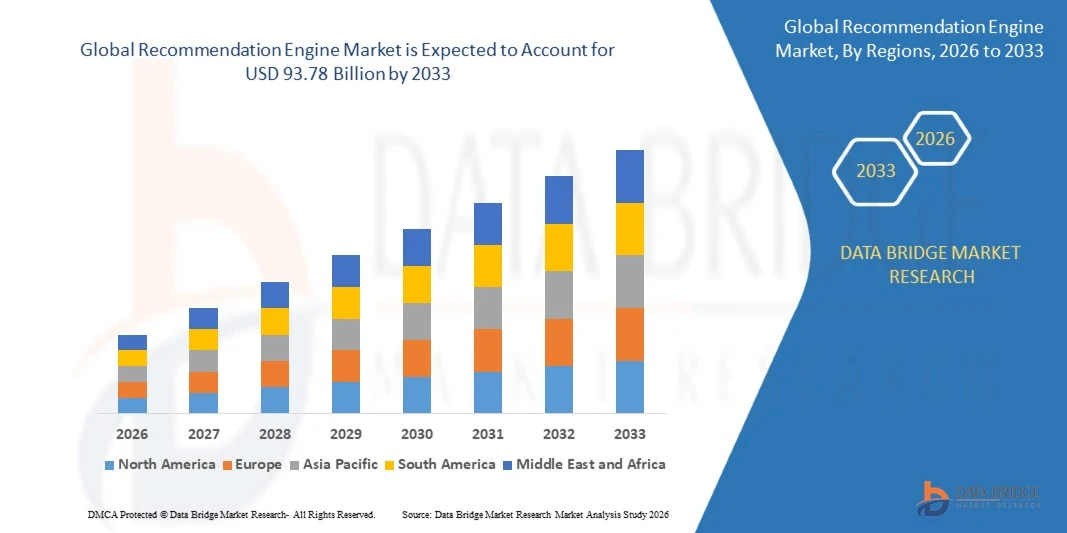
- As per Data Bridge Market Research analysis, the recommendation engine market was valued at USD 8.40 billion in 2025 and is projected to reach USD 93.78 billion by 2033, growing at a CAGR of 35.20% from 2026 to 2033.
- The market is experiencing rapid growth driven by rising demand for personalized digital experiences, increasing adoption of AI and machine learning, and expanding applications across retail and e-commerce, media and entertainment, BFSI, healthcare, and IT and telecom sectors.
- The increasing volume of user interaction data, growing adoption of cloud platforms, and rapid advances in large language models are supporting market adoption. Recommendation engines are being applied across personalization software, e-commerce, and digital advertising, helping companies increase engagement, improve conversion, and strengthen customer retention.
Market Size & Forecast
- Global Market Value (2025): USD 8.40 Billion
- Expected Market Value (2033): USD 93.78 Billion
- Forecast CAGR (2026–2033): 35.20%
- Leading Region in 2025: North America
- Fastest Growing Region: Asia Pacific
What are the Major Takeaways of the Recommendation Engine Market?
- North America dominated the recommendation engine market with the largest revenue share of 38.94% in 2025, supported by the presence of leading technology platforms, large digital audiences, and advanced adoption of AI-driven personalization.
- Asia-Pacific is expected to be the fastest-growing region at a CAGR of 38.60% from 2026 to 2033, fueled by rapid e-commerce expansion, large mobile-first user bases, and strong investment in AI.
- The solution segment led the market with a 74.31% share in 2025, driven by widespread deployment of software platforms and APIs that generate and serve recommendations in real time.
- Services are the fastest-growing component, projected to register a CAGR of 38.40%, reflecting demand for model integration, data engineering, experimentation, and managed personalization.
- The collaborative filtering segment dominated the type category with a 41.18% revenue share in 2025, led by its proven effectiveness on large interaction datasets.
- Product and content recommendation accounted for 44.62% of the market share in 2025, preferred for its direct impact on discovery, engagement, and conversion.
- The healthcare segment is the fastest-growing end user, with a CAGR of 38.90%, driven by personalized care pathways, content recommendations, and patient engagement tools.
Report Scope and Recommendation Engine Market Segmentation
|
Attributes |
Recommendation Engine Key Market Insights |
|
Segments Covered |
|
|
Countries Covered |
North America
Europe
Asia-Pacific
Middle East and Africa
South America
|
|
Key Market Players |
|
|
Market Opportunities |
|
|
Value Added Data Infosets |
In addition to the market insights such as market value, growth rate, market segments, geographical coverage, market players, and market scenario, the market report curated by the Data Bridge Market Research team includes in-depth expert analysis, import/export analysis, pricing analysis, production consumption analysis, and pestle analysis. |
What is the Key Trend in the Recommendation Engine Market?
- Recommendation engines are shifting from collections of specialized, feature-engineered models toward unified foundation models trained on large interaction histories, enabling reusable user and item representations across multiple surfaces and applications.
- For instance, in March 2025, according to the Netflix Technology Blog, Netflix described a foundation model for personalized recommendation that centralizes member preference learning, replacing many specialized models with an autoregressive transformer-based architecture and showing that scaling laws observed in language models also apply to recommendation.
- Large language models are being introduced into ranking and retrieval, allowing recommendations to use natural-language context and to be steered by user intent rather than only by historical behavior.
- Embedding-based integration is gaining preference, as platforms feed shared foundation-model outputs into downstream ranking models to improve innovation speed while managing the cost of very large models.
- For instance, in November 2025, according to the Netflix Technology Blog, Netflix detailed how its foundation model is integrated into personalization applications through three consumption patterns, namely embeddings, subgraph integration, and fine-tuning, enabling new applications to build on the shared model rather than starting from scratch.
- As foundation models, LLM-based ranking, real-time data pipelines, and user-controllable interfaces continue to advance, recommendation engines are expected to expand from passive suggestion toward conversational and collaborative discovery across commerce and media.
What are the Key Drivers of the Recommendation Engine Market?
- The rapid growth of digital content and product catalogs has increased the need for systems that help users find relevant items quickly, making personalization a core factor in engagement and retention for consumer platforms.
- For instance, in December 2025, according to Spotify, the company launched Prompted Playlist in beta for Premium subscribers in New Zealand, allowing users to describe what they want to hear in text and giving them more direct control over recommendations, which Spotify described as part of a broader shift in personalization.
- Retailers, streaming services, banks, and healthcare providers are adopting recommendation engines to increase conversion, extend viewing or session time, and deliver tailored offers across web, mobile, and in-store channels.
- For instance, in October 2025, according to Spotify, ChatGPT Free, Plus, and Pro users in 145 markets could begin receiving personalized music and podcast recommendations in English directly inside ChatGPT, demonstrating how recommendation capabilities are being distributed through third-party AI assistants.
- With AI assistants, LLM interfaces, and mobile apps becoming new discovery channels, demand for scalable engines that can personalize across channels in real time continues to rise.
What Factors Are Challenging the Growth of the Recommendation Engine Market?
- Recommendation engines depend on large volumes of personal behavioral data, and evolving regulation on transparency, profiling, and the protection of minors increases compliance requirements for platforms operating internationally.
- For instance, in July 2024, according to the European Commission, the Commission sent Amazon a request for information under the Digital Services Act on its compliance with obligations related to transparency of recommender systems and parameters, and on providing a recommender option not based on user profiling.
- Technical limitations such as cold-start problems for new users and items, data sparsity, and bias toward popular content can reduce recommendation quality and the diversity of what users see.
- Operating large recommendation and LLM-based models also requires substantial computing infrastructure, continuous experimentation, and skilled data science teams, which can limit adoption among smaller organizations.
- For instance, in September 2025, according to the ACM Conference on Recommender Systems (RecSys ’25), researchers demonstrated through experiments on three multimedia datasets that cold-start recommenders can inherit popularity bias from collaborative filtering models and be affected more severely, because they must estimate popularity without interaction data, highlighting fairness challenges for new items.
- The combination of regulatory scrutiny, data quality limitations, algorithmic bias, and infrastructure costs can constrain adoption among privacy-sensitive and cost-conscious organizations, particularly where simple rule-based or editorial approaches already meet basic needs.
How is the Recommendation Engine Market Segmented?
The recommendation engine market is segmented on the basis of component, type, application, and end user.
- By Component
On the basis of component, the recommendation engine market is segmented into solution and services. The solution segment dominated the market with 74.31% share in 2025, supported by widespread deployment of recommendation platforms, APIs, and embedded personalization modules. These solutions process behavioral, contextual, and catalog data to generate recommendations in real time. Cloud-native architectures and pre-built integrations with commerce and content systems are reducing time to deployment. Continuous improvement in ranking models is further strengthening demand.
The services segment is projected to register the fastest growth at a CAGR of 38.40% from 2026 to 2033, driven by increasing demand for data engineering, model integration, experimentation, and managed personalization. Organizations often lack in-house expertise to deploy and tune advanced models. Consulting, implementation, and ongoing optimization services help align recommendations with business goals. Growing regulatory requirements are also creating demand for auditing and transparency support.
- By Type
On the basis of type, the recommendation engine market is segmented into collaborative filtering, content-based filtering, hybrid recommendation, and others. The collaborative filtering segment dominated the type category with 41.18% share in 2025, supported by its proven effectiveness on large user–item interaction datasets. It identifies patterns across users with similar behavior, without requiring detailed item descriptions. Mature open-source tools and long industry experience have broadened its use. However, challenges such as cold-start and popularity bias are encouraging combination with other approaches.
The hybrid recommendation segment is projected to register the fastest growth at a CAGR of 40.20% from 2026 to 2033, driven by increasing adoption of architectures that combine interaction data, content features, and foundation-model embeddings. Hybrid systems improve accuracy and address cold-start problems for new items and users. Integration of large language models enables natural-language steering of results. The segment is expected to account for 42.08% of the market by 2033, becoming the largest type category.
- By Application
On the basis of application, the recommendation engine market is segmented into product & content recommendation, personalized marketing campaigns, customer experience management, and others. The product & content recommendation segment dominated the application category with 44.62% share in 2025, supported by its direct influence on discovery, engagement, and conversion across online stores and streaming platforms. Recommendation carousels, personalized feeds, and similar-item suggestions are now standard features. Integration with search and merchandising tools improves relevance. Platforms continue to expand the number of surfaces that use personalized ranking.
The customer experience management segment is projected to register the fastest growth at a CAGR of 38.70% from 2026 to 2033, driven by demand for consistent, personalized journeys across web, mobile, call-center, and in-store channels. Recommendation engines support next-best-action decisions, service personalization, and proactive engagement. Integration with customer data platforms improves real-time context.
- By End User
On the basis of end user, the recommendation engine market is segmented into retail & e-commerce, media & entertainment, BFSI, healthcare, IT & telecom, and others. The retail & e-commerce segment dominated the end-user category with 37.46% share in 2025, supported by large product catalogs, high online traffic, and the direct link between recommendations and sales. Retailers use personalization across product pages, search results, email, and apps. Growth of mobile commerce and marketplaces is increasing the need for scalable, real-time engines. Omnichannel strategies further support adoption.
The healthcare segment is projected to register the fastest growth at a CAGR of 38.90% from 2026 to 2033, driven by personalized care pathways, health-content recommendations, patient engagement, and clinical decision support. Providers and digital health platforms use recommendation techniques to tailor reminders, educational material, and services. Strict privacy and data-governance requirements are shaping solution design. The segment is expected to reach USD 8.89 billion by 2033 from a smaller base.
Which Region Holds the Largest Share of the Recommendation Engine Market?
- North America dominated the recommendation engine market with the largest revenue share of 38.94% in 2025, supported by the presence of leading technology and streaming platforms, large digital audiences, and advanced adoption of AI-driven personalization.
- The region also benefits from mature e-commerce and digital advertising ecosystems, strong cloud infrastructure, and active research and engineering communities in recommender systems. Increasing use of foundation models and LLM-based ranking, together with growing demand for transparent and user-controllable personalization, continues to strengthen North America’s position in the global market.
U.S. Recommendation Engine Market Insight
The U.S. recommendation engine market is witnessing strong growth due to the presence of major technology, streaming, and e-commerce platforms and rapid adoption of AI-driven personalization. Companies are investing in foundation models, real-time data pipelines, and LLM-based interfaces to improve engagement and conversion. The country’s mature cloud ecosystem, large digital audiences, and active developer community are driving demand for scalable recommendation solutions across retail, media, financial services, and healthcare.
Asia-Pacific Recommendation Engine Market Insight
The Asia-Pacific recommendation engine market is expected to witness rapid growth, driven by fast-growing e-commerce, large mobile-first populations, and the popularity of short-video and social platforms across countries such as China, India, and Japan. Growing investment in AI, expanding digital payments, and rising online content consumption are supporting regional expansion. In addition, the region’s strong technology companies and increasing adoption of cloud services are accelerating demand for recommendation engines.
Japan Recommendation Engine Market Insight
The Japan recommendation engine market is witnessing consistent growth due to a mature e-commerce sector, strong media and gaming industries, and growing interest in AI-based customer engagement. Retailers, streaming providers, and financial institutions are increasingly using recommendation technologies to improve relevance and loyalty. Moreover, strong expectations for service quality, careful handling of personal data, and integration with mobile and loyalty ecosystems are contributing to market growth in Japan.
China Recommendation Engine Market Insight
The China recommendation engine market is growing rapidly, driven by large e-commerce marketplaces, short-video and social platforms, and extensive use of AI in consumer applications. Platforms rely on recommendation algorithms to drive discovery, advertising, and content distribution for very large user bases. In addition, strong domestic technology companies, advanced mobile payment ecosystems, and growing regulatory attention on algorithm transparency are shaping the development of recommendation engines in China.
U.K. Recommendation Engine Market Insight
The U.K. recommendation engine market is experiencing steady growth, supported by a well-developed e-commerce sector, strong streaming and media industries, and growing adoption of AI in financial services. Retailers, broadcasters, and banks are increasingly using personalization to improve customer engagement. Furthermore, growing focus on responsible AI, data protection, and online safety obligations is encouraging transparent and privacy-conscious recommendation practices in the U.K.
Germany Recommendation Engine Market Insight
The Germany recommendation engine market is expanding steadily due to the country’s large e-commerce and retail sector, strong enterprise software base, and growing adoption of AI in customer engagement. Retailers, media companies, and industrial firms are increasingly deploying recommendation engines for product discovery, content, and service personalization. Continuous advancements in cloud and AI platforms, along with Germany’s and the European Union’s focus on data protection and algorithmic transparency, are shaping market growth in the country.
Which are the Top Companies in Recommendation Engine Market?
The recommendation engine industry is primarily led by well-established companies, including:
- Amazon.com, Inc. (U.S.)
- Netflix, Inc. (U.S.)
- Google LLC (U.S.)
- Meta Platforms, Inc. (U.S.)
- Microsoft Corporation (U.S.)
- IBM Corporation (U.S.)
- Oracle Corporation (U.S.)
- Salesforce, Inc. (U.S.)
- Adobe Inc. (U.S.)
- SAP SE (Germany)
- Spotify Technology S.A. (Sweden)
- Alibaba Group Holding Limited (China)
- Tencent Holdings Limited (China)
- ByteDance Ltd. (China)
- Pinterest, Inc. (U.S.)
- Mastercard Incorporated (U.S.)
- Algolia, Inc. (U.S.)
- Coveo Solutions Inc. (Canada)
- Recombee s.r.o. (Czech Republic)
- Rakuten Group, Inc. (Japan)
What are Latest Developments in Recommendation Engine Market?
- In July 2026, Netflix published GenRec, an LLM-native recommendation ranker that post-trains an internal foundation language model on Netflix-specific data and objectives, converting member viewing patterns into natural language context instead of relying on thousands of hand-engineered features, and describing results against its production system.
- In April 2026, Spotify expanded its AI-powered Prompted Playlist feature beyond music to include podcasts, rolling out the beta to Premium users in the United States, Canada, the United Kingdom, Ireland, New Zealand, and Sweden, as part of its strategy to give listeners more direct control over recommendations.
- In February 2026, Spotify announced that Prompted Playlist, which was first tested in New Zealand and then launched in the U.S. and Canada, would roll out to Premium subscribers in the U.K., Ireland, Australia, and Sweden, allowing users to specify prompts such as mostly new music or music from their library.
- In October 2024, the European Commission opened an investigation into the online marketplace Temu’s use of recommender systems under the Digital Services Act, covering how the platform’s recommendation design is assessed against transparency and systemic-risk obligations for very large online platforms.
- In May 2024, the European Commission opened proceedings against Meta under the Digital Services Act in relation to recommender system design and the protection of minors, reinforcing that Article 38 obligations on non-profiling recommendation options and Article 28 duties on minors’ safety apply to very large platforms.
- Interactive Data Analysis Dashboard
- Company Analysis Dashboard for high growth potential opportunities
- Research Analyst Access for customization & queries
- Competitor Analysis with Interactive dashboard
- Latest News, Updates & Trend analysis
- Harness the Power of Benchmark Analysis for Comprehensive Competitor Tracking
Data collection and base year analysis are done using data collection modules with large sample sizes. The stage includes obtaining market information or related data through various sources and strategies. It includes examining and planning all the data acquired from the past in advance. It likewise envelops the examination of information inconsistencies seen across different information sources. The market data is analysed and estimated using market statistical and coherent models. Also, market share analysis and key trend analysis are the major success factors in the market report. To know more, please request an analyst call or drop down your inquiry.
The key research methodology used by DBMR research team is data triangulation which involves data mining, analysis of the impact of data variables on the market and primary (industry expert) validation. Data models include Vendor Positioning Grid, Market Time Line Analysis, Market Overview and Guide, Company Positioning Grid, Patent Analysis, Pricing Analysis, Company Market Share Analysis, Standards of Measurement, Global versus Regional and Vendor Share Analysis. To know more about the research methodology, drop in an inquiry to speak to our industry experts.
Data Bridge Market Research is a leader in advanced formative research. We take pride in servicing our existing and new customers with data and analysis that match and suits their goal. The report can be customized to include price trend analysis of target brands understanding the market for additional countries (ask for the list of countries), clinical trial results data, literature review, refurbished market and product base analysis. Market analysis of target competitors can be analyzed from technology-based analysis to market portfolio strategies. We can add as many competitors that you require data about in the format and data style you are looking for. Our team of analysts can also provide you data in crude raw excel files pivot tables (Fact book) or can assist you in creating presentations from the data sets available in the report.