


What is the Recycled Construction Materials Market Size and Growth Rate?
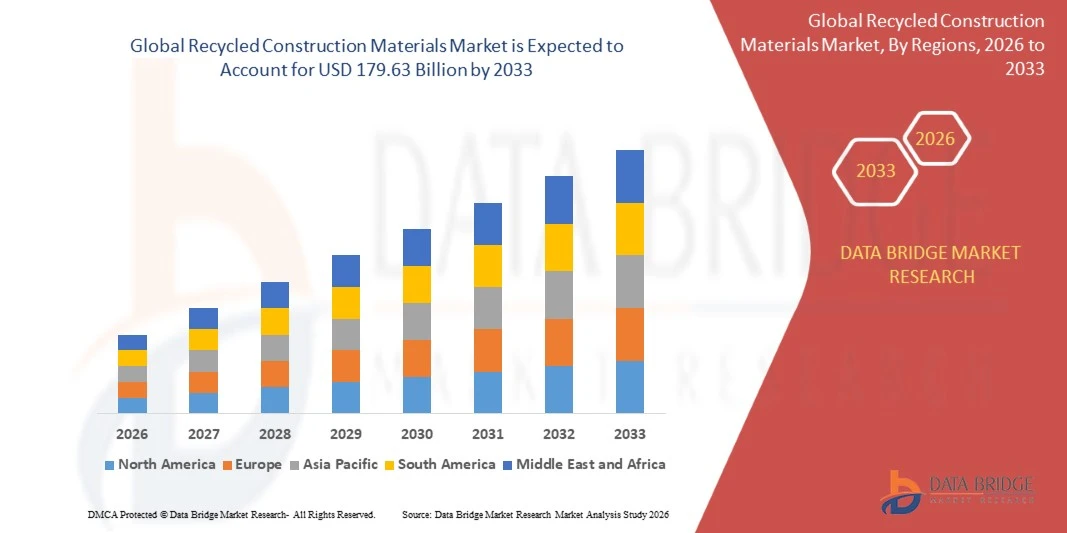
- As per Data Bridge Market Research analysis, the recycled construction materials market was valued at USD 98.50 billion in 2025 and is projected to reach USD 179.63 billion by 2033, growing at a CAGR of 7.80% from 2026 to 2033.
- The market is experiencing consistent growth driven by rising adoption of sustainable construction practices, increasing demand for resource-efficient building solutions, and growing utilization of recycled materials such as recycled concrete, asphalt, metals, wood, and glass to reduce construction waste and support circular economy initiatives.
- The increasing focus on reducing landfill waste, conserving natural resources, and lowering the environmental impact of construction activities, combined with stringent waste-management regulations and growing investments in sustainable infrastructure, is compelling construction companies, contractors, developers, governments, and material manufacturers to adopt recycled construction materials. Recycled aggregates, reclaimed asphalt, recycled metals, and other recovered materials are increasingly being used in infrastructure, commercial, residential, and industrial construction projects to reduce raw material consumption, improve resource efficiency, and support sustainable building practices.
Market Size & Forecast
- Global Market Value (2025): USD 98.50 Billion
- Expected Market Value (2033): USD 179.63 Billion
- Forecast CAGR (2026–2033): 7.80%
- Leading Region in 2025: North America
- Fastest Growing Region: Asia Pacific
What are the Major Takeaways of the Recycled Construction Materials Market?
- North America dominated the recycled construction materials market with the largest revenue share of 34.6% in 2025, supported by stringent construction and waste-management regulations, established recycling infrastructure, high volumes of construction and demolition waste, and increasing use of recycled materials in infrastructure development.
- Asia-Pacific is expected to be the fastest-growing region at a CAGR of 8.6% from 2026 to 2033, fueled by rapid urbanization, expanding construction activity, increasing infrastructure investments, rising construction and demolition waste generation, and growing adoption of circular-economy practices.
- The recycled concrete segment led the market with a 31.4% share in 2025, driven by the high availability of concrete waste from demolition activities, increasing demand for cost-efficient construction materials, and growing emphasis on reducing the environmental impact of aggregate production.
- Recycled metal is the fastest-growing type, projected to register a CAGR of 9.1%, reflecting increasing demand for resource-efficient construction materials, high recyclability of metals, rising metal recovery from demolition waste, and growing emphasis on reducing raw-material consumption.
- The construction & demolition waste segment dominated the source of materials category with a 61.8% revenue share in 2025, led by the substantial volume of concrete, asphalt, metal, wood, and glass generated through building demolition, renovation, and infrastructure projects.
- Infrastructure construction accounted for 38.7% of the market share in 2025, supported by increasing investment in roads, bridges, transportation networks, and public infrastructure, along with growing incorporation of recycled materials into large-scale construction projects.
- The mechanical recycling segment is the fastest-growing recycling process category, with a CAGR of 8.3%, driven by its broad applicability to concrete, asphalt, metal, wood, and glass, comparatively established processing technologies, and increasing demand for recovered construction materials.
Report Scope and Recycled Construction Materials Market Segmentation
|
Attributes |
Recycled Construction Materials Key Market Insights |
|
Segments Covered |
|
|
Countries Covered |
North America
Europe
Asia-Pacific
Middle East and Africa
South America
|
|
Key Market Players |
|
|
Market Opportunities |
|
|
Value Added Data Infosets |
In addition to the insights on market scenarios such as market value, growth rate, segmentation, geographical coverage, and major players, the market reports curated by the Data Bridge Market Research also include import export analysis, production capacity overview, production consumption analysis, price trend analysis, climate change scenario, supply chain analysis, value chain analysis, raw material/consumables overview, vendor selection criteria, PESTLE Analysis, Porter Analysis, and regulatory framework. |
What is the Key Trend in the Recycled Construction Materials Market?
- Increasing adoption of circular construction practices is driving the recovery and reuse of concrete, asphalt, metals, wood, and other materials from construction and demolition waste.
- For instance, in December 2024, the European Commission’s BUILD UP platform highlighted projects focused on transforming demolition waste into recycled concrete, glass, ceramic products, and other construction materials, demonstrating the growing application of circular approaches in construction.
- Growing use of recycled aggregates and recovered materials in infrastructure projects is reducing dependence on virgin construction materials.
- For instance, in January 2025, Holcim announced the expansion of its circular construction solutions, including recycled aggregates produced from construction and demolition materials for use in new construction applications.
- Increasing government emphasis on construction and demolition waste segregation, recycling, and resource recovery is supporting the development of recycled-material supply chains.
- For instance, in October 2024, Germany notified the European Commission of proposed measures to strengthen the separate collection and management of construction and demolition waste, supporting improved recycling and recovery of individual waste fractions.
- As construction companies increasingly incorporate recycled materials into projects and governments strengthen circular-economy and waste-management measures, the adoption of recycled construction materials is expected to expand.
What are the Key Drivers of the Recycled Construction Materials Market?
- Rising construction and demolition waste generation is increasing the availability of recyclable concrete, asphalt, metal, wood, and glass for use in construction applications.
- For instance, in January 2024, the European Commission’s Joint Research Centre reported that construction and demolition waste represents more than one-third of total waste generated in the European Union, highlighting the substantial volume of materials available for recycling and reuse.
- Increasing infrastructure development and urbanization are driving demand for recycled aggregates and other recovered construction materials in roads, bridges, buildings, and public infrastructure.
- For instance, in June 2024, the U.S. Environmental Protection Agency highlighted the use of recycled materials from construction and demolition activities as part of sustainable materials-management practices, including the reuse and recycling of concrete, asphalt, wood, and metals.
- Growing regulatory focus on waste reduction, landfill diversion, and resource efficiency is encouraging builders and contractors to incorporate recycled materials into construction projects.
- With increasing construction activity, rising waste generation, infrastructure investments, and stronger circular-economy initiatives, demand for recycled construction materials is expected to continue increasing.
What Factors are Challenging the Growth of the Recycled Construction Materials Market?
- Recycled construction materials require specialized collection, sorting, crushing, processing, and quality-control infrastructure, increasing operational costs and investment requirements.
- For instance, in January 2024, the European Commission’s Joint Research Centre identified economic and technical factors affecting the recycling and preparation for reuse of construction and demolition waste, highlighting cost considerations across different waste-material fractions.
- Variations in the composition and contamination levels of construction and demolition waste can affect the quality, consistency, and usability of recycled materials.
- For instance, in October 2024, Germany proposed stronger requirements for the separate collection of construction and demolition waste fractions to improve waste management and facilitate higher-quality recycling.
- Limited recycling infrastructure, collection networks, and end-markets for recovered materials can restrict adoption, particularly in regions where waste-processing capabilities remain underdeveloped.
- For instance, in 2025, the U.S. Environmental Protection Agency included construction and demolition debris within eligible waste streams under its recycling-infrastructure initiatives, with emphasis on improving collection, processing capacity, contamination reduction, and end-markets.
- The combination of processing costs, inconsistent waste streams, contamination concerns, limited infrastructure, and quality requirements can constrain the wider adoption of recycled construction materials.
How is the Recycled Construction Materials Market Segmented?
The recycled construction materials market is segmented on the basis of type, source of materials, recycling process, application, and end user.
- By Type
On the basis of type, the recycled construction materials market is segmented into recycled concrete, recycled asphalt, recycled metal, recycled wood, recycled glass, and other types. The recycled concrete segment dominated the market with a 31.4% share in 2025, owing to the high volume of concrete generated from demolition and renovation activities and its extensive use in construction and infrastructure projects. Recycled concrete can be processed into aggregates for use in road bases, foundations, concrete production, and other applications. Increasing emphasis on reducing construction waste and minimizing the use of virgin aggregates is supporting the adoption of recycled concrete. Growing infrastructure development and circular construction practices are further contributing to segment growth.
The recycled metal segment is projected to register the fastest growth at a CAGR of 9.1% from 2026 to 2033, driven by the high recyclability and recovery value of metals generated from construction and demolition activities. Recycled metals can be recovered and processed for use in new construction products, reducing dependence on primary raw materials. Increasing demand for resource-efficient construction materials and growing emphasis on material recovery are supporting segment expansion. Rising demolition and renovation activities are also increasing the availability of recoverable metals.
- By Source of Materials
On the basis of source of materials, the recycled construction materials market is segmented into construction & demolition waste, industrial waste, municipal solid waste, and others. The construction & demolition waste segment dominated the market with a 61.8% share in 2025, owing to the increasing generation of waste from construction, renovation, demolition, and infrastructure activities. Construction and demolition waste contains recoverable materials such as concrete, asphalt, wood, metals, bricks, and glass. These materials can be separated, processed, and reused in new construction applications, reducing the need for virgin raw materials. Increasing adoption of recycling and material recovery practices is supporting the use of construction and demolition waste as a major source of recycled construction materials. Government initiatives promoting sustainable construction and waste diversion are further supporting material recovery from construction and demolition activities.
The construction & demolition waste segment is projected to grow at a CAGR of 8.6% from 2026 to 2033, driven by increasing focus on waste reduction, material recovery, and circular construction practices. Construction and demolition materials such as concrete, asphalt, metals, and wood can be recovered and processed for reuse in construction and infrastructure applications. Increasing adoption of source separation, selective demolition, and recycling practices is creating greater availability of recoverable materials. Growing emphasis on conserving natural resources and reducing disposal of construction waste is further supporting recycling activities. The increasing use of recycled aggregates and other recovered construction materials is also creating opportunities for construction and demolition waste recycling.
- By Recycling Process
On the basis of recycling process, the recycled construction materials market is segmented into mechanical recycling, chemical recycling, and energy recovery. The mechanical recycling segment dominated the market with a 42.7% share in 2025, owing to the increasing use of physical processing methods for recovering construction materials from waste. Mechanical recycling involves sorting, crushing, grinding, screening, and separation of materials such as concrete, asphalt, metals, and other construction waste. These processes allow recovered materials to be converted into usable secondary materials for construction applications. Increasing focus on material recovery, waste diversion, and resource conservation is supporting the adoption of mechanical recycling.
The mechanical recycling segment is projected to grow at a CAGR of 8.3% from 2026 to 2033, driven by increasing demand for efficient recovery and reuse of construction and demolition materials. Mechanical processing provides an effective method for recovering recyclable materials from large volumes of construction waste. Growing adoption of recycled aggregates in construction and infrastructure applications is further supporting demand for mechanical recycling. Increasing investment in sorting, crushing, screening, and material recovery facilities is also creating opportunities for advanced mechanical recycling technologies. Government initiatives promoting recycling and reuse of construction and demolition waste are further supporting the growth of mechanical recycling.
- By Application
On the basis of application, the recycled construction materials market is segmented into residential construction, commercial construction, industrial construction, and infrastructure construction. The infrastructure construction segment dominated the market with a 38.7% share in 2025, owing to the large-scale consumption of construction materials in roads, bridges, transportation infrastructure, and other civil engineering projects. Recycled concrete, asphalt, metals, and other recovered materials can be incorporated into infrastructure applications, particularly where recycled aggregates and reclaimed materials are suitable. Increasing emphasis on resource-efficient infrastructure development is supporting the integration of recycled materials into construction and maintenance activities.
The infrastructure construction segment is projected to grow at a CAGR of 8.4% from 2026 to 2033, driven by increasing adoption of recycled materials in road construction, maintenance, civil engineering, and other infrastructure projects. Government initiatives promoting resource efficiency and circular construction are encouraging greater consideration of secondary raw materials in infrastructure development. The use of recycled construction materials can support material recovery while reducing the demand for newly extracted construction resources. Increasing implementation of circularity principles across infrastructure planning and construction is further supporting the use of recovered materials.
- By End User
On the basis of end user, the recycled construction materials market is segmented into builders, contractors, government agencies, environmental agencies, and others. The builders segment dominated the market with a 35.8% share in 2025, owing to the increasing adoption of recycled and recovered materials in residential, commercial, industrial, and infrastructure construction activities. Builders are increasingly incorporating recycled concrete, recycled asphalt, recycled metals, and other recovered materials into construction projects where technical specifications permit their use. Growing emphasis on sustainable construction practices is encouraging builders to consider recycled materials as alternatives to virgin construction materials. Increasing availability of recycled construction products is further supporting their adoption across building projects.
The government agencies segment is projected to grow at a CAGR of 8.9% from 2026 to 2033, driven by increasing government focus on construction and demolition waste management, resource recovery, and sustainable infrastructure development. Government agencies are implementing policies and procurement practices that encourage the reuse and recycling of construction materials. Increasing focus on waste diversion, recycled-content requirements, and circular construction practices is creating greater demand for recovered materials. Public infrastructure projects are also providing opportunities for wider adoption of recycled construction materials through sustainable procurement and resource-efficiency initiatives.
Which Region Holds the Largest Share of the Recycled Construction Materials Market?
- North America dominated the recycled construction materials market with the largest revenue share of 34.6% in 2025, supported by stringent construction and waste-management regulations, established recycling infrastructure, high volumes of construction and demolition waste, and increasing use of recycled materials in infrastructure development.
- The region also benefits from strong adoption of construction and demolition waste recovery practices, increasing demand for recycled concrete, asphalt, metals, and other secondary construction materials, and growing emphasis on resource conservation. Increasing infrastructure development and the implementation of sustainable construction practices are further supporting the use of recycled construction materials across North America.
U.S. Recycled Construction Materials Market Insight
The U.S. recycled construction materials market is witnessing strong growth due to its large construction sector, established recycling infrastructure, and increasing focus on construction and demolition waste recovery. High volumes of concrete, asphalt, wood, metals, bricks, and other materials generated from construction and demolition activities are creating significant opportunities for recycling and reuse. In addition, increasing adoption of sustainable construction practices, waste diversion initiatives, and recycled materials in infrastructure projects is accelerating demand for recycled construction materials across the country.
Asia-Pacific Recycled Construction Materials Market Insight
The Asia-Pacific recycled construction materials market is expected to witness rapid growth, driven by expanding construction activities, increasing urbanization, rising volumes of construction and demolition waste, and growing focus on sustainable resource management across countries such as China, India, and Japan. Increasing infrastructure development is generating greater demand for construction materials while encouraging the recovery and reuse of materials from construction waste. In addition, increasing investments in recycling infrastructure and growing adoption of circular construction practices are supporting regional market expansion.
Japan Recycled Construction Materials Market Insight
The Japan recycled construction materials market is witnessing consistent growth due to advanced waste-management infrastructure, strong emphasis on resource efficiency, and increasing adoption of sustainable construction practices. The recovery and reuse of concrete, asphalt, metals, wood, and other construction materials are supporting the development of recycled material applications. Moreover, the country's focus on efficient resource utilization, recycling technologies, and sustainable infrastructure development is further contributing to market growth in Japan.
China Recycled Construction Materials Market Insight
The China recycled construction materials market is growing rapidly, driven by extensive construction and infrastructure development, increasing generation of construction and demolition waste, and growing emphasis on resource recovery. Increasing demand for construction materials and the need to reduce waste disposal are supporting the development of recycling activities. In addition, expanding recycling infrastructure, improvements in material sorting and processing, and increasing adoption of circular construction practices are supporting the use of recycled construction materials in China.
U.K. Recycled Construction Materials Market Insight
The U.K. recycled construction materials market is experiencing steady growth, supported by increasing emphasis on circular construction, resource efficiency, and sustainable management of construction and demolition waste. Construction stakeholders are increasingly adopting material recovery, selective demolition, reuse, and recycling practices to reduce the disposal of recoverable materials. Furthermore, growing demand for sustainable construction materials and increasing use of recycled materials in building and infrastructure projects are contributing to continued market growth in the U.K.
Germany Recycled Construction Materials Market Insight
The Germany recycled construction materials market is expanding steadily due to advanced waste-management practices, strong sustainability initiatives, and increasing focus on circular construction. Construction and demolition waste management activities increasingly emphasize material separation, recovery, reuse, and recycling, creating opportunities for recycled concrete, metals, asphalt, wood, and other materials. In addition, increasing focus on resource conservation and sustainable construction practices is supporting the adoption of recycled construction materials across Germany.
Which are the Top Companies in Recycled Construction Materials Market?
The recycled construction materials industry is primarily led by well-established companies, including:
- Holcim Ltd. (Switzerland)
- Heidelberg Materials AG (Germany)
- Veolia Environnement S.A. (France)
- WM (Waste Management, Inc.) (U.S.)
- Republic Services, Inc. (U.S.)
- REMONDIS SE & Co. KG (Germany)
- GFL Environmental Inc. (Canada)
- SUEZ S.A. (France)
- FCC Environment (U.K.)
- Biffa plc (U.K.)
- Cleanaway Waste Management Limited (Australia)
- Waste Connections, Inc. (U.S.)
- Sims Limited (Australia)
- Ragn-Sells AB (Sweden)
- Urbaser S.A. (Spain)
- Geocycle (Switzerland)
- RE Sustainability Limited (India)
- Saur Group (France)
- Aggregate Industries (U.K.)
- Mick George Group (U.K.)
What are Latest Developments in Recycled Construction Materials Market?
- In April 2025, Ammann India hosted an Asphalt Recycling Seminar in Mumbai focused on Recycled Asphalt Pavement (RAP) and sustainable road construction. The event brought together infrastructure professionals and technical experts to discuss RAP applications, recycling technologies, and opportunities for increasing the use of recycled materials in Indian road construction, highlighting the growing adoption of recycled asphalt in infrastructure development.
- In July 2025, UEM Edgenta announced the development and operational readiness of its first Premix Plant with a Recycling Facility in Perak, Malaysia. The facility produces Recycled Asphalt Premix and incorporates technology for producing asphalt mixtures containing recycled materials, supporting the company's focus on sustainable road infrastructure and increasing the use of recycled materials in asphalt production.
- In January 2025, VINCI Construction completed the acquisition of FM Conway, a U.K. infrastructure company known for its circular-economy activities in road construction and maintenance. FM Conway operates an integrated recycling model that processes roadwork waste, including asphalt and aggregates, through its network of processing facilities, strengthening the use of recycled materials in infrastructure applications.
- In February 2025, Aggregate Industries reported progress toward producing asphalt with increasingly high recycled content. The company developed asphalt mixes containing more than 95% recycled materials for binder-course applications, using contaminated non-hazardous waste that was studied, cleaned, crushed, and re-graded into asphalt aggregate constituents. The development demonstrates increasing efforts to expand the use of recycled materials in road construction.
- In July 2025, CKC Operations announced its production of 100% Net Zero Asphalt using reclaimed asphalt materials, including Reclaimed Asphalt Pavement and Recycled Asphalt Shingles. The company highlighted the use of recycling technologies and material tracking to increase the recovery and reuse of asphalt materials for sustainable road construction.

- Interactive Data Analysis Dashboard
- Company Analysis Dashboard for high growth potential opportunities
- Research Analyst Access for customization & queries
- Competitor Analysis with Interactive dashboard
- Latest News, Updates & Trend analysis
- Harness the Power of Benchmark Analysis for Comprehensive Competitor Tracking
Global Recycled Construction Materials Market, Supply Chain Analysis and Ecosystem Framework
To support market growth and help clients navigate the impact of geopolitical shifts, DBMR has integrated in-depth supply chain analysis into its Global Recycled Construction Materials Market research reports. This addition empowers clients to respond effectively to global changes affecting their industries. The supply chain analysis section includes detailed insights such as Global Recycled Construction Materials Market consumption and production by country, price trend analysis, the impact of tariffs and geopolitical developments, and import and export trends by country and HSN code. It also highlights major suppliers with data on production capacity and company profiles, as well as key importers and exporters. In addition to research, DBMR offers specialized supply chain consulting services backed by over a decade of experience, providing solutions like supplier discovery, supplier risk assessment, price trend analysis, impact evaluation of inflation and trade route changes, and comprehensive market trend analysis.
Data collection and base year analysis are done using data collection modules with large sample sizes. The stage includes obtaining market information or related data through various sources and strategies. It includes examining and planning all the data acquired from the past in advance. It likewise envelops the examination of information inconsistencies seen across different information sources. The market data is analysed and estimated using market statistical and coherent models. Also, market share analysis and key trend analysis are the major success factors in the market report. To know more, please request an analyst call or drop down your inquiry.
The key research methodology used by DBMR research team is data triangulation which involves data mining, analysis of the impact of data variables on the market and primary (industry expert) validation. Data models include Vendor Positioning Grid, Market Time Line Analysis, Market Overview and Guide, Company Positioning Grid, Patent Analysis, Pricing Analysis, Company Market Share Analysis, Standards of Measurement, Global versus Regional and Vendor Share Analysis. To know more about the research methodology, drop in an inquiry to speak to our industry experts.
Data Bridge Market Research is a leader in advanced formative research. We take pride in servicing our existing and new customers with data and analysis that match and suits their goal. The report can be customized to include price trend analysis of target brands understanding the market for additional countries (ask for the list of countries), clinical trial results data, literature review, refurbished market and product base analysis. Market analysis of target competitors can be analyzed from technology-based analysis to market portfolio strategies. We can add as many competitors that you require data about in the format and data style you are looking for. Our team of analysts can also provide you data in crude raw excel files pivot tables (Fact book) or can assist you in creating presentations from the data sets available in the report.













