


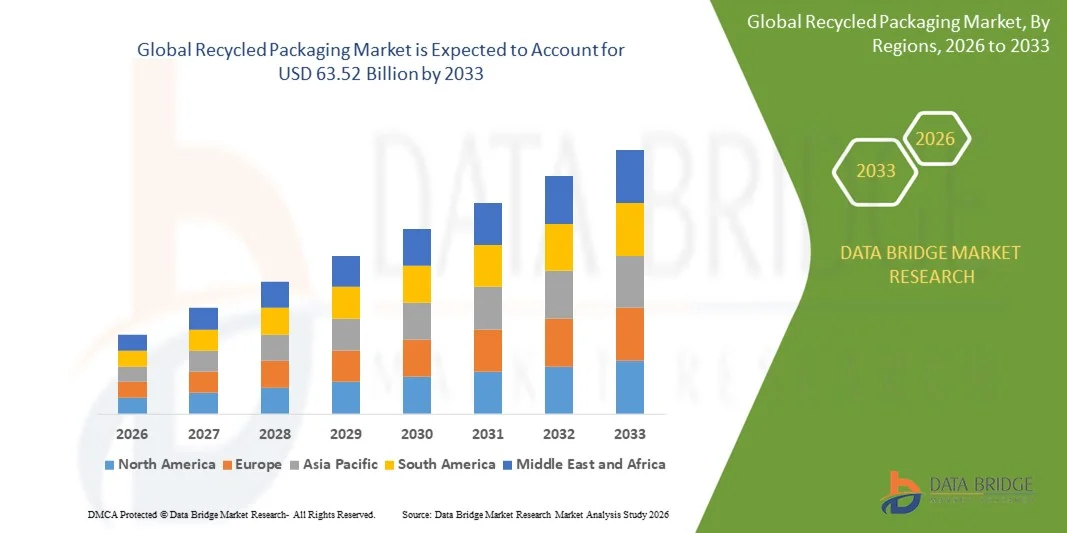
Recycled Packaging Market Size
- The global recycled packaging market size was valued at USD 50.15 billion in 2025 and is expected to reach USD 63.52 billion by 2033, at a CAGR of 3.00% during the forecast period
- The market growth is largely fuelled by rising environmental concerns and increasing regulatory pressure to reduce plastic waste
- Growing adoption of sustainable packaging solutions across food and beverage, personal care, and consumer goods sectors is supporting steady demand
Recycled Packaging Market Analysis
- The market is characterized by strong emphasis on circular economy practices, with companies focusing on recyclability, reduced carbon footprint, and resource efficiency
- In addition, supportive government policies, corporate sustainability commitments, and consumer preference for eco-friendly packaging are shaping long-term market growth
- North America dominated the recycled packaging market with the largest revenue share in 2025, driven by strong sustainability initiatives, high recycling rates, and widespread adoption of eco-friendly packaging across food, beverage, and consumer goods industries
- Asia-Pacific region is expected to witness the highest growth rate in the global recycled packaging market, driven by expanding manufacturing activities, increasing regulatory focus on plastic waste reduction, rising consumer demand for sustainable packaging, and improving recycling infrastructure
- The Paper segment held the largest market revenue share in 2025 driven by its high recyclability rate, widespread availability of raw materials, and extensive use across food, beverage, and consumer goods packaging. Paper-based recycled packaging offers cost efficiency, ease of processing, and strong acceptance among brands aiming to meet sustainability targets
Report Scope and Recycled Packaging Market Segmentation
|
Attributes |
Recycled Packaging Key Market Insights |
|
Segments Covered |
|
|
Countries Covered |
North America
Europe
Asia-Pacific
Middle East and Africa
South America
|
|
Key Market Players |
• Lacerta Group, Inc. (U.S.) |
|
Market Opportunities |
|
|
Value Added Data Infosets |
In addition to the insights on market scenarios such as market value, growth rate, segmentation, geographical coverage, and major players, the market reports curated by the Data Bridge Market Research also include in-depth expert analysis, pricing analysis, brand share analysis, consumer survey, demography analysis, supply chain analysis, value chain analysis, raw material/consumables overview, vendor selection criteria, PESTLE Analysis, Porter Analysis, and regulatory framework. |
Recycled Packaging Market Trends
Rise of Sustainable and Circular Packaging Solutions
- The increasing focus on sustainability and environmental responsibility is transforming the recycled packaging landscape by encouraging the use of recycled paper, plastics, metals, and glass across multiple industries. Brands are actively shifting toward recycled packaging to reduce carbon footprints, minimize landfill waste, and meet ESG commitments set by investors and regulators. This transition is strengthening brand value while accelerating large-scale adoption across consumer goods, food, and industrial packaging segments
- Growing regulatory pressure and plastic waste reduction mandates across developed and emerging economies are accelerating demand for recycled packaging materials. Government policies promoting recycling targets, extended producer responsibility, and bans on single-use plastics are compelling manufacturers to increase recycled content in packaging designs. These regulations are also pushing innovation in compliant, lightweight, and recyclable packaging formats
- Advancements in recycling technologies and material processing are improving the quality, durability, and aesthetic appeal of recycled packaging. Enhanced sorting systems, chemical recycling, and improved de-inking techniques are enabling recycled materials to meet performance standards for food, beverage, personal care, and pharmaceutical applications. This technological progress is expanding end-use acceptance and commercial scalability
- For instance, in 2023, global FMCG brands increased the use of recycled paperboard and post-consumer recycled plastics in product packaging to achieve sustainability targets. These initiatives reduced dependence on virgin raw materials, lowered emissions across supply chains, and improved brand perception among environmentally conscious consumers. The success of these programs is encouraging wider industry replication
- While recycled packaging adoption is accelerating, its long-term impact depends on consistent raw material supply and consumer participation in recycling programs. Investments in waste collection systems, sorting infrastructure, and recycling capacity remain critical to support growing demand. Continued collaboration between brands, municipalities, and recyclers will be essential for scalable and reliable growth
Recycled Packaging Market Dynamics
Driver
Rising Environmental Awareness and Government Regulations
- Growing environmental awareness among consumers and corporations is driving demand for recycled packaging as a preferred alternative to virgin materials. Companies are increasingly adopting recycled packaging to align with sustainability goals, reduce environmental impact, and meet consumer expectations for responsible sourcing. This shift is influencing procurement strategies across multiple industries
- Stringent government regulations related to waste management, recycling mandates, and carbon emission reduction are pushing manufacturers to integrate recycled content into packaging solutions. Compliance with these regulations is becoming a critical factor in packaging material selection and product design decisions. Non-compliance risks penalties, reputational damage, and market access limitations
- Increasing pressure from retailers and end users for sustainable packaging solutions is further boosting adoption. Large retail chains and multinational brands are setting minimum recycled content requirements for suppliers to meet sustainability benchmarks. This top-down pressure is accelerating supply chain transformation toward recycled packaging materials
- For instance, in 2022, the European Union strengthened its packaging waste directive, significantly increasing demand for recycled paper and plastic packaging across food and consumer goods sectors. Manufacturers responded by expanding recycled material capacity and redesigning packaging formats to meet compliance standards. These regulatory changes are reshaping regional packaging strategies
- While regulations and awareness are supporting market growth, continuous collaboration between policymakers, recyclers, and manufacturers remains essential. Alignment on standards, certification, and recycling definitions is needed to ensure market stability. Long-term regulatory clarity will further support investment confidence and innovation
Restraint/Challenge
High Processing Costs and Inconsistent Quality of Recycled Materials
- The high cost of recycling processes, including collection, sorting, cleaning, and material reprocessing, poses a major challenge for recycled packaging manufacturers. These additional costs can reduce profit margins and make recycled packaging less competitive than conventional materials. Cost pressures are particularly significant for small and mid-sized producers
- Inconsistent quality and limited availability of recycled raw materials affect product performance and reliability. Variations in feedstock quality can restrict the use of recycled materials in sensitive applications such as food, beverage, and pharmaceutical packaging. This inconsistency often requires additional processing and quality control investments
- Limited recycling infrastructure in developing regions further restricts market penetration and material availability. Poor waste segregation, informal collection systems, and inadequate processing facilities lead to supply chain inefficiencies. As a result, manufacturers may rely on imported recycled materials, increasing costs and lead times
- For instance, in 2023, packaging manufacturers in several emerging economies reported difficulties in maintaining consistent recycled content due to inadequate waste segregation and recycling systems. These challenges disrupted production planning and limited compliance with sustainability targets. Infrastructure gaps continue to slow regional market growth
- While technological advancements are improving recycling efficiency, addressing cost, quality, and infrastructure gaps remains critical. Market participants must focus on supply chain optimization, material innovation, and public–private partnerships to strengthen recycling ecosystems. Overcoming these challenges is key to unlocking the full potential of the global recycled packaging market
Recycled Packaging Market Scope
The market is segmented on the basis of material type, packaging type, and end-use industry.
- By Material Type
On the basis of material type, the recycled packaging market is segmented into Glass, Paper, Plastic, Tinplate, Wood, Aluminum, Biodegradable Plastic, and Recycled Papers. The Paper segment held the largest market revenue share in 2025 driven by its high recyclability rate, widespread availability of raw materials, and extensive use across food, beverage, and consumer goods packaging. Paper-based recycled packaging offers cost efficiency, ease of processing, and strong acceptance among brands aiming to meet sustainability targets.
The Plastic segment is expected to witness the fastest growth rate from 2026 to 2033, driven by rising investments in advanced recycling technologies and increasing regulatory pressure to reduce virgin plastic usage. Recycled plastic packaging is gaining traction due to its lightweight nature, durability, and suitability for a wide range of applications such as food containers, personal care packaging, and flexible packaging solutions.
- By Packaging Type
On the basis of packaging type, the recycled packaging market is segmented into Paper & Cardboard, Void Fill Packing, Bubble Wrap, and Pouches & Envelopes. The Paper & Cardboard segment accounted for the largest market revenue share in 2025 owing to its extensive use in retail, e-commerce, and food & beverage packaging. Its biodegradability, ease of recycling, and strong regulatory support make it a preferred choice for sustainable packaging solutions across industries.
The Pouches & Envelopes segment is expected to witness the fastest growth rate from 2026 to 2033, driven by the rapid expansion of e-commerce and the rising demand for lightweight, flexible, and space-efficient packaging formats. Recycled pouches and envelopes help reduce material usage and transportation costs while supporting sustainability goals, boosting their adoption globally.
- By End-Use Industry
On the basis of end-use industry, the recycled packaging market is segmented into Healthcare Industry, Personal Care & Cosmetics Industry, and Food & Beverages Industry. The Food & Beverages Industry segment dominated the market in 2025 due to increasing demand for sustainable food packaging, strict regulations on packaging waste, and growing consumer preference for eco-friendly packaged products. Recycled paper, plastics, and glass are widely used to ensure safety, functionality, and environmental compliance.
The Personal Care & Cosmetics Industry segment is expected to register the fastest growth rate from 2026 to 2033, driven by rising brand commitments toward sustainability and premium eco-friendly packaging. Companies are increasingly using recycled materials to enhance brand image, meet regulatory requirements, and cater to environmentally conscious consumers, supporting strong segment growth.
Recycled Packaging Market Regional Analysis
- North America dominated the recycled packaging market with the largest revenue share in 2025, driven by strong sustainability initiatives, high recycling rates, and widespread adoption of eco-friendly packaging across food, beverage, and consumer goods industries
- Companies in the region place significant emphasis on reducing carbon footprints, complying with environmental regulations, and meeting consumer demand for sustainable packaging solutions
- This dominance is further supported by advanced recycling infrastructure, high consumer awareness, and strong participation from large FMCG brands, establishing recycled packaging as a preferred solution across multiple end-use industries
U.S. Recycled Packaging Market Insight
The U.S. recycled packaging market captured the largest revenue share in 2025 within North America, supported by stringent environmental regulations, corporate sustainability commitments, and strong consumer preference for recyclable and reusable packaging. Major brands are increasingly incorporating post-consumer recycled content into packaging to meet ESG goals. The presence of advanced recycling technologies and well-established waste management systems further strengthens market growth.
Europe Recycled Packaging Market Insight
The Europe recycled packaging market is expected to witness the fastest growth rate from 2026 to 2033, primarily driven by strict packaging waste directives and circular economy policies. Rising adoption of recycled paper, plastics, and glass across food, beverage, and personal care sectors is accelerating growth. Strong government support and high recycling participation rates continue to foster market expansion across the region.
U.K. Recycled Packaging Market Insight
The U.K. recycled packaging market is expected to witness the fastest growth rate from 2026 to 2033, driven by ambitious recycling targets, plastic tax regulations, and increasing adoption of sustainable packaging by retailers and brands. Consumer preference for environmentally responsible products and strong retail-led sustainability initiatives are further supporting market growth.
Germany Recycled Packaging Market Insight
The Germany recycled packaging market is expected to witness the fastest growth rate from 2026 to 2033, fueled by advanced recycling infrastructure, strong environmental awareness, and strict compliance with EU packaging regulations. Germany’s leadership in waste management technologies and circular economy practices promotes extensive use of recycled materials across industrial and consumer packaging applications.
Asia-Pacific Recycled Packaging Market Insight
The Asia-Pacific recycled packaging market is expected to witness the fastest growth rate from 2026 to 2033, driven by rapid urbanization, rising consumption of packaged goods, and growing regulatory focus on waste reduction. Increasing investments in recycling infrastructure and sustainability initiatives across developing economies are accelerating market adoption.
Japan Recycled Packaging Market Insight
The Japan recycled packaging market is expected to witness the fastest growth rate from 2026 to 2033 due to strong government recycling policies, high consumer awareness, and advanced waste segregation systems. Japanese manufacturers emphasize lightweight, recyclable, and resource-efficient packaging solutions, supporting consistent market growth across food, beverage, and consumer electronics sectors.
China Recycled Packaging Market Insight
The China recycled packaging market accounted for the largest market revenue share in Asia Pacific in 2025, attributed to rapid industrialization, growing packaged food consumption, and government mandates promoting recycling and waste reduction. Expansion of domestic recycling capacity and rising adoption of recycled paper and plastics by major manufacturers are key factors propelling market growth in China.
Recycled Packaging Market Share
The Recycled Packaging industry is primarily led by well-established companies, including:
• Lacerta Group, Inc. (U.S.)
• American Packaging Corporation (U.S.)
• Graham Packaging Company (U.S.)
• 3M (U.S.)
• Mondi (U.K.)
• Salazar Packaging, Inc. (U.S.)
• Amcor plc (U.K.)
• Asia Pulp & Paper (APP) Sinar Mas (Indonesia)
• Gerresheimer AG (Germany)
• Ball Corporation (U.S.)
• Ardagh Group S.A. (Luxembourg)
• Crown Holdings (U.S.)
• DS Smith (U.K.)
• International Paper (U.S.)
• Berry Global Inc. (U.S.)
• BASF SE (Germany)
• Ebro Color GmbH (Germany)
• Avery Dennison Corporation (U.S.)
• Crown (U.S.)
• Smurfit Kappa (Ireland)
Latest Developments in Global Recycled Packaging Market
- In June 2023, Mondi, partnership development, collaborated with Syntegon to develop a recyclable paper-based packaging solution made from recycled fibres for dried food products such as flour, sugar, and pasta. This initiative aims to replace conventional plastic packaging with sustainable alternatives. The development supports circular economy goals and helps food manufacturers reduce environmental impact. It also strengthens Mondi’s position in sustainable flexible packaging. The partnership is expected to accelerate adoption of paper-based recycled packaging in the food sector
- In May 2023, Mauser Packaging Solutions, capacity expansion and circular infrastructure development, expanded its global collection and reconditioning network by opening a new facility in Tarsus, Turkey. The site enables the collection, reconditioning, reuse, and recycling of IBCs and industrial drums. This enhances packaging life cycles and reduces waste generation. The expansion improves regional access to sustainable packaging services. It supports the growing demand for reusable and recycled industrial packaging solutions
- In February 2023, Ball Corporation, product innovation and sustainability enhancement, partnered with Novelis to increase the recycled content of the Ball Aluminum Cup™ to 90%. This move significantly lowers the product’s carbon footprint while maintaining infinite recyclability. The development strengthens Ball’s sustainability credentials. It encourages broader adoption of high recycled-content aluminum packaging. The initiative supports decarbonization efforts across beverage and event packaging markets
- In April 2022, WestRock Company, strategic partnership and packaging transition, partnered with Recipe Unlimited to implement recyclable paperboard packaging solutions across foodservice operations in Canada. The initiative aims to divert approximately 31 million plastic containers from landfills annually. This shift supports waste reduction and sustainability targets. It enhances the adoption of fiber-based packaging in foodservice. The move reinforces demand for recyclable paper packaging solutions
- In January 2022, Cryopak Industries, product launch and portfolio expansion, introduced CryoEco, a recyclable paper-based thermal insulation solution for shipping perishable products. Made from recycled, shredded, and compressed paper, it offers effective temperature control. The solution replaces traditional foam-based insulation. It supports sustainable cold-chain logistics. This innovation expands recycled packaging applications in temperature-sensitive shipping markets

- Interactive Data Analysis Dashboard
- Company Analysis Dashboard for high growth potential opportunities
- Research Analyst Access for customization & queries
- Competitor Analysis with Interactive dashboard
- Latest News, Updates & Trend analysis
- Harness the Power of Benchmark Analysis for Comprehensive Competitor Tracking
Global Recycled Packaging Market, Supply Chain Analysis and Ecosystem Framework
To support market growth and help clients navigate the impact of geopolitical shifts, DBMR has integrated in-depth supply chain analysis into its Global Recycled Packaging Market research reports. This addition empowers clients to respond effectively to global changes affecting their industries. The supply chain analysis section includes detailed insights such as Global Recycled Packaging Market consumption and production by country, price trend analysis, the impact of tariffs and geopolitical developments, and import and export trends by country and HSN code. It also highlights major suppliers with data on production capacity and company profiles, as well as key importers and exporters. In addition to research, DBMR offers specialized supply chain consulting services backed by over a decade of experience, providing solutions like supplier discovery, supplier risk assessment, price trend analysis, impact evaluation of inflation and trade route changes, and comprehensive market trend analysis.
Data collection and base year analysis are done using data collection modules with large sample sizes. The stage includes obtaining market information or related data through various sources and strategies. It includes examining and planning all the data acquired from the past in advance. It likewise envelops the examination of information inconsistencies seen across different information sources. The market data is analysed and estimated using market statistical and coherent models. Also, market share analysis and key trend analysis are the major success factors in the market report. To know more, please request an analyst call or drop down your inquiry.
The key research methodology used by DBMR research team is data triangulation which involves data mining, analysis of the impact of data variables on the market and primary (industry expert) validation. Data models include Vendor Positioning Grid, Market Time Line Analysis, Market Overview and Guide, Company Positioning Grid, Patent Analysis, Pricing Analysis, Company Market Share Analysis, Standards of Measurement, Global versus Regional and Vendor Share Analysis. To know more about the research methodology, drop in an inquiry to speak to our industry experts.
Data Bridge Market Research is a leader in advanced formative research. We take pride in servicing our existing and new customers with data and analysis that match and suits their goal. The report can be customized to include price trend analysis of target brands understanding the market for additional countries (ask for the list of countries), clinical trial results data, literature review, refurbished market and product base analysis. Market analysis of target competitors can be analyzed from technology-based analysis to market portfolio strategies. We can add as many competitors that you require data about in the format and data style you are looking for. Our team of analysts can also provide you data in crude raw excel files pivot tables (Fact book) or can assist you in creating presentations from the data sets available in the report.













