What is the Recycled PET Strapping Market Size and Growth Rate?
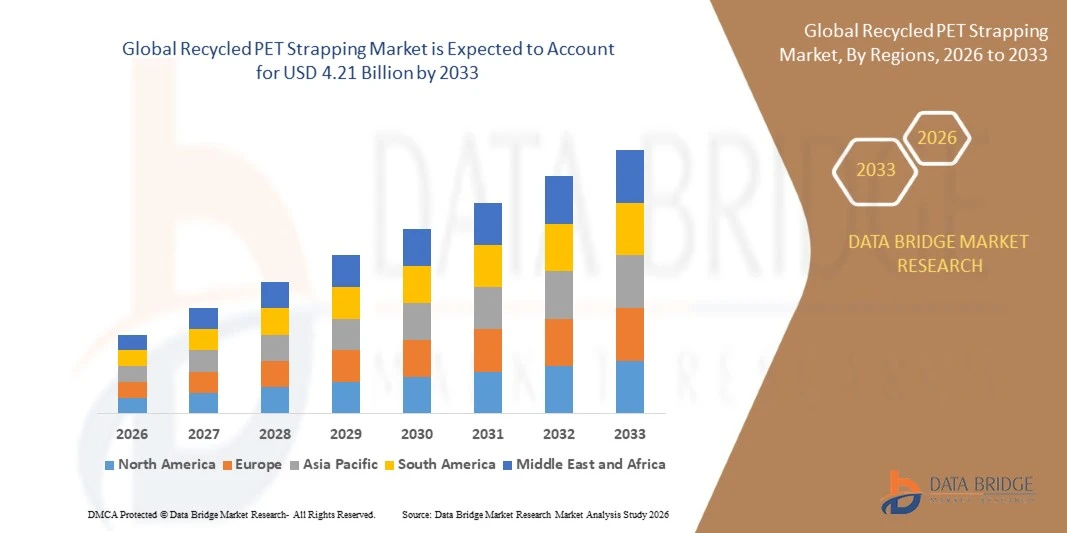
- As per Data Bridge Market Research analysis, the recycled PET strapping market was valued at USD 3.25 billion in 2025 and is projected to reach USD 4.21 billion by 2033, growing at a CAGR of 7.90% from 2026 to 2033.
- The market is experiencing consistent growth driven by rising demand for sustainable packaging solutions, increasing adoption of recycled plastic materials, and expanding applications across logistics, construction, food and beverage, and industrial packaging.
- The growing emphasis on reducing plastic waste globally, combined with stricter environmental regulations and corporate sustainability commitments, is encouraging manufacturers to adopt recycled PET strapping. These straps provide durable, lightweight, and recyclable alternatives to conventional packaging materials, supporting efficient palletizing, bundling, and load securing across industries.
Market Size & Forecast
- Global Market Value (2025): USD 3.25 Billion
- Expected Market Value (2033): USD 4.21 Billion
- Forecast CAGR (2026–2033): 7.90%
- Leading Region in 2025: North America
- Fastest Growing Region: Asia Pacific
What are the Major Takeaways of the Recycled PET Strapping Market?
- North America dominated the recycled PET strapping market with the largest revenue share of 37.8% in 2025, supported by established recycling infrastructure, advanced logistics networks, and strong demand for sustainable industrial packaging solutions.
- Asia-Pacific is expected to be the fastest-growing region at a CAGR of 8.0% from 2026 to 2033, fueled by expanding manufacturing activities, rising e-commerce shipments, and increasing demand for sustainable packaging solutions.
- The embossed recycled PET straps segment led the market with a 60% share in 2025, driven by its excellent surface grip, reliable load stability, and suitability for securing heavy palletized goods.
- Printed recycled PET straps are the fastest-growing product type, projected to register a CAGR of 8.0%, reflecting the surge in demand for product identification, branding, and traceability across packaging and distribution operations.
- The 0.6–0.8 mm segment dominated the strap thickness category with a 35% revenue share in 2025, led by its balance of tensile strength, flexibility, and cost efficiency.
- Palletizing accounted for 42% of the market share in 2025, preferred by extensive use of strapping to stabilize goods during storage, handling, and transportation.
- The bale strapping s segment is the fastest-growing application category, with a CAGR of 8.1%, driven by increasing demand for secure bundling of recyclable materials, fibers, paper, and other compressed products.
Report Scope and Recycled PET Strapping Market Segmentation
|
Attributes |
Recycled PET Strapping Key Market Insights |
|
Segments Covered |
|
|
Countries Covered |
North America
Europe
Asia-Pacific
Middle East and Africa
South America
|
|
Key Market Players |
|
|
Market Opportunities |
|
|
Value Added Data Infosets |
In addition to the insights on market scenarios such as market value, growth rate, segmentation, geographical coverage, and major players, the market reports curated by the Data Bridge Market Research also include import export analysis, production capacity overview, production consumption analysis, price trend analysis, climate change scenario, supply chain analysis, value chain analysis, raw material/consumables overview, vendor selection criteria, PESTLE Analysis, Porter Analysis, and regulatory framework. |
What is the Key Trend in the Recycled PET Strapping Market?
- Manufacturers are increasingly developing recycled PET strapping solutions that combine high tensile strength, durability, and sustainability to meet industrial packaging requirements while reducing dependence on virgin plastic materials.
- For instance, in February 2025, Greenbridge launched AtlaStrap, a high-strength polyester strapping product made from 100% post-consumer recycled materials, including recycled PET bottles, designed for heavy-duty load securing and fully recyclable packaging applications.
- These developments support the transition toward circular packaging systems by converting discarded PET bottles into durable materials for palletizing, bundling, and transportation.
- Packaging manufacturers are also prioritizing improved strap performance, consistent load stability, and compatibility with industrial handling requirements to support wider adoption across end-use industries.
- For instance, in May 2025, Mosca GmbH launched its “Loop that!” circularity project in partnership with Interzero to establish a closed-loop recycling system for strapping materials, supporting resource efficiency and the reuse of PET strapping in new production.
- As sustainability commitments and demand for recyclable packaging materials increase, recycled PET strapping is gaining importance as an alternative to conventional load-securing materials across industrial supply chains
What are the Key Drivers of the Recycled PET Strapping Market?
- The growing emphasis on sustainable packaging and plastic waste reduction is increasing demand for recycled PET strapping across manufacturing, logistics, construction, and consumer goods industries.
- For instance, in February 2025, the European Commission announced the entry into force of the Packaging and Packaging Waste Regulation, introducing measures to promote recycling, improve resource efficiency, and encourage circular use of packaging materials, supporting demand for recycled PET strapping
- Manufacturers and distributors are increasingly incorporating recycled materials into packaging operations to reduce virgin plastic consumption, improve resource efficiency, and support corporate environmental targets.
- For instance, in February 2025, Greenbridge launched AtlaStrap, a high-strength polyester strapping product manufactured using materials derived from post-consumer recycled PET bottles, addressing industrial demand for durable and more sustainable load-securing solutions.
- As industries increasingly prioritize circular material use and sustainable logistics, recycled PET strapping is positioned to benefit from growing demand for durable packaging solutions that support environmental objectives.
What Factors are Challenging the Growth of the Recycled PET Strapping Market?
- Recycled PET strapping manufacturers face challenges related to feedstock availability, raw material price volatility, recycling costs, and competition for high-quality post-consumer PET waste.
- For instance, in October 2025, OPIS reported that recycled PET demand remained sluggish in India and China, as weak downstream demand and lower virgin PET prices reduced buyers’ willingness to purchase recycled materials, limiting sales opportunities for recycled PET producers and strapping manufacturers
- These constraints can affect production costs, material consistency, and the ability of manufacturers to maintain competitive prices against virgin PET and alternative strapping materials.
- Such fluctuations in recycled material collection and end-market demand can create uncertainty for recyclers and strapping producers that depend on reliable supplies of suitable PET feedstock.
- For instance, in February 2025, S&P Global reported that Californian recyclers faced margin pressure due to high production costs, weak end-consumer demand, and competition from lower-priced imported recycled PET flakes, highlighting the cost and competitive pressures affecting recycled PET supply chains.
- The availability of affordable recycled resin, investment in recycling infrastructure, and competition from alternative packaging materials continue to influence manufacturing economics and wider market adoption.
How is the Recycled PET Strapping Market Segmented?
The recycled PET strapping market is segmented on the basis of product type, strap thickness, application, and end user.
- By Product Type
On the basis of product type, the recycled PET strapping market is segmented into embossed recycled PET straps, smooth recycled PET straps, and printed recycled PET straps. The embossed recycled PET straps segment dominated the market with an estimated 60% share in 2025, owing to its excellent surface grip, reliable load stability, and suitability for securing heavy palletized goods. The embossed texture improves friction between the strap and the packaged load, reducing the risk of slippage during transportation. These straps are widely used in logistics, construction materials, paper, and industrial packaging applications. Their compatibility with manual and automated strapping equipment further supports adoption.
The printed recycled PET straps segment is expected to witness the fastest growth at an estimated CAGR of 8.0% from 2026 to 2033, driven by increasing demand for product identification, branding, and traceability across packaging and distribution operations. Printed straps allow manufacturers and logistics providers to display company names, handling instructions, and identification codes directly on packaging materials. This helps improve product recognition and warehouse handling efficiency. Increasing adoption of customized packaging across consumer goods, manufacturing, and retail distribution is supporting demand. Advances in printing technologies are enabling clearer markings and improved print durability.
- By Strap Thickness
On the basis of strap thickness, the recycled PET strapping market is segmented into up to 0.6 mm, 0.6–0.8 mm, and above 0.8 mm. The 0.6–0.8 mm segment is expected to dominate the market with an estimated 35% share in 2025, supported by its balance of tensile strength, flexibility, and cost efficiency. These straps are suitable for securing medium-to-heavy loads across manufacturing, warehousing, and transportation operations. Their versatility allows their use with different packaging equipment and load configurations. They are commonly suited to palletized products, paper rolls, construction materials, and consumer goods. Their ability to provide reliable load stability without excessive material consumption supports adoption.
The up to 0.6 mm segment is expected to witness the fastest growth at an estimated CAGR of 8.2% from 2026 to 2033, driven by increasing demand for lightweight and material-efficient packaging solutions. These thinner straps can help reduce material consumption in applications that do not require extremely high load-bearing capacity. They are suitable for bundling lighter products, cartons, and selected consumer goods. Their lower material requirements can support cost optimization for high-volume packaging operations. Improvements in recycled PET processing and strap manufacturing are helping manufacturers optimize strength and flexibility. Increasing automation in packaging lines is also supporting demand for consistent, lightweight strapping materials.
- By Application
On the basis of application, the recycled PET strapping market is segmented into palletizing, bundling and unitizing, heavy-duty load securing, carton and box strapping, industrial packaging, and bale strapping. The palletizing segment is expected to dominate the market with an estimated 42% share in 2025, driven by the extensive use of strapping to stabilize goods during storage, handling, and transportation. Recycled PET straps help secure cartons, packaged products, and industrial materials to pallets, reducing the risk of load movement. Their strength and resistance to moisture make them suitable for various supply-chain environments. They are widely applicable across food and beverage distribution, consumer goods, construction materials, and manufacturing. Compatibility with automated palletizing and strapping equipment further supports operational efficiency.
The bale strapping segment is expected to witness the fastest growth at an estimated CAGR of 8.1% from 2026 to 2033, supported by increasing demand for secure bundling of recyclable materials, fibers, paper, and other compressed products. Recycled PET straps provide a lightweight alternative to certain conventional strapping materials used to hold compacted bales together. Their flexibility and tensile strength help maintain bale integrity during storage and transportation. Growing recycling activities are increasing the need to bundle collected plastics, textiles, and paper efficiently. The expansion of material recovery facilities and waste-processing operations is creating additional demand for reliable bale-securing solutions. Improvements in strap strength and compatibility with industrial baling equipment are also supporting adoption.
- By End User
On the basis of end user, the recycled PET strapping market is segmented into food and beverage, building and construction, paper and paperboard, textile and fibers, metal and steel, logistics and transportation, consumer goods, and other industrial sectors. The logistics and transportation segment is expected to dominate the market with an estimated 28% share in 2025, supported by extensive requirements for securing palletized shipments, warehouse inventory, and goods in transit. Recycled PET strapping helps maintain load stability across distribution networks and reduces the risk of product displacement during handling. Its lightweight construction and resistance to corrosion provide advantages compared with certain traditional metal strapping applications. Logistics operators use strapping to secure a wide variety of packaged and industrial products. Growth in e-commerce, third-party logistics, and organized warehousing is increasing demand for efficient load-securing materials.
The building and construction segment is expected to witness the fastest growth at an estimated CAGR of 8.3% from 2026 to 2033, driven by increasing demand for secure packaging and transportation of construction materials. Recycled PET straps are used to bundle products such as bricks, tiles, pipes, timber, and selected prefabricated building components, depending on their load requirements. Their resistance to moisture and corrosion makes them useful in storage and transportation environments exposed to varying weather conditions. Increasing construction activity and infrastructure development are generating demand for reliable material-handling solutions. Manufacturers are also seeking alternatives to conventional strapping materials that support sustainability targets. The use of recycled materials in industrial packaging is gaining attention as construction supply chains prioritize resource efficiency.
Which Region Holds the Largest Share of the Recycled PET Strapping Market?
- North America dominated the recycled PET strapping market with the largest revenue share of 37.8% in 2025, supported by established recycling infrastructure, advanced logistics networks, and strong demand for sustainable industrial packaging solutions.
- The region also benefits from well-developed logistics networks, increasing corporate sustainability commitments, and demand for durable load-securing solutions across manufacturing, construction, and transportation industries. Growing emphasis on plastic waste reduction, recycled material utilization, and efficient packaging operations continues to support North America's leading position in the global recycled PET strapping market.
U.S. Recycled PET Strapping Market Insight
The U.S. recycled PET strapping market is witnessing steady growth due to rising demand for sustainable packaging materials, expanding logistics operations, and increasing investments in recycling infrastructure. The country's established manufacturing and distribution networks, along with growing adoption of recycled plastics in industrial packaging, are driving demand across construction, consumer goods, and transportation applications. In addition, increasing corporate sustainability commitments and efforts to reduce plastic waste are accelerating the adoption of recycled PET strapping among manufacturers and packaging companies.
Asia-Pacific Recycled PET Strapping Market Insight
The Asia-Pacific recycled PET strapping market is expected to witness rapid growth, driven by expanding manufacturing activities, rising e-commerce shipments, and increasing demand for cost-effective packaging solutions across countries such as China, India, and Japan. Growing industrialization, expanding logistics infrastructure, and increasing awareness of recyclable packaging materials are supporting regional market expansion. In addition, rising investments in recycling facilities and the growing use of recycled plastics in industrial supply chains are accelerating adoption across manufacturing and distribution sectors.
Japan Recycled PET Strapping Market Insight
The Japan recycled PET strapping market is witnessing consistent growth due to increasing emphasis on resource efficiency, advanced packaging technologies, and sustainable material utilization. Manufacturers and logistics companies are increasingly adopting recycled PET strapping for palletizing, bundling, and securing industrial goods during storage and transportation. Moreover, the country's focus on waste reduction, efficient recycling systems, and circular economy practices is encouraging the use of recycled packaging materials across industrial and commercial applications.
China Recycled PET Strapping Market Insight
The China recycled PET strapping market is growing rapidly, driven by expanding manufacturing output, increasing logistics activity, and rising demand for sustainable packaging solutions. Growing adoption of recycled plastics across industrial packaging, construction materials, and consumer goods is supporting market demand. In addition, China's extensive PET recycling industry, expanding e-commerce distribution networks, and increasing emphasis on resource recovery are strengthening the country's position in the global recycled PET strapping market.
U.K. Recycled PET Strapping Market Insight
The U.K. recycled PET strapping market is experiencing steady growth, supported by increasing demand for recyclable packaging materials, established distribution networks, and growing emphasis on reducing plastic waste. Manufacturers and logistics providers are increasingly incorporating recycled PET strapping into packaging operations to secure palletized goods and improve material efficiency. Furthermore, sustainability initiatives, packaging waste regulations, and increasing corporate commitments to circular economy practices are encouraging wider adoption across industrial, retail, and transportation applications.
Germany Recycled PET Strapping Market Insight
The Germany recycled PET strapping market is expanding steadily due to the country's strong industrial manufacturing base, advanced packaging capabilities, and growing focus on sustainable materials. Automotive suppliers, construction material manufacturers, paper producers, and logistics companies use PET strapping to secure goods during storage and transportation. Continuous improvements in recycling technologies, increasing demand for recycled-content packaging, and Germany's emphasis on resource efficiency and circular economy practices are further supporting market growth.
Which are the Top Companies in Recycled PET Strapping Market?
The recycled PET strapping industry is primarily led by well-established companies, including:
- Greenbridge (U.S.)
- Signode Industrial Group LLC (U.S.)
- Teufelberger (Austria)
- FROMM Group (Switzerland)
- Mosca GmbH (Germany)
- Cyklop International (Netherlands)
- Samuel Packaging Systems Group (Canada)
- Messersì Packaging (Italy)
- TITAN Umreifungstechnik GmbH & Co. KG (Germany)
- StraPack Corporation (Japan)
- Reisopack S.L. (Spain)
- Transpak Equipment Corp. (Taiwan)
- Strapex (Switzerland)
- PAC Strapping Products, Inc. (U.S.)
- Plastic Extruders Ltd (U.K.)
- LINDER GmbH (Germany)
- Yongsun (South Korea)
- FROMM Plastics GmbH (Germany)
- Signode Packaging Systems (U.S.)
- Samuel Strapping Systems (Canada)
What are Latest Developments in Recycled PET Strapping Market?
- In May 2025, Mosca GmbH launched its “Loop that!” circularity project in partnership with Interzero to establish a closed-loop recycling system for used strapping materials. The initiative aims to collect, recycle, and reintroduce PET and polypropylene strapping into manufacturing, reducing waste and dependence on virgin raw materials. The project also seeks to encourage industry-wide collaboration on strapping circularity.
- In February 2025, Greenbridge announced the launch of AtlaStrap, a high-performance polyester strapping product manufactured using materials derived from post-consumer recycled PET bottles. Designed for demanding industrial applications, the product combines high tensile strength, durability, and recyclability for palletizing and heavy-duty load securing. This launch highlights the industry's focus on combining sustainable materials with reliable packaging performance.
- In May 2024, Mosca announced its cooperation with Interzero to strengthen recycling and recycled-material sourcing for its strapping production. The partnership includes collecting used strapping from customers, processing the material, and returning recycled feedstock to manufacturing operations. A digital material-tracking system also supports transparency regarding recycled material availability and utilization. This development strengthens circular material management within the PET strapping supply chain.
- In November 2022, Greenbridge expanded its manufacturing footprint in Northeast Ohio by securing a facility in Cleveland for manufacturing and warehousing, including plans for four PET strapping production lines. The project involved a reported investment of USD 7.6 million and was expected to create more than 80 jobs. The expansion was intended to strengthen the company's production capabilities and regional presence in the packaging sector, supporting the supply of PET strapping to industrial customers.
- In April 2021, Polychem rebranded as Greenbridge, introducing a new corporate identity and sustainability-focused business strategy. The company highlighted its recycled PET and polypropylene strapping products, recycling programs, and plans to expand recycled PET manufacturing capacity. Greenbridge also emphasized its role in helping customers reduce waste and advance circular economy objectives. This development reinforced the importance of recycled materials and integrated recycling services in the strapping industry.

- Interactive Data Analysis Dashboard
- Company Analysis Dashboard for high growth potential opportunities
- Research Analyst Access for customization & queries
- Competitor Analysis with Interactive dashboard
- Latest News, Updates & Trend analysis
- Harness the Power of Benchmark Analysis for Comprehensive Competitor Tracking
Global Recycled Pet Strapping Market, Supply Chain Analysis and Ecosystem Framework
To support market growth and help clients navigate the impact of geopolitical shifts, DBMR has integrated in-depth supply chain analysis into its Global Recycled Pet Strapping Market research reports. This addition empowers clients to respond effectively to global changes affecting their industries. The supply chain analysis section includes detailed insights such as Global Recycled Pet Strapping Market consumption and production by country, price trend analysis, the impact of tariffs and geopolitical developments, and import and export trends by country and HSN code. It also highlights major suppliers with data on production capacity and company profiles, as well as key importers and exporters. In addition to research, DBMR offers specialized supply chain consulting services backed by over a decade of experience, providing solutions like supplier discovery, supplier risk assessment, price trend analysis, impact evaluation of inflation and trade route changes, and comprehensive market trend analysis.
Data collection and base year analysis are done using data collection modules with large sample sizes. The stage includes obtaining market information or related data through various sources and strategies. It includes examining and planning all the data acquired from the past in advance. It likewise envelops the examination of information inconsistencies seen across different information sources. The market data is analysed and estimated using market statistical and coherent models. Also, market share analysis and key trend analysis are the major success factors in the market report. To know more, please request an analyst call or drop down your inquiry.
The key research methodology used by DBMR research team is data triangulation which involves data mining, analysis of the impact of data variables on the market and primary (industry expert) validation. Data models include Vendor Positioning Grid, Market Time Line Analysis, Market Overview and Guide, Company Positioning Grid, Patent Analysis, Pricing Analysis, Company Market Share Analysis, Standards of Measurement, Global versus Regional and Vendor Share Analysis. To know more about the research methodology, drop in an inquiry to speak to our industry experts.
Data Bridge Market Research is a leader in advanced formative research. We take pride in servicing our existing and new customers with data and analysis that match and suits their goal. The report can be customized to include price trend analysis of target brands understanding the market for additional countries (ask for the list of countries), clinical trial results data, literature review, refurbished market and product base analysis. Market analysis of target competitors can be analyzed from technology-based analysis to market portfolio strategies. We can add as many competitors that you require data about in the format and data style you are looking for. Our team of analysts can also provide you data in crude raw excel files pivot tables (Fact book) or can assist you in creating presentations from the data sets available in the report.